Q2 Net Profit Slashes Losses by 80%! Has Costar Emerged from Its Darkest Hour?
 08/28 2026
 474
474
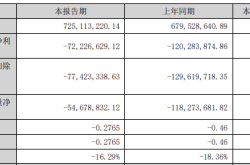
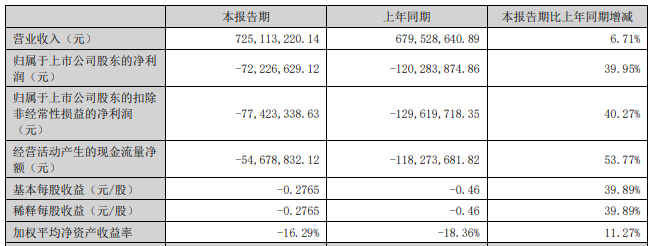
Recently, Costar unveiled its financial results for the first half of the year, revealing a total operating revenue of 725 million yuan, marking a 6.71% year-on-year increase. The net profit attributable to shareholders stood at -72.2266 million yuan, a significant 39.95% reduction in losses compared to the same period last year. On a quarterly basis, the second quarter witnessed revenue of 453 million yuan, up 8.57% year-on-year and a substantial 66.82% increase from the previous quarter. The net profit attributable to shareholders for Q2 was -9.5767 million yuan, representing an impressive 81.64% year-on-year reduction in losses.
Delving into Costar's business portfolio, optical components remain the cornerstone, generating 339 million yuan in revenue during the reporting period, accounting for 46.82% of the total revenue. This segment experienced a 19.28% year-on-year growth, with a gross profit margin of 4.27%. Revenue from optoelectronic defense and strategic surveillance businesses reached 198 million yuan, making up 27.25% of the total revenue and showing a 13.10% year-on-year increase. More notably, the gross profit margin of this segment soared by 20.83 percentage points to 21.52%.
In stark contrast, revenue from projector units and accessories declined by 5.72% year-on-year to 118 million yuan, with a negative gross profit margin of -5.64%. With the domestic consumer projector market dominated by brands such as XGIMI, Dangbei, and JmGO, Costar, operating both as an OEM and a proprietary brand, lacks distinctive competitive edges. This segment has consistently been the biggest drag on the company's profits.
The improved performance is mirrored by a substantial boost in management efficiency. During the reporting period, the combined ratio of selling, administrative, and financial expenses to revenue decreased compared to the same period last year, with particularly remarkable cost-control achievements in administrative and selling expenses. The company's implementation of the "3040" Tough Project (also known as the 3040 Pivotal Project) and ten major special initiatives has yielded tangible cost-saving results.
However, the company's net profit was directly eroded by an increase in financial expenses year-on-year, influenced by exchange rate fluctuations. Meanwhile, the company's asset-liability ratio remains high at approximately 80%, and operating cash flow continues to be in the negative territory. High leverage and cash flow pressures persist as a constant threat.
In the automotive optics sector, Costar's HUD products have successfully passed automotive-grade certification and entered the supply chains of mainstream domestic automakers. On July 1st, the company clarified on an interactive platform that "customer validations and steady progress in fixed-point (designated projects) for automotive AR-HUD and LiDAR-related products are ongoing." The company has established an automotive optoelectronics subsidiary, equipped with full-series product design and manufacturing capabilities for W-HUD/AR-HUD/P-HUD.
Simultaneously, in the realm of AR waveguide technologies, leveraging its core competencies in precision optics, micro-nano fabrication, and optical coating, the company is now capable of mass-producing core products such as waveguides and precision optical modules. These products are applicable to AR wearables, automotive, and industrial display scenarios. Downstream customer validations and small-batch supply have already commenced.
Nevertheless, the industrialization of automotive-grade products necessitates lengthy validation and ramp-up cycles, often spanning several years from designations to scalable revenue. Revenue contributions from new businesses will take time to materialize. If automotive optics and AR waveguide technologies can successfully scale in the coming years, they have the potential to unlock entirely new growth avenues for the company. However, realizing this vision will require enduring the test of time.
Amidst the photonics industry's surge towards a trillion-yuan market, Costar's semi-annual report presents a classic "transition-phase report card": traditional businesses are curbing losses, new businesses are budding, and financial structures are under pressure. The surge in the gross profit margin of optoelectronic defense to 21.5% stands out as the brightest spot, while the persistent losses in the projector business remain the heaviest drag. The industrialization progress of automotive HUD and AR waveguide technologies represents the largest variable.
Whether Costar can transition from "loss reduction" to "profitability" hinges on answers to three practical questions: Can the high gross profit margin of optoelectronic defense withstand order fluctuations? Should the projector business undergo drastic restructuring to curb losses or await a turnaround? How long will the time lag be from "designations" to "scaling" in new markets?
The market eagerly awaits these answers, and Costar's management is racing against time. OFweek Optics will continue to closely monitor its subsequent market developments.
-
![]()
Net Profit Surges 13.65% Year-on-Year! Yutong Optics Reports RMB 1.782 Billion in H1 Revenue
-
![]()
Q2 Net Profit Slashes Losses by 80%! Has Costar Emerged from Its Darkest Hour?
-
AI Agents: The Paradigm Shift from 'Conversation' to 'Execution'
-
NVIDIA Takes Bold Strides to Lead in Both Hardware and Software Realms
-
![]()
It's Hard to Build Cars, Even Harder to Build Humans, and XPENG is Doing Both
-
![]()
Valuation Soars by $57 Billion: Three Entrepreneurs Born in the 1980s Forge an AI Unicorn Now Suddenly on the Market
-
![]()
How Can We Achieve the Goal of 100,000 Hydrogen Vehicles by 2030?
-
![]()
July Online Market for Consumer-Grade Sports Cameras: Robust Double-Digit Growth in Sales Volume and Value, Mid-Range Products Fuel Market Expansion