Observation on the Brain-Computer Interface Industry: Which Link Presents the Highest Technical Challenge?
 01/27 2026
 639
639
The brain-computer interface (BCI), a groundbreaking technology enabling direct communication between the human brain and external devices, is swiftly transitioning from laboratory experiments to real-world applications. Focused on two primary technical routes—invasive and non-invasive—it strives to balance signal precision with safety and user-friendliness. Despite being in the early stages of commercialization, BCI has already embarked on significant explorations in specialized fields like medical rehabilitation, showcasing immense potential to revolutionize human-computer interaction paradigms.
01. Technical Routes: Invasive, Semi-Invasive, and Non-Invasive
In the ultimate contest of human-computer interaction that BCI embodies, technological advancements are the bedrock upon which everything rests.
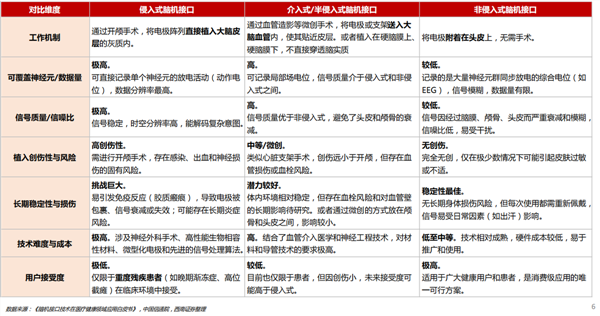
The technical routes of BCI are currently categorized into two main types: invasive and non-invasive, based primarily on the extent of device-brain interaction. Invasive technology necessitates the surgical implantation of electrodes directly into the cerebral cortex or its interior, facilitating the collection of exceptionally high-quality neural signals. This approach yields clear signals with minimal interference, enabling precise control over individual neuron activity. It is particularly well-suited for facilitating fine mental control in severely paralyzed individuals, such as operating robotic arms or cursors. However, its drawbacks are significant: surgical risks include infection and tissue damage, implants may trigger immune responses leading to signal degradation, and costs are substantial. Currently, its application is predominantly confined to rigorous medical and research environments.
Conversely, non-invasive technology offers a safer and more convenient alternative. It captures brain signals through devices worn on the scalp, such as EEG caps. This method is entirely non-invasive, user-friendly, and can be quickly donned, making it ideal for civilian applications like daily health monitoring, attention training, and simple device control. Nevertheless, its critical weakness lies in signal quality, as the skull and soft tissues severely attenuate and interfere with signals, complicating the interpretation of complex intentions and resulting in low spatial resolution. Consequently, its current use is limited to scenarios not requiring extreme precision, such as gaming interactions, fatigue monitoring, or basic rehabilitation training.
Additionally, there exists a semi-invasive/interventional approach. Striving for the optimal balance between risk and performance, it represents a highly promising 'compromise solution' for future medical applications. Recent explorations in route development include novel methods like minimally invasive vascular stent electrode arrays and in-ear electronic devices.
In terms of market share, according to Xinhua News Agency data, among BCI enterprises in China, those adopting non-invasive technical routes dominate, accounting for up to 88%, while those utilizing invasive routes constitute only 12%.
02. Current State of Commercialization: Partial Scenarios Begin to Materialize
With a clear technical route established, how is BCI faring in terms of real-world implementation? The commercialization process reveals the gap between aspirations and reality.
The widespread attention garnered by BCI often creates the illusion of maturity. In truth, this technology is still in the nascent stages of commercialization exploration, with difficult implementation processes initiated in only a few specific scenarios.
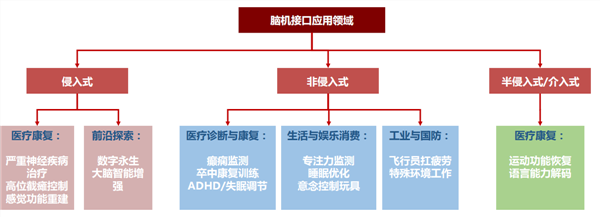
Its 'nascent' characteristics are first evident in the constraints of technical routes. Whether it's the invasive approach requiring craniotomy or the non-invasive method with limited signal accuracy, neither has yet achieved a perfect balance between safety, stability, and efficiency. Invasive technology, while capable of collecting high-quality neural signals, faces formidable challenges such as biological rejection, long-term stability, and surgical trauma. Even for systems that have undergone clinical trials, issues like long-term reliability and cross-day stability of signal decoding persist as ongoing challenges. This inevitably restricts its application to narrow fields with urgent demands.
Therefore, the limited commercialization observed currently is highly focused on the 'critical support' scenario of medical rehabilitation, particularly the reconstruction of motor functions. For instance, assisting patients paralyzed due to spinal cord injuries or strokes in controlling robotic arms or exoskeletons through mental control to perform basic functions like grasping and drinking. Although these cases are inspiring, they essentially represent functional replacement and repair, with each case being a complex systems engineering project. There is still a considerable journey ahead before standardized, universally applicable products can be realized. In the consumer market, some non-invasive devices like headbands for attention monitoring or sleep analysis have begun to emerge, but they generally face skepticism regarding their limited application scenarios and subpar user experience, far from forming a scalable market. The ecosystem supporting the industry is also relatively immature, characterized by being 'small and fragmented' globally.
Besides technological and industrial bottlenecks, BCI touches upon humans' most private neural data and mental activities, raising ethical, privacy, and security concerns that have become issues requiring careful consideration at the societal consensus level. How to define the ownership of neural data, prevent data abuse, and clarify responsibility for device malfunctions are all uncharted territories in regulations that also pose intangible barriers on the road to commercialization.
Overall, BCI is at a critical juncture transitioning from astonishing experimental demonstrations to robust product validation. It is opening a window in rigid demand scenarios like medical rehabilitation, but to truly step into a broader landscape, it still needs to navigate a long tunnel in terms of technological reliability, industrial ecosystem, and ethical norms.
The current commercialization direction of BCI is highly 'specialized.' Whether it's paralysis, amyotrophic lateral sclerosis, or spinal cord injuries, BCI targets patients with severe neurological diseases for whom existing medical means are ineffective. While this undoubtedly reflects the immense social value of the technology, it also determines that it will be an extremely vertical 'niche' medical market in the short term.
03. Industrial Chain Landscape: The Highest Technical Barrier Lies in Upstream Core Components
Although implementation scenarios are still limited, the industrial chain supporting these applications has begun to take shape. Analyzing its structure helps clarify the core driving forces and bottlenecks in industrial development.
From an industrial chain perspective, the BCI industrial chain can be divided into three major segments: upstream (electrodes/chips), midstream (EEG processing equipment), and downstream (application scenarios), with significant differences in technical barriers and commercialization rhythms among the segments.
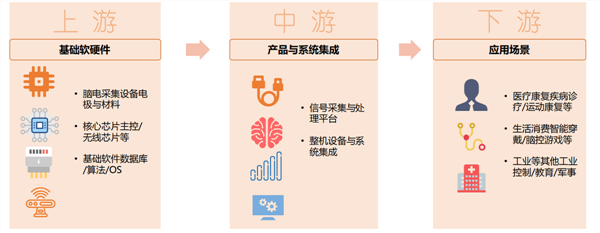
The upstream segment determines the signal accuracy and stability of BCI and represents the core competitiveness of the industrial chain. Core components in the upstream, such as high-precision electrodes and dedicated chips, are the segments with the highest technical barriers. This is akin to constructing a precise 'dialogue bridge' for the brain, requiring biocompatible materials to safely capture weak neural signals at an extremely small scale and convert them into clear electronic instructions. It integrates cutting-edge breakthroughs in multiple disciplines like materials science, microelectronics, and neurobiology, with lengthy research and development cycles and exorbitant trial-and-error costs. Any minor progress relies on long-term accumulation of basic research. In contrast, system integration and scenario applications in the midstream and downstream are more based on the adaptation and optimization of these core hardware components. Therefore, innovations in the upstream directly determine the depth and breadth of the entire industry's development.
The midstream is responsible for the collection, analysis, and transmission of EEG signals, with core capabilities lying in low latency (<60ms), multimodal fusion (EEG + voice + gestures), and data compression. Downstream applications determine the industry's ceiling, with current medical (Parkinson's disease, amyotrophic lateral sclerosis) and consumer (gaming, home, rehabilitation) sectors being the two core directions.
In terms of related stocks, Southwest Securities believes: 1) For invasive technology, which has just commenced clinical trials in China, attention should be paid to leading invasive enterprises and those with the potential to become industry key players in flexible electrodes, implantation technology, and algorithms for specific scenarios. Related stocks include: Tiandi Medical, Brain Tiger Technology, and Chipintel, etc.; 2) For semi-invasive/interventional paths, attention should be paid to 'data readout' and 'enrollment scale,' both of which can significantly enhance commercialization certainty and industry attention. Related stocks include: Boruikang, Sanbo Brain Hospital, and Mindray Medical, etc.; 3) For non-invasive technology, attention should be paid to the rare combination of 'medical + consumer' dual-wheel drive, with an overall faster commercialization path for the technical approach. Related stocks include: Strong Brain Technology, Vasyli Medical, Xiangyu Medical, Aipeng Medical, Innovative Medical, and MaiLand, etc.
04. Conclusion
In summary, as an innovative technology, the development of BCI is still at the dawn of commercialization. Currently, non-invasive technology has become the mainstream in the market due to its safety, while high-precision invasive technology brings hope to severely ill patients. In the industrial chain, the high technical barriers of core components in the upstream constitute the key bottleneck and core competitiveness for industrial development.
Although initial implementation has been achieved in vertical fields like medical rehabilitation, BCI still faces long and arduous challenges in terms of technological stability, industrial ecosystem construction, and ethical safety norms. In the future, with the continuous deepening of multidisciplinary integration and gradual breakthroughs in technological bottlenecks, BCI is expected to transition from 'critical support' medical applications to 'value-added' consumer sectors, truly initiating a new era of deep human-machine integration and profoundly changing the ways humans live, rehabilitate, and expand their cognition.
Therefore, this path is both fraught with challenges and shining with an unparalleled visionary light.
- End -
-
![]()
Registered Capital Slashed to 372 Million Yuan! Yutong Optical Finalizes Industrial and Commercial Change Registration
-
![]()
Zhuque-3 Successfully Lands, and 'Time Traveler' Secures Another ¥100 Million in Funding: China's Commercial Space Industry Experiences a 'Dynamic August'
-
![]()
Autohome Faces a Shrinking Window of Opportunity
-
![]()
Even a Titan Like Musk Has Faced Setbacks in Fulfilling Promises
-
![]()
AI Office: The End of the Racing Era, Context Becomes the Key to Success
-
![]()
Domestic Vehicle Chassis Revolution ②: The Steering Wheel Remains, But Mechanical Connections in the Steering System Are Decreasing
-
![]()
Exploring MiniMax Design: Can Video Editing Be as Simple as Speaking?
-
![]()
Why Can SenseTime Achieve Profitability While CloudWalk Still Faces Challenges, Despite Both Adopting Large Models?