It's the Age of Agents, Yet AI Competition Still Relies on Spring Festival Red Packets?
 01/27 2026
 505
505
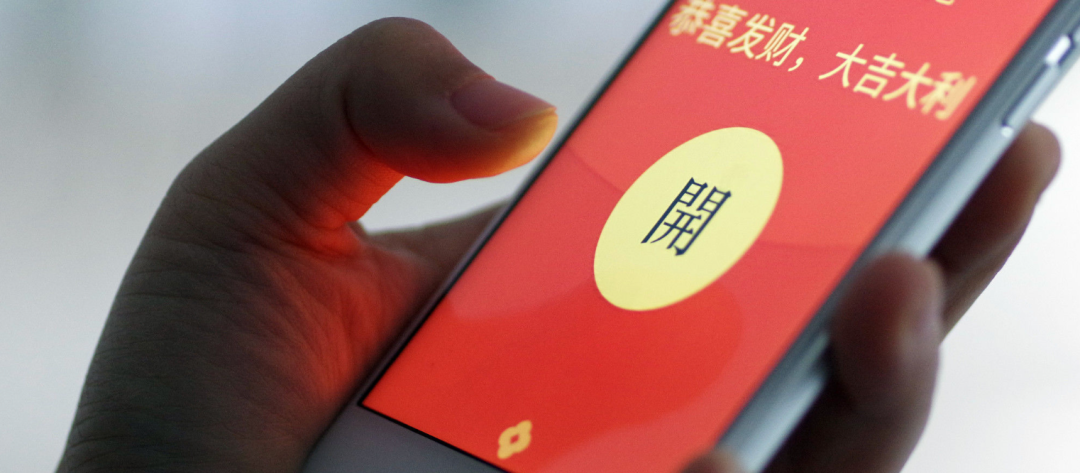
How Significant an AI Entry Point Can Red Packets Create?
The AI sector's festive spirit for 2026 was amped up by Tencent and Baidu around the Laba Festival. On January 25, Tencent Yuanbao and Baidu Wenxin unveiled plans to distribute 1 billion and 500 million yuan in cash red packets during the Spring Festival, with individual packets reaching up to 10,000 yuan.
The two companies employed distinct strategies: Tencent capitalized on its 'social fission' strength, allowing users to claim red packets and share them with WeChat, QQ friends, and communities. Meanwhile, Yuanbao was conducting grayscale tests on its social product, Yuanbao Pai, described by Tencent Chairman Ma Huateng as a top-secret project.
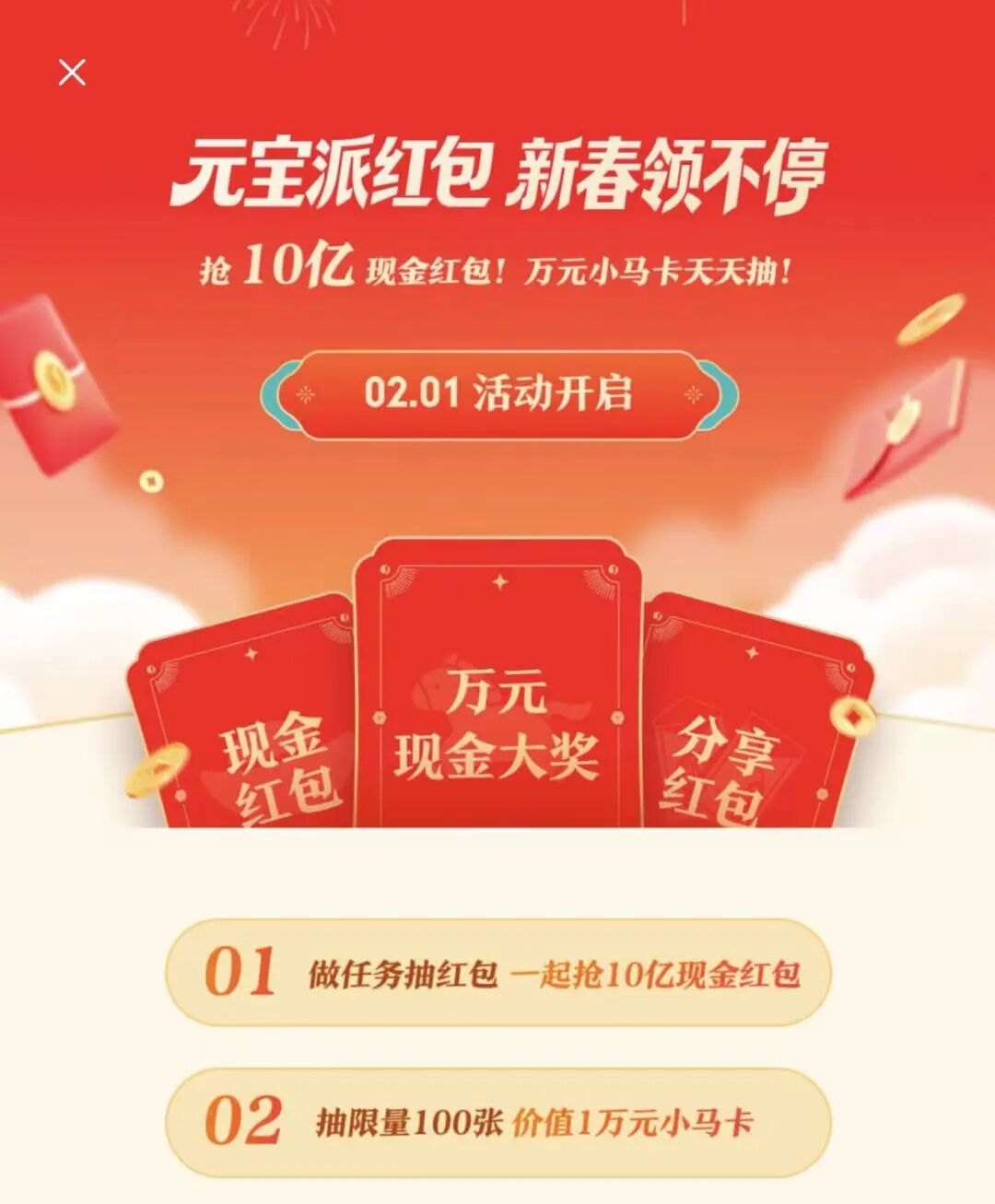 Caption: Screenshot of Yuanbao Red Packet Event by Tang Chen
Baidu, in contrast, collaborated with the Beijing Radio and Television Spring Festival Gala, introducing three core gameplay mechanics: earning money by watching videos, awarding 10,000 yuan to the first 1,000 users to collect rare cards, and guessing passwords through the Wenxin Assistant. Its hallmark was deep integration with 'AI,' aiming to boost return on investment.
This tactic of 'using money to attract users' is not novel in the mobile internet era, with clear intentions: to achieve rapid growth in user scale and mindshare during the Spring Festival's golden window.
However, it's disheartening that even as AI enters the Age of Agents, red packets remain a familiar 'old face' in the competition for the new super AI entry point, serving as companies' best tool to attract users. Despite varied strategies, all participants share a highly consistent core objective.
Tencent's Sense of Urgency
Tencent pioneered the Spring Festival red packet gameplay. In 2015, WeChat Pay leveraged the Spring Festival Gala's 'shake' feature to distribute 500 million yuan in red packets, establishing a foothold in mobile payments and reshaping the market.
Over the next decade, Alibaba, Baidu, Kuaishou, and ByteDance adopted this strategy, partnering with the Spring Festival Gala to promote their products. For instance, in 2019, Baidu invested 1.9 billion yuan to join the red packet battle, adopting a 'product suite' approach to compete for users, which required downloading the Baidu App.
Now, Tencent has replicated this strategy for its AI application, Yuanbao, recognizing that at critical junctures, high-incentive, strongly social 'behavioral implantation' can swiftly reshape user habits.
Tencent's greatest asset remains WeChat, a social goldmine, which it aims to use to swiftly divert traffic from social scenarios to its AI application.
Behind this lies Tencent's urgency in response to ByteDance's Doubao and Alibaba's Qianwen carving out territories in AI2C and acquiring hundreds of millions of active users: the 1 billion yuan in red packets is essentially a strategic investment by Tencent to compete for user mindshare.
Yuanbao, as described by iFeng, has become Tencent's primary battlefield for AI2C and the third front for social engagement.
Over the past year, Tencent's pace in native AI has been perceived as 'slow' by the outside world, creating a relatively laid-back image. For example, its base model capabilities are average, and its ToB business has not made significant waves. Tencent President Liu Chiping has shifted industry expectations for Tencent AI to the still-'brewing' WeChat Agent.
Although Yuanbao heavily invested in user acquisition in early 2025, most of it was within Tencent's ecosystem, with minor investments in external channels. Tencent's 'cautious' approach contrasts sharply with the rapid expansion of ByteDance (Volcano Cloud, Doubao), Alibaba (Qianwen, Kuake), DeepSeek, and Zhipu AI.
This 1 billion yuan red packet campaign during the Spring Festival appears to be Tencent's 'rapid march' after being cornered. It needs to accelerate the integration of Yuanbao with WeChat, QQ, Mini Programs, and other ecosystems.
An industry consensus is that 2026 will be a breakthrough year for AI Agents. This trend, predicted by Google, is also reflected in Alibaba's Qianwen 6.0 and Baidu's Wenxin 5.0, which rely on Agents and MCPs to deliver capabilities to users as the core experience in the AI2C competition.
Tencent's anxiety lies in not losing the 'default entry point' in the AI era. Despite owning WeChat and QQ, two super social apps, AI Agents or MCPs could potentially surpass them as new entry points.
If users get into the habit of asking 'Doubao' or 'Qianwen' first instead of Tencent's own AI when encountering problems, WeChat's traffic moat could be bypassed. This is the fundamental reason why Doubao phones, which heated up the AI phone market, were quickly 'intercepted' by super apps like WeChat.
To some extent, Tencent's red packet battle is a stress test of its AI ecosystem integration capabilities and sounds the rallying call for Tencent's AI2C entry point competition.
Because over the past year or two, beneath Tencent's 'laid-back' facade, its layout in native AI has not been sluggish.
Its strategy is aptly summarized by Xiaolong (Allen Zhang)'s 'atom' theory, which promotes business AIization through an 'imperceptible embedding' experience. Meanwhile, it has also prepared in terms of talent acquisition and organizational structure. For example, younger AI native tech talents like Yao Shunyu were recruited in the latter half of last year.
On the afternoon of January 26, at Tencent's annual meeting, Ma Huateng mentioned Yuanbao's upcoming 1 billion yuan cash distribution during the Spring Festival, expressing hope to recreate the success of WeChat's red packets. He also emphasized that Tencent should maintain composure and focus on its own business rhythm, stating, 'Each company has a different gene and constitution; Tencent's style is steady and sure-footed.'
This is also a response to the 'laid-back' rumors. However, whether this success can be replicated and whether Tencent can usher in a new era of AI social networking ultimately depends on Yuanbao's subsequent execution capabilities.
Baidu Regains Its Confidence
Baidu's swift response, standing in direct opposition to Tencent, was quite unexpected.
Firstly, Baidu's initial foray into distributing Spring Festival Gala red packets in 2019, despite a massive 1.9 billion yuan investment, was met with criticism due to poor user experience. Secondly, since the AI war began, Baidu has often been ridiculed as 'starting early but arriving late,' with some even claiming it has fallen behind in the AI era.
Given Baidu's previous track record, its reaction would not have been so swift; it would have likely been constrained by external criticism, hesitant or responding with altered actions.
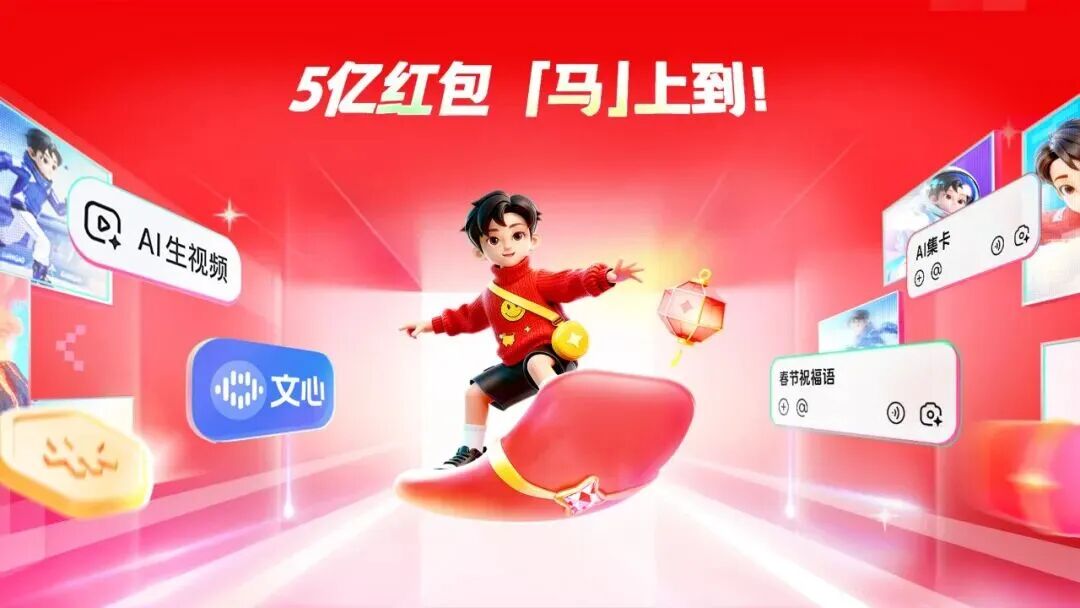 Caption: Official Image of Baidu Red Packet Event
However, this time, Baidu launched its 2026 Horse Year Spring Festival red packet campaign shortly after Tencent. Besides industry-wide anxiety, it's more important to note that Baidu's confidence has returned.
Over the past year or so, including at the recently held Wenxin Moment Conference 2026, I've clearly sensed a change in Baidu: it's not only deeply cultivating technology but also actively and confidently communicating externally.
One memorable moment at the event was a public debate between media personnel and the 'Luo Yonghao' digital avatar, which addressed several pressing questions from the outside world.
Baidu used 'Luo Yonghao's' mouth to respond to these piercing and sharp concerns, which required not only courage but also confidence: a capable Baidu has returned to the AI main table. Beyond the controversies, it has built a 'chip-cloud-model-body' full-stack collaborative system, achieving full-link self-research and control from the underlying chips to the upper-layer applications.
At the 2025 Baidu World Conference, Baidu founder Robin Li announced a full-scale commitment to AI and introduced a concept: internalizing AI capabilities. This is a spiritual entry point, a precise refinement of Baidu's AI application ecosystem capabilities, indicating that it has completed the closed loop from goal to realization.
The direct effect is that Baidu, after more than a decade of exploration in the AI uncharted territory, has built a full-stack AI closed-loop capability comparable to giants like Google and Microsoft, also completing a transformation in its temperament.
If Baidu's confidence restoration is seen as a phased project, this Spring Festival red packet battle serves as a dividing line. Before this, Baidu was somewhat hesitant; after this, Baidu has undergone a complete transformation, adjusting its rhythm in the AI era, completing its technological closed loop, and rapidly seizing the highest point of AI value:
While others are still burning tokens and money, unsure when they can break through the model, Baidu has already started making money. This is also its confidence in waging a protracted AI war.
The latest move is that Baidu recently established the Personal Super Intelligence Business Group (PSIG), integrating core AI application assets like NetDisk and Wenku, led by Vice President Wang Ying, who reports directly to CEO Robin Li. This integration of AI application asset businesses is also Baidu's response to external doubts about whether its AI capabilities can be translated into scalable revenue.
Of course, Baidu's anxiety has not completely dissipated. This proactive response is also Baidu's self-proof: it remains China's most AI-savvy company, with a sufficiently deep technological moat.
Will 'Doubao, Qianwen' Follow Suit?
Currently, AI newcomers like ByteDance's Doubao, Alibaba's Qianwen, and Kimi have not made targeted deployments, but it doesn't mean they will abandon the competition during the 'Spring Festival Golden Moment' – DeepSeek's emergence during last year's Spring Festival led China's AI down a new path, making the Spring Festival exceptionally meaningful for the AI industry – relevant Spring Festival events are bound to be launched successively, collectively igniting this round of 'Spring Festival Red Packet Battles.'
 Caption: Informational Image of Doubao Spring Festival Event
For instance, Volcano Engine has become the exclusive AI cloud partner for the Spring Festival Gala, and Doubao will also participate, launching various interactive gameplay mechanics. Although ByteDance has not disclosed the specific sponsorship amount, referring to past Spring Festival Gala sponsorship standards and its style of achieving remarkable results through massive investments, it will undoubtedly be a substantial sum, possibly even ByteDance's or the industry's largest AI brand marketing investment this year.
Since the end of last year, Qianwen has been continuously exploring the strategic depth of AI2C within the Alibaba ecosystem, primarily focusing on Qianwen 6.0 and Kuake AI Glasses as two wings, encompassing both software and hardware. Among them, Qianwen 6.0 has been fully integrated into Alibaba ecosystem businesses like Taobao, Alipay, Taobao Flash Sale, Fliggy, and Gaode, enabling AI shopping functions such as ordering food, making purchases, and booking flights, and is open for testing to all users.
This has made it the world's first AI assistant capable of completing complex real-life tasks, leading the AI industry from 'chat and dialogue' into the 'era of getting things done.'
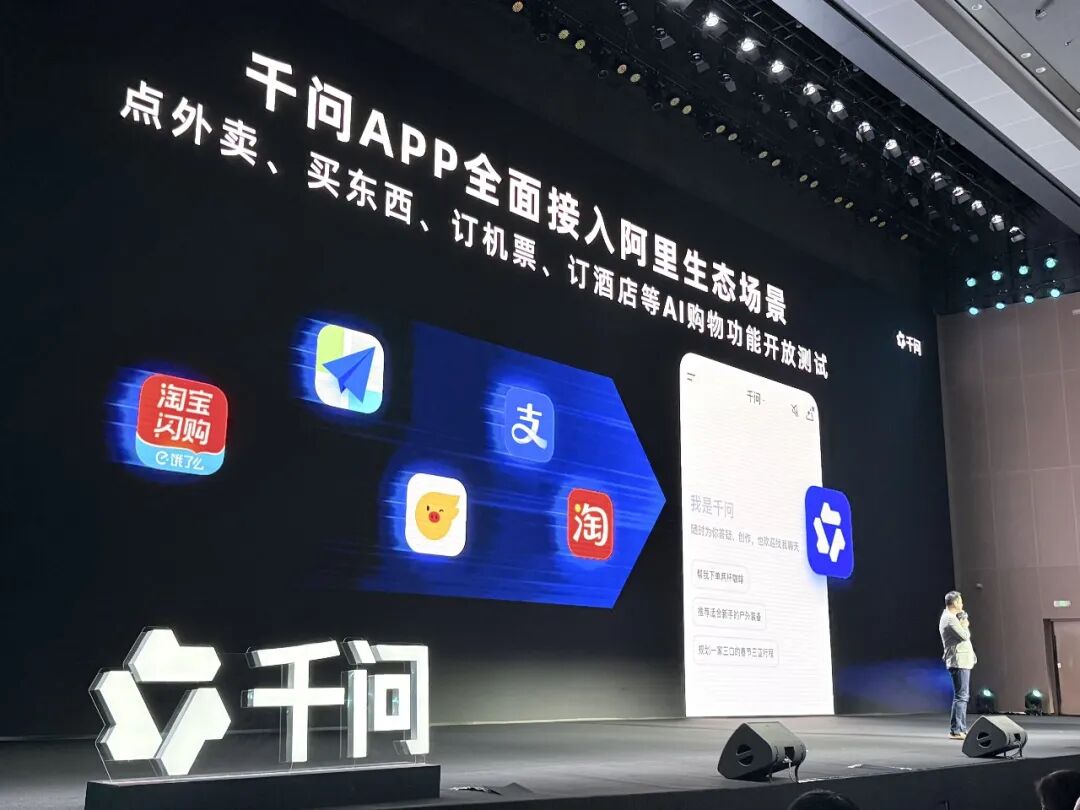 Caption: Photograph of Qianwen 6.0 by Tang Chen
Although Qianwen has not confirmed whether it will participate in the red packet battle, it's certain that Qianwen's Spring Festival gameplay will be a systematic 'corps-level operation' mode, integrating with Alibaba's commercial ecosystem across various businesses. Red packets will merely serve as a link to seamlessly popularize the AI 'getting things done' experience among more merchants and ordinary consumers.
This is the logical starting point for whether Qianwen should participate and how to participate in the Spring Festival red packet battle. Deviating from this point, even if Qianwen distributes numerous red packets, it would only be a hasty response with uncertain effects.
However, for all participating AI giants, they must face a realistic question: Can red packets pave the way for the future of AI?
In the short term, the 'pulsed traffic' brought by Spring Festival red packets will inevitably lead to a short-term surge in downloads and daily active users. However, historical experience has also taught us a lesson: product strength and ecosystem experience are the real currencies.
DeepSeek's rise proves that technological barriers and ultimate experiences (low cost, high performance) are more penetrating than simply throwing money around. If companies cannot gain an advantage in experience and scenario closure, red packets may become mere 'digital fireworks,' with users leaving after claiming them, unable to truly retain them on their AI applications.
Nevertheless, this Spring Festival red packet battle represents a collective bet by giants like ByteDance, Tencent, Alibaba, and Baidu on the 'super entry point' in the AI era, and it will be difficult to determine a winner in the short term.
However, objectively speaking, it has accelerated the popularization of AI, pushing AI to truly enter ordinary households. For average users, this is a carnival; groups that were previously indifferent to AI or not accustomed to using it will undergo market education at this juncture.
I also hope to see this red packet battle become even more lively.
References:
Jiemian News, 'Spring Festival Red Packet Battle Shifts to AI'
Tang Chen's Classmate, ''Luo Yonghao' Has Another Argument, But This Time It's on Baidu AI's 'Home Turf''
-
![]()
Registered Capital Slashed to 372 Million Yuan! Yutong Optical Finalizes Industrial and Commercial Change Registration
-
![]()
Zhuque-3 Successfully Lands, and 'Time Traveler' Secures Another ¥100 Million in Funding: China's Commercial Space Industry Experiences a 'Dynamic August'
-
![]()
Autohome Faces a Shrinking Window of Opportunity
-
![]()
Even a Titan Like Musk Has Faced Setbacks in Fulfilling Promises
-
![]()
AI Office: The End of the Racing Era, Context Becomes the Key to Success
-
![]()
Domestic Vehicle Chassis Revolution ②: The Steering Wheel Remains, But Mechanical Connections in the Steering System Are Decreasing
-
![]()
Exploring MiniMax Design: Can Video Editing Be as Simple as Speaking?
-
![]()
Why Can SenseTime Achieve Profitability While CloudWalk Still Faces Challenges, Despite Both Adopting Large Models?