The High-Stakes 'Normandy' of Life and Death Behind the 3 Billion AI Red Packet Battle: A Gamble for Dominance or a Lavish Display of Wealth?
 02/04 2026
 530
530
By | Zeng Xianyong
Presented by | Yongli Business Review, Atong Observation
The atmosphere during the 2026 Spring Festival is not only imbued with festive cheer but also tinged with a palpable sense of competition.

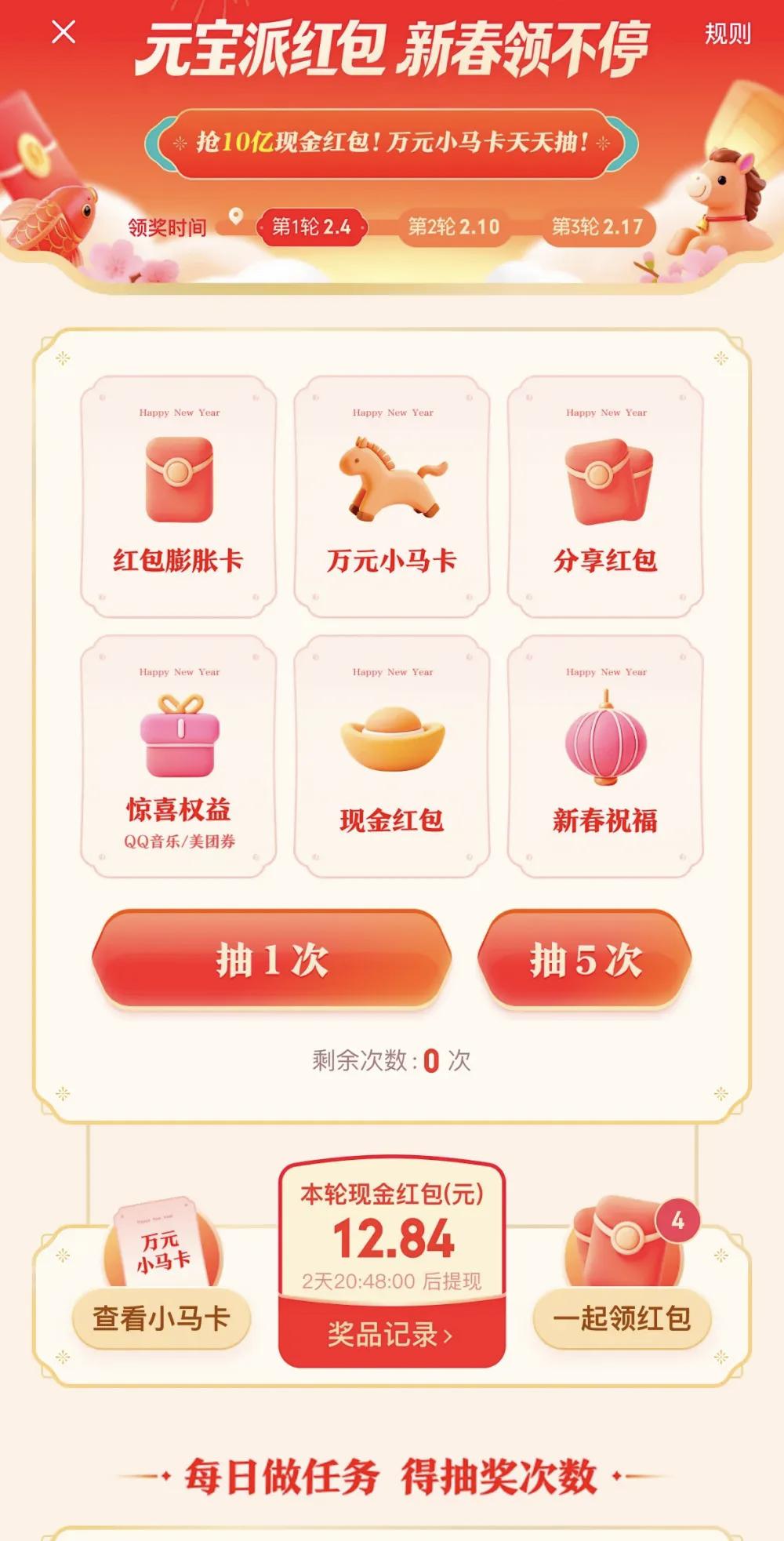
As the Year of the Horse Spring Festival draws near, a historic 'red packet war' has quietly erupted among major internet companies. This time, rather than exchanging courteous greetings, these tech behemoths have engaged in a fierce 'red packet skirmish' valued at 3 billion yuan.
Tencent Yuanbao, Baidu Wenxin, and Alibaba Qianwen—the three leading AI assistants—have almost simultaneously unveiled their ace cards. This is no longer the 2015 'Normandy landing' in the payment sector but a ruthless knockout round for the super gateway in the AI era and a make-or-break battle for internet access in the next decade.
Money-Burning is Just the Tip of the Iceberg; Competing for Access is the Core
Recalling 2015, WeChat utilized the Spring Festival Gala's 'shake' red packets to revolutionize national payment habits in a pure traffic blitz. Today, as the dividends of mobile internet reach their peak, the giants have set their sights on AI assistants as the new super gateway.
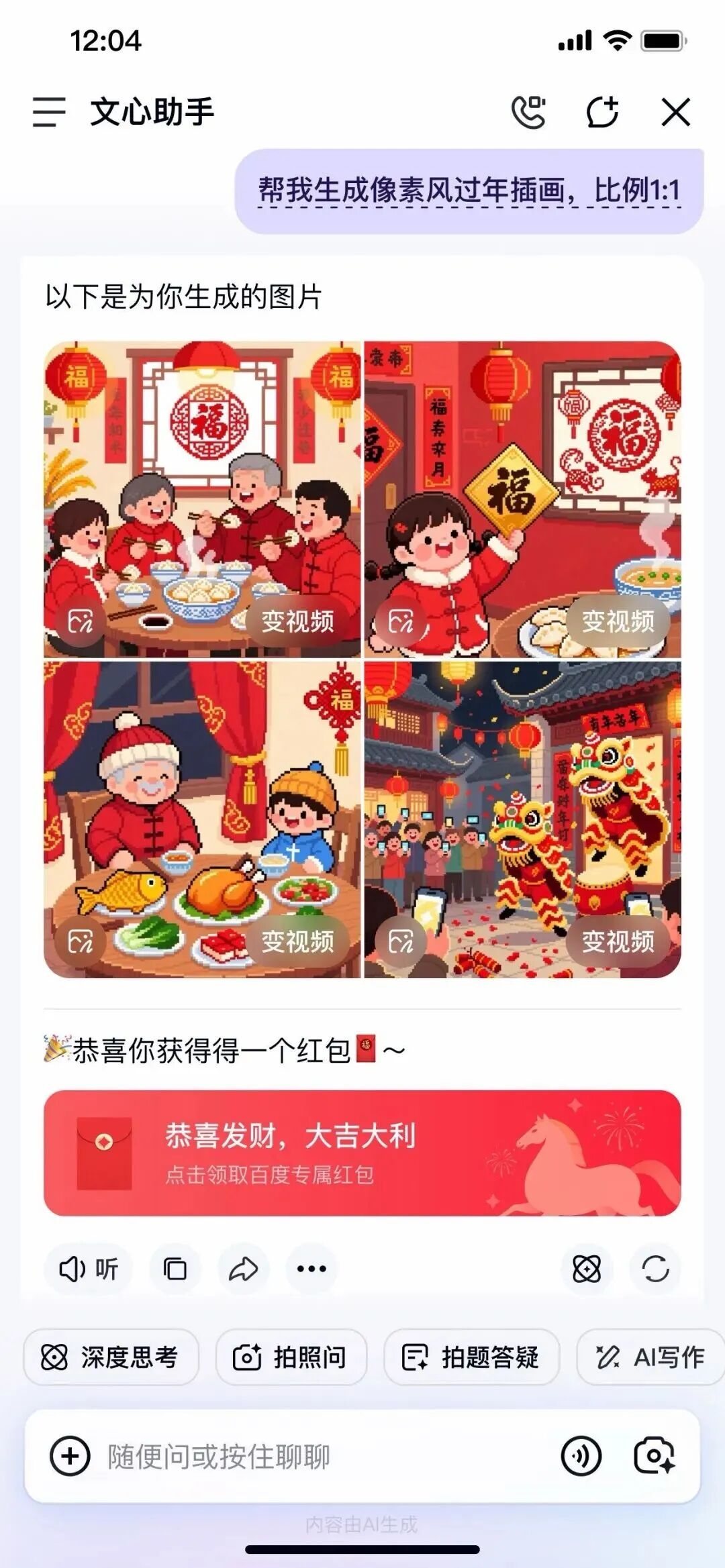
On the surface, this appears to be a familiar display of extravagant spending. Tencent has launched a 1 billion yuan cash giveaway, attempting to replicate the miracle of WeChat red packets; Baidu follows suit with 500 million yuan, aiming to reconstruct search access through AI; Alibaba Qianwen has initiated a 3 billion yuan 'Spring Festival Hospitality Plan,' extending the battle from online to offline dining, entertainment, and leisure.

However, the true motive behind these 3 billion yuan expenditures is not merely to secure a few downloads. In today's mobile internet landscape, where traffic growth has plateaued, the giants' anxiety has never been more pronounced. They recognize that AI assistants are not just another app but the master switch for all traffic in the next decade. Whoever captures this gateway will control distribution in the next wave of technological innovation. Thus, the essence of this red packet war is a life-and-death struggle for the 'national-level AI assistant.'
Three Philosophies, Three Approaches
In this melee, the three giants have adopted vastly different strategic paths, reflecting their unique perspectives on the form of the AI gateway.
Tencent has opted to replicate 'social fission.' The Yuanbao app endeavors to leverage WeChat and QQ's vast social networks, forcibly inserting the AI assistant into users' daily communication scenes through methods like 'share for red packets' and 'group chat triggers.' Pony Ma's intention is clear: if WeChat is the gateway connecting people, then Yuanbao should be the gateway connecting people and AI. He aspires to recreate the glory of 11 years ago, using social media's explosive power to instantly gain traction.
Baidu, meanwhile, has chosen the path of 'search reconstruction.' It aims to seamlessly integrate the Wenxin assistant into the search bar, so that when users query weather, recipes, or New Year customs, they no longer encounter cold blue links but complete AI-generated solutions. Baidu's rationale is that if users are accustomed to 'searching for answers,' then future searches should be 'asking AI for answers.' It seeks to smoothly transition from traditional search to AI agents during the Spring Festival holiday.
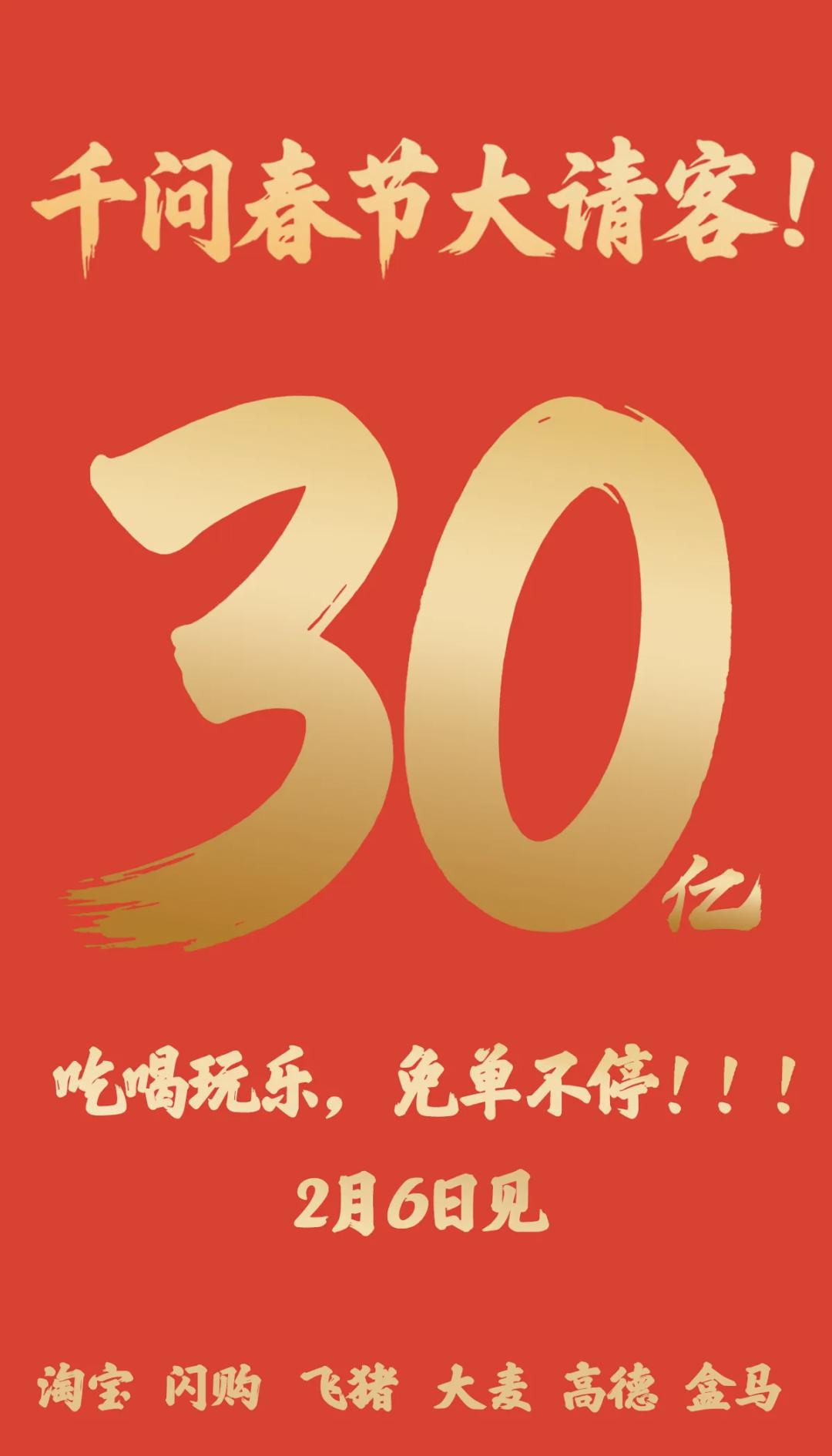
Alibaba Qianwen, on the other hand, has executed an 'ecosystem fusion' masterstroke. Unlike the others' focus on user acquisition, Qianwen emphasizes conversion. Instead of simply giving away money, it has launched the 'Spring Festival Hospitality Plan,' deeply integrating the AI assistant into core businesses like Taobao, Alipay, Gaode, and Fliggy. Its objective is not to let you chat with AI but to let you use AI to accomplish tasks. Whether it's 'booking a flight with one sentence' or 'AI-powered price comparison,' Qianwen aims to establish itself not just as a chat tool but as the central brain of a commercial agent.
The Battle Has Begun, but the True Test Lies Ahead
In reality, the red packet war among BAT is just the tip of the iceberg, as more AI giants have joined the fray.
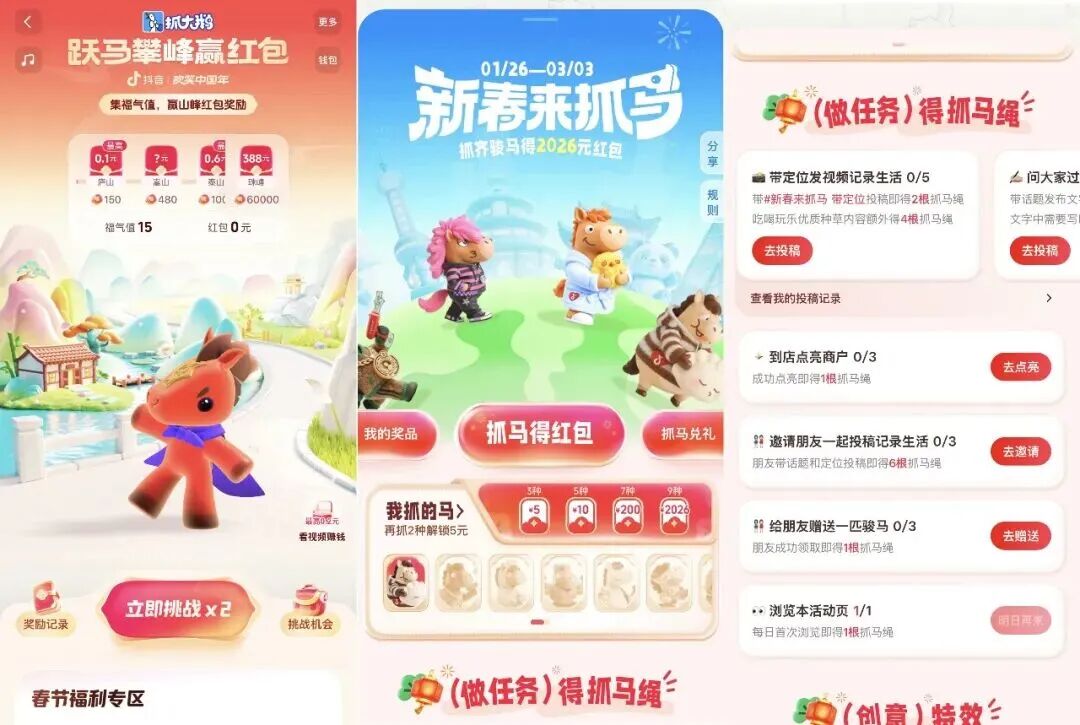
As the exclusive AI cloud partner for CCTV's Spring Festival Gala, ByteDance has become the traffic focal point through the dual-platform synergy of 'Doubao + Douyin.' Its red packet campaign centers on AI interaction, featuring two main themes: real-time gala interaction and card-collecting for a share of the prize, with individuals eligible to win up to 2,026 yuan in cash red packets. On New Year's Eve, users can snatch red packets through zero-barrier methods such as voice-activating Doubao to say passwords, AR scanning Spring Festival couplets and blessings, and participating in gala program interactions. The campaign supports multi-dialect recognition and cross-screen participation, catering to users of all ages.

The essence of this Spring Festival red packet war is the competition among internet giants for the next-generation interaction gateway. With AI user scale surpassing 500 million and a penetration rate of 36.5%, the Spring Festival serves as the perfect national experience event. Although the four major players have different approaches, their core logic remains the same: using red packets as a stepping stone to guide users into experiencing AI functions and ultimately capturing user mindshare.
Among the chaos, Alibaba Qianwen's strategy stands out. Instead of simply throwing cash around, it has played the 'ecosystem integration' card. The slogan for Qianwen's 'Spring Festival Hospitality Plan' is 'Eat, Drink, Play, Enjoy—Freebies Non-Stop,' backed by the vast Alibaba commercial empire, including Taobao, Alipay, Fliggy, Gaode, and Hema.
While other AI assistants are trying to get you to 'play' with red packets, Qianwen is already trying to get you to 'use' it. Half a month ago, Qianwen was already integrated into core scenarios like Taobao Flash Sales and Fliggy to test AI shopping functions. This means that users' experiences during the Spring Festival will not just be entertaining but functional. You won't need to switch between multiple apps; just tell Qianwen your needs, and it will mobilize the ecosystem's resources to serve you.
The ambition behind this strategy is to skip the 'chatbot' phase and directly become the user's 'intelligent life manager.' The freebies and red packets are bait, but the real killer move is letting users experience firsthand the efficiency gains of AI in real consumption scenarios. This is not just about competing for space on users' phone screens but for their lifestyles.
After the Red Packet Frenzy, Who Will Remain on the AI Stage?
ByteDance relies on traffic hype, Tencent leverages social media to break through, Alibaba emphasizes ecosystem synergy, and Baidu wins with deep scenario cultivation. When the Spring Festival hubbub fades and the red packet dividends are exhausted, the real test begins. Will users uninstall the apps they downloaded just for the red packets? Which AI assistant can maintain high daily active users after the festival? The answers to these questions will directly determine who the true 'survivors' are.
In my view, what appears to be giants 'throwing money around' is actually using financial subsidies to forcibly shift user behavior. They are trying to tell users: the future of search is not about entering keywords but conversing with AI; the future of services is not about clicking through menus but issuing direct commands. These billion-dollar red packets are, in essence, an 'expensive tuition fee' to cultivate users' AI application habits.

The 2026 Spring Festival is destined to become a watershed moment in China's AI development history. The size of the red packets will eventually be forgotten, but the AI assistant(s) that ultimately integrate into our lives and become our 'external brains' will forever change the world. (By Zeng Xianyong)
-
![]()
Tough Times Are Here: The Auto Industry Is Mired in Immense Pain
-
![]()
Honda Finds Itself 'With No Alternative' but to Battle On for Another Ten Years
-
![]()
Is the 'Chili Fish Head' Car, Once a Hit Among Noble Ladies, on Its Way Out?
-
![]()
DJI Osmo 360 II Review: Impeccable Hardware, Yet Software Still Lags Behind
-
![]()
The 'Dichotomy' in Alibaba's AI Ledger
-
Reinventing the 'Old Guard' with AI: A $12 Billion Venture in Just a Year
-
![]()
Alibaba's Q2 Profit Plummets by 32.6 Billion Yuan, with 67.7 Billion Yuan Earmarked for Capital Expenditures
-
![]()
DJI Osmo 360 II In-Depth Review: How Does It Achieve Significant Image Quality Enhancements Without Sensor Changes or Excessive Spec Stacking?