Yin Qi 'Greater Than' 5 Billion
 02/05 2026
 570
570
The 5 Billion Secured by Jieyue Xingchen is, in a Way, a Vote Cast for People.
Author | Wang Haoran
Editor | Gu Nian
While most large model companies are still struggling to find a commercialization path and secure their next round of financing, Jieyue Xingchen has recently shaken up the AI industry with a massive 5 billion yuan Series B+ funding round and an unexpected personnel appointment.
Beyond setting a new record for the largest single funding round among Chinese large model companies in the past 12 months, what is even more intriguing is why capital has placed such a heavy bet on Jieyue amid a cautious VC/PE landscape and a cooling financing environment for large models over the past year.
The answer may lie in the new personnel appointment.
On January 26th, Yin Qi, an 'AI veteran, founder of Megvii Technology, and chairman of Qianli Technology,' officially took over as chairman of Jieyue Xingchen. His statement on social media also sent a clear signal: this is not a symbolic position but a substantive strategic intervention, marking the most significant capability restructuring since Jieyue Xingchen's inception.
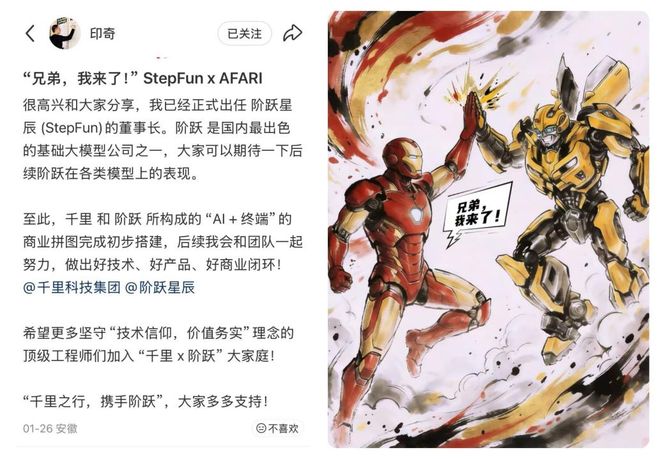
From the outcome, this 5 billion funding round is less about financial support for a large model company and more about capital's logic of investing in people. Yin Qi will simultaneously helm Qianli Technology, focused on 'AI + Automotive,' and Jieyue Xingchen, focused on multimodal large models, Preliminary setup (preliminarily completing) a clear commercial puzzle of 'AI + End Devices.'
As one of the earliest entrepreneurs in China's AI sector, Yin Qi has over the past 15 years fully experienced the Repeatedly pulling and tugging (back-and-forth struggles) of technological cycles, commercialization trials, and industrial competition. This long-term experience of friction with reality, uncommon among current large model entrepreneurs, is precisely the capability most valued by capital in the second half of the competition.
From this perspective, Yin Qi's joining does not merely bring a new chairman title to Jieyue Xingchen but addresses deficiencies in funding, industrial resources, talent deployment, and organizational structure.
Of course, another layer of uncertainty remains. Under deeper collaboration, whether the cultural differences, decision-making styles, and organizational structures of the 'Megvii Faction' and 'Jieyue Faction' can smoothly integrate—or whether new internal tensions will arise in subsequent evolution—remains a real issue for Jieyue Xingchen to confront.
But at least for now, this 5 billion represents: after the large model competition enters its second half, the core of capital assessment is shifting from 'what models can achieve' to 'who can take models where.' In this round of betting, the leader is a variable greater than money.

Founder Steps Down, Chairman Steps Up
Regarding this personnel change, Jiang Daxin commented in a WeChat moment: 'A young entrepreneurial veteran, riding the waves.'

Conveying a sense of 'Lian Po is old' and now passing the baton.
Yin Qi's 'parachuting in' has been a topic of much external discussion, as prior to his joining Jieyue, founder and CEO Jiang Xin had been leading the company forward.
However, from information disclosed by key figures at Jieyue, numerous management issues—such as low organizational efficiency, insufficient talent density, and poor commercialization narratives—may have directly contributed to Jieyue's 'leadership change.'
On one hand, CEO Jiang Daxin believes he has not done well in commercialization narratives.
Jiang Daxin directly admitted this in an interview with 'LatePost,' stating that unlike his previous role at Microsoft, where he simply led teams, serving as CEO requires making many decisions and engaging in external commercial narratives—something he had little desire to do and, based on results, did poorly.
Indeed, from public perception, whether compared to MiniMax and Zhipu, which have both achieved market caps exceeding 100 billion yuan post-IPO and garnered frequent attention, or to Yuezhi Aidian, which has deeper C-end user connections, Jieyue Xingchen's presence among the 'AI Four Little Tigers' is relatively weak.
Several early C-end products launched by Jieyue Xingchen, such as 'Maopao Ya' and 'Yuewen,' failed to gain traction and were discontinued. After shifting to end-device agents, while its models boast tens of millions of installations on mobile phones and in-vehicle systems, they largely serve as 'behind-the-scenes technology providers' without significant C-end user mindshare.
On the other hand, Yin Qi does not consider his arrival a 'parachute drop' and believes it will improve Jieyue's future.
As early as Jieyue Xingchen's founding in 2023, Yin Qi participated as one of the key initiators in its early birth and development. However, preoccupied with Megvii Technology's consecutive failed IPO attempts in A-shares and H-shares, Yin Qi could not deeply engage in Jieyue's growth. He say frankly (admitted) in an interview with 'Guixingren': 'If I had joined earlier, Jieyue Xingchen would be even better now.'
Moreover, he directly expressed dissatisfaction with Jieyue Xingchen's organizational efficiency in the interview, noting that while Jieyue's talent team is very strong and balanced, it lacks slightly in organizational combat effectiveness and talent density.
Previously, Duan Nan, the head of Jieyue's video generation model team, left to join JD.com as the head of the Vision and Multimodal Laboratory at its Exploration Research Institute, To some extent, it confirms (to some extent confirming) Yin Qi's assertion.
At the same time, Yin Qi believes, 'If Jieyue can learn from its mistakes and practice hard, there will be significant improvements, and its upside remains very high.'
Yin Qi's confidence stems from his experience as an 'AI 1.0 veteran.' After Megvii Technology's IPO failure, he recognized that closed-loop business models are essential for sustaining technological progress. He later took over Qianli Technology to drive its 'AI + Automotive' strategy, successfully navigating technical routes, product layouts, talent integration, and commercialization.
As chairman, Yin Qi's responsibilities are clearer: overseeing Jieyue Xingchen's overall strategic rhythm and technical direction. In other words, making major company decisions—exactly where CEO Jiang Xin felt inadequate.

People Matter More Than Money
As large models enter their second half, capital has begun to notice: money can solve fewer problems, while individuals increasingly determine the upper limits.
For instance, 'LatePost' revealed in 'The Full Record of ByteDance, Alibaba, and Tencent's AI Wars: A Battle That Shapes Destiny' several key details: ByteDance's large model capabilities took a turn when Wu Yonghui, former vice president of Google DeepMind, joined; similarly, Yao Shunyu's arrival at Tencent corrected Hunyuan's previous benchmark-focused technical path.
When model gaps are quickly closed, what truly differentiates competitors becomes the judgment of key individuals. For Jieyue Xingchen, Yin Qi's value is similar.
As one of the earliest entrepreneurs in China's AI sector, Yin Qi's career trajectory—from founding Megvii Technology and propelling it to become one of the 'AI Four Little Dragons' in the AI 1.0 era to later leading Qianli Technology's 'AI + Automotive' transformation—has always been closely tied to technological implementation and organizational development.
Such experience is uncommon among current large model entrepreneurs. After taking office, Yin Qi quickly issued a public invitation on social media, hoping 'more top engineers will join the 'Qianli × Jieyue' family.'
Previously, rumors circulated that Qi Junyuan, former head of Doubao PC, had joined Jieyue Xingchen after leaving ByteDance to oversee mobile-related businesses. Although Zhang Peng, founder of GeekPark, later posted a 'debunking' message on social media after verifying with Qi Junyuan, who responded with 'completely false,' Jieyue Xingchen's official silence on the matter

to some extent corroborates Jieyue's hunger for talent. Even if the rumor ultimately proves unfounded, it suggests that in external perception, Jieyue is already seen as a potential destination for top engineers.
In terms of personnel structure, with Yin Qi's joining, Jieyue Xingchen's future core team is gradually taking shape as a more complex factional combination: the 'Megvii Faction' represented by Yin Qi, superposition (overlapped with) the 'Microsoft Faction' represented by founder Jiang Daxin, Zhang Xiangyu, and Zhu Yibo, together forming the new management.
From a personal capability perspective, this combination is not arbitrary. Yin Qi provides industrial and commercialization perspectives; Jiang Daxin represents engineering systems and overall architecture; Zhang Xiangyu strengthens the algorithm and model foundation; and Zhu Yibo handles system and platform capabilities.
In organizational collaboration, these four capabilities precisely correspond to the four core and scarcest dimensions for a large model company moving toward commercialization. For this reason, this team is described in the industry as a '1+3 golden squad.'
However, upgrading from a relatively stable 'iron triangle' to a more complex 'quadrilateral' is not without risks.
For example, earlier, Haomo.ai, a smart driving business spun off from Great Wall Motors, once became a domestic leader in mass-produced autonomous driving under Wei Jianjun's personal endorsement and heavy resource allocation. However, the company's long-standing 'dual-leadership system' (co-decision-making by chairman Zhang Kai and CEO Gu Weihao) led to unclear authority, severe internal friction, and eventually evolved into opposition between teams of different backgrounds, culminating in a technological misjudgment and shutdown.
This means that money, resources, or even industrial support cannot replace clear personnel boundaries and efficient organizational collaboration. Returning to Jieyue Xingchen, it Facing the same challenges (similarly faces) cultural integration issues between the 'Megvii Faction' and 'Microsoft Faction.'
In response, Yin Qi offered a reply in a dialogue with Zhang Xiaojun. He believes that Qianli Technology and Jieyue Xingchen, as organizations with different cultural backgrounds, should remain relatively independent. However, the two already have numerous business and personnel connections, so future collaboration does not start from scratch.
'Like Tai Chi and Yin-Yang, many things have two sides. If two systems are well-constructed, they may form a unique competitive edge.' The flip side of this statement is also clear: if they fail, different systems may also backfire on the organization itself. And external competition will not leave Jieyue much time for internal run in (integration).
Recently, large model companies have accelerated their integration with end devices. For example, Li Auto established new departments for humanoid robots and software ontology (ontology), merging many autonomous driving employees into its base model team. Li Xiang Speak frankly (stated bluntly) in internal meetings that this is to prepare for a new round of AI competition.
Yin Qi has repeatedly emphasized a viewpoint: 'There used to be a notion in entrepreneurship circles: 'jump off a cliff and assemble the plane in midair.' I don't agree with this business model.' In his view, truly sustainable AI businesses must simultaneously possess good products, scalable profits, and a long-term operational foundation.
However, shifting from general-purpose large models to AI + end devices is not merely a Track switching (track switch). It is more like replacing an engine mid-flight. The trial-and-error window for Jieyue Xingchen is not wide.
-
Several Judgments on the Development Trends of AI Data Centers
-
![]()
Tough Times Are Here: The Auto Industry Is Mired in Immense Pain
-
![]()
Honda Finds Itself 'With No Alternative' but to Battle On for Another Ten Years
-
![]()
Is the 'Chili Fish Head' Car, Once a Hit Among Noble Ladies, on Its Way Out?
-
![]()
DJI Osmo 360 II Review: Impeccable Hardware, Yet Software Still Lags Behind
-
![]()
The 'Dichotomy' in Alibaba's AI Ledger
-
Reinventing the 'Old Guard' with AI: A $12 Billion Venture in Just a Year
-
![]()
Alibaba's Q2 Profit Plummets by 32.6 Billion Yuan, with 67.7 Billion Yuan Earmarked for Capital Expenditures