Revenue and Valuation Skyrocket: Can Moonshot AI Secure Victory in the AI Race’s Second Half?
 02/26 2026
 791
791

What Fuels the Rapid Rise of Moonshot AI, China’s Fastest-Growing ‘Decacorn’?
In early 2026, China’s large-scale AI model sector witnessed a remarkable milestone: Moonshot AI, a company established just over two years prior, secured over $1.2 billion in funding within two months, propelling its valuation beyond $10 billion. This achievement not only sets a new benchmark as the fastest domestic company to attain ‘decacorn’ status (valuation exceeding $10 billion) but also marks the largest financing round in China’s large-scale AI model industry in nearly a year. Furthermore, a new financing round valuing the company between $10 billion and $12 billion is already underway.
From a $300 million Angel Round valuation to surpassing $10 billion, Moonshot AI achieved over 30-fold growth in just two years. While shattering valuation records, media reports indicate that its revenue in the last 20 days exceeded its total earnings for 2025.
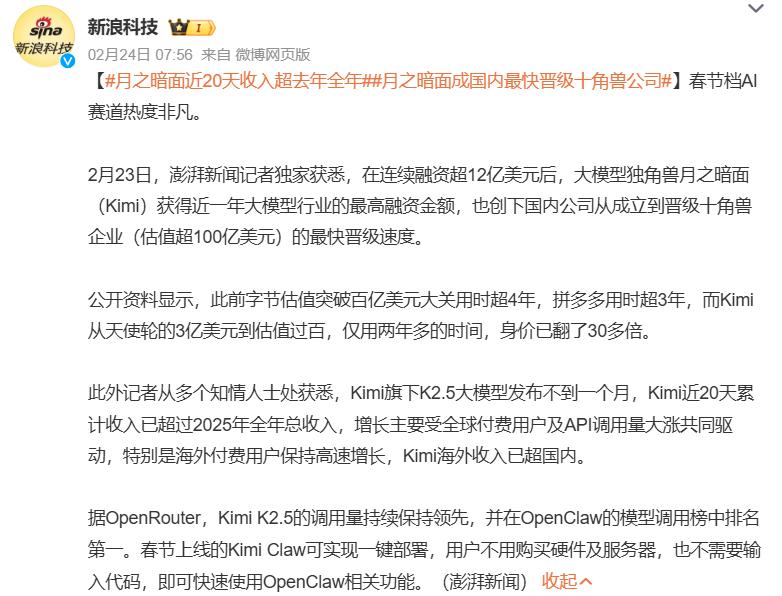
Image Source: Weibo Screenshot
What factors have driven this young large-scale AI model enterprise to experience simultaneous surges in revenue and valuation? Amid an AI race dominated by tech giants and rapid technological advancements, can Moonshot AI transform its fleeting breakthroughs into sustainable competitive advantages?
01. Is K2.5 the Key to Growth?
Moonshot AI’s primary revenue streams come from API call fees and C-end user subscriptions. Over 20 days ago, the company open-sourced its latest K2.5 large-scale model, with recent revenue growth directly linked to K2.5’s exceptional performance.
As Moonshot AI’s new-generation flagship model, K2.5 achieves critical breakthroughs in multimodal understanding, intelligent agent collaboration, and long-text processing. It not only comprehensively upgrades image and document parsing capabilities but also officially supports video input and understanding, granting the model cross-modal reasoning abilities.
Industry practitioners note that while cloning animated websites with Kimi previously required screenshot descriptions, users can now directly send video clips. Testing reveals that K2.5 delivers outstanding physical simulation and procedural animation generation.
In third-party developer communities, comparisons between Kimi K2.5 and Claude Opus 4.5 (ranked alongside GPT-4o and Gemini 1.5 Pro in the global top tier) show that K2.5 outperforms Claude in mathematics, visual programming, context window, and web interaction capabilities while offering lower pricing—making it highly attractive to small-to-medium development teams.
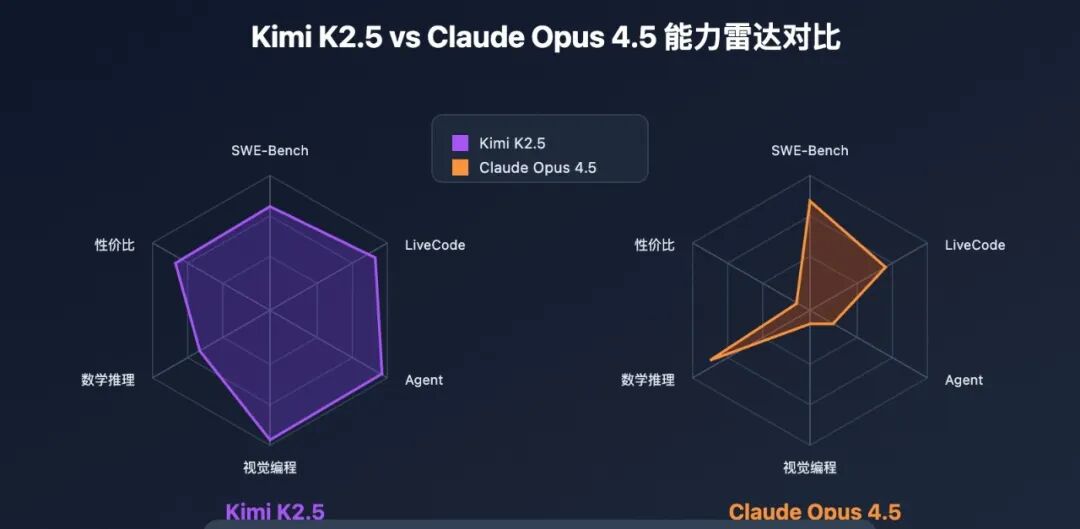
Image Source: APIYI
Additionally, K2.5 implements a self-developed Agent Swarm architecture that supports parallel collaboration among multiple agents. For example, when users request a deep investigative report, specialized agents execute tasks sequentially: search experts locate policy documents and market data, analysis experts process the information, and writing experts generate the final report. ‘Quijie Business’ observes that Moonshot AI has structured tiered membership plans based on Kimi’s capabilities, with Agent cluster functionality requiring $199/month or $699/month subscriptions.
Non-Agent cluster plans offering increased K2.5 usage quotas are priced at $49/month and $99/month. Reports indicate strong willingness to pay among Kimi users, particularly overseas, where international revenue now exceeds domestic earnings.
The recent surge in paid users was no accident. Prior to K2.5’s open-sourcing, founder Yang Zhilin stated in an internal letter that overseas C-end commercialization was rapidly expanding, with paid user counts growing over 170% month-on-month in both domestic and international markets, while overseas API revenue quadrupled from September to November. Leveraging superior performance and competitive pricing, K2.5 gained traction in overseas developer communities and tech forums post-launch, becoming one of China’s top large-scale models by API call volume on OpenRouter (a global developer aggregation platform).
The model’s performance and commercialization breakthroughs stem from Moonshot AI’s strategic pivot in 2025. The company exited competitive marketing battles to focus entirely on model capabilities and Agent development. Media reports reveal that the algorithm team approached the K2 model open-sourcing with ‘do-or-die determination.’
This technical resolve persisted into 2026. Yang Zhilin announced plans to aggressively expand GPU inventory to accelerate K3 model training, aiming to match global front-running models in pre-training capabilities. The company will concentrate on Agent development rather than pure user acquisition, striving to push intelligence boundaries, create greater productivity value, and achieve order-of-magnitude revenue growth.
Image Source: Canstock Photo Library
Despite being a startup, Moonshot AI now stands at the center of the global large-scale model arena through dual strengths in technology and commercialization. 2026 will mark direct competition between Kimi, domestic internet giants, and global leading models.
02. How Sustainable Is the $10 Billion Valuation?
Technological and product breakthroughs are driving positive commercial cycles for Moonshot AI. The company completed two financing rounds totaling over $1.2 billion within three months.
Tianyancha data shows that Alibaba, Tencent, and IDG Capital led Moonshot AI’s $500 million Series C round in December 2025. In February 2026, a new $700+ million Series C+ round was jointly led by Alibaba, Tencent, 5Y Capital, Jiu’an Medical, and Gaorong Capital, with existing investors like Gaorong Capital doubling down. Post-financing valuation exceeded $10 billion.
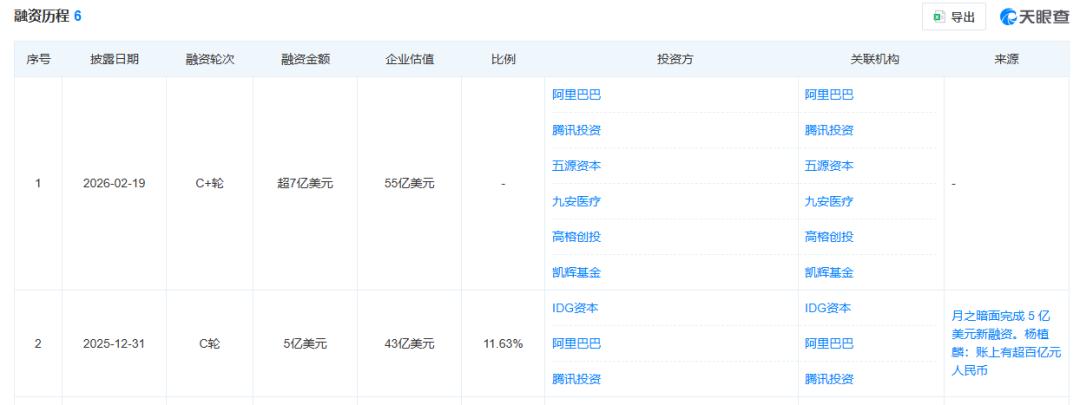
Image Source: Tianyancha Screenshot
Moonshot AI’s $10-12 billion valuation places it among China’s top-tier large-scale model players but remains significantly below listed competitors like Zhipu and MiniMax (both exceeding HK$250 billion market cap). Globally, it represents approximately 1/66th of OpenAI’s $730 billion valuation and 1/35th of Anthropic’s $380 billion valuation.
In 2024, Yang Zhilin faced speculation about selling Moonshot AI shares for cash, raising doubts about internal confidence. However, with K2 and K2.5 open-sourcing, the company regained primary market favor, as evidenced by oversubscribed follow-on rounds from existing investors. This reflects sustained investor confidence in the project.
The successful financings provide Moonshot AI with substantial cash flow, enabling a capital strategy distinct from Zhipu and MiniMax. In December 2025, Yang Zhilin stated the company held $1 billion in cash reserves: ‘We believe we can raise larger sums from primary markets than secondary listings offer, so we’re not prioritizing IPOs in the short term. However, we plan to use listings as a means to accelerate AGI development in the future.’ Based on MiniMax and Zhipu’s IPO filings, Moonshot AI’s cash reserves could sustain 3-5 years of R&D investment.

Image Source: Weibo Screenshot
Moonshot AI’s core revenue currently relies heavily on developer API calls and paid subscriptions, making its competitive moat dependent on foundational model technological leadership. Should iteration slow, developers might pivot to more cost-effective or capable alternatives.
While Moonshot AI advances rapidly, Zhipu and MiniMax have also achieved notable milestones. Zhipu’s GLM-5 raised programming package pricing due to performance advantages yet remains oversubscribed. MiniMax’s M2.5 recently topped OpenRouter’s weekly/monthly rankings, becoming the first model to exceed 3 trillion token calls in a single week.
Notably, Agent scenarios represent a strategic focus for Zhipu and MiniMax as well. GLM-5 was designed for Agentic Engineering, while M2.5 became the world’s first production-grade model natively built for Agent applications. With Open Claw gaining traction, the 2026 AI competition has shifted from ‘model performance’ to ‘Agent practicality.’ As former members of China’s ‘AI Six Dragons,’ Zhipu, MiniMax, and Moonshot AI now face inevitable head-to-head competition in the Agent space.
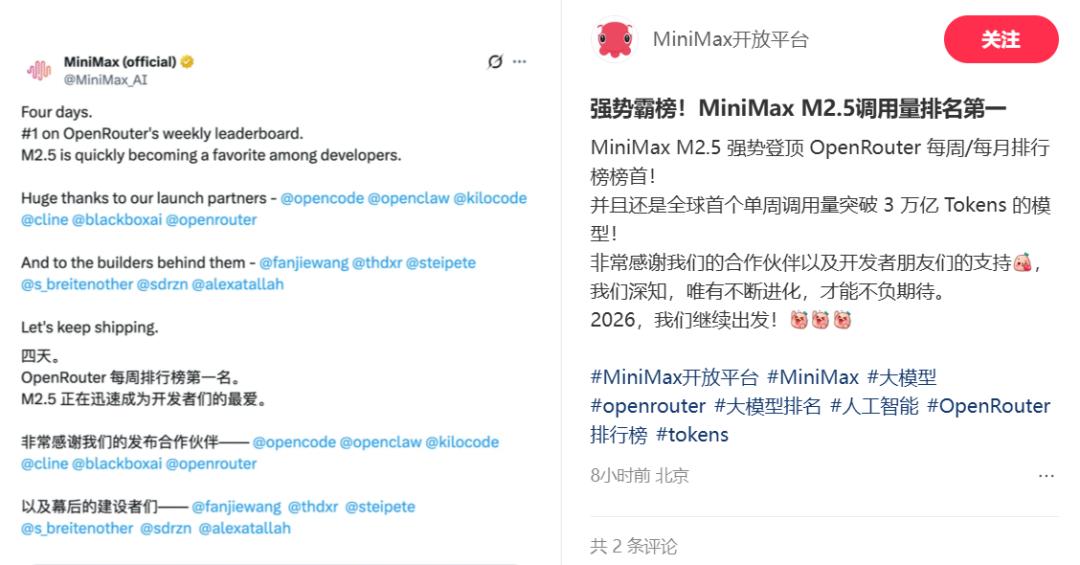
Image Source: Xiaohongshu Screenshot
Internet giants will soon leverage their ecosystems and traffic advantages to rapidly enter the field, integrating Agent OS with office, device, and cloud services. In contrast, Moonshot AI—lacking a proprietary ecosystem—faces dual pressures from peer pursuit and industry giant encirclement.
For Moonshot AI, K2.5’s breakthrough marks just the beginning of a prolonged commercialization journey. The enduring battle will test not only the burn rate of its $10 billion cash reserves but also its speed in balancing technological iteration with commercial viability.
-
![]()
Doubao Work Unveiled! Domestic AI Leaders Fully Commit to the 'Work' Sector
-
![]()
Who’s Sounding the Alarm on ‘Rushed Vehicles’?
-
![]()
Over 5.3 Billion Yuan in Losses Over Three and a Half Years! Can Yonyou Reverse Its Fortunes Through Streamlining and AI Transformation?
-
![]()
Baidu AI Adopts Free Model: A Strategic Maneuver in Traffic and Monetization
-
![]()
Silicon-Based OLED Pioneer Unveils Financial Results: H1 Shipments Outpace Entire 2025 Volume
-
![]()
AI's First "Lost Summer"
-
![]()
Zeiss Makes Another €2.2 Million Bet: Will Eye Tracking Be the Next Big Thing in the Smart Glasses Industry?
-
![]()
RUNTO Ranking | Global Top TV ODM Factories' Shipment Figures for July 2026