Farewell to the 'Pioneering Generation': Trip.com Reconstructs Its Moat with AI Amid Antitrust Pressures
 02/26 2026
 623
623

On February 26, 2026, Trip.com Group Limited (Stock Code: 9961) released its financial results for the fourth quarter and full year of 2025. Accompanying these results was a significant personnel change: co-founders Min Fan and Ji Qi announced their resignations from the board of directors.
AI Capital Bureau believes: This not only marks the further retirement of Trip.com's 'pioneering generation' but also signifies that the OTA giant, now over a quarter-century old, is formally entering a new era driven by technology and global expansion.
At this juncture, analyzing Trip.com's financial results requires looking beyond the impressive revenue and net profit figures to examine the deeper role of artificial intelligence (AI) in shaping the company's future trajectory.
Financial Fundamentals: Core Business Remains Rock-Solid, While 'Non-Recurring Gains' Create Profit Marvel
From a straightforward financial perspective, Trip.com demonstrated strong business resilience in 2025. For the full year, the company achieved net revenue of RMB 62.4 billion (approximately USD 8.9 billion), up 17% year-on-year. In the fourth quarter, net revenue reached RMB 15.4 billion, up 21% year-on-year.
Breaking down the core business for the full year, all four segments showed steady recovery and growth:
- Accommodation booking revenue reached RMB 26.1 billion, up 21% year-on-year, accounting for 42% of total annual revenue.- Transportation ticketing revenue was RMB 22.5 billion, up 11% year-on-year, representing 36% of total revenue.- Tourism and vacation business revenue amounted to RMB 4.7 billion, up 8% year-on-year.- Corporate travel management revenue was RMB 2.8 billion, up 13% year-on-year.
However, the most eye-catching figure in the entire report was the 'surge' in net profit. For the full year of 2025, Trip.com's net profit reached RMB 33.4 billion (USD 4.8 billion), nearly doubling from RMB 17.2 billion in 2024—a fact that has drawn envy from many.
But we must dispel this 'illusion': This remarkable growth was not entirely driven by explosive growth in the core business but rather stemmed from a substantial investment gain. The financial report explicitly states that the significant year-on-year increase in net profit was primarily due to investment gains included in other (expenses)/income, totaling RMB 19.9 billion (USD 2.8 billion) for the full year of 2025, compared to just RMB 1.1 billion in 2024.
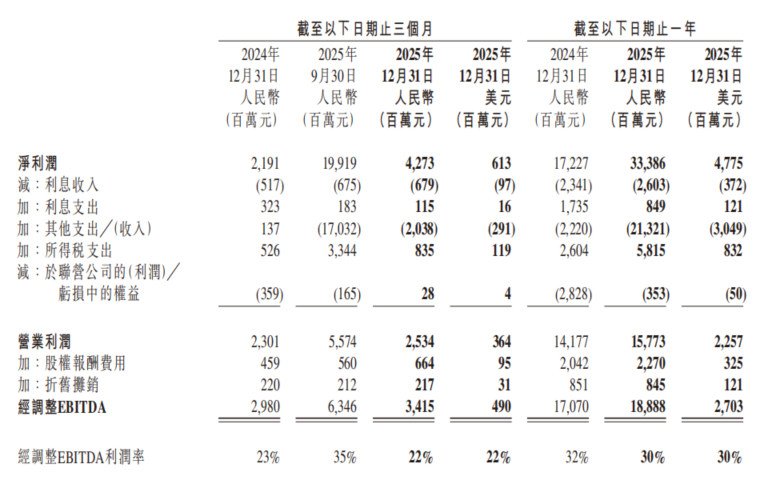
After excluding the impact of non-recurring gains and losses, equity compensation expenses, and other factors, adjusted EBITDA for the fourth quarter of 2025 was RMB 3.4 billion (USD 490 million). This reflects Trip.com's true profitability from its core business—solid but not detached from industry fundamentals.
The real business highlights lie in internationalization and inbound tourism. In 2025, the company's total bookings on international OTA platforms grew by approximately 60% year-on-year. It served around 20 million inbound travelers throughout the year. As Jane Sun, CEO of Trip.com, stated, inbound tourism remains a key growth driver for economic development and job creation.
RMB 15.1 Billion in R&D Spending, Accounting for 24% of Revenue: AI is Reshaping the OTA Ecosystem and Trip.com
If globalization represents Trip.com's spatial expansion, then AI represents its elevation in terms of time and efficiency. In the financial report, James Liang, Executive Chairman of Trip.com's Board of Directors, explicitly listed 'AI innovation' alongside inbound tourism and social responsibility as one of the company's three major investment directions for laying a solid foundation for sustainable long-term development.
Over the past year, the AI industry has rapidly evolved from general-purpose large language models (LLMs) to vertical agents, and Trip.com has been a direct beneficiary and active practitioner of this technological dividend. By examining the cost structure in the financial report, we can glimpse Trip.com's heavy investment in technology.
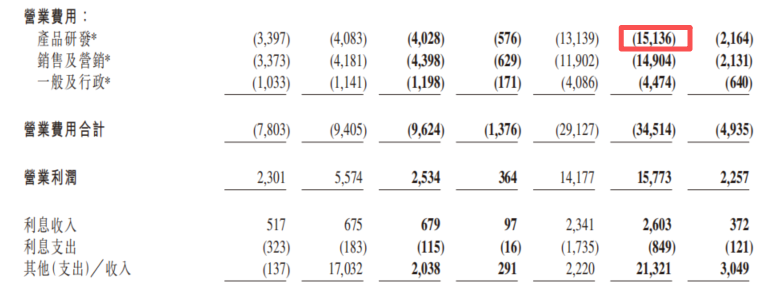
In the fourth quarter of 2025, Trip.com's product development expenses reached RMB 4 billion, accounting for 26% of quarterly net revenue. For the full year, product development expenses amounted to RMB 15.1 billion, representing 24% of net revenue. Such consistently high R&D investment, amounting to nearly a quarter of revenue, is not merely for maintaining daily operations of the ticketing system but is also fueling AI infrastructure development.
AI's reshaping of Trip.com's future trajectory is primarily reflected in the following three dimensions:
- Eliminating Multilingual and Cross-Cultural Friction Costs: The biggest pain point in internationalization strategy lies in localization services. Trip.com's self-developed AI translation engine and other technologies enable it to distribute content globally at extremely low marginal costs. This explains why its international OTA platform can sustain a 60% booking growth rate, with AI acting as a seamless 'translator' and 'guide.'- Reshaping User Interaction Paradigms and Decision-Making Pathways: The traditional OTA model follows a 'search-compare-book' process, requiring users to expend significant effort on planning. AI agents like 'TripGenie' are transforming this model into 'intent-generation-fulfillment.' Users need only express vague travel wishes, and AI can generate structured itineraries including flights, hotels, and local activities for one-click booking. This experience upgrade significantly boosts cross-selling conversion rates.- Extreme 'Cost Reduction and Efficiency Enhancement' on the Supply Chain Side: From intelligent routing in customer service systems to automated generation of merchant content, AI has dramatically reduced the company's rigid operational costs. The financial report shows that while general and administrative expenses reached RMB 1.2 billion in the fourth quarter of 2025, their proportion of net revenue was effectively controlled at a low 8%. For a heavy-operation enterprise serving hundreds of millions of users globally, this directly reflects optimized operating leverage.The Antitrust Sword and AI-Era 'Moat'
While AI paints an imaginative blueprint for Trip.com, capital markets must always examine the other side of the coin.
In January 2026, the State Administration for Market Regulation (SAMR) launched an investigation into Trip.com under China's Anti-Monopoly Law. The investigation is ongoing, and the company stated it is fully cooperating while maintaining normal business operations.
AI Capital Bureau believes this investigation is deeply connected to the dual drivers of AI and data. In the AI era, the richness and quality of data determine model foresight. Trip.com possesses decades of accumulated high-value user transaction data, travel preferences, and in-depth global supply chain resources. When these exclusive datasets are fed into AI, Trip.com's 'moat' becomes extremely deep, making it increasingly difficult for smaller competitors or even cross-border players from content platforms to compete in personalized recommendations and dynamic pricing.
The antitrust investigation may reflect regulators' routine oversight of large platforms regarding algorithmic recommendations, data barriers, and market dominance. For Trip.com, the challenge in 2026 will be how to leverage AI to expand its leading advantage while building a more open and inclusive tourism ecosystem.
Meanwhile, the appointment of Ms. Yihong Wu and Ms. Yang Xiao as new independent directors reflects the board's prudent strategy in introducing diverse professional expertise and compliance perspectives to navigate future opportunities and risks.
AI Capital Bureau's Perspective
Analyzing Trip.com Group's 2025 financial results reveals a 'new' company accelerating its self-iteration through cutting-edge technologies atop a solid core business foundation. The founders' graceful exit symbolizes a smooth transition from the pioneering era, while the management team led by James Liang and Jane Sun attempts to continue growth logic in the next cycle with dual engines of 'globalization + AI innovation.'
In the short term, the pending antitrust investigation remains an uncertainty factor hanging over valuation models. However, looking ahead, AI is not merely a technological concept for Trip.com but a long-term factor substantially reshaping its cost structure, service boundaries, and revenue ceiling. Whether Trip.com can truly evolve from a 'transaction platform' into a 'super-intelligent travel assistant' will be the most anticipated narrative for capital markets over the next three years.
AI Capital Bureau is a professional observation and analysis platform focused on capital market dynamics in the artificial intelligence field. We closely track capital operations such as financing, listings, and mergers and acquisitions among AI and embodied intelligence enterprises, conducting in-depth analyses of industry trends and corporate development trajectories to provide valuable insights for industry participants. We are committed to bridging AI innovation and capital markets to help Chinese hard-tech companies realize value discovery and growth.
Risk Warning and Disclaimer: The market carries risks; invest cautiously. This article does not constitute investment advice and should not be used as practical operational guidance. Trading risks are borne by the investor.
-
![]()
Doubao Work Unveiled! Domestic AI Leaders Fully Commit to the 'Work' Sector
-
![]()
Who’s Sounding the Alarm on ‘Rushed Vehicles’?
-
![]()
Over 5.3 Billion Yuan in Losses Over Three and a Half Years! Can Yonyou Reverse Its Fortunes Through Streamlining and AI Transformation?
-
![]()
Baidu AI Adopts Free Model: A Strategic Maneuver in Traffic and Monetization
-
![]()
Silicon-Based OLED Pioneer Unveils Financial Results: H1 Shipments Outpace Entire 2025 Volume
-
![]()
AI's First "Lost Summer"
-
![]()
Zeiss Makes Another €2.2 Million Bet: Will Eye Tracking Be the Next Big Thing in the Smart Glasses Industry?
-
![]()
RUNTO Ranking | Global Top TV ODM Factories' Shipment Figures for July 2026