Qianwen Emerges as Unified Moniker for Alibaba’s AI Brand, Amid Departure of Prominent Post-90s Tech Leader
 03/05 2026
 602
602

Insight into Business Nature, Straight to Corporate Core
Author | Li Ping
During the Spring Festival, Qianwen rose to prominence as a sensational app and has since undergone a significant transformation. On March 2, Alibaba Group (09988.HK, BABA.US) declared its intention to consolidate its AI branding and core brand under the Qianwen banner. The Qianwen large model (Qwen) encompasses both foundational and specialized domain models, with the Qianwen App serving as Alibaba’s flagship AI application for consumer-end (C-end) users. This strategic move aims to eliminate confusion stemming from previous brand names such as Qianwen, Tongyi Qianwen, and Qwen. Notably, in the early hours of March 4, Lin Junyang, the technical lead for Alibaba’s Qwen, announced his departure from the project on social media, stating, “I’ve stepped down.”
01
Qianwen Emerges as a National-Level AI Assistant
Qianwen, a personal AI assistant application developed by Alibaba, was launched in China on November 13, 2025. Built upon the Qwen large model, it signifies Alibaba’s strategic pivot from B2B enterprise services to the C-end consumer market.
On March 2, Alibaba Group announced its decision to unify its AI branding and core brand under Qianwen. The Qianwen large model (Qwen) now encompasses both foundational and specialized domain models, with the Qianwen App serving as Alibaba’s premier AI application for C-end users.
This consolidation aims to mitigate confusion arising from previous brand names such as Qianwen, Tongyi Qianwen, and Qwen.
Following the rebranding, Alibaba’s large model brand will be known as “Qianwen Large Model” in Chinese and “Qwen” in English, with “Tongyi Lab” designated as the organizational name for Alibaba Group’s AI institution.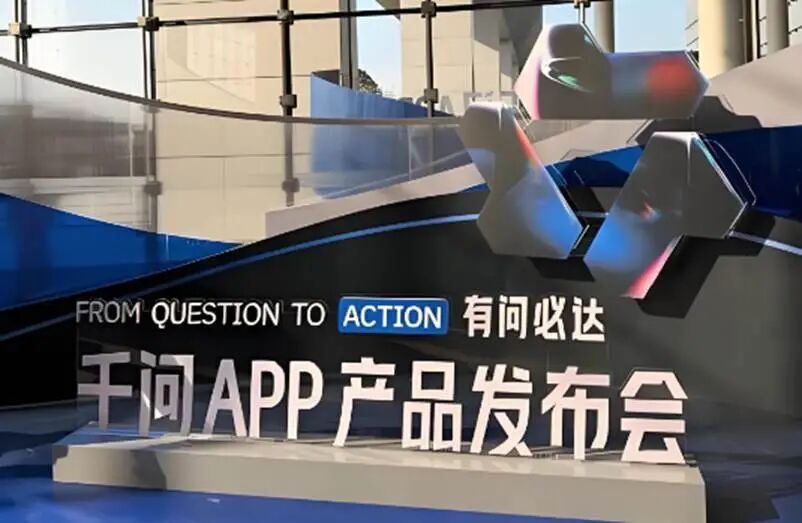
During the Spring Festival, Qianwen gained widespread popularity, largely attributed to a “cup of milk tea” promotion.
On February 6, the Qianwen APP launched a 3 billion yuan Spring Festival “AI Treats” campaign, with the “Get a milk tea for just 1 cent” offer being the inaugural promotion.
According to the campaign rules, each registered user receives a 25 yuan no-threshold voucher. Upon authorizing AI Agent services, users can simply instruct Qianwen, “Get me a milk tea,” and the AI will automatically match suitable stores and products. Once confirmed, the order can be placed for a mere 1 cent. In fact, the campaign extends beyond milk tea to encompass a comprehensive range of lifestyle consumption scenarios, including takeout food, supermarket fresh produce, and more on Taobao Flash Sales.
It is reported that on Chinese New Year’s Eve 2026, Qianwen 3.5 was open-sourced, followed by the release of several small and medium-sized Qwen3.5 models. Renowned for their robust performance and high efficiency, these models dominated the top four spots on Hugging Face’s global open-source large model rankings, establishing them as one of the most sought-after large models in the global AI community.
During the Spring Festival, users placed nearly 200 million “one-sentence orders” on the Qianwen APP. Questmobile data reveals that Qianwen’s DAU (Daily Active Users) surged to 73.52 million during the Spring Festival, ranking first among domestic AI applications with a remarkable 940% increase, propelling Qianwen to national-level AI assistant status.
The latest updates indicate that Qianwen’s inaugural AI hardware product, the “Qianwen AI Glasses,” has officially launched, with “0 yuan reservations” available across all online and offline channels. The product will be available for purchase in the Chinese market on March 8 and will enter the global market within 2026. The G1 series will be priced at 1997 yuan after national subsidies.
Furthermore, the Qianwen AI Glasses will be seamlessly integrated with the Qianwen APP, with the first batch of “task-oriented” functions, such as ordering takeout and booking hotels, expected to be accessible to users by the end of March.
Qianwen also plans to introduce AI rings, AI earphones, and other products within the year. Alibaba is strategically positioning itself across the AI industry landscape—encompassing AI cloud computing (Alibaba Cloud), AI chips (Pingtouge), AI large models (Tongyi Qianwen), AI applications (Qianwen), and AI edge devices (Kuake/Qianwen Glasses)—to maintain a leading position both domestically and globally.
02
120 Billion Yuan Invested in AI+Cloud Infrastructure
The release of Qianwen is also the culmination of Alibaba’s long-term strategic planning.
In terms of financial performance, for the six months ended September 30, 2025, Alibaba’s revenue reached RMB 495.447 billion (USD 69.595 billion), marking a 3% year-on-year increase. Excluding revenue from disposed businesses such as Sun Art Retail and Intime, revenue on a like-for-like basis would have increased by 12% year-on-year.
During the same period, Alibaba’s operating profit stood at RMB 40.353 billion (USD 5.668 billion), reflecting a 43% year-on-year decrease.
Alibaba attributed this decline primarily to a decrease in adjusted EBITA, partly offset by a one-time provision in the same period last year. Adjusted EBITA (a non-GAAP financial metric) decreased by 44% year-on-year to RMB 47.917 billion (USD 6.731 billion), primarily due to investments in instant retail, user experience, and technology, partly offset by improved operating performance driven by double-digit revenue growth in Alibaba’s China e-commerce group, sustained growth in cloud business, and enhanced operational efficiency across multiple businesses.
For the six months ended September 30, 2025, Alibaba’s net income attributable to ordinary shareholders amounted to RMB 64.106 billion (USD 9.005 billion). Net income reached RMB 62.994 billion (USD 8.849 billion), reflecting a 7% year-on-year decrease, primarily due to a decline in operating profit, partly offset by changes in the market valuation of the company’s equity investments, gains from the disposal of Trendyol’s local services business, and a sequential reduction in investment impairments and net foreign exchange losses.
During the same period, Alibaba’s non-GAAP net income stood at RMB 43.862 billion (USD 6.161 billion), down 43% from RMB 77.209 billion in the same period in 2024.
Alibaba stated that revenue from its AI-related products remains robust, with these products being rapidly adopted by a wide range of enterprise clients and increasingly focused on value-added applications, including code assistants. “We will continue to invest in customer growth and technological innovation, including AI products and services, to drive adoption of AI cloud infrastructure and strengthen our market leadership.”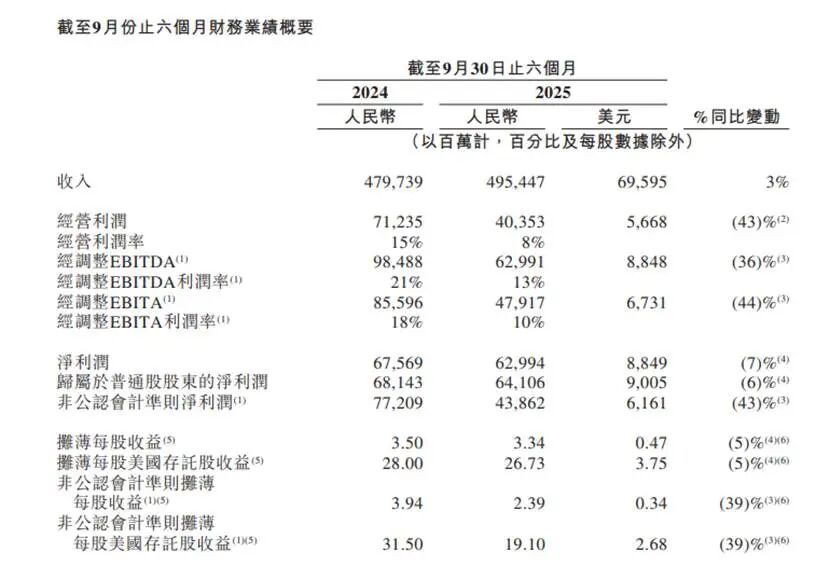
Eddie Wu, CEO of Alibaba Group, remarked, “We are in an investment phase, building AI technology and infrastructure platforms, as well as a large-scale consumption platform that integrates lifestyle services with e-commerce, creating long-term strategic value. This quarter, we made significant strategic investments in these areas, with AI+cloud and large-scale consumption maintaining strong growth.”
Toby Xu, CFO of Alibaba Group, commented, “Our core business revenue remains strong, with AI revenue accounting for an increasing share of cloud external commercialization revenue and customer management revenue up 10% year-on-year. We are investing profits and free cash flow into future strategic布局 (translated as 'strategic layout' or 'future layout' depending on context, here kept as is for precision), and short-term profitability is expected to fluctuate. Over the past four quarters, our capital expenditures on AI+cloud infrastructure have been approximately RMB 120 billion.”
03
Several Technical Executives Have Departed
In the early hours of March 4, Lin Junyang, the technical lead for Alibaba’s Qwen, bid farewell to Qianwen on social media, stating, “I’ve stepped down.”
Subsequently, Binyuan Hui, a scientist at Alibaba’s Tongyi Lab, reposted the message and indicated his own departure from Qianwen.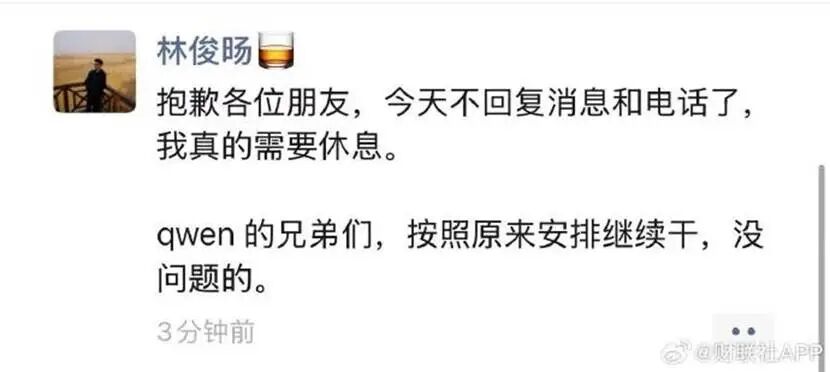
It is understood that Lin Junyang was a pivotal figure in Alibaba’s Qianwen model development.
According to public records, Lin Junyang was born in 1993. He pursued undergraduate studies in Computer Science and graduate studies in Linguistics and Applied Linguistics at Peking University. His research interests encompass natural language processing and multimodal representation learning, with multiple papers published in prestigious conferences such as NeurIPS, ICML, and ACL.
After graduating in 2019, Lin Junyang joined Alibaba’s DAMO Academy as a Senior Algorithm Engineer, participating in the development of ultra-large-scale pre-trained models M6 and the general-purpose unified multimodal pre-trained model OFA.
At the end of 2022, Alibaba integrated the AI teams specializing in language and vision from DAMO Academy into Alibaba Cloud, establishing Tongyi Lab. Lin Junyang was officially appointed as the technical lead for the Tongyi Qianwen series of large models. In 2023, he spearheaded the release of the Tongyi Qianwen large model, integrating multimodal technological achievements into its architecture.
In 2024, Lin Junyang led the open-sourcing of the Qwen series models, covering versions with different parameter scales such as 7B, 14B, and 72B. In 2025, he introduced the flagship model Qwen3-Max, boasting over a trillion parameters and trained on 36T of pre-training data, surpassing international mainstream models in evaluations like GPQA. That same year, he established a robotics and embodied AI research team to extend multimodal agents into real-world applications.
It is reported that since 2024, several technical executives have departed from Alibaba’s large model team.
In December 2025, Fei Huang, former head of Natural Language Processing (NLP) at Tongyi Lab, was reported to have left. In April 2025, Liefeng Bo, former head of the Applied Vision team at Tongyi Lab, who led popular features on the Qianwen App such as “Everybody Dances” and “Terracotta Warriors Dance,” departed and was reported to have joined Tencent’s Hunyuan large model team.
In February 2025, Zhijie Yan, former head of the Speech team at Tongyi Lab, left and joined JD Explore Academy as head of the Speech Lab in August 2025. In July 2024, Chang Zhou, a former technical member of Alibaba Cloud’s Tongyi large model team, was reported to have left and joined ByteDance to lead AI large model efforts in October 2024. Over a dozen members of his team also joined ByteDance, prompting Alibaba to file a lawsuit alleging breach of non-compete agreements.
END
Layout | Wu Yue
Editor-in-Chief | Lao Chao
Images sourced from the internet
-
![]()
Doubao Work Unveiled! Domestic AI Leaders Fully Commit to the 'Work' Sector
-
![]()
Who’s Sounding the Alarm on ‘Rushed Vehicles’?
-
![]()
Over 5.3 Billion Yuan in Losses Over Three and a Half Years! Can Yonyou Reverse Its Fortunes Through Streamlining and AI Transformation?
-
![]()
Baidu AI Adopts Free Model: A Strategic Maneuver in Traffic and Monetization
-
![]()
Silicon-Based OLED Pioneer Unveils Financial Results: H1 Shipments Outpace Entire 2025 Volume
-
![]()
AI's First "Lost Summer"
-
![]()
Zeiss Makes Another €2.2 Million Bet: Will Eye Tracking Be the Next Big Thing in the Smart Glasses Industry?
-
![]()
RUNTO Ranking | Global Top TV ODM Factories' Shipment Figures for July 2026