Qianwen’s Evolution: Why Lin Junyang’s Departure Could Be a Strategic Turning Point
 03/06 2026
 672
672
Produced by | Frontline of Entrepreneurship
Art Editor | Xing Jing
Reviewed by | Song Wen
An internal email from Alibaba has marked the official transition following Lin Junyang’s departure from the Qianwen team.
On the morning of March 4th, Lin Junyang, the technical leader of Alibaba Qianwen, posted on a social platform, saying, “Stepping down. Farewell, my beloved Qianwen.” This sparked immediate market speculation and intense discussion.
The following day, Alibaba CEO Wu Yongming sent an internal email confirming Lin’s departure and announcing the formation of a foundational model support team. Wu, along with Zhou Jingren and Fan Yu, will coordinate group-wide resources to bolster foundational model development.
This move signals a clear shift: Qianwen is entering a new era. Moving forward, its development will no longer rely on rapid, small-team iterations but will instead leverage coordinated group resources, specialized expertise, and large-scale talent investment. Lin Junyang’s exit aligns precisely with this transformative moment.
1. Talent Mobility: Normalcy in a Dynamic Industry
Historically, the Chinese internet sector has often linked the departure of key figures to the fate of a business. While such associations are common, they don’t fully align with the operational logic of modern tech companies, especially in the highly specialized field of large-scale AI models.
Core technical mobility among leading firms in the large model industry is not uncommon.
Globally, OpenAI co-founder John Schulman moved to competitor Anthropic, followed by Jan Leike, who led superalignment efforts. Despite their influence, the AI community viewed these shifts as natural talent transitions rather than strategic setbacks for OpenAI.
Domestically, Tencent Hunyuan restructured its R&D operations in late 2025, bringing in former OpenAI researcher Yao Shunyu and establishing a new AI Infra department. Similarly, ByteDance’s Seed team, under Wu Yonghui, merged AI Lab and Doubao technical teams.
These adjustments, while involving personnel changes, reflect inevitable evolution as businesses scale. From this perspective, Lin Junyang’s departure can be seen as part of a broader industry trend rather than an isolated event.
Moreover, Alibaba maintains a robust AI talent ecosystem. Earlier this year, former Google DeepMind senior researcher Zhou Hao joined the Tongyi Lab, bringing expertise from projects like Gemini 3.0 and DeepResearch to oversee model post-training.
Wu Yongming’s commitment to “intensifying efforts to attract outstanding talent” underscores proactive expansion—Qianwen’s scale and industry position demand continuous infusion of fresh perspectives.
Critically, the new phase requires different skill sets. Early large model R&D relied on “full-stack” technical leaders capable of managing algorithms, engineering, and data. Today, in an era of scaled competition, specialized roles—pre-training architects, post-training optimizers, multimodal algorithm experts, and AI Infra engineers—are indispensable. Alibaba’s decision to split teams by function aligns with this shift toward specialization.
From a business standpoint, Qianwen’s technical output remains unaffected by personnel changes. Just 48 hours before Lin’s announcement, Alibaba Qianwen officially open-sourced four Qwen3.5 small-scale model series, which Elon Musk praised as “impressively intelligent dense.” This rapid iteration stems from the team’s collaborative mechanisms.
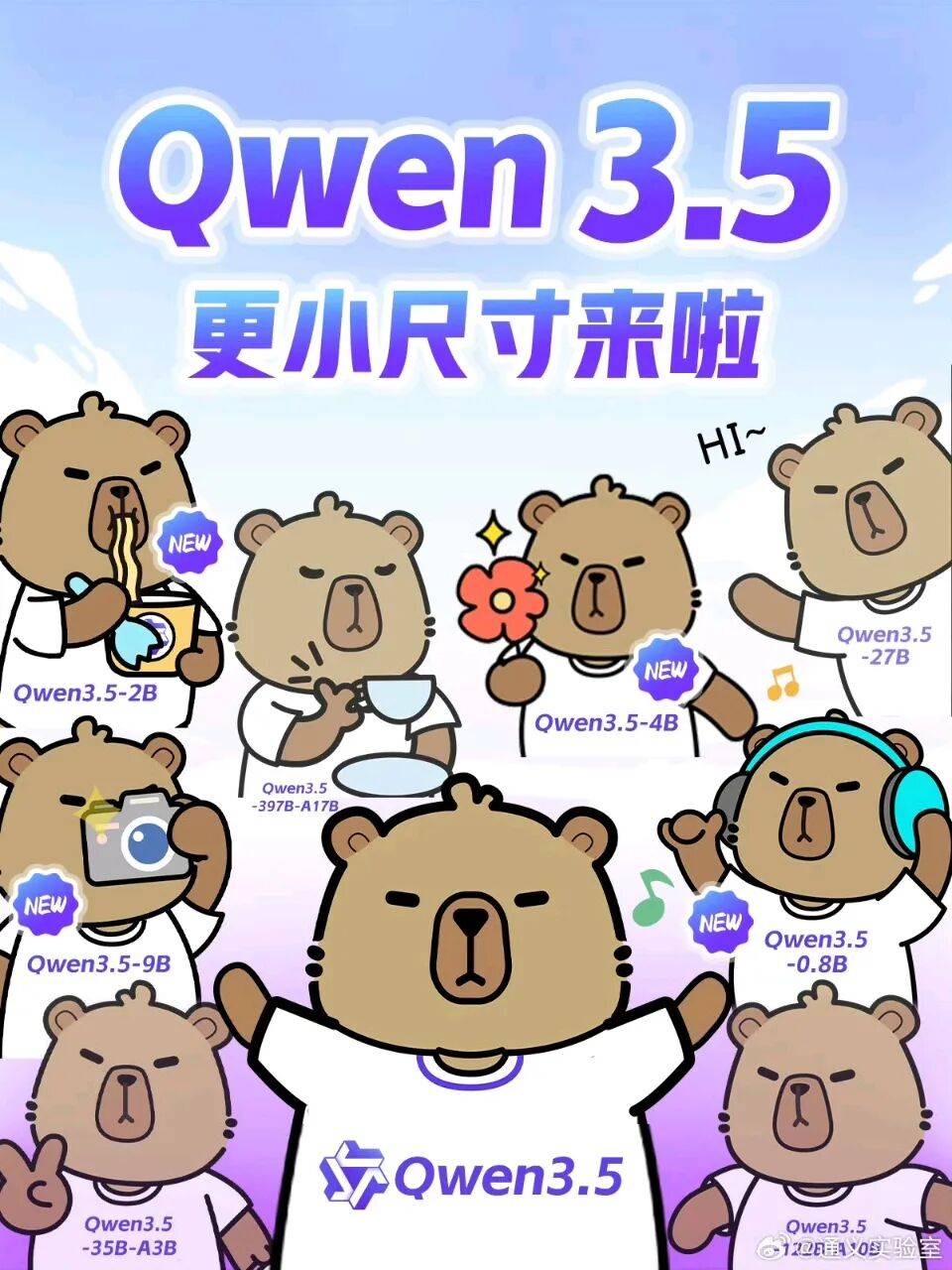
(Figure/Qwen3.5 small-scale model series)
The internal email’s emphasis on “adhering to an open-source strategy” reflects a strategic pivot for the new phase. Open-source is not merely a technical approach but a means of ecosystem building. With over 1 billion global downloads, 200,000 derivative models, and recognition as the world’s top open-source model, Qianwen’s ecosystem resilience remains unaffected by leadership changes. Instead, organizational upgrades to strengthen open-source community operations mark a crucial step in transitioning from “technical leadership” to “ecosystem dominance.”
2. Industry Shifts: Qianwen’s Strategic Evolution
Compared to domestic peers, Alibaba Qianwen’s team stability has been remarkable—until now.
From the 2023 launch of “Tongyi Qianwen” to its current unified branding as “Qianwen,” its core R&D team has maintained consistency. This stability enabled Qianwen to rapidly advance on the open-source path, surpassing Llama and Deepseek to become one of the world’s most powerful and widely adopted open-source large models.
However, by 2026, the industry landscape has shifted.
Early 2026 saw the AI sector pivot from “parameter competition” to “application competition.” During the Spring Festival, internet giants engaged in a fierce red envelope battle, with Doubao and Qianwen vying for App Store rankings. Alibaba’s unification of B-end and C-end brands under “Qianwen” signals a clear commitment to its All-in-AI-to-C strategy.

(Figure/Shetuwang, based on VRF protocol)
Indeed, as a technology matures toward application, R&D organizational methods must adapt.
Qianwen’s rise bears the hallmarks of a “lab-based startup.” In 2022, Zhou Jingren founded the Tongyi Lab, with Lin Junyang as an early member involved in M6 large model R&D. The team was lean, decision-making chains were short, and technical iteration was rapid. During the 0-to-1 breakthrough phase, this structure proved highly efficient: Tongyi Qianwen debuted publicly in September 2023, Qwen2.5 topped global rankings upon open-sourcing in 2024, and the Qwen3.5 series maintained technical leadership in 2025.
However, by 2026, the competitive landscape had transformed. Qianwen’s monthly active users surpassed 200 million, with a 552% growth rate—the highest globally. At this scale, the original lab structure began to show limitations.
Now, Wu Yongming has positioned himself, Zhou Jingren, and Fan Yu in the foundational model support team, signaling that Qianwen is no longer just a Tongyi Lab project but a Group-level strategic priority for Alibaba. This CEO-led resource coordination underscores unchanged strategic priority and increased investment, elevating Qianwen from a “lab startup” to a cross-departmental group strategy.
Under the new structure, Zhou Jingren will continue leading Tongyi Lab to advance Qianwen’s development, ensuring technical continuity. At the CEO level, Wu will coordinate compute, data, and cloud resources while planning to introduce new talent and split teams by pre-training, post-training, multimodal, and other dimensions.
This is not a rejection of the past organizational model but an inevitable choice for Qianwen’s scaled expansion: it will shift from vertical integration to horizontal specialization, moving from reliance on core individuals’ capabilities to systematized team operations.
One detail underscores this transition’s inevitability: over the past year, Lin Junyang repeatedly emphasized the need for closer integration and communication among pre-training, post-training, Infra, and training teams.
Alibaba’s adjustment—splitting teams by function—reflects changes in Qianwen’s technical evolution phase. Early models, with limited parameter scales, required end-to-end tight coupling to ensure iteration speed. Today, facing trillion-parameter models, multimodal fusion, and complex agent system development, specialized division of labor enhances overall R&D breadth. The internal email’s assertion that “technical development must advance or retreat” is rooted in recognizing this industry pattern.
Wu Yongming’s simple closing remark in the internal email—“Let’s work together”—is addressed to all employees and signals to the industry: Alibaba’s AI momentum will not slow due to personnel changes. Instead, it is assembling a faster, stronger team.
-
![]()
Doubao Work Unveiled! Domestic AI Leaders Fully Commit to the 'Work' Sector
-
![]()
Who’s Sounding the Alarm on ‘Rushed Vehicles’?
-
![]()
Over 5.3 Billion Yuan in Losses Over Three and a Half Years! Can Yonyou Reverse Its Fortunes Through Streamlining and AI Transformation?
-
![]()
Baidu AI Adopts Free Model: A Strategic Maneuver in Traffic and Monetization
-
![]()
Silicon-Based OLED Pioneer Unveils Financial Results: H1 Shipments Outpace Entire 2025 Volume
-
![]()
AI's First "Lost Summer"
-
![]()
Zeiss Makes Another €2.2 Million Bet: Will Eye Tracking Be the Next Big Thing in the Smart Glasses Industry?
-
![]()
RUNTO Ranking | Global Top TV ODM Factories' Shipment Figures for July 2026