Lin Junyang’s Departure from Qwen: Dispelling the Myths—The Truth is More Straightforward Than You Think
 03/06 2026
 525
525
In the first week of March 2026, China’s AI sector buzzed with news of a significant personnel shift.
Lin Junyang, the technical leader behind Alibaba’s Qwen project, posted a heartfelt message on social media reading, “bye my beloved qwen.” This simple statement triggered far more speculation than a typical resignation announcement. Observers and industry outsiders quickly floated theories, ranging from technical disagreements to intense pressures from commercialization efforts.
However, on March 5, an internal email from Alibaba CEO Wu Yongming, along with insights from within the company, helped set the record straight.
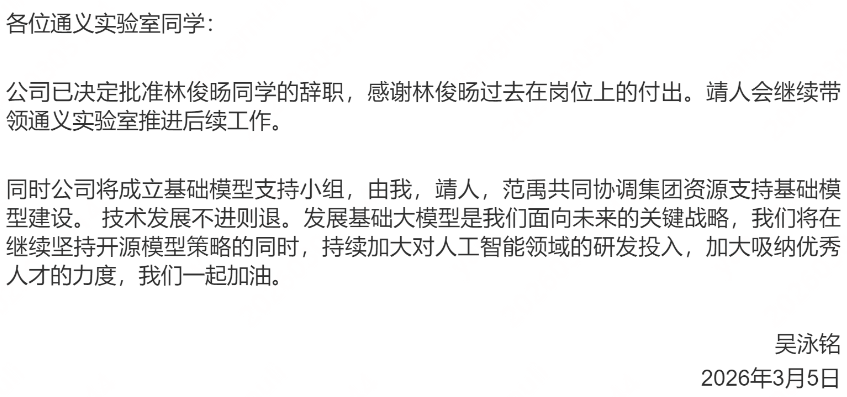
Most of the circulating rumors did not hold up under closer examination. Claims that Alibaba was abandoning its open-source approach were unfounded; Qwen’s commitment to open-source remains as strong as ever. Similarly, there was no truth to speculation that the base model team was struggling under the weight of user growth and commercialization goals. The reason such baseless rumors spread so quickly is simply that sensational stories tend to capture public attention.
In reality, the events were far less dramatic. Qwen has transitioned from a technical project to a core strategic initiative for Alibaba—a change that naturally requires greater organizational capacity. Strategic initiatives of this scale demand a higher concentration of top talent. As a result, adjustments were made, and Lin Junyang’s responsibilities were redefined. He chose not to accept these changes and resigned.
That’s the whole story. No hidden motives, no purges, and no villains in this narrative.
Lin Junyang followed a philosophy akin to running a “private kitchen”: for an exceptional meal, every step—from ingredient selection to knife skills and heat control—must be tightly integrated within a single system to ensure consistent quality and outstanding flavor. Applied to model development, this means that pre-training, post-training, and the underlying infrastructure must be highly coordinated and tightly coupled. To achieve this, he even built a dedicated infrastructure team within his group, bypassing the company’s shared platforms to maintain full control over the entire pipeline.
This approach is ideal for a boutique strategy. However, the potential of large-scale models is not solely determined by precision. The essence of the Scaling Law lies in the brute-force accumulation of data and resources. To scale each component independently, the pipeline must be disaggregated—pre-training separated from infrastructure, each focusing on its own scaling—to achieve breakthroughs across all dimensions.
“Timing and Trends”: Alibaba’s Strategic Organizational Upgrade in China’s AI Leadership
The past two years have seen fierce competition in the global arena of large-scale AI models.
This period has been marked by significant strategic shifts and personnel changes. ByteDance’s AI leadership transitioned from Zhu Wenjia to Wu Yonghui, while OpenAI’s 11-member founding team now has only two members remaining.
In contrast, Alibaba’s Qwen team had been a rare “stable island” in the industry, with no major changes in two years. This stability allowed Qwen to expand its influence in the global open-source community, with over 200,000 derivative models, becoming a “white moonlight” in the hearts of developers worldwide.
But now, the battlefield has shifted.
OpenAI has significantly reduced the release of “flashy” models aimed solely at刷新 (refreshing) SOTA (State of the Art) benchmarks, instead focusing on the agent-based implementation of the GPT-5 series. Meta has acquired Manus for billions of dollars.
Behind these moves is a clear industrial evolution: the 2026 AI competition has shifted from “technical benchmarking” to “value realization.”
At this juncture, Alibaba’s decision to increase talent density and adjust responsibilities within Qwen is a necessary move to adapt to a more complex new battlefield. It is a matter of “timing and trends.”
Recent internal sources confirm that Lin Junyang’s departure was not due to disagreements over technical routes or commercialization conflicts, as speculated externally. Instead, as Qwen evolved from a foundational model project into a comprehensive group strategy, Alibaba decided to bring in more top technical talent and comprehensively enhance the talent density of the base model team. This process inevitably involved adjustments to Lin Junyang’s scope of responsibilities.
Lin Junyang’s resignation stemmed from a gap between his personal expectations of roles and responsibilities and the organizational needs, unrelated to personal grievances or strategic routes. Alibaba’s core goal for Qwen is to accommodate more top talent and build a stronger foundation.
Now, in terms of personnel, Wu Yongming personally leads the foundational model support team, while Zhou Jingren oversees the Tongyi Lab. The open-source strategy and investment commitments remain unchanged. Talent may come and go, but the system endures and grows stronger.
Moving Beyond the “Hero Narrative” to See the “Power of the System”
Lin Junyang’s departure has resonated so strongly largely due to the public’s natural admiration for “technical heroes.”
However, if we step outside individual narratives and look at the global tech industry’s evolution, a deeper logic emerges: talent mobility is normal and even acts as a catalyst for systemic innovation.
For instance, during OpenAI’s transformation from an idealistic lab to a commercial powerhouse, the team underwent a complete overhaul, yet the GPT series continued to iterate. Google, to catch up with OpenAI, acquired or invested in three AI companies in a single week, absorbing key engineers and increasing talent density, which forced OpenAI into a “Code Red” state.
What underpins this? It is the “systemic strength” of talent, capital, computing power, data, and organizational mechanisms. In the long run of technological industrialization, individual talent determines the starting point, but the depth of the system determines the race's duration.
From a broader perspective, over the past few decades, countless Chinese scientists and engineers have flowed to the United States, yet China has still achieved accelerated technological breakthroughs in many fields, even surpassing competitors in areas like high-speed rail, commercial drones, and 5G/6G communications.
China's tech breakthroughs rely on the “systemic soil” formed by the synergy of policy, economy, and commercial organizations. This does not deny the value of individuals but reveals a simple truth: the environment that nurtures talent is far more important than the seeds themselves.
For Alibaba, Qwen’s moat has never been any single individual but Alibaba’s collective strength:
First, technical iteration efficiency. Qwen did not emerge overnight but is the culmination of Alibaba DAMO Academy’s years of deep cultivation in NLP and multimodal fields. Today, Alibaba has built one of the world’s most complete open-source model matrices, enabling continuous technical iteration and maintaining a leading pace in intelligent density evolution.
Second, the breadth of the data ecosystem. Compared to other large model providers, Alibaba possesses a unique treasure trove of “commercial + lifestyle” full-scenario data. High-value scenario data from e-commerce transactions, logistics networks, local services, and entertainment content provides Qwen with a natural “training ground.” This closed loop of “scenarios as data, data as intelligence” is a barrier that no pure tech company can replicate.
Third, the robustness of infrastructure. Alibaba’s 380 billion yuan AI infrastructure investment plan continues to advance, from self-developed chips like Hanguang and Yitian to the ability to schedule clusters of tens of thousands of cards. Alibaba has achieved full-stack autonomy from “chips-frameworks-models-applications.”
Personnel change, but the system endures. Lin Junyang is gone, but Qwen still has the strongest minds. With Alibaba as a whole, Qwen truly gains a body and soul.
In the future, Qwen will become an ocean of group-wide co-evolution within the entire Alibaba ecosystem.
Qwen's Future: From Leading the Open-Source Ecosystem to Scaling Value Heights
After the watershed moment of shifting to collective operations, Alibaba’s Qwen holds its ace cards in the group's resolve to “adhere to the open-source strategy” and “continue increasing investment,” as stated in Wu Yongming's email.
Three major trends are expected in Alibaba’s AI strategy:
First, an exponential increase in resource density.
Building on the accelerated technical iteration from adhering to the open-source model strategy, Wu Yongming’s stance is clear: technological development is a race where standing still means falling behind.
The establishment of a foundational model support team by key figures Wu Yongming (Alibaba CEO), Zhou Jingren (Alibaba Cloud CTO), and Fan Yu (Ele.me Chairman & CEO) signifies the complete breakdown of barriers in computing power, funding, and cross-departmental collaboration.
Alibaba Cloud, as the foundation of China’s cloud computing infrastructure, will collaborate even more closely with Qwen, supporting an open ecosystem and attracting more enterprises and service providers to form a complete industrial chain. This is a hard infrastructure that no startup can match.
Second, deep penetration into real-world scenarios.
In early March, Alibaba unified its AI brands under “Qwen” and merged the Tongyi App into the Smart Information Business Group, signaling a move to integrate models into applications. Additionally, as a next-generation AI terminal, Qwen AI glasses made a stunning debut at the Mobile World Congress (MWC), with a booth located right opposite Meta’s.
This foreshadows the next phase of competition among global tech giants: a dual-wheel drive of foundational models and application ecosystems.
Finally, the ambition to lead the fourth technological revolution remains.
By 2026, the global AI competition has entered the deep waters. If the past two years were about catching up to GPT, the next two will be about exploring AI’s unknown frontiers.
Alibaba’s continued investment in AI R&D and recruitment of more technical experts to enhance the talent density of the base model team aims to ensure that Chinese players hold sufficient intellectual cards—and good ones—on the path to AGI.
Looking back at the entire event, Lin Junyang’s exit marks a difficult but necessary transition for Alibaba. Qwen’s next act will be a continuous refinement and evolution in the crucible of computing power, scenarios, and organizational strength.
This time, Alibaba is truly prepared to embrace the fourth technological wave with China’s unique collective wisdom and strength, becoming an AI infrastructure platform company for the next era.
-
![]()
Doubao Work Unveiled! Domestic AI Leaders Fully Commit to the 'Work' Sector
-
![]()
Who’s Sounding the Alarm on ‘Rushed Vehicles’?
-
![]()
Over 5.3 Billion Yuan in Losses Over Three and a Half Years! Can Yonyou Reverse Its Fortunes Through Streamlining and AI Transformation?
-
![]()
Baidu AI Adopts Free Model: A Strategic Maneuver in Traffic and Monetization
-
![]()
Silicon-Based OLED Pioneer Unveils Financial Results: H1 Shipments Outpace Entire 2025 Volume
-
![]()
AI's First "Lost Summer"
-
![]()
Zeiss Makes Another €2.2 Million Bet: Will Eye Tracking Be the Next Big Thing in the Smart Glasses Industry?
-
![]()
RUNTO Ranking | Global Top TV ODM Factories' Shipment Figures for July 2026