Price Drops to 4000 Yuan: Apple Makes a Strategic Concession
 03/06 2026
 737
737
At the dawn of 2026, the global PC component market experienced unprecedented turmoil. In the memory sector, DDR5 contract prices skyrocketed by over 90% quarterly, while NAND flash memory prices surged nearly 40%. On the processor front, mainstream configurations heavily relied on Intel CPUs, but price hikes for their entry-level processors led to supply shortages that were only expected to ease after March. Coupled with escalating costs for panels, PCBs, batteries, and other components, the cumulative pressure pushed the global PC supply chain into a precarious position—manufacturers faced the dilemma of either raising prices and risking market share loss or maintaining prices and suffering profit erosion. In response, many manufacturers either increased retail prices or reduced specifications to preserve margins, dampening consumer enthusiasm and intensifying competition in a shrinking market.
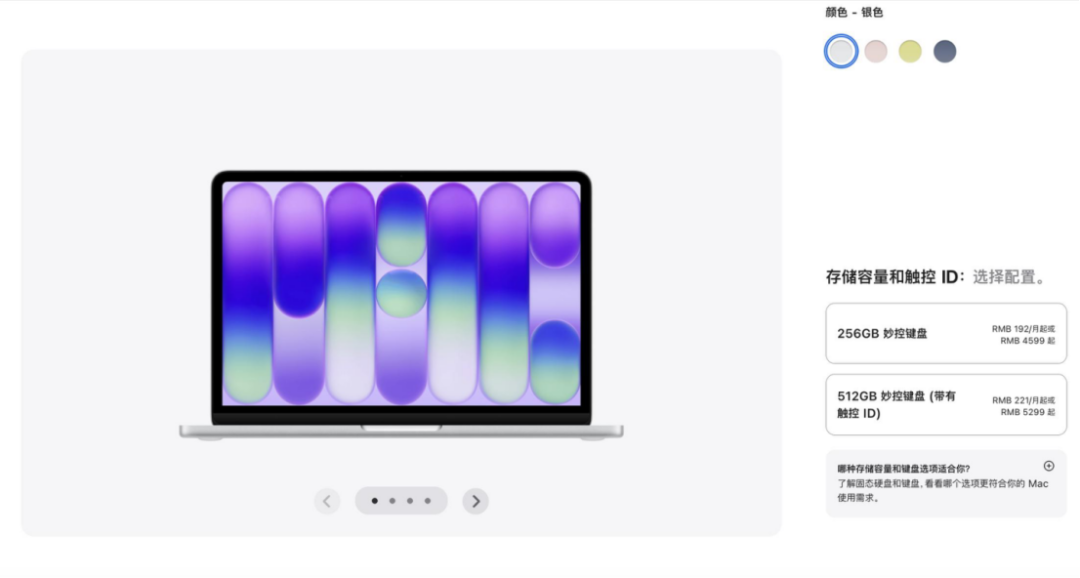
Against this tumultuous industry backdrop, Apple took an unconventional approach. Instead of hosting a high-profile launch event, it quietly released its most affordable MacBook to date—the MacBook Neo. Priced at just 4,599 yuan officially (and as low as 3,999 yuan with education discounts), this model shatters Apple's long-standing price barrier for its Mac lineup.
01
Starting at 4,599 Yuan! Apple Adjusts Its Strategy to Address Consumer Pain Points
For years, MacBooks have dominated the premium PC segment, with entry-level models consistently priced above 7,000 yuan, putting them out of reach for most consumers. The MacBook Neo's pricing disrupts Apple's traditional price structure.
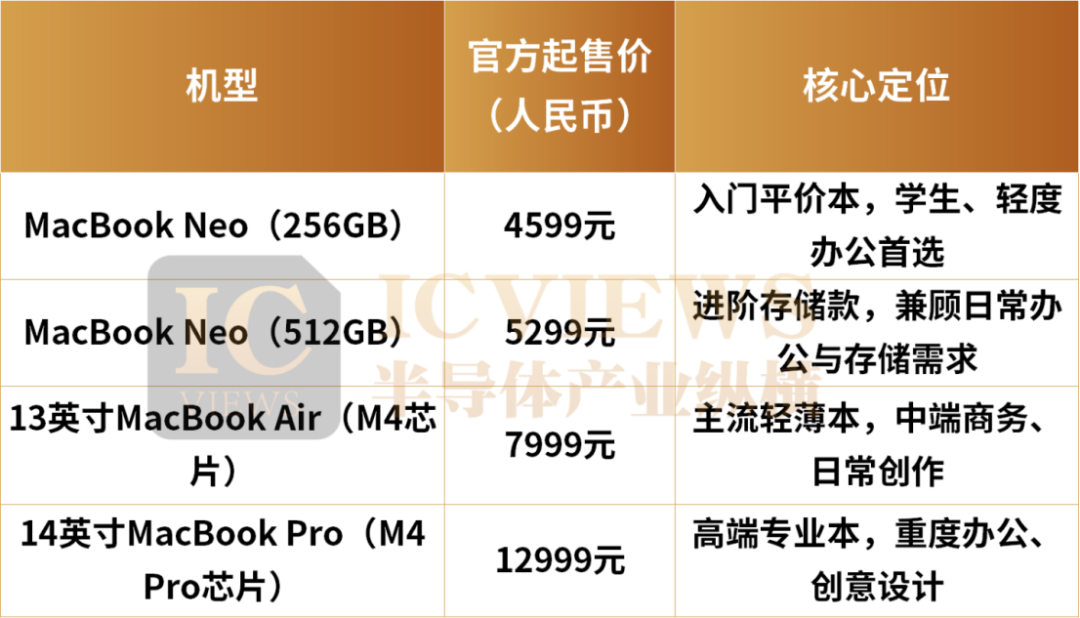
Visually, the MacBook Neo's starting price undercuts the entry-level MacBook Air by 3,400 yuan—nearly halving the price difference—and its 4,599 yuan price point directly infiltrates the core pricing band of domestic ultrabooks. From a market perspective, this move represents not a short-term concession by Apple but a strategic shift downmarket: abandoning the niche allure of premium positioning, it targets the PC market's largest growth demographic—students, entry-level professionals, and light office users. By leveraging its brand strength and cost-effectiveness, Apple aims to seize market share from mainstream PCs, marking its first genuine bow to the mass consumer market in over a decade.
Uncompromised Specifications: Low Price Does Not Equate to Low Quality
In consumer electronics, the adage "you get what you pay for" often rings true, but the MacBook Neo defies this industry norm.
At its core, the affordable MacBook Neo is powered by the same A18 Pro chip as the iPhone 16 Pro, marking Apple's first use of a flagship mobile chip in a Mac. This move significantly reduces traditional PC chip R&D and production costs. Paired with 8GB of unified memory, it handles daily tasks, web browsing, multimedia, and light AI workloads with ease. Official data shows it processes routine tasks 50% faster than similarly priced Intel Core ultrabooks and boosts on-device AI performance threefold.
For display and build quality, it features a 13-inch Liquid Retina display with 1 billion colors and 500 nits brightness, outperforming Windows ultrabooks in its price range. The chassis, crafted from recycled aluminum, weighs just 1.2kg, ensuring portability. Available in silver, peach pink, citrus yellow, and indigo blue, it caters to young users' aesthetic preferences.
In terms of battery life and functionality, it offers up to 16 hours of runtime for all-day use. The 512GB version includes a Touch ID Magic Keyboard for secure unlocking, while ports, cooling, and other essentials are fully optimized for daily use without noticeable drawbacks.
02
Strategic Disruption: Another AI PC Contender
To analyze the MacBook Neo's market positioning and industry impact, we interviewed senior PC analysts and frontline channel operators, combining terminal market feedback and competitive dynamics to dissect its core strengths and underlying market logic.
Industry insiders note that the MacBook Neo's market strategy is not a broad sweep but a precise focus on two key segments: domestic and international.
In China, it directly challenges mainstream 5K-priced ultrabooks like the Lenovo Xiaoxin and Huawei MateBook. Real-time pricing on JD.com shows the Lenovo Xiaoxin 14 2025 Core edition (24G+512G storage) at 4,079.15 yuan after subsidies, while the Huawei MateBook 14 (16G+1TB storage) starts at 4,929.15 yuan.
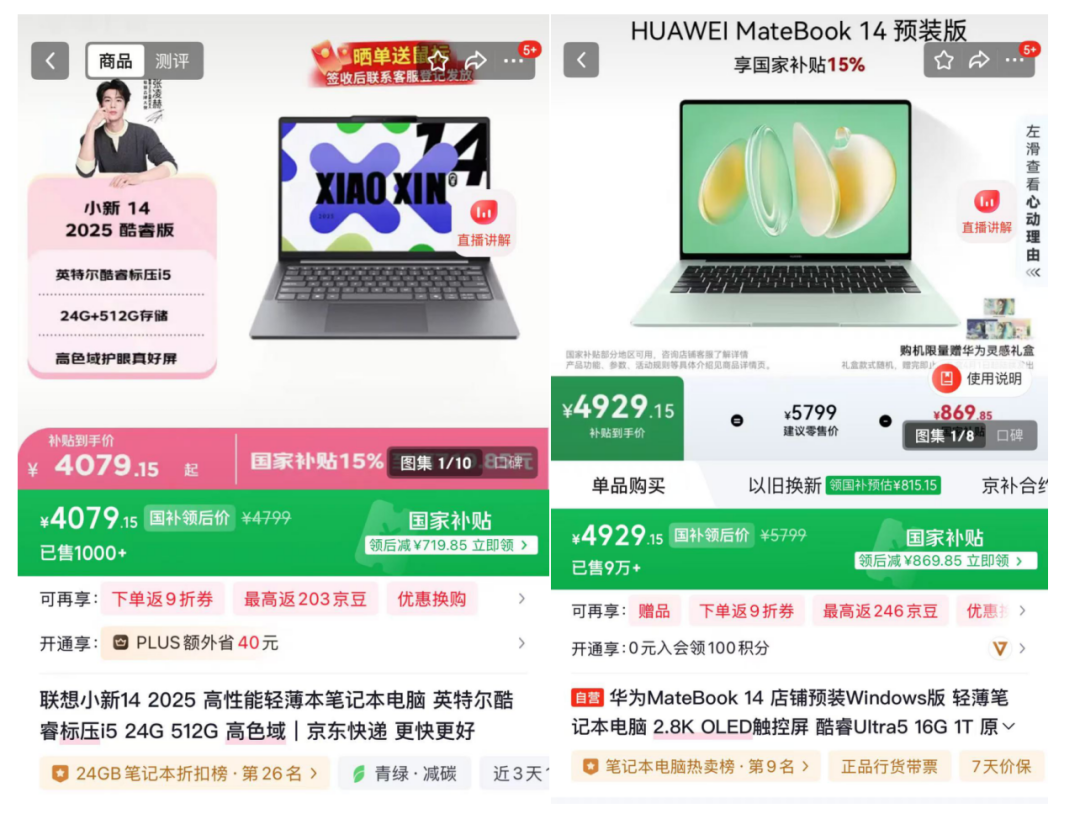
The 4,000–5,000 yuan range is a critical sales segment for domestic PCs, but rising industry costs have forced Lenovo to issue price hikes, with many ultrabooks and office laptops seeing increases exceeding 500 yuan (and over 1,000 yuan for premium models). Coupled with memory chip price surges, terminal pricing continues to climb, further eroding cost-effectiveness. In contrast, the MacBook Neo's 4,599 yuan price point, coupled with macOS's seamless ecosystem, Apple's stringent quality control, and cross-device synergy, delivers a disruptive blow. For young users and students prioritizing long-term usability and brand prestige, it holds strong appeal.
Internationally, the MacBook Neo targets Chromebooks, which dominate the entry-level market with low-cost, lightweight designs but suffer from limited system functionality, restricting them to basic office tasks. The MacBook Neo, priced similarly, offers a fully functional macOS ecosystem, practical performance, complete ecosystem integration, and basic AI capabilities. It caters to overseas educational and SME office needs while breaking Chromebooks' functional barriers, seizing share in the entry-level PC market and reshaping the low-end landscape abroad, paving the way for Apple's mass-market expansion.
03
"Raising Lobsters": An Affordable Gateway to Local AI
Looking ahead to the AI PC era, the MacBook Neo emerges as an excellent, affordable platform for ordinary users to engage with local AI, becoming the second Mac device (after the Mac mini) suited for private AI deployment. The recent "raising lobsters" trend in semiconductor and PC circles—a playful term for building local AI Agents using the open-source OpenClaw framework (icon: a red lobster)—epitomizes this shift.
This trend reflects a deeper industry transformation: as cloud AI privacy risks grow, local deployment and private AI are becoming new industry focal points. High-end M-series chips, built on 3nm architectures, deliver surging GPU and AI performance. Running personal AI models and creating AI assistants demand secure, independent, and easy-to-deploy devices.
The MacBook Neo addresses this need perfectly. It retains Apple's closed-loop security and system stability while offering portability. Without cloud dependency, it runs lightweight local AI models smoothly, safeguarding data privacy and enabling AI-assisted office work and smart learning. Compared to high-end Macs, it drastically lowers entry barriers, allowing ordinary users to tap into local AI ecosystems and aligning with the AI PC trend.
04
Apple's Triple Ambitions Behind the Price War
Beyond the product itself, Apple's launch of the 4,599 yuan MacBook Neo amid industry-wide price hikes is not mere price competition but a calculated strategic move with three layers:
First, leveraging in-house chips to offset cost pressures and regain pricing control. As highlighted earlier, the PC industry's biggest pain point is reliance on third-party suppliers for core chips and memory, leaving downstream manufacturers at their mercy—raise prices and lose market share or hold prices and erode profits. Apple's vertically integrated supply chain and cross-use of in-house chips enable cost autonomy, breaking free from supplier pricing constraints. This is not just a breakthrough for Apple but a wake-up call for the PC industry: mastering core hardware like chips is essential to weather cost fluctuations.
Second, capturing market share and expanding the Mac ecosystem. The global PC market has plateaued, making market competition the norm. The 4,000–5,000 yuan mid-range segment accounts for over 60% of global PC demand—a market Apple has never truly penetrated, missing out on vast potential users. The MacBook Neo aims to pry open this segment, converting long-time Windows users into Apple ecosystem participants. Apple's profit model hinges on ecosystem synergy, not single-device margins. Once users enter the Mac ecosystem, cross-device purchases (iPhone, iPad, Apple Watch) and conversions to software subscriptions and cloud services surge, yielding far greater long-term returns than short-term pricing concessions.
Third, reshaping the PC market and forcing industry upgrades. The 4,000–5,000 yuan range has long been dominated by domestic Windows PCs. Apple's entry, armed with brand, ecosystem, and chip advantages, delivers a disruptive blow, likely accelerating the exit of less competitive SMEs. Leading players will either follow suit with price cuts (eroding profits) or invest heavily in core tech to close the gap. This will push domestic PC makers to refine pricing, polish products, and focus on core chip R&D, system optimization, and ecosystem building, while driving the entire industry toward technical innovation and reduced third-party dependency.
The MacBook Neo's arrival signals the end of "premium excess" in consumer electronics, ushering in an era of practicality, cost-effectiveness, and core technology.
For ordinary consumers, the 4,599 yuan MacBook is a tangible boon, making Apple's premium ecosystem accessible to students and young professionals at a lower cost. For domestic PC makers, it brings harsh industry pain—relying on cost-effectiveness to dominate the mid-range market is no longer viable. Survival now demands competition in core chip R&D, system optimization, and ecosystem strength. For the broader semiconductor and PC industry, Apple's move is a clear indicator: only by mastering core technologies and optimizing supply chain control can companies thrive amid market downturns and secure an edge in fierce market competition.
-
![]()
Proposed to Raise 955 Million Yuan through Private Placement! Huicheng Vacuum Boosts Localization of Ultra-Precision Optical Coating Equipment
-
![]()
Cash Flow Soars 13-Fold! What Major Strategic Move is Wuhan Five Square Optoelectronics Planning?
-
![]()
Leaked Design of vivo X500: Reverts to Circular Camera Module in Top-Left Corner, Pays Homage to Classic X90 Aesthetic
-
![]()
DeepSeek Shows Signs of Foraying into Code Agents, Launches WeChat Official Account Focused on Harness
-
![]()
Auto Companies Deny Claims That ‘Cooperation with Huawei Is Non-Essential’, as Huawei Transforms into a ‘Public Platform’
-
![]()
Starship to Independently 'Return to the Launch Tower': SpaceX's Ambitions Extend Beyond Rocket Building to Dominating Space Transportation
-
![]()
Starship Set to Independently 'Return to the Launch Tower': SpaceX is Revolutionizing Space Transportation, Not Just Building Rockets
-
![]()
Anthropic and OpenAI Face Off Against Deepseek