Junyang Lin’s Departure: Most Circulating Claims Are Unfounded
 03/06 2026
 525
525
Following Junyang Lin’s announcement of his resignation, a surge of news has emerged over the past two days, much of which remains unverified.
There are speculations that Alibaba is making a complete shift from open-source to closed-source models, discussions suggesting that Lin's departure is due to the group cutting back on investment in foundational model R&D, and even some absurd claims of internal factional strife.
Some of these claims clearly defy business logic and are inconsistent with Alibaba’s established AI strategy. I liken this to Freudian dream analysis—where evidence is ignored in favor of personal whims.
Of course, the suddenness of the event also contributes to this situation. Lin had just been promoted to P10 and was leading Alibaba’s most critical foundational model R&D team. Typically, even in resignations, there is a negotiation process. One side openly expresses grievances and demands, while the other attempts to placate and stabilize the situation.
Lin, however, took to social media directly, and the moment he did, it sparked public debate. His determination to leave was evident, and Alibaba seemed to be compelled to respond.

Lin posted his message in the early hours, and it is likely that some internal executives only learned of the news the following morning. Consequently, the group was probably occupied with devising solutions and conducting internal communications yesterday. I heard that 'Wu Ma' (Wu Yongming) also convened a meeting with the Qwen team.
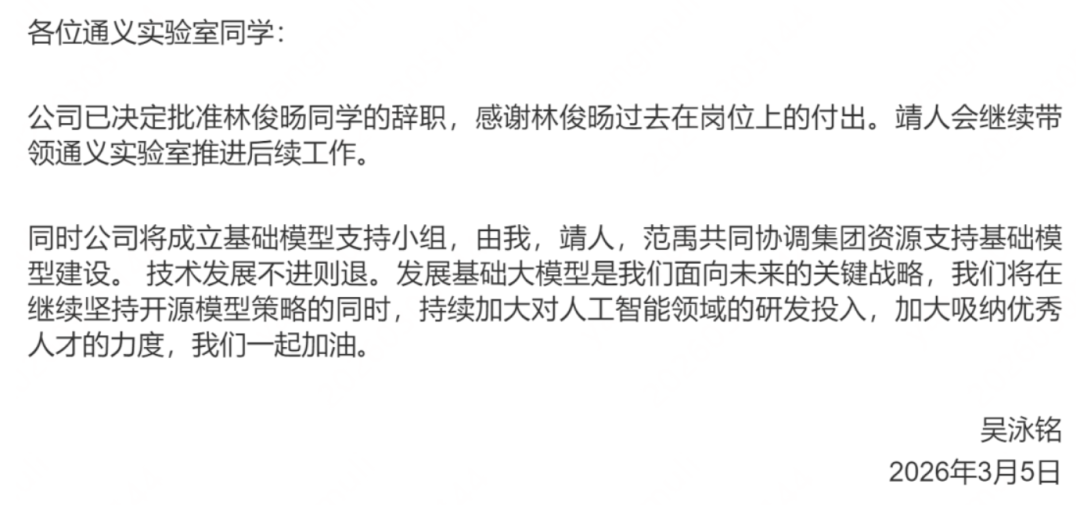
This morning, 'Wu Ma' issued another internal memo. Based on the available information, the situation now has a clearer timeline.
Dreams Are the Reverse of Reality
The biggest controversy in the community yesterday was whether Lin's departure signaled Alibaba’s shift from open-source to closed-source models.
Open-sourcing models has always been challenging, but Alibaba is currently the most consistent and high-level contributor in this space.
After Llama4, Zuckerberg faltered, but Alibaba and other players held the line. If Alibaba were to truly abandon open-source now, it would not be an exaggeration to say that half of the open-source community would crumble.
This claim is peculiar because, regardless of whether a model is open-source or closed-source, R&D must persist. The only difference lies in whether the weights are made public. The two are not inherently linked.
Today's internal memo from 'Wu Ma' explicitly states that Alibaba will continue to adhere to an open-source model strategy.
Personally, I am not surprised by this, as I always considered this rumor to be unreliable.
Many argue that Alibaba's commitment to open-source models hampers its ability to generate revenue through APIs via Alibaba Cloud. However, establishing technical influence through open-source models and then attracting clients to use Alibaba Cloud's services was precisely the foundation that initially supported Alibaba's open-source approach.
This foundation remains solid. As the creator, no one understands model optimization better than Alibaba or knows how to reduce deployment and inference costs more effectively, not to mention Alibaba Cloud's scale advantages. Alibaba Cloud's high-growth performance is testament to this.
As for clients requiring private deployments, even if Qwen were not open-source, they would not opt for public cloud providers like Alibaba.
Thus, adhering to open-source is entirely appropriate, as 'Wu Ma' has affirmed. The open-source community is unforgiving—model quality speaks for itself. Gaining community feedback through open-sourcing while building a reputation to attract talent also facilitates model iteration.
Another point highlighted in 'Wu Ma's' internal memo is that Alibaba will 'increase investment in AI R&D and intensify efforts to attract top talent.'
A specific measure is the establishment of a foundational model support team, with Wu Yongming, Zhou Jingren, and Fan Yu jointly coordinating group resources to support model development. This is a significant boost for the Qwen foundational model R&D team.
Alibaba remains steadfast in its capital investment. It first announced AI infrastructure investments exceeding 380 billion yuan over three years, with plans for even greater follow-up investments. However, computational power remains a limiting factor, necessitating a balanced allocation between R&D and different business lines.
The unintended consequence of this technical executive's resignation is that the Qwen foundational model R&D team's resource priority has increased.
Having 'Wu Ma,' Zhou Jingren, and Fan Yu coordinate together essentially provides a more stable resource channel. Issues like computational power allocation, data resources, and engineering support—which may have required repeated negotiations in the past—will now be easier to resolve.
Foundational models are a capital-intensive, long-cycle competition. Direct support and attention from the group's highest leadership are crucial. After today, Qwen's strategic position within Alibaba will only ascend, not decline.
Alibaba AI: Moving Forward
After Junyang Lin announced his resignation, there has been external concern that his sudden departure could bring uncertainty to Qwen’s subsequent model R&D and updates.
Honestly, I do not understand where this concern stems from. The belief that a star technical leader's departure would severely disrupt the R&D system is a misunderstanding.
Liang Wenfeng once said, 'What we lack in innovation is not capital but confidence and knowing how to organize high-density talent for effective innovation.'
This statement is highly pertinent.
Foundational model R&D is no longer an era of individual breakthroughs but a systems engineering effort highly dependent on organizational capabilities. Algorithm research, data engineering, training infrastructure, inference optimization, evaluation systems, and product feedback—each link requires collaboration from large numbers of top engineers.
While individual core talents are important, what truly determines the upper limit is the ability to organize a high-density group of talents and enable continuous iteration in the same technical direction.
Foundational models are not like lobsters—they cannot be created by a single person's 'vibe coding.'
From this perspective, while technical leaders like Junyang Lin and Yu Bowen are important contributors to the Qwen series, Qwen's success is fundamentally a product of organizational capability, not the achievement of any one individual.
If the departure of a single technical executive could collapse the system, then companies from OpenAI and Anthropic down to MiniMax and Zhipu would have collapsed long ago.
The AI industry is inherently characterized by fierce competition and frequent talent mobility. What truly matters is whether a company can continuously attract new talent and integrate them into an efficiently functioning R&D system.
I do not believe Qwen will completely falter because of Lin's departure, just as I do not believe Tencent hiring Yao Shunyu will turn the tide.
Lin's departure may not be a bad thing for Alibaba—it could even be beneficial.
In any company, the question of whether business line executives make decisions based on personal technical preferences or must align with the company's overall strategy is not up for debate.
Organizational structure must closely align with strategic direction; otherwise, even the strongest technical teams will struggle to form a cohesive force.
Alibaba’s organizational structure for its large model team has not seen many changes recently. However, a notable recent development is the company's increased involvement in competing for AI-native entry points. This strategic shift necessarily requires organizational adjustments.
A core aspect is that the group aims to expand the team, increase talent density, develop stronger foundational models, and achieve tighter integration between product development and research to support the C-side Qwen APP in maintaining and expanding its market position.
In this context, the relatively 'small and beautiful' and 'vertically integrated' Qwen team clearly needs to adjust its mindset and embrace change.
Qwen belongs to Qwen and Alibaba, not to any individual executive.
As team leader, Junyang Lin could either lead the charge or part ways amicably. His personal choices are understandable. Alibaba provided him with a platform, and he achieved results. With this track record, he will have no shortage of opportunities elsewhere.
With Lin 'moving on' and Qwen 'soaring higher,' this outcome is not a bad one.
-
![]()
Doubao Work Unveiled! Domestic AI Leaders Fully Commit to the 'Work' Sector
-
![]()
Who’s Sounding the Alarm on ‘Rushed Vehicles’?
-
![]()
Over 5.3 Billion Yuan in Losses Over Three and a Half Years! Can Yonyou Reverse Its Fortunes Through Streamlining and AI Transformation?
-
![]()
Baidu AI Adopts Free Model: A Strategic Maneuver in Traffic and Monetization
-
![]()
Silicon-Based OLED Pioneer Unveils Financial Results: H1 Shipments Outpace Entire 2025 Volume
-
![]()
AI's First "Lost Summer"
-
![]()
Zeiss Makes Another €2.2 Million Bet: Will Eye Tracking Be the Next Big Thing in the Smart Glasses Industry?
-
![]()
RUNTO Ranking | Global Top TV ODM Factories' Shipment Figures for July 2026