OpenClaw's Unexpected Rise Saves Zhipu, MiniMax, and Kimi
 03/10 2026
 536
536
The past half-month has felt surreal in China’s internet scene.
As the aftershocks of the “AI Red Packet War” launched by tech giants like Tencent, Alibaba, Baidu, and ByteDance linger, media and the public are dissecting the “battle results” with a tinge of pessimism: Daily active users plummeted post-Chinese New Year, leading to jokes like “growth zeros out the moment red packets stop.”
On the flip side, global hardcore geeks and AI entrepreneurs witnessed an epic spectacle: An open-source project named OpenClaw amassed over 250,000 Stars in record time, dethroning long-reigning champion React and even surpassing Linux to become GitHub’s highest-starred non-aggregated software project in history.
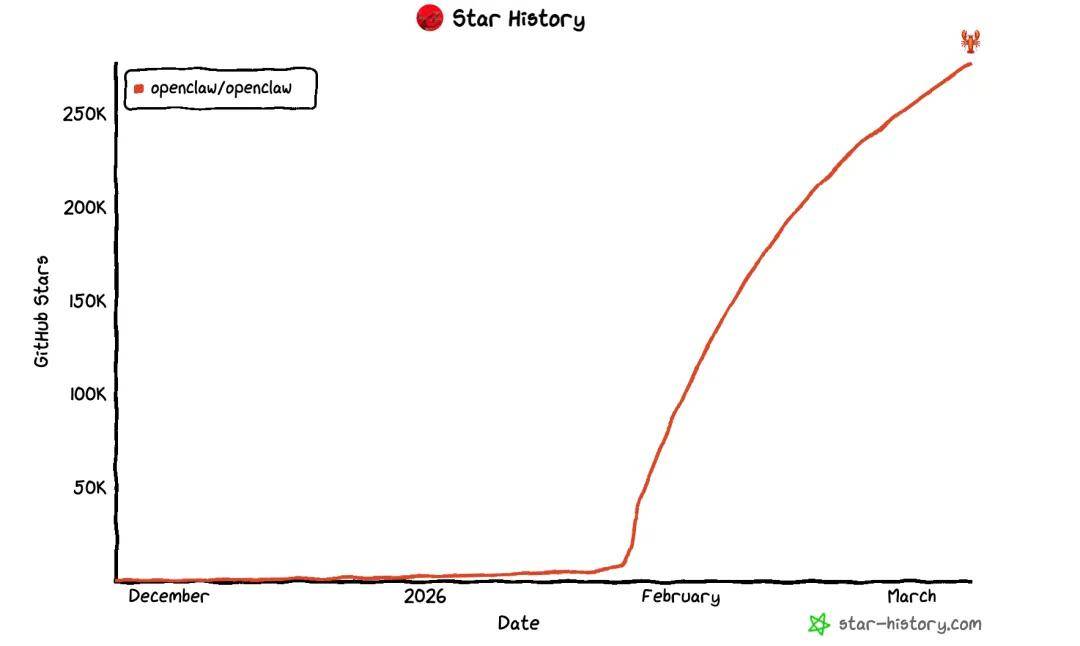
Unexpectedly, within a week of returning to work after the Chinese New Year holiday, OpenClaw’s popularity transcended geek circles. Nearly every “internet worker” took notice of this “little lobster.” Driven by FOMO (fear of missing out), “lobster discussion groups” overflowed, deployment tutorials racked up 100,000+ views, and even lines formed for physical OpenClaw installations...
The AI-native era had arrived in the most unexpected way.
The hardest hit, aside from internet giants potentially wasting billions on red packets, were survivors of the “Hundred-Model War” like Zhipu, MiniMax, and Kimi. They finally broke free from the traffic game dominated by tech behemoths, no longer struggling to “stay alive.”
01 OpenClaw’s Meteoric Rise: “The World Is Sick of Chatboxes”
Before diving into Kimi’s “lifeline,” let’s grasp what OpenClaw is.
If you haven’t followed AI news in the past half-month, the fervor OpenClaw sparked among developers is hard to fathom. Its predecessor, Moltbot, began as a weekend hackathon project by developer Peter Steinberger. Within months, it evolved into the world’s hottest “personal AI assistant runtime.”
Unlike ChatGPT, QianWen, or Zhipu Qingyan’s chatbox interfaces, OpenClaw is a headless, automated agent framework.
Its core product logic is ruthlessly efficient:
1. Localization and Control: Your AI assistant doesn’t run in the cloud. Deploy it on your own device—an old Mac, a dusty Windows PC in your study, or even a $10 VPS.
2. Omnichannel Integration: No need for specific apps. OpenClaw acts as a gateway, connecting to Feishu, DingTalk, WeCom, iMessage, and more. Your AI stays where you chat.
3. Soul Injection (SOUL.md): Ditch cumbersome System Prompt tuning. Define your AI’s identity, personality, memory, and permissions via a geeky SOUL.md file.
4. Tool Integration (Tool Use): Silently read local files, execute Shell scripts, control browser rendering, or even auto-fetch news at 3 AM to generate briefings.
Why did OpenClaw explode post-holiday?
Because “the world is sick of chatboxes.”
From 2023 to 2025, AI usage has been passive: Sit at a screen, open a webpage, input commands, wait, then copy-paste. This “question-answer” mode stifles AI’s potential as a productivity tool, like a superbrain locked in a cage—no limbs, no ears, just a mouth.
OpenClaw gave that superbrain “limbs.”
As millions returned to work with post-holiday syndrome, countless cloud-based or local OpenClaw instances quietly hummed to life. They processed documents, monitored market fluctuations, and generated/distributed briefings...
OpenClaw’s viral success proves a point: True AI-native applications aren’t better chat apps but invisible, 24/7 infrastructure.
02 Ditching the “User Acquisition Game”: Big Models’ Escape Pod
Let’s pivot to China’s large model vendors.
Before OpenClaw’s explosion, Zhipu, MiniMax, and Kimi endured a protracted “identity crisis.” In the mobile internet era, Chinese tech giants and VCs swore by one rule: “Traffic is king.”
As seen: Over three years, large model startups plunged into a brutal “Hundred-Model War” and “user acquisition arms race.” To build AI-era “WeChat” or “Douyin,” companies burned cash on 2C super-apps. Elevator ads, Douyin info streams, and Bilibili UP the Lord's sponsorships bombarded users with AI assistant promotions.
For startups, this model was fatal from the start. Financially, they couldn’t afford billion-dollar red packet campaigns. Ecologically, they lacked WeChat or Douyin’s built-in traffic pools.
Crushed by giants’ traffic grinders, the once-glorious “Six Little Tigers” of large models dwindled to three by late 2025. Baichuan AI retreated to vertical B2B healthcare and finance, 01.AI pivoted overseas, and JueYue XingChen faded into obscurity.
If they stuck to Web2.0’s “user acquisition logic,” the remaining “Three Little Tigers” faced doom:
1. Sky-high CAC and abysmal retention: Users downloaded apps for red packet wool (freebies) and left immediately.
2. Terrifying marginal costs: Traditional apps add bandwidth per user; AI models add direct compute costs. More free users = heavier losses without paid conversions—a “bleeding sprint.”
3. Fragile moats: Users switch allegiances at whim. Today, Kimi’s long-text wins; tomorrow, Zhipu Qingyan updates; the next day, a billion red packets are distributed. Loyalty is nonexistent.
OpenClaw’s emergence, and the Agentic ecosystem it represents, offered a perfect “escape pod.”
OpenClaw’s BYOK (Bring Your Own Key) design lets users/developers run the framework locally, requiring API access to underlying models. It’s China-friendly: Zhipu, Kimi, and MiniMax models were supported immediately and endorsed by OpenClaw on X.
This means Zhipu, MiniMax, and Kimi no longer need to build grimy, giant-competing 2C apps. The open-source community, geeks, and SMEs will use frameworks like OpenClaw to create eclectic personal assistants and vertical workflows.
03 AI’s Fundamental Logic: Be “Utilities,” Not “Amusement Parks”
Even before OpenClaw’s China fame, the “Three Little Tigers” tasted success.
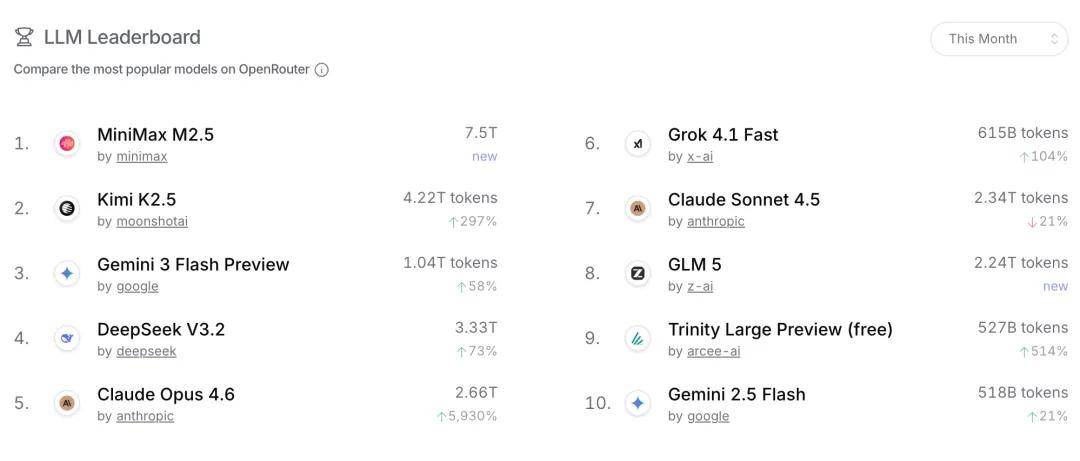
Data from OpenRouter, the world’s largest AI model API aggregator, shows that as of February 28, 2026, the top 10 models surpassed 28.7 trillion total Token consumption. Chinese models contributed over 14.69 trillion, with monthly Token calls exceeding 50% for the first time.
From February 16–22, Chinese models hit 5.16 trillion weekly Tokens, while U.S. models fell to 2.7 trillion. Among the top five models, China claimed four: MiniMax M2.5, Moonshot AI’s Kimi K2.5, DeepSeek V3.2, and Zhipu GLM-5.
Back then, OpenClaw was niche in China, with “little lobster” hype concentrated on overseas platforms like X.
In other words, before China’s “internet workers” jumped on board, MiniMax and peers had already conquered overseas developers.
The reason? Cost-effectiveness.
For input, MiniMax M2.5 and Zhipu GLM-5 cost $0.3/million Tokens, versus Claude Opus 4.6’s $5. For output, MiniMax-M2.5 charged $1.1/million Tokens, Zhipu GLM-5 $2.55, and Claude Opus 4.6 a staggering $25.
OpenClaw’s Agent ecosystem is a veritable “Token vacuum.”
Traditional chatbots burn a few thousand Tokens daily for heavy users. Assign OpenClaw to “monitor the entire internet (web-wide) long AI 2026 trend reports, extract key points, cross-compare, and generate a 100,000-word bilingual industry insight with auto-formatting for Feishu,” and it consumes millions of Tokens per run.
Why? OpenClaw’s backend goes wild:
Web searches and scraping (millions of input Tokens)
Summarization and extraction (frequent short-context calls)
Self-reflection and error correction (Agent self-dialogue doubles Token use)
Final long-text generation (costly long-context output)
This reinforces a fundamental truth: In the AI-native era, productivity gains are real—no need for user acquisition to monetize.
The healthiest model for large model companies? Return to being technical infrastructure—“utilities,” not Web2.0’s “attention economy” playbook of building walled “amusement parks” (apps) to sell attention to advertisers.
OpenClaw is just the first shot.
As long as the ecosystem thrives and machines keep thinking, underlying models’ Token meters will spin endlessly, flooding them with API requests.
The AI era’s Killer App might not be an app at all—but ubiquitous APIs.
04 The Bubble Behind the Hype: Agent Ecosystems Have a Long Road
Capital markets mirrored the frenzy.
Zhipu’s stock soared 42.72% on February 20, hitting a HK$320 billion market cap—up 4.6x from its IPO price. MiniMax’s stock jumped 19% on March 2 despite posting an $1.87 billion annual loss.
OpenClaw’s value is undeniable, but the hype risks a “geek orgy meets herd mentality” bubble.
First, OpenClaw’s scenarios remain limited, with public adoption feeling trendy.
Most users deploy OpenClaw as a glorified “auto-bot” for simple web scraping. It solves geeky niche problems but is far from scaling (mass-scale) enterprise workflow automation or true “self-driving” AI.
In short, many “use AI for AI’s sake.”
Second, security is a ticking time bomb—it’s half-baked.
Engineering-wise, OpenClaw is a dangerous half-product.
Granting a “headless AI” unrestricted access to local files and Shell scripts without proper sandboxing risks catastrophic data loss if malicious Prompt Injection occurs. Private keys, API Keys, or entire hard drives could be compromised.
Yet, despite its flaws and narrow use cases, OpenClaw receives glowing praise.
Its roughness and audacity validate a product direction: Large models don’t need pretty faces (app interfaces)—just powerful brains (APIs). The open-source ecosystem will build the endless limbs.
-
![]()
Doubao Work Unveiled! Domestic AI Leaders Fully Commit to the 'Work' Sector
-
![]()
Who’s Sounding the Alarm on ‘Rushed Vehicles’?
-
![]()
Over 5.3 Billion Yuan in Losses Over Three and a Half Years! Can Yonyou Reverse Its Fortunes Through Streamlining and AI Transformation?
-
![]()
Baidu AI Adopts Free Model: A Strategic Maneuver in Traffic and Monetization
-
![]()
Silicon-Based OLED Pioneer Unveils Financial Results: H1 Shipments Outpace Entire 2025 Volume
-
![]()
AI's First "Lost Summer"
-
![]()
Zeiss Makes Another €2.2 Million Bet: Will Eye Tracking Be the Next Big Thing in the Smart Glasses Industry?
-
![]()
RUNTO Ranking | Global Top TV ODM Factories' Shipment Figures for July 2026