"Lobster Farming" Trend Soars, Big Tech Shows Limited Enthusiasm for Token-Based Overseas Expansion
 03/10 2026
 565
565
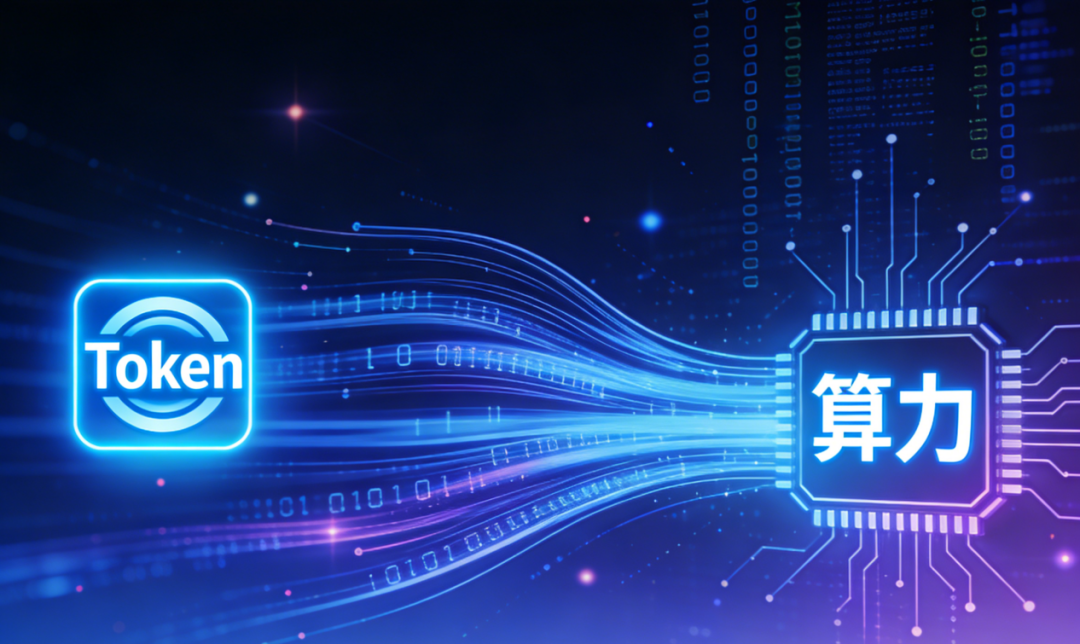
Non-Direct Competition Outshines Head-to-Head Clashes
By Chen Dengxin
Edited by Li Ji
Layout by Annalee
The super-intelligent agent OpenClaw is currently creating quite a stir.
Behind the "lobster farming" craze, the competitive landscape for large AI models has shifted from a focus on model capabilities to application prowess, propelling Tokens from the background to the forefront.
For a while, "OpenClaw's massive Token consumption" became a hot topic of discussion.
Interestingly, China is abundant in Tokens—it has even ushered in a new era for Chinese exports: Multiple media outlets have reported that the Token usage of China's large AI models has, for the first time, surpassed that of their overseas counterparts, with significant contributions from models developed by MiniMax, DeepSeek, Zhipu, Moonshot AI, and StepFun.
This raises a question: Despite possessing vast Token resources, why haven't internet giants emerged as the primary force in Token-based overseas expansion, even after launching various adaptation plans for OpenClaw?
Cost Efficiency Takes Center Stage
In the AI era, Tokens reign supreme.
As digital identifiers in computing, Tokens represent the smallest unit of computational power and serve as a crucial metric for measuring AI inference.
It is widely recognized that computational demand can be broadly categorized into two scenarios: training and inference.
Training involves continuously feeding massive datasets over extended periods, enabling large models to learn, digest, and master more knowledge, thereby enhancing their intelligence. Inference, on the other hand, leverages trained large models to empower external applications and facilitate AI implementation, consuming vast quantities of Tokens in the process.
Particularly after OpenClaw gained popularity, there has been an exponential surge in Token consumption.
"Naobrain" observed: "Previously, AI operated in a straightforward Q&A chat mode, with daily Token consumption per person capped at the million level. However, once switched to AI task mode, daily Token consumption can skyrocket to the hundred-million level—a hundredfold increase in per-capita usage."
Against this backdrop, cost-effective Tokens have become the focal point.
Recent data from OpenRouter reveals that MiniMax's M2.5, DeepSeek's V3.2, Moonshot AI's Kimi K2.5, StepFun's Step 3.5 Flash (free), and Zhipu's GLM 5 rank among the Top 10 models for Token usage, accounting for half of the list.
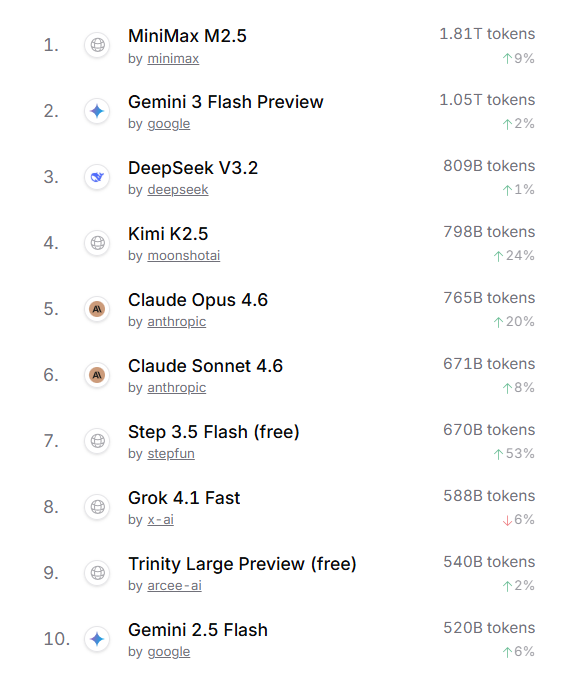
Source: OpenRoute
Notably, the Token usage rankings primarily reflect overseas users, with Chinese users accounting for just 6.01%, objectively indicating the true global appeal of China's large AI models.
In other words, OpenClaw has inadvertently accelerated Token exports from China.
The driving force behind this is cost: MiniMax M2.5 costs $0.3 per million Tokens for input and $1.1 per million Tokens for output, whereas Claude Opus 4.6 costs $5 per million Tokens for input and $25 per million Tokens for output—highlighting a stark contrast between Chinese and foreign models.
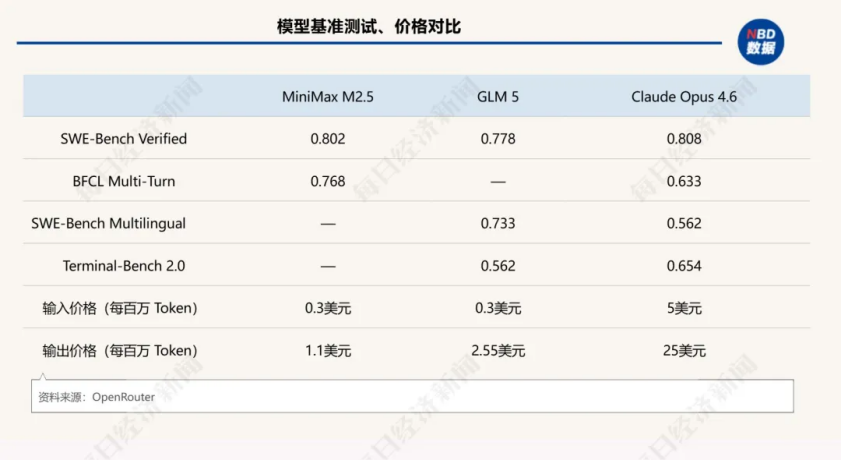
Source: National Business Daily
Huatai Securities astutely noted: "Electricity and computational power account for over 70% of Token cost structures. China's advantage in low electricity prices is translating into global pricing power for AI services."
Indeed, at the heart of computational power lies electricity.
This implies that the underlying logic of Token exports is essentially electricity exports: Overseas users call APIs from Chinese large models, which then complete inference via the "electricity → computational power → Token" conversion chain and relay the results back to users.
Thus, Tokens have emerged as a new medium for China's electricity and computational power exports.
Recent data from the National Energy Administration shows that China's total electricity consumption surpassed 10 trillion kWh in 2025, more than double the annual consumption of the U.S. and higher than the combined total of the EU, Russia, India, and Japan.
"Jiou Studio" remarked: "When Gansu's wind, Qinghai's solar, and Yunnan's hydro power flow through the 'East Data, West Compute' initiative into western data centers' GPU arrays, they are transformed into Tokens. These Tokens, leveraging systematic low costs, are sold abroad at premium prices—becoming the 'containers' of the AI era."
Market Expansion Still Hinges on Big Tech
Despite this trend, internet giants like Baidu, Tencent, Alibaba, and ByteDance are unlikely to become the primary players in Token exports anytime soon.
Why? Because Tokens serve as a "barometer" for AI cloud services.
AI cloud represents the seamless integration of AI and industries, acting as a critical hub for large model implementation by providing users with a steady stream of Tokens—reflecting actual AI business demand.
Consequently, internet giants are ramping up investments in AI cloud.
This is evident from Alibaba Cloud's bold claim of "capturing 80% of new shares in China's 2026 AI cloud market," which has stunned the industry.
Behind this lies the expanding AI cloud market.
IDC data reveals that large model calls on China's public cloud reached 536.7 trillion Tokens in the first half of 2025, nearly quadrupling from the full year of 2024.
"In the new AI era, computational power equals revenue; without it, Tokens cannot be generated; without Tokens, revenue growth is impossible," argued Jensen Huang, founder and CEO of NVIDIA. He noted that global Token demand is growing exponentially: "We've reached an inflection point, producing valuable Tokens that enhance productivity for clients and profits for cloud providers."
The issue is that smaller players lag behind internet giants in terms of infrastructure and AI capabilities, with their survival space further squeezed by intensifying competition.
Even renowned players like DeepSeek have lost their initial luster.
The "2025 Core Report on AI Application Layer Development" reveals that as of December 2025, DeepSeek's monthly active users stood at 135 million, down from 145 million in September—a loss of 10 million users in three months, or a quarter of its peak user base.
In short, large models from MiniMax, DeepSeek, Zhipu, Moonshot AI, and StepFun are leveraging Token exports to engage in non-direct competition, avoiding futile domestic rivalry while finding new growth avenues for their businesses.
Take MiniMax, for instance: Its 2025 revenue reached $79.038 million, up 158.9% year-on-year, with 73% from international markets and products covering over 200 countries and regions.
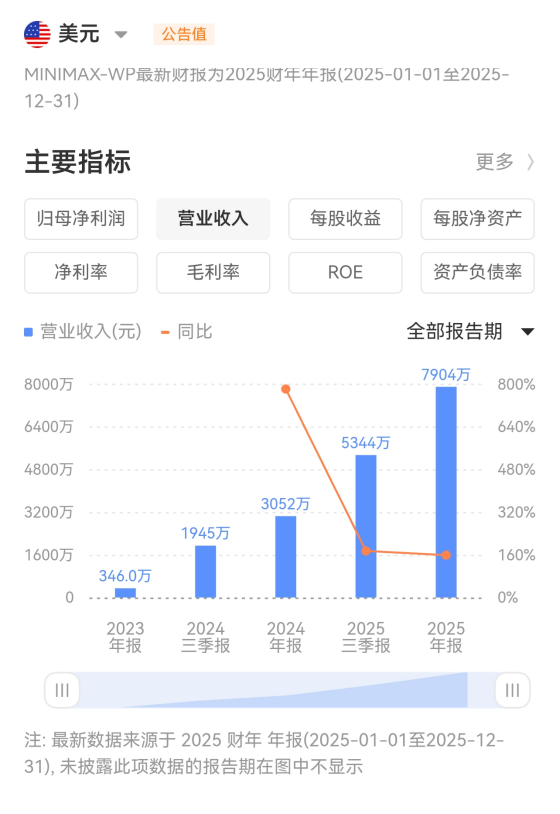
Source: Flush
Looking back, it collaborated with Google Vertex AI, Microsoft Azure AI Foundry, Fireworks AI, Nebius AI, and others, becoming the default model for platforms like OpenCode and Kilo Code.
Yan Junjie, founder and CEO of MiniMax, defines AI platform value as intelligence density × Token throughput: "Each generation of models shows significant improvements in capabilities and usage. We've proven our R&D prowess and ability to handle high traffic volumes."
Clearly, while internet giants focus on domestic market expansion, smaller players are executing low-cost, strategic strikes overseas—each forging a promising future.
In fact, internet giants' market expansion strategies vary.
For instance, Baidu favors intelligent agents, viewing them as the mainstream form of future AI applications. Their advantage lies in being "easier to create than a webpage in the internet era," enabling them to meet diverse user needs.
Simply put, intelligent agents act as multipliers for Token consumption.
Public data shows that over 30 million intelligent agents globally serve users, driving a nearly 300-fold increase in global daily Token consumption over the past two years.
Another example is ByteDance's focus on AI smart assistants, with its Doubao leading the pack. Especially after the Lunar New Year red packet campaign, users increasingly turn to Doubao for answers.
Quest Mobile data reveals that as of December 2025, monthly active users for mobile and PC AI applications reached 722 million and 205 million, respectively. Doubao ranked first with 226 million monthly active users—nearly matching the combined total of the next four players.
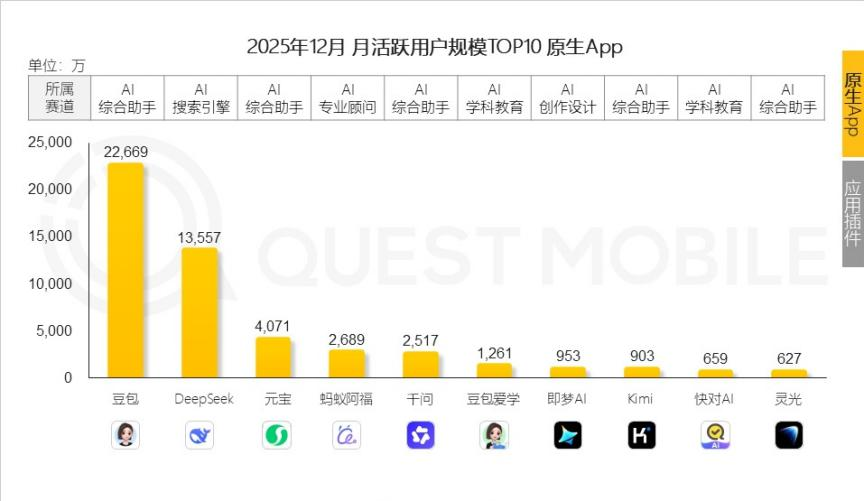
Source: Quest Mobile
Unsurprisingly, Doubao leads the industry in Token consumption, ranking among the global Top 3.
Official data shows that Doubao's large model averaged 120 billion daily Tokens in May 2024, now exceeding 500 times that volume.
Wu Di, head of intelligent algorithms at Volcano Engine, stated: "By 2030, domestic Token consumption will be over 100 times current levels. The core metric for enterprise intelligence will shift from GPU count to total Token consumption, as it uniquely penetrates 'model capabilities, usage frequency, and real demand.'"
Notably, beyond internet giants, leading players in smartphones, automotive, and other sectors also view Tokens as key to embracing AI.
The most prominent example is XPENG Motors.
XPENG's second-generation VLA in-vehicle model, deployed across 200,000 Ultra models, consumes 58.8 trillion Tokens daily—comparable to internet giants.
He Xiaopeng, chairman and CEO of XPENG, declared: "I firmly believe fully autonomous driving will arrive in 1–3 years, and within 3–5 years, all cars will be powerful super-intelligent agents."
In summary, the rise of Token exports stems from internet giants vying for domestic market share while smaller players carve out a "second front" overseas.
Undoubtedly, China's large AI models have become even more formidable.
-
![]()
Doubao Work Unveiled! Domestic AI Leaders Fully Commit to the 'Work' Sector
-
![]()
Who’s Sounding the Alarm on ‘Rushed Vehicles’?
-
![]()
Over 5.3 Billion Yuan in Losses Over Three and a Half Years! Can Yonyou Reverse Its Fortunes Through Streamlining and AI Transformation?
-
![]()
Baidu AI Adopts Free Model: A Strategic Maneuver in Traffic and Monetization
-
![]()
Silicon-Based OLED Pioneer Unveils Financial Results: H1 Shipments Outpace Entire 2025 Volume
-
![]()
AI's First "Lost Summer"
-
![]()
Zeiss Makes Another €2.2 Million Bet: Will Eye Tracking Be the Next Big Thing in the Smart Glasses Industry?
-
![]()
RUNTO Ranking | Global Top TV ODM Factories' Shipment Figures for July 2026