Popular Science Essay | Why Do Laser Beams Travel in a Straight, Cylindrical Path?
 03/10 2026
 674
674
Why Do Laser Beams Travel in a Straight, Cylindrical Path?
On a dark night, when we switch on a regular flashlight, the beam we observe diverges continuously. Yet, when we press the button on a laser pointer, we see a straight, well-defined cylindrical beam of light. Why doesn't the laser beam diverge? The key to this intriguing phenomenon lies in a precise device known as an "optical resonator," which can be likened to two parallel mirrors. Within these mirrors, photons replicate and amplify themselves through a process known as "stimulated emission." Only photons traveling in directions that are highly parallel to the axis of the two mirrors can persist and be amplified; those with slight deviations are quickly eliminated. The filtered light is what we perceive as the laser.
Where Does a "Pure" Laser Beam Originate? What is Light?
Light is an electromagnetic wave capable of propagating through a vacuum and is also a stream of particles, namely photons.
Where Does Light Come From?
To understand the origin of lasers, we must first grasp how light is generated. Ordinary matter is composed of atoms, which contain numerous electrons at varying energy levels. Generally, the electrons in matter are in states that keep the atom's energy at a lower level, a state referred to as the ground state. If we employ some means to increase the atom's energy, causing its electrons to move to higher energy positions, this state is termed an excited state. Think of the ground state as electrons at the base of a mountain and the excited state as electrons at the peak. We use electrical or thermal energy to propel electrons from the base to the peak. As atoms transition from the peak back to the base, they release energy in the form of photons. When many photons enter our eyes, they form the light we perceive.
Common light sources, such as incandescent bulbs and lasers, operate on this luminescence mechanism. So, what sets lasers apart from ordinary light sources? As we observe, the beams from flashlights or ceiling lights cover a large area relative to the size of the light source; in contrast, the beam coverage of a laser is not significantly different from the size of its source. This is because the photons in a flashlight beam travel in all directions, while the photons in a laser move in essentially the same direction.
Laser: Stimulated Emission
Simply put, when a photon "passes by" an atom in an excited state, it "stimulates" the atom to release another photon identical to itself. This new photon possesses the same energy and direction of motion as the original photon, and their vibration directions are consistent, meaning they are perfectly in phase, or exhibit good coherence.
Laser: Resonator
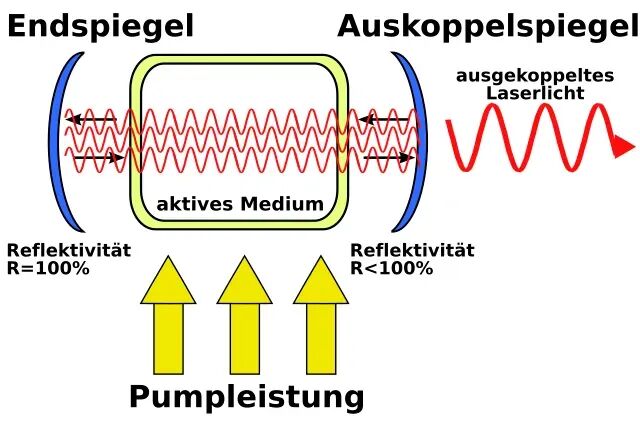
Figure 1 Schematic Diagram of the Working Principle of an Optical Resonator (Image Source: Sgbeer / Wikimedia Commons, CC-by-sa ver.4.0)
How exactly does a laser come into being? This involves a core device—the "optical resonator." The optical resonator consists of two parallel reflective mirrors: one is a fully reflective mirror where photons only "bounce back," and the other is a partially reflective mirror where photons have a chance to "bounce back" or exit. Initially, we use an external energy source to ensure that there are more atoms in the excited state than in the ground state within the resonator. Excited atoms may spontaneously release energy in the form of photons, which scatter in various directions. These photons undergo the stimulated emission process described above, generating new photons identical to themselves. These photons reflect inside the cavity and undergo stimulated emission again, repeating the process and creating an "avalanche effect." Photons not perpendicular to the mirrors will eventually exit the resonator from the sides, while those traveling along the axis will continuously reflect between the two mirrors, generating new, coherent photons as they pass through the working material. This process continues to intensify until the intensity of the photon beam is sufficient to overcome various losses. At that point, a portion of the light will stably exit through the partially reflective mirror, forming the laser we see.
Why Can We See "Invisible" Lasers?
In perfectly pure air without any impurities, no matter how strong a laser beam is, our eyes cannot perceive it. The reason we can see lasers is due to the phenomenon of light scattering. Specifically, when light propagates and interacts with matter, some of it deviates from its original direction and scatters in all directions. When lasers propagate through the air, they interact with tiny particles such as aerosols, smoke, water vapor, and pollen, whose sizes are comparable to the laser's wavelength, causing scattering. The scattered light enters our eyes, allowing us to see the laser beam.

Figure 2 Laser Scattering (Prepared by the Author of This Article)
Why Do Lasers Travel Straight and Appear Cylindrical?
Cylindrical Appearance: The Symmetry of the Optical Resonator
Lasers are generated and amplified within the structure of an "optical resonator." This structure itself is a perfectly cylindrical rotationally symmetric body. Photons reflect back and forth inside this cavity, and only those with propagation directions very close to the axis can be stably amplified. Since the cavity is isotropic in the cross-section (no direction is special), the resulting stable light field in the cross-section must also be symmetric. The most perfectly symmetric shape is a circle.
Traveling Straight: The Role of the Resonator
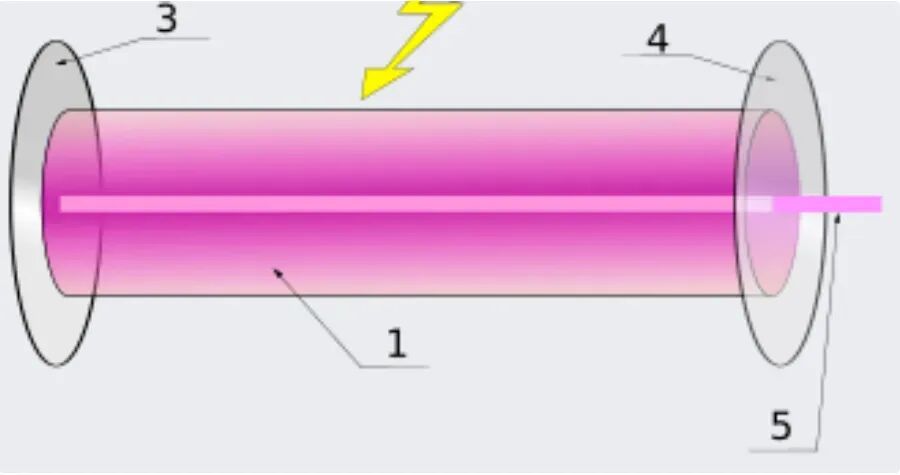
Figure 3 Laser Resonator (Image Source: Tatoute / Wikimedia Commons, CC-by-sa ver.2.5)
The straight travel of lasers is actually predetermined within the optical resonator. As mentioned earlier, the optical resonator consists of two parallel reflective mirrors. Only photons traveling in directions nearly perfectly parallel to the two mirror surfaces can continuously reflect between them and be sustainably amplified. Photons with significant angles relative to the axis are like runners who deviate from the track; after a few reflections, they will exit the resonator from the sides. Therefore, the beam that is ultimately output consists almost entirely of photons traveling along the axis. Naturally, the beam travels straight.
Cylindrical Appearance: Description by Gaussian Distribution
The intensity distribution of a common laser beam across its cross-section can be described by a Gaussian distribution. This intensity distribution is circular—brightest at the center and uniformly and continuously fading to zero along any direction in the cross-section, with the same rate of fading.
Imperfect Cylinder: The Divergence of Laser Beams
Laser beams are not strictly cylindrical because they also undergo diffraction, causing the beam to diverge. After diffraction occurs, the divergence angle of the laser beam over a certain distance is extremely small, almost appearing as a straight cylinder. This distance is called the Rayleigh length, which follows this rule: the larger the laser wavelength, the smaller the Rayleigh length; the smaller the initial spot radius, the smaller the Rayleigh length. For a common 532nm green laser pointer, if its initial spot diameter is 1mm, its Rayleigh length is approximately 1.5m. However, due to its small divergence angle (about 0.04 radians), after propagating 147m, the spot diameter only increases to 100 times its original size, becoming 10cm. The beam diameter increases with distance, but this change is almost imperceptible to the human eye. Therefore, although lasers are not perfectly cylindrical, due to their excellent collimation, they still appear cylindrical to us.
The reason lasers can produce seemingly straight, cylindrical beams stems from their unique generation mechanism and precise optical structure. The optical resonator acts as a strict "referee," only allowing photons with nearly perfect directions to remain on the "track," continuously replicating and amplifying them through stimulated emission, ultimately forming a beam with highly consistent direction and concentrated energy. The Gaussian distribution of intensity contours gives the laser its rounded, uniform "shape." Although lasers still slightly diverge over long distances due to diffraction effects, within the scales we use daily, their beams are almost as straight as columns, with well-defined boundaries. This "artificial purity" not only allows us to draw a clear light path in the dark but also makes lasers an important tool for human exploration and creation in fields such as medicine, communications, manufacturing, and scientific research. Lasers represent a leap in humanity's understanding and control of light. They are no longer just scattered light points in nature but are given direction and purpose, acting as a pen of light that writes the shapes we desire across time and space.
References
[1] Zhou Bingkun, Gao Yizhi, Chen Tirong, et al. Principles of Lasers [M]. 7th ed. Beijing: National Defense Industry Press, 2014.
[2] Zhao Kaihua, et al. New Concept Physics Tutorial: Optics [M]. 2nd ed. Beijing: Higher Education Press, 2021.
[3] Chen Min, Li Yan, et al. Optics [M]. 1st ed. Beijing: Higher Education Press, 2024.
-
![]()
Weighing the Pros and Cons of In-House Chip Development: Most Automakers Shouldn't Feel Compelled to Pursue It
-
![]()
Can the Leapmotor D99 Gracefully Ascend into the Premium MPV Market as the Brand Climbs Higher?
-
Midea Bets 1 Billion Yuan on Liquid Cooling, Targeting AI Computing Power Market with 2027 Production Launch
-
Amidst Declining Profit Margins, Can Anwen Technology Sustain Its Edge in Automotive Cockpits?
-
![]()
5,000 Companion Robots Sold: Can UBTECH Breathe a Sigh of Relief?
-
![]()
NIO Maintains Brand Premium: Onvo Sets Minimum Price at 150,000 Yuan, Avoids Direct Competition with Leapmotor and BYD | MJ Pro
-
![]()
“From a 5-minute escape window to a zero-fire baseline, I finally feel confident driving an electric vehicle”
-
![]()
Profits Skyrocket! From Leasing to Construction: A Storage Enterprise with Hundred-Billion-Yuan Revenue Plans 1.175 Billion Yuan Investment in New Headquarters