Tencent Bets Big on ‘Crayfish’ in the Pivotal AI Consumer Market Battle
 03/10 2026
 726
726
Major Tech Players Engage in Stealthy ‘Crayfish’ War
Written by / Shark
Edited by / Zhu Yu
In March 2026, the tech world was set abuzz by Tencent's subtle yet significant moves in the AI landscape.
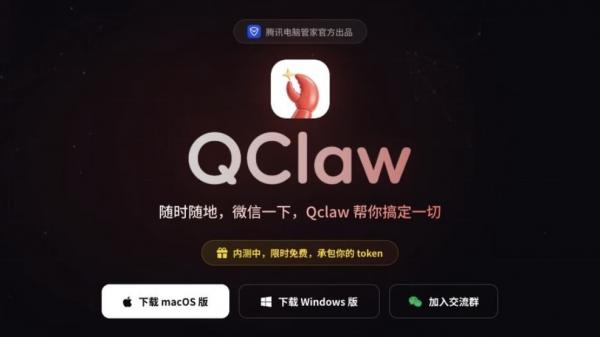
On March 7th, the QQ Open Platform made a strategic move by granting individual users official access to OpenClaw 'Crayfish', enabling them to effortlessly create a QQ robot connected to an AI agent with just a single click, taking no more than a minute. The very next day, a new product named QClaw was introduced, serving as a one-click launcher for OpenClaw. This tool supports local deployment and seamless WeChat integration, allowing users to command AI to perform a myriad of tasks via WeChat—ranging from remote computer control and GitHub automation to social media growth and daily reminders.
Simply send a message to a ‘crayfish’ in WeChat, and watch as it remotely controls your computer to accomplish tasks.
Few observed that these two seemingly unrelated moves were, in fact, part of a grand strategy orchestrated by Tencent.
2026 marks the inaugural year of the AI agent explosion, with the global market size projected to skyrocket from $11.3 billion in 2025 to $200 billion. The Chinese market is experiencing even faster growth, at a rate of 72.7%. Players like ByteDance, Alibaba, and Baidu have already made substantial investments, while Tencent appeared to be lagging in the AI agent race. Some speculate that Tencent, feeling the pressure, is attempting to take a shortcut by leveraging the traffic advantages of WeChat and QQ.
Unlike other vendors who focus on cloud-based AI assistants, Tencent has chosen a different path by opting for local deployment combined with IM integration. With WeChat and QQ boasting billions of users and the open-source popularity of OpenClaw, this combination appears to be a seamless fit.
Can Tencent's QClaw truly capitalize on its traffic to compensate for technical shortcomings and establish itself in the consumer AI agent market? This question lies at the heart of Tencent's anxieties and ambitions, as well as the underlying dilemmas of the entire AI agent industry.
Tencent's Minimalist ‘Crayfish’ Approach
At its core, QClaw is essentially a pre-installed, one-click OpenClaw launcher with built-in skills. It neither features a self-developed large model nor rewrites the underlying framework; it doesn't even qualify as an innovation. Yet, this seemingly technologically unsophisticated product has managed to break through barriers.
Over the past six months, all vendors developing large models have been anxious about one thing: users engage in chat and then leave, resulting in dismal retention rates. The ceiling for conversational AI is too low—so low that any wrapper app can outcompete you.
OpenClaw's popularity precisely addressed this pain point—users don't want a chatty robot; they want a capable assistant.

However, ideals are plentiful, while reality is harsh. To have a capable assistant, users must first learn to configure environments, install dependencies, write configuration files, and endure various cryptic errors. This isn't just about raising shrimp; it's akin to repairing computers.
Tencent's solution is simple and direct: absorb all the complexity, leaving users with just the tasks of downloading, installing, and scanning.
The core logic of QClaw can be summed up in one sentence: You just use it; I'll handle the rest. Local deployment ensures data security, WeChat conversation lowers the barrier to entry, and pre-built skills alleviate scenario anxiety. In three simple steps, a technical task that would normally take two to three days becomes a ten-minute foolproof operation.
Even more ruthless is its integration with WeChat.
Don't underestimate this step. Feishu and DingTalk's integration logic is 'AI in the workflow,' requiring users to actively open the app, find the robot, and input instructions. This essentially still treats AI as a tool.
QClaw's logic, on the other hand, is 'AI in the chatbox.' Your WeChat contacts list gains a robot named 'QClaw Customer Service,' to whom you assign tasks just like sending a message to a friend.
This difference is fundamental. The former approach has users serving AI; the latter has AI serving users.
When you can invoke AI capabilities without deviating from your existing usage habits, the so-called 'technical barrier' disappears entirely.
This time, Tencent is betting not just on AI but on the next generation of human-computer interaction gateways. When you can have AI help you organize files, send emails, write code, and create reports within a chatbox, that little input field is no longer just a social tool but an operating system gateway. This represents an ecological penetration even more formidable than WeChat Pay.
The Real Challenge of the ‘Crayfish Craze’
After Tencent made its move, ByteDance and Alibaba followed suit almost immediately.
On March 9th, ByteDance's Volcano Engine released ArkClaw, emphasizing 'web access without configuration.' Alibaba's QoderWork quietly launched its Windows version a few days earlier, incidentally launching a Skills Plaza. Xiaomi's miclaw started beta testing, aiming to integrate crayfish into phones. Even Zhou Hongyi announced plans to release a one-click installation version.
Overnight, major players collectively started raising shrimp.
On the surface, it's about acquiring users; in reality, it's about seizing the position 'closest to the user.' ByteDance has Feishu, Alibaba has DingTalk, and Tencent has WeChat and QQ. Each holds a high-frequency gateway; the difference lies in who opens it fully first.
ByteDance's logic is 'seamless integration.' ArkClaw deeply integrates with the Feishu suite, allowing users to invoke AI capabilities directly within their workflow to manage schedules, documents, and spreadsheets. This approach aligns with Feishu's past strategy—deepening tools to lock users into the system.
Alibaba's logic is 'cost stratification.' QoderWork offers a dual-tier choice: light tasks use the standard tier to save points, while complex tasks activate the flagship tier for more computing power. This reflects Alibaba's precise grasp of user psychology—most people just want AI to help write a weekly report; asking them to pay for high-end computing power would make them prefer doing it themselves.
Xiaomi's path is the wildest. It directly creates system-level agents, turning phones, TVs, and speakers into the tentacles of crayfish. While others compete for PC entry points, Xiaomi has its eyes on whole-house intelligence.
But regardless of the diverging paths, everyone's endpoint is the same: moving AI from 'conversation' to 'execution.' Over the past two years, AI has competed on who can chat more like a human; now, it's about who can perform tasks more like a human. This isn't a technological iteration; it's a paradigm shift.
This shift forces a harsh reality: model capabilities are no longer a moat. Kimi doesn't offer much more than DeepSeek; DeepSeek isn't much faster than MiniMax. When underlying models converge, what truly differentiates are who is closer to the user, who connects more scenarios, and who imposes lower learning costs on users.
This is why QClaw's emergence makes everyone nervous. It's not the most technologically advanced, but it holds WeChat—the core gateway of China's internet. Once users form the habit of assigning tasks to crayfish in WeChat, all other apps become 'those that require active opening.'
Everyone is fighting for the gateway, but after securing it, the longer road is making AI truly capable. After all, users tolerate a lot from 'chatty' AI but have higher expectations for 'capable' AI.
Having someone who can't configure environments teach AI to perform tasks is somewhat abstract.
QClaw's Invisible Strategy
What's most alarming about Tencent this time isn't its technology but its tactics.
Over the past few years, Tencent has been criticized for being 'slow' in the AI race. A year into the large model frenzy, Tencent Cloud belatedly launched Hunyuan; while other Agents had already gone through several funding rounds, Tencent was still internally racing.
But this time, Tencent's response was unusually swift.
From the late January launch of OpenClaw images on Tencent Cloud Lighthouse to the March 6th queue for installing crayfish at Shenzhen headquarters, followed by QQ Open Platform integration on March 7th, WeChat Enterprise follow-up on March 8th, and QClaw beta exposure on March 9th. In just over a month, Tencent achieved full coverage from cloud to end, from office to social, from geeks to the general public.
This was no coincidence but a long-planned strategy.
Tencent's internal validation path of 'QQ first, then WeChat' was utilized to the extreme in this shrimp-raising battle. QQ handles trial and error and volume, while WeChat handles harvesting and user retention. By the time QClaw officially launches, WeChat's mature viral tactics can be directly applied—invitation codes create hype, beta periods nurture users for free, and habits are formed before slowly tightening the net.
This combination punch left ByteDance and Alibaba only able to react passively. Feishu's official plugins had just launched when QClaw had already moved the battlefield directly into WeChat. DingTalk was still teaching enterprises how to configure robots when QQ allowed individual users to create five crayfish with one click.
Most people see QClaw and think, 'Another OpenClaw launcher.' But a deeper look reveals that Tencent is integrating Agents into the interface users are least likely to exit—the chatbox.
When AI is no longer an app that requires active opening but a contact lying in your message list, user stickiness becomes redundant.
It directly parasitizes WeChat. You can assign tasks to it while scrolling through Moments in the morning, check progress during your commute, and query results while slacking off in meetings. No need to exit WeChat, switch apps, or learn anything extra.
This is Tencent's overt strategy: I don't compete with you on technology; I compete on reach.
Of course, this path has many pitfalls. Local deployment means computing power is consumed on users' own computers; experience quality depends on hardware configuration. WeChat channels mean all instructions pass through Tencent servers, leaving privacy and security protections uncertain.
Plus, the Ministry of Industry and Information Technology has already issued risk warnings about OpenClaw's high security vulnerabilities under improper configurations. Once mass adoption occurs, security loopholes and privacy issues could explode at any moment.
But those are concerns for later. The current reality is that Tencent has transformed AI from a 'technological product' into a 'social feature.' When you chat with crayfish in WeChat, you don't feel like you're using AI; you feel like you're bossing someone around. This cognitive dissolution is more terrifying than any technological breakthrough.
Conclusion
The term 'raising shrimp' may sound like a leisure activity, but it's actually a fundamental revolution in human-computer interaction.
As countless people seek tutorials on Xiaohongshu, watch guides on Bilibili, and ask in groups, 'Can your crayfish perform tasks yet?' they don't realize they're participating in a power shift.
Over the past two decades, the power center of the internet was search engines. To do anything, you first went to Baidu. Over the past ten years, the power center shifted to recommendation algorithms. To see anything, the algorithm fed it to you. Over the next five years, the power center is migrating to AI Agents. You don't need to think; let AI do it for you.
In this migration, whoever controls the gateway controls the lifeblood of the next era. The gateway for search engines was browsers; for recommendation algorithms, it was information feeds. What is the gateway for AI Agents? Now, it seems most likely to be the chatbox.
This is why major players are frantically pouring into the 'raising shrimp' race. ByteDance has Doubao; Alibaba has Qianwen; Tencent has Hunyuan. Models can be built by anyone, but there's only one winner for the gateway. And the cruelty of gateway competition lies in its winner-takes-all nature.
History doesn't repeat, but the rhythm is similar. When Pony Ma said, 'I didn't expect,' he might truly not have expected that a tiny 'crayfish' would pry open the switch of an era.
As for what lies beyond this door, no one knows. The only certainty is that the day you get used to issuing commands to a 'crayfish' in WeChat, AI will no longer be AI but an invisible helper in your life.
-
![]()
Doubao Work Unveiled! Domestic AI Leaders Fully Commit to the 'Work' Sector
-
![]()
Who’s Sounding the Alarm on ‘Rushed Vehicles’?
-
![]()
Over 5.3 Billion Yuan in Losses Over Three and a Half Years! Can Yonyou Reverse Its Fortunes Through Streamlining and AI Transformation?
-
![]()
Baidu AI Adopts Free Model: A Strategic Maneuver in Traffic and Monetization
-
![]()
Silicon-Based OLED Pioneer Unveils Financial Results: H1 Shipments Outpace Entire 2025 Volume
-
![]()
AI's First "Lost Summer"
-
![]()
Zeiss Makes Another €2.2 Million Bet: Will Eye Tracking Be the Next Big Thing in the Smart Glasses Industry?
-
![]()
RUNTO Ranking | Global Top TV ODM Factories' Shipment Figures for July 2026