Jensen Huang Makes a Rare Pronouncement: Energy—The Bedrock and Ultimate Limit of AI
 03/11 2026
 685
685

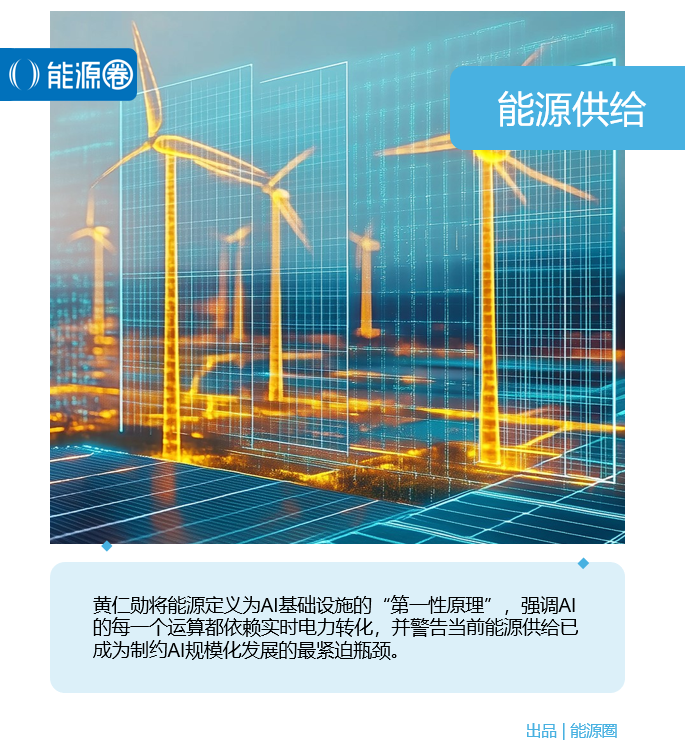
On Tuesday (local time), Jensen Huang, CEO of NVIDIA, penned a rare, in-depth blog post on artificial intelligence. This marks his seventh public long-form article since 2016, offering a systematic exposition of the fundamental logic underpinning the AI industry.
In this sweeping vision for the future, energy emerges as the first principle—the cornerstone—of AI infrastructure.
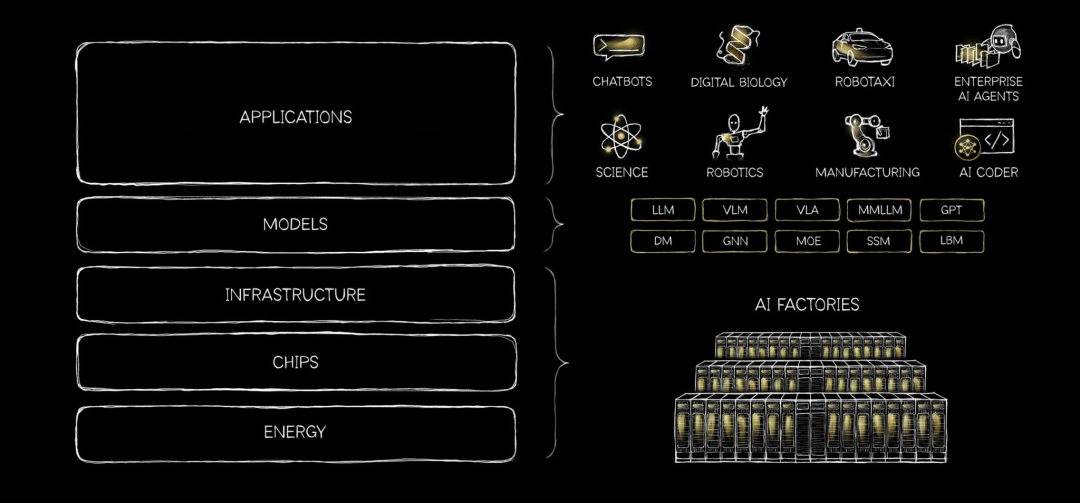
AI's 'Five-Tier Architecture'
To demystify the inner workings of the AI industry, Jensen Huang systematically outlined AI's 'five-tier architecture.' He likened it to a 'five-layer cake,' with energy, chips, infrastructure, models, and applications stacked from bottom to top. Each layer supports and propels the others, creating a synergistic ecosystem.
He underscored that any abstract discourse on AI must ultimately grapple with the tangible constraints of the physical world:
"Real-time generated intelligence demands real-time generated electricity."
Jensen Huang made it abundantly clear that AI's operation is far from an ethereal dance of code; it is a deeply physical process. Behind every Token (a unit of text) generated lies the movement of electrons, the generation and management of heat, and the concrete conversion of energy into computational power. In this intricate dance, there is no abstract layer that can sidestep the need for energy.
Amidst the frenetic pace of the current AI boom, Jensen Huang sounded a note of caution from a foundational standpoint: Energy supply has emerged as the most pressing bottleneck for the large-scale deployment of AI.
Despite the industry's hefty investments—hundreds of billions of dollars—in model development and chip iteration, if the underlying energy supply falters, all the progress made will be as ephemeral as castles built on sand. He highlighted that future AI factories will be designed not to store information but to 'manufacture intelligence,' necessitating massive, continuous, and real-time energy support.
This assertion thrusts the energy industry into the spotlight of the AI revolution. AI is no longer confined to the realms of semiconductors or the internet; it is morphing into an energy-intensive behemoth. In the future, the race for computational power will essentially be a race for power infrastructure; the scale of models will hinge on the carrying capacity of the energy grid.
Jensen Huang's article sheds light on a crucial fact for all stakeholders in AI development: Before delving into discussions on chip computational power, model parameters, and application deployment, we must first confront the most fundamental physical constraint—where will the electricity come from?
For the energy industry, this presents both an unprecedented challenge and a historic opportunity to shape the future.
The end goal of AI is intelligence, and the starting point of intelligence is energy.
-
![]()
Doubao Work Unveiled! Domestic AI Leaders Fully Commit to the 'Work' Sector
-
![]()
Who’s Sounding the Alarm on ‘Rushed Vehicles’?
-
![]()
Over 5.3 Billion Yuan in Losses Over Three and a Half Years! Can Yonyou Reverse Its Fortunes Through Streamlining and AI Transformation?
-
![]()
Baidu AI Adopts Free Model: A Strategic Maneuver in Traffic and Monetization
-
![]()
Silicon-Based OLED Pioneer Unveils Financial Results: H1 Shipments Outpace Entire 2025 Volume
-
![]()
AI's First "Lost Summer"
-
![]()
Zeiss Makes Another €2.2 Million Bet: Will Eye Tracking Be the Next Big Thing in the Smart Glasses Industry?
-
![]()
RUNTO Ranking | Global Top TV ODM Factories' Shipment Figures for July 2026