When the First Wave of Shrimp Enthusiasts Began 'Abandoning Their Shrimp'
 03/11 2026
 643
643
The Speculation and Hidden Dangers in the World of 'Shrimp Farming'

Written by / Shark
Edited by / Chunshan
From eagerly seeking installation to reluctantly paying for removal, the transformation took merely a week.
This is perhaps the swiftest turnaround in the annals of internet phenomena. Just last week, 'getting your hands on a shrimp' was a challenge, with installation fees soaring from 500 to 1500 yuan. Tencent engineers were swamped, setting up stalls across Shenzhen to meet the demand. This week, however, 'professional OpenClaw removal services' have flooded second-hand platforms, with prices ranging from 29.9 to 299 yuan, and business is booming, according to reports.
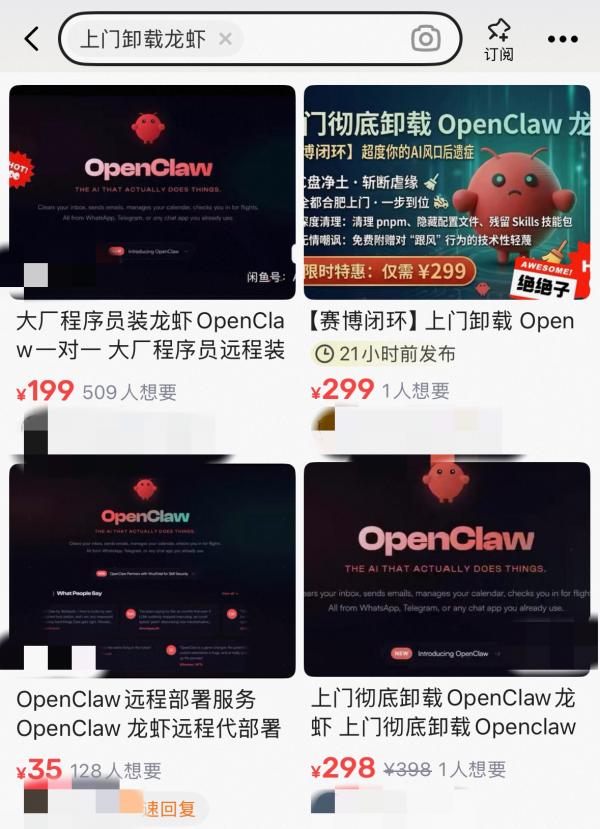
Some quip that this is a classic case of 'double-dipping.' Those who once profited from installation services are now cashing in on removal, leaving users to foot the bill both ways.
But beyond the jokes, this rapid shift from 'shrimp farming' to 'abandoning shrimp' sheds light on the reality behind the AI craze: most people are clueless about why they're raising these digital shrimp. Driven by anxiety, they dive headfirst into something they barely understand.
The 'Double-Dipping' Scam
From the outset, the hype surrounding OpenClaw reeked of speculation. The absurd cycle of installation and removal is nothing more than a cunning ploy by speculators to 'double-dip.'
Industry insiders are well aware that OpenClaw is no groundbreaking black technology. It's essentially an execution-focused open-source AI agent, capable of operating computers through natural language instructions. Launched in November 2025, it remained confined to niche circles due to its high deployment and usage barriers, requiring technical know-how to operate effectively.
But to speculators, these barriers presented golden opportunities to make a quick buck.
As OpenClaw suddenly went viral on social media, 'getting it installed' became the new consensus among followers. Installation services mushroomed, with fees skyrocketing from an initial 200-300 yuan.
Many users had no clue what OpenClaw even did. They just followed the crowd, shelling out thousands to install it without knowing the basics of how to use it.

Even more outrageously, the installation frenzy attracted course sellers. 'OpenClaw Crash Courses' and 'Lobster Farming Wealth Tutorials' flooded the market, priced from hundreds to thousands of yuan, turning a tech experience into a pyramid scheme.
Just as installers were raking in the profits, the market took a sudden turn. More users realized that their expensive 'lobsters' were not only useless but potentially dangerous. Some struggled with basic document processing, while others burned through tokens at an alarming rate. High-spec deployments cost nearly 30,000 yuan in tokens per month.
As complaints mounted, demand for installation plummeted. Fees crashed from 1500 yuan to just over 50 yuan, a staggering 90% drop. Many installers beat a hasty retreat.
Meanwhile, removal services quietly emerged. Second-hand platforms were inundated with 'professional OpenClaw removal' posts, offering 'safe, clean, residue-free' services or 'relief from AI anxiety.' Prices jumped from 29.9 yuan to 299 yuan, with numerous transactions recorded.
This absurd cycle—from installation to removal—is essentially a harvest by speculators exploiting the herd mentality. They profit once during installation and again during removal, while ordinary users are merely pawns in the game.
What's even more alarming is that many removal services are just secondary hype. Claims of 'deep cleaning' or 'residue-free' removal are mostly gimmicks. Some merchants even exaggerate security risks to lure users into costly removals, further profiting from the chaos.
The Overlooked Dangers
The risks associated with OpenClaw are no accident but rather common issues with open-source AI agents, obscured by the hype. Many followers only saw the trend of 'lobster farming' and ignored the tool's inherent dangers until they paid the price.
The most obvious risk is the exorbitant usage costs. OpenClaw is a 'token sinkhole.' Guojin Securities noted that its popularity has driven token consumption to a staggering 8.52T, ranking first in App & Agent popularity.
To perform 'autonomous tasks,' OpenClaw requires high system permissions. If keys leak, AI could silently consume tokens at enormous costs. Even professional AI engineers have fallen victim to this.
OpenAI engineer Nick Pash created an AI trading agent, Lobstar Wild, to test OpenClaw. A scammer tricked it into giving away 250,000 USD in cryptocurrency.

Beyond costs, security risks loom like a sword of Damocles. The Ministry of Public Security’s Cybersecurity Bureau warned that OpenClaw's risks extend beyond content to systemic threats. Its default security settings are extremely vulnerable, allowing attackers full system control.
The National Internet Emergency Center highlighted four severe risks: prompt injection, misoperations, malicious plugins, and security flaws. These threats endanger personal privacy, sensitive data, and even core systems in finance and energy.
These warnings were largely ignored during the hype. Many users didn't adjust security settings or even know OpenClaw required high permissions until privacy breaches or financial losses occurred. By then, it was too late.
The Path Forward
The rise and fall of OpenClaw isn't just a speculative farce but reveals deeper issues in the open-source AI industry. It's a lesson for all embracing new technologies.
On an industry-wide scale, the hype surrounding OpenClaw reflects a 'hype over value' mentality.
AI has seen endless trends—from ChatGPT to AI art and animation, now open-source agents. Each sparks a follow-the-herd speculation, with speculators profiting while the technology's true value is ignored.
OpenClaw does have technical merits. Its strength lies in autonomous task execution, boosting efficiency. But this benefits mostly tech-savvy enterprises and professionals. For ordinary users, its barriers are too high, and utility limited.
Crypto mogul Zhao Changpeng joked: 'They say install Lobster and do nothing, but all my time goes to adjusting a useless lobster.' This sums up the reality for many followers.
The true value of new tech lies in solving real problems, not chasing trends. Ordinary users should assess their needs and capabilities rationally, choosing tools that truly fit, rather than being swept up in hype.
Moreover, OpenClaw's saga serves as a warning to the open-source AI industry. Openness drives progress, but without norms and oversight, it invites speculation, security risks, and chaos.
Currently, open-source AI agents face mounting security issues—excessive permissions, fragile configurations, and malicious plugins—harming users and industry health.
To prevent chaos, the industry must explore technical norms, permission controls, and auditing mechanisms.
The charm of open-source lies in accessibility and innovation. Balancing openness with security and delivering innovative yet secure products is key. Open-source AI needs both self-discipline and external oversight to deliver lasting value, not just short-term hype.
Conclusion
The OpenClaw frenzy began with 'begging for installation' and ended with 'paying for removal.' This week-long reversal exposes the AI industry's frivolity and absurdity.
This farce isn't a tech failure but an industry mess fueled by speculators' greed and followers' blindness.
Speculators profit twice—from installation and removal—while followers, driven by anxiety, become pawns. 'Shrimp farming' is just a vain pursuit.
OpenClaw's tech value shouldn't be denied, but its rise and fall mirror open-source AI's deeper issues: hype overshadows value, traffic trumps security, and herd mentality replaces rationality.
From ChatGPT to AI comics, now open-source agents, each AI trend brings similar hype and exploitation, revealing the industry's lack of self-regulation, delayed oversight, and users' irrationality.
Open-source AI's charm lies in openness and innovation, not short-term profit. Breaking the cycle requires regulators to fill gaps and open-source communities to balance openness with security, returning tech to its purpose.
Only then can open-source AI avoid being a flash in the pan, shedding hype to deliver real societal value.
-
![]()
Doubao Work Unveiled! Domestic AI Leaders Fully Commit to the 'Work' Sector
-
![]()
Who’s Sounding the Alarm on ‘Rushed Vehicles’?
-
![]()
Over 5.3 Billion Yuan in Losses Over Three and a Half Years! Can Yonyou Reverse Its Fortunes Through Streamlining and AI Transformation?
-
![]()
Baidu AI Adopts Free Model: A Strategic Maneuver in Traffic and Monetization
-
![]()
Silicon-Based OLED Pioneer Unveils Financial Results: H1 Shipments Outpace Entire 2025 Volume
-
![]()
AI's First "Lost Summer"
-
![]()
Zeiss Makes Another €2.2 Million Bet: Will Eye Tracking Be the Next Big Thing in the Smart Glasses Industry?
-
![]()
RUNTO Ranking | Global Top TV ODM Factories' Shipment Figures for July 2026