Mocking Microsoft, Targeting White-Collar Workers: How Musk's 'Macrohard' Company Works for You
 03/13 2026
 604
604
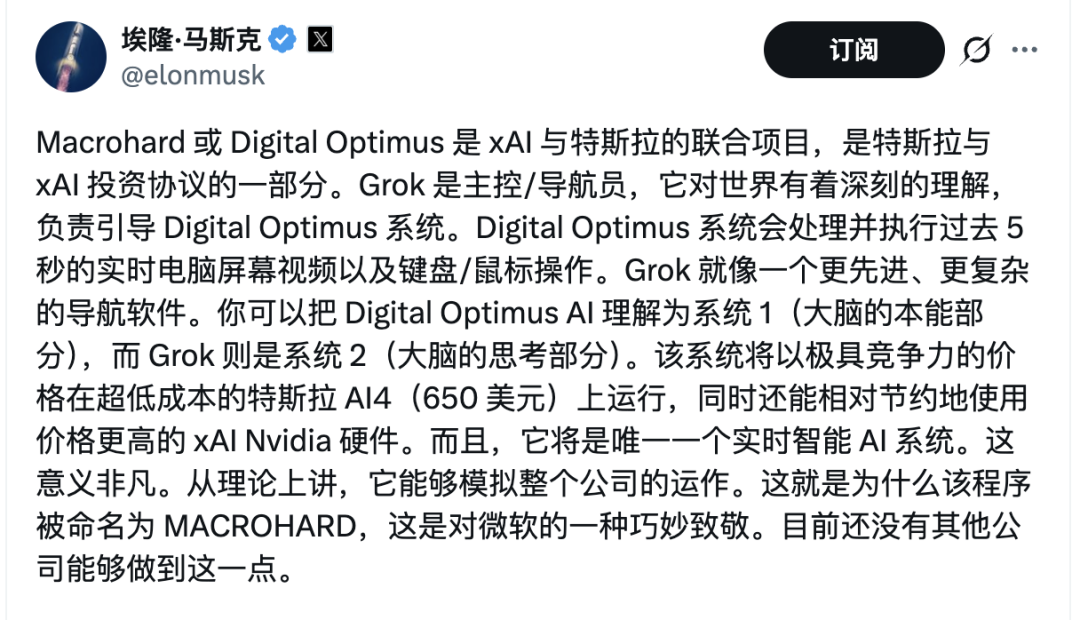
On March 11, 2026, Musk posted on X announcing that Tesla and xAI are jointly developing a new project, codenamed Macrohard.
The name is a play on Microsoft. Microsoft: micro software; Macrohard: macro hardcore.
Jokes aside, Musk defined the project in just one sentence: an AI system that can simulate the operations of an entire company.
This statement is worth pausing to consider. Not a smarter chatbot, not a better code assistant—Musk aims to simulate the operations of an entire company. AI is set to replace those sitting in offices operating computers; Musk is targeting white-collar workers!
● The Challenges of AI in the Workplace
Over the past two years, large language models have transformed how many people write. But one thing has barely changed: people still need to operate computers themselves.
After AI writes a copy, you still have to open your email and send it; after AI generates a report, you still have to upload it to the system. This 'last mile' problem in AI has spurred the development of a technology called AI Agents.
OpenAI's Operator and Anthropic's Computer Use both attempt to let AI directly operate computers—automatically filling out forms, sending emails, navigating web pages, and truly completing tasks rather than just answering questions.
But anyone who has actually used these tools knows: they are slow and unstable.
The reason lies in the architecture. Currently, mainstream AI Agents work by taking screenshots → analyzing → operating → taking more screenshots, waiting for the large model to respond at each step. It's like a person pausing to think for three seconds after every mouse click. While demonstration videos look smooth, real-world usage is frustrating.
This is an unsolved engineering problem, not a marketing issue.
● A Tesla-Style Solution
The architectural design of Digital Optimus fundamentally differs from existing AI Agents.
Current solutions treat the computer screen as a series of static images; Digital Optimus treats it as continuous video, reading the last five seconds of footage in real time to directly drive the mouse and keyboard.
This logic comes directly from Tesla's autonomous driving—cars face a continuous world on the road and cannot analyze screenshots every second without crashing.
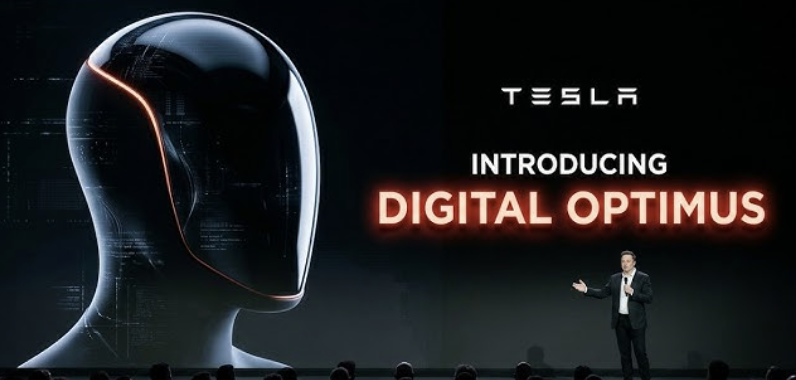
The system has two layers: the execution layer handles real-time operations, while the decision-making layer, powered by xAI's Grok model, understands tasks, plans steps, and intervenes when errors occur.
Psychology calls this System 1 and System 2—the division between intuition and rationality. When using a computer, humans instinctively click familiar buttons and only pause to think during complex judgments. Digital Optimus aims to replicate this fundamental human logic of computer operation.
This design is smarter than existing solutions. But there's still a long way between a clever design and a working product.
● Why Start with Software, Not Robots
Tesla's Optimus robot has been hyped for three years but progress has been slower than expected. The reason is simple: the real world is too complex.
A simple box-moving action involves visual recognition, path planning, grasping control, mechanical structure, and battery life—any failure in these areas causes the task to fail.
There's a saying in the industry: half the cost of a robot is in its hands. That's why almost all robot demonstration videos show painfully slow movements—not to showcase capability, but to hide limitations.
In contrast, the digital world is extremely forgiving. There's no friction, no gravity, no need for batteries, and failures can be instantly retried. Yet corporations are filled with such tasks: data entry, form filling, customer service, ERP processes.
These tasks were previously handled by RPA (Robotic Process Automation). The problem with RPA is that it cannot think—rules changes render it useless, requiring reprogramming for every business adjustment. Digital Optimus aims to replace it with AI that truly understands context—not just executing processes, but grasping intent.
Start by working in the software world to accumulate data and experience, then gradually move into the physical world.
● The Ace in the Hole: Millions of Vehicles' Computing Power
The most easily overlooked aspect of Digital Optimus is its computing power source.
Tesla currently has millions of AI-chip-equipped vehicles on the road, with their chips largely idle when not driving. Years ago, Musk proposed organizing this idle computing power into a distributed AI inference network.
If Digital Optimus's inference architecture is lightweight enough, this network could become its computing foundation—extremely low-cost, massively scalable, and growing automatically with Tesla's fleet expansion.
This is an advantage pure software AI companies struggle to replicate structurally. OpenAI needs to rent data centers, with costs rising linearly with usage; Tesla's edge computing network, once activated, has near-zero marginal costs.
Of course, this vision is still far from implementation, but it explains why the project's ceiling is much higher than it appears.
● The Biggest Risk Isn't Technical
Before Musk's official announcement, media had already reported internal project issues: frequent leadership changes, engineer turnover, and a training program involving 600 data annotators being abruptly halted. These are execution-level frictions, not uncommon in large projects.
The real trouble lies in corporate structure. Tesla is publicly traded, while xAI is Musk's private company. Digital Optimus relies on core assets from both—Tesla's chips and fleet, xAI's models.
Once the project generates commercial value, questions about profit distribution and technology ownership will become very real for shareholders and investors.
While Musk controls both companies and can push forward forcefully, this structure means pressure from either side could disrupt the project's rhythm. Tesla shareholders have repeatedly expressed dissatisfaction with Musk's divided attention. Technical routes can iterate, but corporate governance conflicts are harder to resolve.
-
![]()
Doubao Work Unveiled! Domestic AI Leaders Fully Commit to the 'Work' Sector
-
![]()
Who’s Sounding the Alarm on ‘Rushed Vehicles’?
-
![]()
Over 5.3 Billion Yuan in Losses Over Three and a Half Years! Can Yonyou Reverse Its Fortunes Through Streamlining and AI Transformation?
-
![]()
Baidu AI Adopts Free Model: A Strategic Maneuver in Traffic and Monetization
-
![]()
Silicon-Based OLED Pioneer Unveils Financial Results: H1 Shipments Outpace Entire 2025 Volume
-
![]()
AI's First "Lost Summer"
-
![]()
Zeiss Makes Another €2.2 Million Bet: Will Eye Tracking Be the Next Big Thing in the Smart Glasses Industry?
-
![]()
RUNTO Ranking | Global Top TV ODM Factories' Shipment Figures for July 2026