The Desperate Embrace of Lobsters by Middle-Aged People: A Reflection of Anxiety Over Technological Evolution
 03/15 2026
 721
721

The first major event of the year is intricately linked to a lobster that has taken the global internet by storm.
Stories about people queuing up at Tencent's Shenzhen headquarters to install lobster-related software, and programmers earning over 100,000 yuan monthly from these installations, have been fermenting across social platforms. From various seemingly absurd antics associated with lobsters, such as covert file deletions, public information disclosures, and exorbitant maintenance costs, to paid uninstallation services, this 2026 'sci-fi spectacle' lasted merely a few weeks.
Nevertheless, the 'lobster' phenomenon has broken free from its niche confines.
From a global perspective, companies are rushing to follow suit, and local governments are offering support. Among users, tech enthusiasts, entrepreneurs, and top-tier business leaders are all on board. On Xianyu, searches for lobsters surged by 1,850% month-on-month, with transaction volumes multiplying several times over. A comprehensive service ecosystem has emerged, encompassing tutorials, deployment guidance, Mac Mini M4 device rentals, memberships, and uninstallation services.
However, the most noteworthy group remains the middle-aged individuals bewildered by successive AI crazes.
As early as 2017, the keywords 'AI' and '35 years old' appeared simultaneously in a series of reports on 'Interface Workplace Annual Keywords.' Nearly a decade later, AI's presence in daily work has become increasingly pervasive, and the 'disconnection' caused by lagging AI awareness has once again swept over middle-aged people.
They seem to have become the busiest demographic in the AI circle—spending money, learning, complaining, and attempting to escape—fearing obsolescence yet feeling powerless to change their situation.
Middle-aged people, typically reluctant to spend, find their wallets being emptied by AI.
Undeniably, every technological innovation tends to evolve into a mass movement characterized by blind adherence, sweeping everyone along in its wake.
In the millennium era, people clamored for Xiaolingtong phones, fearing being left behind in the communication age. In 2010, crowds went wild for iPhone 4s, afraid of missing the mobile internet boat. The metaverse bubble and the nationwide AI craze in previous years were no different. By 2026, this fervor had precisely targeted a 'lobster.'
When survival is at stake, panic always outpaces reason. During the 'lobster craze,' office workers in major cities queued up for installations, as if not having this 'lobster' meant being eliminated from their positions and left behind by the times—especially for middle-aged individuals already anxious about workplace survival.
In contrast to the younger generation's enthusiasm for practically applying AI, middle-aged attitudes toward AI are intriguing.
The '2025 Workplace AI Application Trends Report' reveals that age serves as a natural divider in attitudes toward AI. The post-2000s and post-1995s generations, accounting for 57.3% of respondents, view AI as an 'efficiency boost.' In contrast, 62.5% of those born in the 1980s or earlier perceive AI as a threat to job replacement, nearly 9 percentage points higher than the post-2000s cohort.
The 2026 emergence of the 'cyber drudge' lobster further amplifies this anxiety. This generation of middle-aged people, unable to understand English documentation on GitHub or configure complex Python environments, finds themselves trapped in a passive dilemma: 'not spending means being eliminated.'
Installation, usage, uninstallation—each step drains middle-aged wallets. Initially, 'raising a lobster' incurs costs, a reality middle-aged individuals realize after paying for professional installations to secure their workplace positions.
Notably, these expenses are far from trivial.
Countless individuals have shared their 'lobster maintenance bills' on social media: some received 12,000 yuan Token bills at midnight; others spent 30,000 yuan in a month; some used over 800 yuan in half a day. Fu Sheng, who virtually single-handedly popularized lobsters, still incurs daily expenses exceeding 1,000 yuan for his 'Three Ten Thousand' lobster setup.

Based on Token consumption intensity, opting for domestic large models, light users spend approximately 50-200 yuan monthly on 'lobster maintenance,' moderate users around 200-500 yuan, and heavy users over 1,000 yuan monthly. Choosing foreign models like GPT-4 or Claude incurs even higher costs.
In fact, while Gen Z (aged 34 and under) and the silver-haired generation (aged 60-65) drive consumption as the 'dual engines' across various sectors, middle-aged groups tend to be the most conservative spenders. However, in the AI era, content platforms bombard users with messages like 'It's not you failing after 40' or 'OpenClaw is secretly working for you,' making spending on AI seemingly unavoidable.
The 'Workplace Human-Machine Symbiosis Evolution Survey Report' shows that 56.1% of workplace individuals are willing to pay for AI services. Some spend on tickets to attend offline 'lobster parties' and 'lobster salons' for better learning. Even before lobsters dominated online discussions, paid AI learning was already an inescapable topic for this generation of middle-aged people.
Reportedly, six AI courses on Douyin have sold over 10,000 units each. During the rise of ChatGPT and Sora, 'Everyone's AI Course: Zero-Based Entry' generated 50 million yuan in sales. 'ChatGPT AI Monetization Circle' on Knowledge Planet earned 2.79 million yuan in just 17 days.
With DeepSeek's arrival, 'Practical High-Efficiency Earning with DeepSeek' achieved approximately 480,000 yuan in total sales within seven days of launch.
Ironically, most middle-aged people voluntarily abandon consumer rationality in the face of AI. A China News Service survey reveals that nearly 50% of learners aged 31-40 are willing to pay 1,000-5,000 yuan for AI courses, topping the age distribution for this spending bracket.
What does 1,000-5,000 yuan represent?
In the third quarter of 2025, China's average per capita monthly consumer spending was just 3,004 yuan, with first-tier city households averaging 4,442 yuan—both below 5,000 yuan. This is hardly a consumption upgrade for middle-aged people but rather a reluctant compromise to buy security with money.
This fleeting 'lobster' craze exposes the most humble and absurd predicament of ordinary people amidst the tidal wave of technological change.
AI Illusion: Clutching at a 'Survival Straw'
Middle age brings workplace anxiety—a fate seemingly inscribed in the era's script, impossible to evade.
Over 90% of middle-aged people report feeling workplace pressure, a sensation accelerated in the AI era. When a single lobster nearly unravels the mental state of an entire middle-aged demographic, a harsh reality emerges: McKinsey surveys indicate that by 2030, roughly 30% of global occupational activities could be automated.
Following this trend, as AI's cost-effectiveness improves, middle-aged workplace mid-level professionals will inevitably depreciate faster.
Meanwhile, capital and the broader environment propagate a single narrative: AI as the last 'straw' for workplace survival in the future.
This is not mere rhetoric. After the lobster craze, new job demands are emerging.
Companies in Beijing, Shanghai, Shenzhen, and elsewhere have posted positions like 'OpenClaw Development Engineer,' 'AI Product Manager,' and 'OpenClaw Research Intern,' requiring skills such as 'familiarity with OpenClaw tools and practical deployment experience' and 'ability to build agents and automated workflows with OpenClaw.'
Across various course offerings, terms like 'monetization,' 'side hustle,' and 'passive income' abound. Categories range from AI photo editing and writing to AI design, translation, voice acting, and programming—directly creating an illusion for this generation of middle-aged people: acquiring an additional AI skill opens another career path, even if their main job is unrelated to AI.
Notably, AI penetration remains low in traditional industries crowded with middle-aged professionals.
For instance, energy, environmental protection, and real estate. The '2025 Workplace AI Application Trends Report' shows that 38.5% of employees in energy and environmental protection report their companies have not initiated AI training, while 31.8% in real estate believe future work models will remain human-centric.
Currently, AI systematized training coverage stands at just 12.2% in some private enterprises.
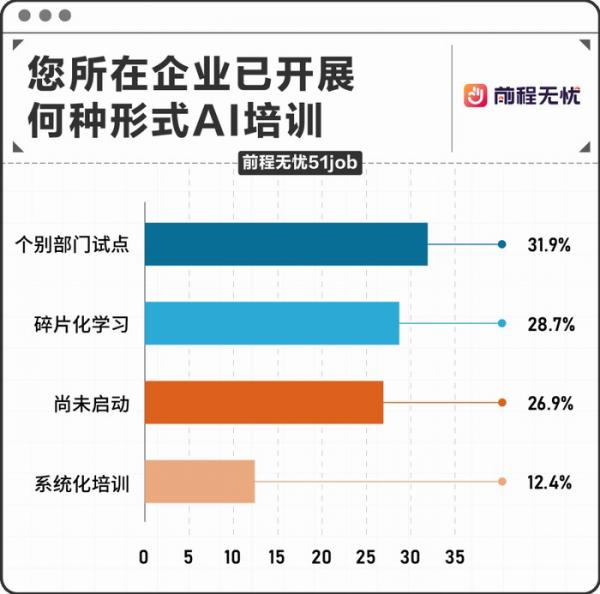
Despite this, middle-aged groups, ever eager to chase trends, fear falling behind—even if it means learning costs are silently shifted. When anxiety over skill iteration spreads to the majority, those already vulnerable to workplace marginalization inherently lack the courage to 'opt out.'
So, can AI truly serve as a genuine way out for middle-aged workplace self-preservation?
First, its value is undeniable. Generative AI's penetration in knowledge-based roles surged from 12% in 2020 to 37% in 2023, with administrative roles seeing 72.3% AI tool adoption. When repetitive tasks become exponentially more efficient, costs plummet, productivity soars, and users can redirect time to core work.
Yet, how much of this productivity dividend reaches self-funded trend-followers? The answer is cold and real. A joint study by the University of Chicago and the University of Copenhagen reveals that AI's impact on income is negligible—so small it's almost insignificant. Even when income grows, the increase rarely exceeds 1%.
Second, the myth of 'passive income through AI side hustles' is crumbling. Zhaopin surveys show that nearly 80% of workplace individuals use AI tools weekly, yet only 23.4% achieve paid conversions. Most are merely AI tool users, far from genuine 'beneficiaries.'
The lobster craze attempts to replicate early AI circle tactics. While few online cases showcase successful lobster 'raising,' each is highly shareable—such as Fu Sheng and his 'Three Ten Thousand.' Research reports by Founder Securities and GF Securities in March note that the lobster's viral explosion relied heavily on finance influencers amplifying the trend.
Indeed, manufacturing anxiety remains the best customer acquisition strategy, and ordinary people's best defense is refusing to be swept up in panic.
The 'Joy' of Technological Iteration Has Vanished
There was a time when technological iteration brought shared delight:
Xiaolingtong made long-distance calls affordable, the iPhone 4 launched the mobile internet at our fingertips, and WeChat and short videos allowed ordinary people to embrace digital life effortlessly. Back then, people eagerly chased new technologies with curiosity and anticipation—a pure, user-centric joy.
But in the AI era, this joy has quietly faded.
For some middle-aged groups, technological innovation is no longer a life enhancement but a source of survival anxiety. The lobster's rise and abrupt uninstall crisis, spanning just 45 days, caught countless users off guard.
A profound question arises: Is the joy of technological iteration disappearing because technology itself has lost its warmth?
Certainly not.
On one hand, the core focus of current technological iteration has shifted.
Early technological innovations always centered on life upgrades: Xiaolingtong addressed communication barriers, smartphones enriched entertainment, and the mobile internet made shopping and travel more convenient. These technologies added value to life, benefiting everyone effortlessly—no barriers, no obsolescence, only inclusive joy.
Today's AI, however, carries inescapable labels of automation, efficiency gains, and job displacement. The '2026 Global Talent Barometer' shows that the proportion of workers regularly using AI surged by 13 percentage points to 45% over the past year. Yet, their confidence in their technical abilities plummeted by 18%.
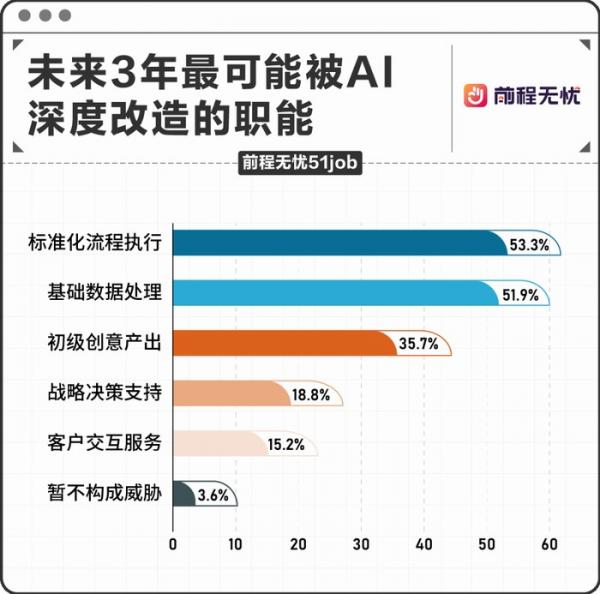
People once pursued technology to live better; now, they learn AI to avoid obsolescence. Under survival pressure, joy finds no foothold.
On the other hand, the entry barriers to technology keep rising.
Past technologies arrived user-ready: no learning, no cost, just instant convenience from texting, video streaming, or online payments. AI-era technologies, however, erect high professional walls.
GitHub documentation, Python environments, Token billing, and agent deployment all intimidate middle-aged users.
On social media, countless users have 'killed' their lobsters. Industry estimates suggest that environment deployment, installation, and configuration block 70% of ordinary people; skill selection and configuration deter another 20%; and memory and prompt optimization during actual use cause 5% more to quit.
In other words, fewer than 5% of all attempters can truly 'keep a lobster alive.'
Moreover, contemporary technology's commercial cycles and user experiences differ starkly from the past. After brief, frenzied hype, trends often collapse rapidly.
The 'lobster' went from nationwide installations to mass uninstallations in days. On March 11, lobster concept stocks plummeted—Zhipu fell 6%, MiniMax 9%. Trading platforms flooded with '299-yuan lobster uninstallation' posts, with merchants even advertising 'safe, thorough, residue-free' services.
In contrast, early technologies enjoyed stable growth cycles, mature products, positive experiences, and long-term value creation for users.
Finally, and most fundamentally:
Early technology popularization consistently conveyed the message that 'technology makes life better.'
Today, capital, training institutions, and influencers jointly craft 'obsolescence narratives.' Phrases like 'Those over 35 who don't learn AI will lose their jobs' or 'Not using lobsters means job abandonment' abound. A Cheung Kong Graduate School of Business study reveals that 34.13% of those heavily concerned about AI replacement suffer from depression—far higher than those anxious about economic downturns.
When all promotions amplify panic rather than pure technological sharing, no one can reclaim the joy of chasing new innovations.
-
![]()
Doubao Work Unveiled! Domestic AI Leaders Fully Commit to the 'Work' Sector
-
![]()
Who’s Sounding the Alarm on ‘Rushed Vehicles’?
-
![]()
Over 5.3 Billion Yuan in Losses Over Three and a Half Years! Can Yonyou Reverse Its Fortunes Through Streamlining and AI Transformation?
-
![]()
Baidu AI Adopts Free Model: A Strategic Maneuver in Traffic and Monetization
-
![]()
Silicon-Based OLED Pioneer Unveils Financial Results: H1 Shipments Outpace Entire 2025 Volume
-
![]()
AI's First "Lost Summer"
-
![]()
Zeiss Makes Another €2.2 Million Bet: Will Eye Tracking Be the Next Big Thing in the Smart Glasses Industry?
-
![]()
RUNTO Ranking | Global Top TV ODM Factories' Shipment Figures for July 2026