How AI Glasses Go From 'Must-Have Hit' to 'Return Hotspot'?
 03/13 2026
 479
479
Can They See Clearly and Withstand Scrutiny?
Written by / Li Xuanqi
Edited by / Chen Dengxin
Typeset by / Annalee
In the spring of 2026, the smart wearable device market presented a paradoxical scene.
On one hand, there was rapid growth: IDC data showed that China's AI glasses shipments surged by 107% year-on-year in 2025. At the start of 2026, with ByteDance's 'Doubao' project entering the fray and Apple's internal R&D intensifying, the track (market segment) became fiercely competitive. On the other hand, a chill set in: XR Visio monitoring revealed that the average return rate for AI glasses on mainstream e-commerce platforms reached 30%, while on Douyin (TikTok's Chinese counterpart), where live-streaming sales dominate, this figure soared to an alarming 40-50%.
So, while influencers were still flaunting the 'first-person perspective' coolness of AI glasses in short videos, real-world consumers were being deterred by red-pressed noses, embarrassing battery life, and after-sales service that passed the buck like a hot potato.
Several Reasons to Disenchant with AI Glasses
'Extremely disappointed. Don't follow the hype.' Chen Yi, who bought Rokid Glasses as a New Year's gift in early 2026, deeply regretted her purchase. 'I spent nearly 3,000 yuan—that's not easy money. But the glasses had severe light leakage, few functions, and the AI Q&A was unintelligent. I deeply regret not returning them.'
Over the past year, Chen Yi was not alone in disenchanting with AI glasses.
A search on social platforms like Xiaohongshu and Weibo reveals numerous complaints about AI glasses, with more gripes than imagined.
First is wearing comfort. While many brands now compete on frame weight—a top concern for users—Zinc Scale's research found: Xiaomi AI Glasses weigh 40g for the bare frame and ~50g with plano tinted lenses; Thunderbird V3 weighs 39g; Ray-Ban Meta Wayfarer weighs ~49g with lenses; Quark AI Glasses S1 series weighs 51g; Meizu StarV Air2 weighs 44g; and Li Weike View AI Glasses weigh 38g...
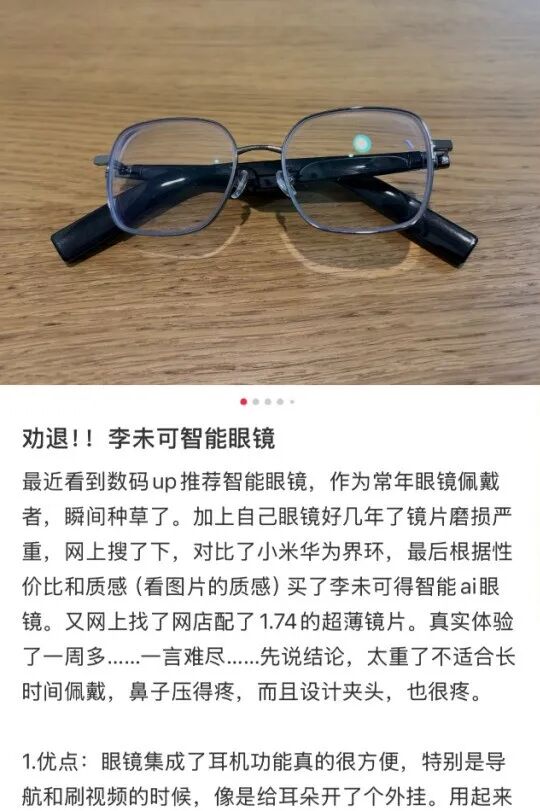
Image source: Xiaohongshu
In short, most AI glasses on the market weigh between 36-50g. According to DT Business Insight, even the '20% lighter than mainstream industry' Ideal Livis (36g) is heavier than ordinary prescription glasses (typically ~20g for frame + lenses).
Influencer 'Liangliang' mentioned buying Li Weike AI Glasses and pairing them with 1.74 ultra-thin lenses, only to find them 'too heavy for prolonged wear, causing nose pain.' Many commenters agreed: 'Definitely too heavy. Gave up after three days.'
Notably, a consumer recently told media that a Rokid (Leqi) AI smart glasses purchased via WeChat's official mini-program had glue cracking on the temple and the temple falling off during normal use, causing the lenses to shatter.
If wearing discomfort already pushes many to 'quit the fandom,' the functional flaws of AI glasses disappoint users even more.
For example, influencer 'Pengpeng & XiaoQ' posted a guide to avoiding Rokid AI Glasses pitfalls, citing issues like battery life: 'The biggest complaint is the battery—it drains way too fast. Light daily use drains it in half a day, forcing you to carry a charger everywhere. Too troublesome.' Others said 'With voice wake-up on, the battery only lasts two hours.' This isn't unique to Rokid; users reported Ideal's AI glasses 'went from 100% at 11 AM to 20% by 6:30 PM with full charge.' Similarly, Thunderbird's RayNeo V3 was criticized by netizen 'Maogu Yaya' for 'draining from 100% to 20% in an hour just restarting and connecting Bluetooth.'
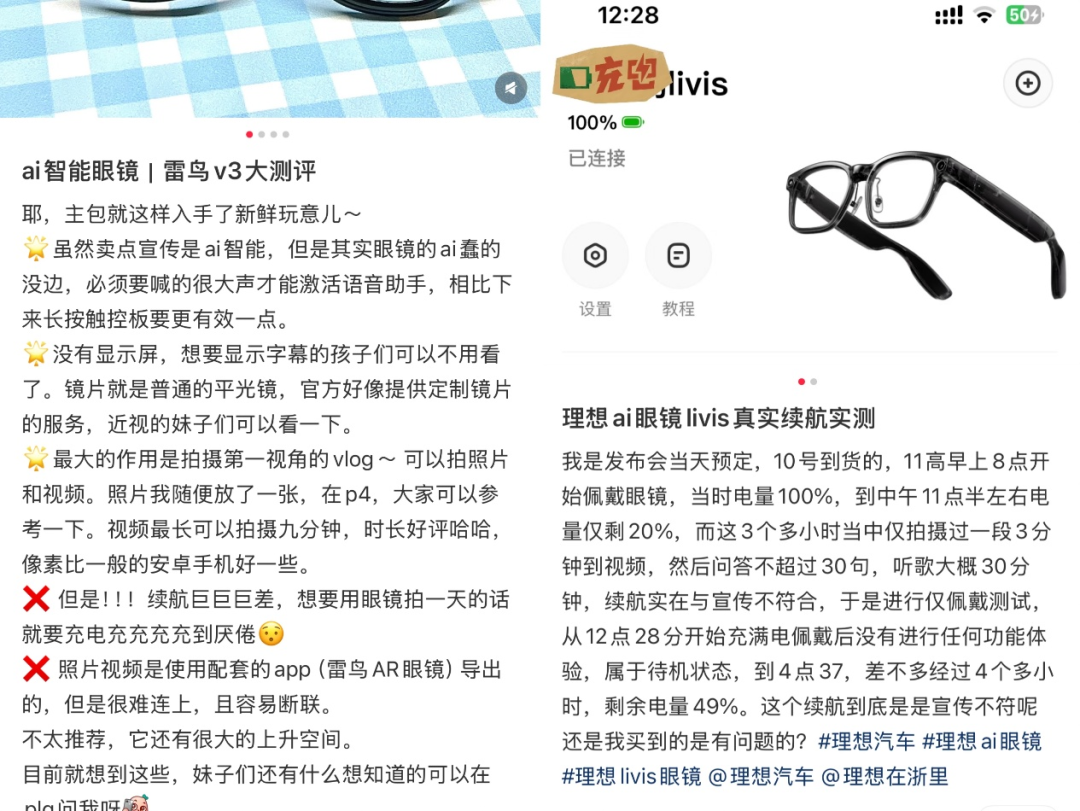
Battery life is a top concern for users
Though Xiaomi claims 21-hour standby and ~8.6-hour active use, and Quark highlights 'infinite battery life with swappable batteries' (its S1 has an internal and removable battery for alternating use), users widely doubt AI glasses' battery performance.
Interaction issues also drive returns, such as 'Xiaomi's answers are too quiet to hear outdoors,' 'Li Weike AI Glasses sometimes don't respond, or the app answers but the earphones stay silent,' and 'Thunderbird X3 Pro's dialogue is too slow, no continuous conversation support.'...
All this has made counters in Shenzhen's Huaqiangbei—the 'National Electronics First Street'—keenly sense the market's cooling. By 2026's Spring Festival, cheap 'no-brand' smart glasses that once flooded the area were largely removed. When Securities Times interviewed Huaqiangbei vendors, the reply was: 'If products don't sell, why keep displaying them?'
Many Issues, But Hard to Get After-Sales Support
Consumers' disenchantment with AI glasses isn't unfounded.
In 2025, Guangdong Provincial Consumer Council, Shenzhen Consumer Council, and Zhongshan Consumer Council jointly conducted comparative testing of smart AI glasses. Results showed 13 of 15 samples had app vulnerabilities prone to tampering and repackaging. In battery life, Xuanjing, Yinhaosi, INMO, Thunderbird, and MYVU performed poorly. For intelligence level, Li Weike, Kreet, and Ray-Ban underperformed.
Specifically, intelligence level evaluated whether samples had exclusive AI assistants, teleprompters, contextual smart services, gesture controls, and other innovations, rated by feature count and execution. Six samples like Jiehuan and Moyou lacked smart innovations, while three like Li Weike, Kreet, and Ray-Ban had only two.
Warranty periods and services vary widely among mainstream brands. For example, Rokid and Thunderbird offer 1-year whole-device warranties; Xiaomi and Huawei provide 'nationwide after-sales'; the LOHOxShanji collaboration adds lifetime free cleaning, adjustments, and vision checks beyond the 1-year warranty; Ideal Livis Zeiss supports prescription lens maintenance. Some no-brand products offer inadequate warranty protections—consumers should scrutinize exclusion clauses, retain receipts, and ask about 'trade-in' services.
Yet on consumer platforms like Heimao Tousu (Black Cat Complaints), more complaints about AI glasses concern returns/exchanges and poor after-sales attitudes than quality issues themselves.
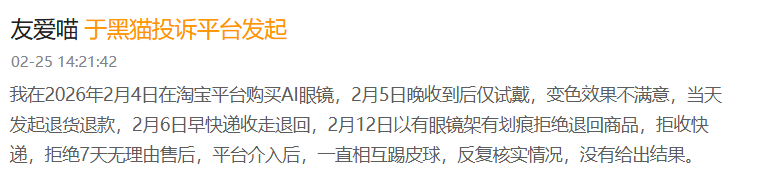
Image source: Heimao Tousu
One consumer complained: 'I bought AI glasses on Taobao on Feb 4, 2026. After trying them on the evening of Feb 5 and disliking the tint effect, I initiated a return the same day. The courier picked them up on Feb 6, but on Feb 12, they rejected the return, claiming scratches on the frame, refusing the 7-day no-reason return. After platform intervention, they kept passing the buck without resolution.' Another said they bought Meizu AI glasses in Nov 2025: 'They stopped working on Dec 26. After sending them in, Meizu's after-sales never replied—my glasses vanished. Can't reach customer service either.'
On Xiaohongshu, an influencer said after breaking Meizu StarV AI Glasses lenses, repair costs hit 1,900 yuan: 'Official after-sales quoted exorbitant fees without providing inspection reports.' Netizen 'Sylvia' said her Thunderbird AI Glasses' nose pad snapped: 'Asked customer service—no parts available, so no fix... A thousand-dollar glasses with online-only after-sales—what a struggle. Can't use them, can't return them.'
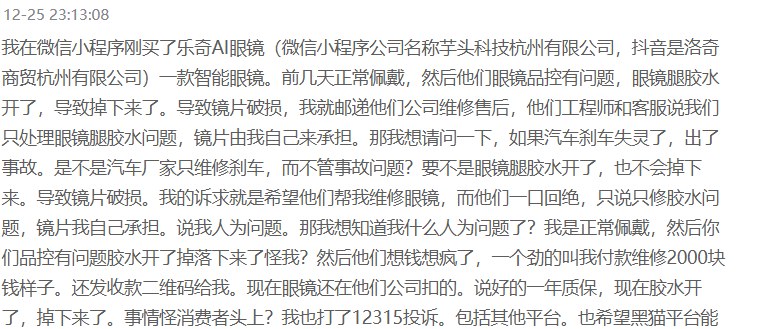
Repair difficulties aren't isolated. On Heimao Tousu, a consumer said they bought Leqi AI Glasses via WeChat mini-program: 'After normal wear, the frame's glue cracked, causing the leg to fall off and lenses to break. Sent them for repair, but engineers/customer service said they'd only fix the glue issue—I'd have to pay for the lenses myself... Supposedly a 1-year warranty, but now they blame the consumer for the glue failing.'
Zinc Scale found AI glasses' after-sales chaos centers on three issues: 1) Vague warranty scopes—many brands label obvious quality issues like frame cracks or lens breaks as 'user damage,' refusing free repairs, leading to tug-of-war over 'quality' vs 'user error'; 2) High return thresholds—rejecting legitimate returns citing 'unsealing/activation' or 'impacting resale'; 3) High rights protection (rights protection) costs—consumers must repeatedly contact customer service, with some brands ignoring complaints, forcing consumers to escalate via complaint platforms or legal action, wasting time and effort.
Recall that in 2012, Google launched Google Glass as a 'moonshot' to revolutionize human-world interaction, but it folded in just three years due to high costs, immature functions, and privacy controversies.
Today, AI glasses again stand at a crossroads. They're a 'darling' of capital and giants, with surging sales, yet a 'pariah' for consumers voting with their feet, as return rates soar.
The industry's high return rates, poor quality control, and chaotic after-sales stem from 'hype' and 'short-termism.' With AI's rise, AI glasses are seen as the next big personal mobile gateway after smartphones. Alibaba, Huawei, Xiaomi, and others rushed in to grab market share during the hype, trapping the industry in a cycle of 'heavy marketing, light R&D' and 'quantity over quality.' The lack of after-sales systems further fuels consumer dissatisfaction.
When will AI glasses truly 'see clearly and withstand scrutiny'? The answer likely lies not in the next product launch's flashy screen, but in attention to detail—from quality control to after-sales.
-
![]()
The Unstoppable Rise of 'Optical Progress and Copper Decline': Sunny Optical’s Strategic Vision for the Next Decade
-
![]()
AI + Going Global in the Second Half: No Intermission for Robot Vacuum Cleaners
-
![]()
The Suffering Endured in E-commerce, Walmart Doesn't Want to Repeat in AI
-
![]()
What Does the Doubling of New Energy Vehicle Exports Mean?
-
![]()
Ghosn: 'Only I Can Save Nissan'
-
![]()
Volkswagen Lays Off 100,000 Employees, The Elephant Sits Down
-
![]()
Expanding Production Capacity! Yutong Optics Acquires Approximately 1.5 Hectares of Industrial Land in Chang'an, Dongguan
-
![]()
Why Is Nokia Making a Comeback in the AI Era?