After Visiting AWE 2026, I Realized Consumer Electronics Have Finally Found a New Path
 03/13 2026
 502
502
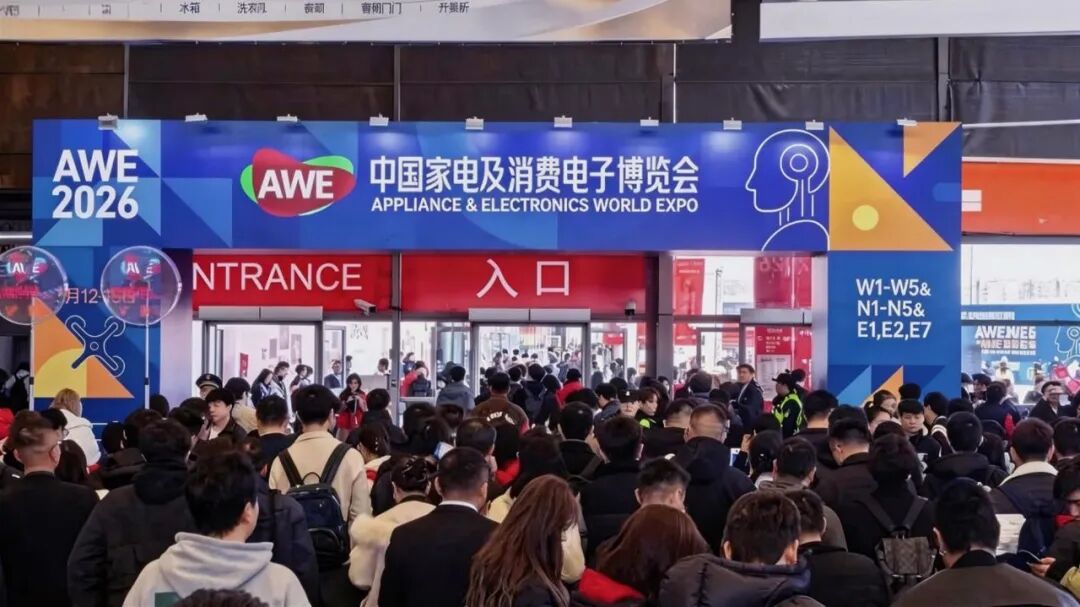
When AI pushes home appliances to their limits, China's consumer electronics industry has finally shifted its battleground.
Unlike previous years, few people at this year's AWE discussed the capacity of new refrigerators, the resolution of TVs, or the energy efficiency of air conditioners. Instead, most conversations revolved around "AI-native smartphones," "humanoid robot experience zones," and "L4-level smart home appliance suites."
As one of the world's top three home appliance and consumer electronics expos, AWE has been around for over three decades. In past exhibitions, the industry's core focus has always been on "upgrades"—white goods competed on larger capacities and quieter operation, black goods on higher resolutions and thinner profiles, and consumer electronics on faster performance and longer battery life.
However, the narrative logic of the entire industry underwent a complete shift at AWE 2026.
Over the past decade, the parameters, prices, and channels that Chinese home appliance companies fiercely competed on have nearly disappeared at this year's AWE. Instead, all leading brands are desperately focusing on one thing: full-scenario AI-native intelligence.
According to official AWE information, this year's expo, themed "AI Technology, Smart Future," brought together over 1,000 domestic and international exhibitors. For the first time, AI-related exhibits accounted for more than 55%, surpassing traditional white and black goods to become the largest category.
The impact of this change is even more evident when walking through the exhibition halls.
High-end flagship home appliances that once occupied prime positions have largely been replaced by AI-native products this year. The areas with the longest queues are no longer celebrity-endorsed brand events but robot, AI glasses, and intelligent agent home appliance experience zones, with waiting times at popular booths often exceeding half an hour.
Take Haier Smart Home as an example—its "robot + smart home appliance" system can now recognize various household scenarios and begin sharing household chores, bringing unmanned housework (household tasks) closer to reality. At the event, Haier's home robot demonstrated a work scenario: in the kitchen, newly purchased ingredients no longer require manual sorting. The robot automatically transports them to the refrigerator, uses barcode or visual recognition to store mutton in the freezer, vegetables in the refrigerator, and nuts in the dry goods area, while the refrigerator simultaneously initiates the corresponding preservation program.
In other words, since the rise of smart home appliances in 2014, China's consumer electronics industry has finally bid farewell to the era of "pseudo-intelligence," where "connectivity equals intelligence and voice control equals AI." Powered by AI large models, the industry has truly reached the threshold of "proactive intelligence."
This battle unfolding in Shanghai's exhibition halls also signals that China's consumer electronics industry has completely left behind the old era of parameter competition and entered a new cycle of ecosystem competition.
01
From "Parameter Competition" to "AI-Native": The Fundamental Logic of Consumer Electronics is Completely Reconstructed
Over the past five years, the entire consumer electronics industry has been trapped in a cycle of parameter competition, with nearly every category hitting the ceiling of hardware upgrades.
In the white goods sector, refrigerator capacities have surged from 400 liters to over 600 liters, exceeding the reserved kitchen space in ordinary households. Air conditioner energy efficiency ratios have reached the national standard ceiling for top-tier efficiency, with further improvements requiring exponentially higher R&D costs. Washing machine drying technologies and cleaning capabilities now meet the daily needs of most households, making it difficult to form differentiated competitiveness.
In the black goods sector, TV resolutions have climbed from 1080P to 4K and then 8K. However, according to public data from domestic streaming platforms, most users' daily viewing content doesn't even fully cover 4K. Screen refresh rates have jumped from 60Hz to 120Hz and 240Hz, but ordinary users cannot perceive these differences in daily viewing. Panels have become thinner and bezels narrower, yet these changes bring negligible improvements to user experience.
The smartphone industry is no exception. Processor performance upgrades annually, but users rarely need such power for daily activities like watching videos or chatting on WeChat. Camera pixels have soared from tens of millions to 100 million and 200 million, yet most users' photos end up as compressed images on social media. Fast-charging power has surged from tens of watts to 200 watts, but the difference between a 10-minute and 20-minute charge is insignificant for daily use.
The end result of parameter competition is industry-wide growth stagnation.
Data from the National Household Appliance Industry Information Center shows that China's home appliance market reached RMB 846.1 billion in full-channel sales in 2025, a slight 0.1% year-on-year decline, nearly hitting a growth bottleneck. The smartphone market faces even greater challenges—according to IDC's 2025 domestic smartphone market report, annual shipments reached 285 million units, down 0.6% year-on-year, while user replacement cycles have lengthened from 18 months to over 36 months.
Everyone in the industry knows that simple hardware parameter upgrades can no longer attract users. What consumers need are not "bigger, faster, clearer" hardware but products that truly solve life's pain points and improve efficiency. AI is the core variable capable of breaking the industry's deadlock.
This was fully evident at this year's AWE.
02
From "Passive Execution" to "Proactive Service": AI-Native Reconstructs Product Logic
At this year's AWE, nearly all leading manufacturers abandoned simple parameter comparisons and instead made AI capabilities the core selling point of their products. More critically, the AI here is no longer the pseudo-intelligence of "adding a voice assistant to hardware" but native products built around AI capabilities from the initial design stage.
Traditional smart home appliances essentially operated on a "human gives instructions, machine executes" model. You say, "Turn on the air conditioner," and it starts. You say, "Set the refrigerator to preservation mode," and it adjusts the temperature. Throughout this process, the machine remains a passive tool, requiring constant human instructions to perform operations—essentially just replacing the remote control with voice commands without altering the product's core logic.
In contrast, AI-native home appliances at this year's expo have achieved a full-process closed loop (closed loop) of "proactive perception, autonomous decision-making, and automatic execution." The most typical example is Haier Smart Home's global debut of the Seeker, the first L4-level intelligent agent home appliance suite. Equipped with Haier's self-developed AI Eye 2.0 technology, it uses sensors and cameras throughout the home to perceive environmental changes and user behavior patterns in real time, even anticipating user needs.
Midea directly held a strategic launch event at the expo, unveiling its "Three Ones" strategy for whole-house intelligence: one smart home network, one intelligent brain, and one open platform. Simply put, this equates to equipping the entire home with an operating system. Future homes should not be a patchwork of smart devices but an organic whole that collaborates, thinks, and understands users.
Even Gree, previously conservative about intelligence and focused on "core technologies," fully embraced AI this year. Gree's AI-centric whole-house interconnection system, as introduced by Gree Electric CMO Zhu Lei, is not an ordinary voice interaction system but an energy interaction system. "When other household devices, such as rice cookers and refrigerators, connect to Gree's air conditioner, the built-in AI 2.0 dynamic energy-saving algorithm empowers all connected appliances to operate using this energy-saving logic," he explained.
Beyond home appliance brands, cross-industry players have further escalated this AI ecosystem war. Huawei showcased its HarmonyOS Smart Home ecosystem at AWE. Take the newly unveiled Xiaoyi Butler 6.0, for example—deeply integrated with AI large model technology, users no longer need to remember complex device names. A simple command like "Dim the light beside the sofa" combined with 3D directional lighting control allows precise light adjustments. Moreover, from smartphones to cars, from living rooms to bedrooms, Huawei is reconstructing the logic of interconnected everything with AI.
03
The Collective Turn of Traditional Home Appliance Manufacturers
The most surprising aspect of this year's AWE was not the AI concepts pushed by internet companies but the collective pivot of traditional home appliance manufacturers.
In the past, many believed traditional home appliance makers understood AI merely as "adding a voice module to products" and struggled to create genuine AI-native solutions. However, at this year's expo, leading traditional manufacturers like Haier, Gree, Siemens, and Robam all unveiled truly differentiated AI-native products, shattering stereotypes.
The common trait of these products is that AI capabilities are no longer an additional feature but the core determinant of user experience. Decades of accumulated understanding of user needs and hardware expertise, when combined with AI technology, have unleashed remarkable vitality.
When it comes to implementing AI for consumers, traditional home appliance manufacturers with decades of experience in household scenarios have found the right path earlier than internet players accustomed to traffic-driven logic. They better understand real-life user scenarios, recognize pain points in home appliance usage, and possess stronger hardware R&D, production, and supply chain capabilities to truly integrate AI into products rather than keeping it at the conceptual level.
As a veteran home appliance industry insider told me at the expo: "Internet companies approach AI by first building a cloud-based large model and then seeking application scenarios, often ending up with 'AI for AI's sake.' But we've spent decades with home appliances and user lifestyles. We know what users need when they wake up, when they return home from work, and what troubles they face while cooking. For us, AI development starts not with how flashy the technology is but whether it solves a real user problem."
04
Transformation Isn't Just Sloganeering—True Intelligence Must Always Focus on Users
This year's AWE undoubtedly marks a major turning point for China's consumer electronics industry. It signals the end of a decade-long era of parameter competition and price wars, as well as the official arrival of the AI-native full-scenario intelligence era.
Over the past 30 years, China's consumer electronics industry has evolved from contract manufacturing and imitation to independent R&D and global leadership through continuous self-revolution. Now, this new revolution has begun. AI brings new growth opportunities but also new challenges to the industry.
We must remember that AI is never the goal but a tool. Whether for smart home appliances or full-scenario ecosystems, the ultimate purpose is to provide users with a better life experience—not to hype concepts, tell stories, or capture market share.
Transformation isn't just about slogans or slapping an "AI" label on products and calling them intelligent. True intelligence solves real user pain points, makes life more effortless and comfortable, and allows users to unknowingly feel the warmth of technology without adding complexity.
At this year's AWE, we saw both the infinite potential and much hype in China's consumer electronics industry. In the future, those who truly focus on technological R&D, solve real user pain points, achieve cross-brand interoperability, and protect user privacy will ultimately prevail in this new war.
Original article by Xinmou
— END —
-
![]()
Hardware is the skeleton, AI is the soul, and data integrates the two
-
![]()
China’s AI Industry: A Unified Pivot Towards Monetization?
-
![]()
New Progress! Infineon Completes Acquisition of ams OSRAM's Non-Optical Sensor Business
-
![]()
35 Million Bet on an Optical Future! Tengjing Technology Makes a Move in AR
-
![]()
Why World Models Get Stuck on Construction Roads in Autonomous Driving Applications
-
Alibaba Initiates Cultural Transformation: Is Jack Ma Making a Strategic Comeback?
-
Tianfeng Heads to Hong Kong for IPO with RMB 3.8 Billion in Funds: Xingyu's Cross-Border Foray into Embodied AI Faces Uncertain Future
-
![]()
Mengshi Auto’s High-End Aspirations Dashed: Huawei Partnership Fails to Revive Sales, New Model’s Entry Price Dips Below 300,000 Yuan