National Frenzy Over 'Shrimp Farming': The 'Appropriation' Carnival Among Tech Titans
 03/13 2026
 724
724
LAIKA
2026/03/12
If Everyone Becomes a 'Shovel Seller,' Who Will Be Left to Mine for Gold?
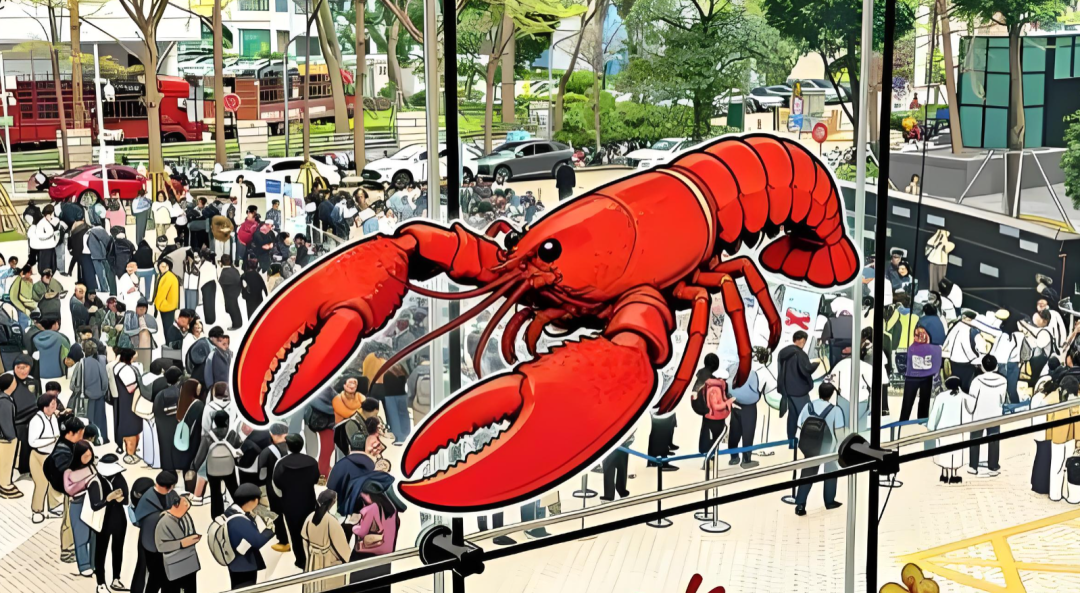
The recent 'shrimp farming' craze, sparked by the open-source AI agent OpenClaw (affectionately dubbed 'Lobster'), has continued to gain momentum, now entering its second phase.
This trend, which originated in the tech community and has since spread to the general public, has prompted China's tech giants to spring into action. Their rapid response and heavy investment have even eclipsed the recent Lunar New Year 'AI Red Packet War' in intensity.
While OpenClaw's emergence has shed light on the future of AI, it has also exposed a deep-seated structural contradiction within China's AI industry: Why do disruptive technological innovations consistently originate from agile startups rather than from well-funded, technologically advanced, and user-rich tech giants? When 'appropriation' becomes a shortcut and giants rely on their capital and channel advantages to 'copy assignments,' what does this mean for China's drive for independent AI innovation?
01
Tech Giants Dive into the 'Shrimp Farming' Frenzy as 'Shovel Sellers'
The commercial warfare in the AI era remains as straightforward as it is surprising.
Just a month ago during the Lunar New Year, tech giants spent billions on an AI red packet war to attract users. However, the 'shrimp farming' craze has excited internet giants even more intensely and frenziedly.
In late January, Alibaba Cloud and Tencent Cloud nearly simultaneously launched one-click OpenClaw deployment services. In February, Baidu Smart Cloud introduced related mirroring services. In March, Tencent Cloud engineers set up a 'stall' outside Shenzhen's Tencent Building to install OpenClaw for developers free of charge. Pony Ma commented on WeChat Moments, 'I never expected it to be this popular.' ByteDance's Feishu hosted 'Shrimp Play Parties,' while Volcano Engine launched the plug-and-play ArkClaw. Xiaomi initiated a small-scale closed beta for its 'Phone Lobster,' Xiaomi Miclaw, with Lei Jun hyping it up through three Weibo posts. On March 11, Baidu Smart Cloud released its zero-deployment service, DuClaw...
By March 11, at least 15 domestic tech giants and dozens of listed companies had intensively deployed OpenClaw-related services, even triggering a surge in OpenClaw concept stocks.
On the surface, tech giants are embracing new technologies to meet market demand. However, a closer look reveals a highly consistent core strategy: becoming 'shovel sellers' in the AI era. By providing convenient deployment tools, stable cloud computing power, and deep integration with their ecosystems, they transform users' 'shrimp farming' needs into dependencies on their cloud resources, model services, and traffic entry points. This model, both familiar and lucrative, enables rapid monetization while reinforcing ecological barriers—a win-win scenario.
An insider at a cloud provider calculated: A heavy 'shrimp farming' user consumes 30 million to 100 million tokens daily. In contrast, an average ChatGPT user, even chatting daily, consumes only millions monthly. Thus, each OpenClaw deployment drives dozens of times more computing power consumption for cloud providers.
No wonder Pony Ma excitedly listed his products on WeChat Moments: 'Self-developed lobsters, local shrimp, cloud shrimp, enterprise shrimp, cloud desktop shrimp, secure isolated shrimp pens, cloud security guards, knowledge bases... and more products are on the way.'
From 'money-throwing' red packet wars to 'money-making' shrimp farming, tech giants seem to have found their comfort zone in the AI era.
02
Why Do Tech Giants Frequently Miss Out on Groundbreaking AI Innovations?
Reviewing the past four years of AI evolution reveals a strikingly similar pattern at each breakthrough.
In 2022, OpenAI, a non-profit research institution, tore open the generative AI gap with ChatGPT. In early 2025, the obscure DeepSeek exploded in popularity, breaking large model cost barriers through extreme algorithmic optimization and open-source strategies—few even knew its backer, Fantasy Square Quantitative, was behind it. Earlier this year, OpenClaw, created by an independent Austrian developer, began as a weekend experiment in November 2025. Its GitHub stars rapidly surged to an all-time high, igniting the 'shrimp farming' craze.
These events expose a stark yet embarrassing reality: Why do groundbreaking AI innovations consistently emerge from obscure startups rather than from domestic giants with massive data, capital, and user bases?
In November last year, ByteDance's 'Doubao Phone' was hailed as a breakthrough for AI agents on mobile devices. It aimed to free AI from app confinement by embedding it directly into the operating system for true intent recognition and task execution. However, this forward-thinking product was jointly blocked for threatening super-apps' ecological interests and security boundaries, ultimately failing.
For tech giants, unlike Doubao Phone's ambition to become an entry point, OpenClaw is a money printer. Every OpenClaw use consumes vast tokens, flowing into cloud and model providers' accounts. This explains the fundamental difference: Doubao sought to be an entry point; OpenClaw gladly serves as a pipeline.
Tech giants' frequent absences and interest conflicts touch on China's AI industry's core pain point: the 'innovator's dilemma.' For giants like Tencent and Alibaba, their core businesses have formed strong moats. Any disruptive innovation first threatens their existing profit models. Thus, their decision-making naturally leans conservative, prioritizing KPIs and short-term returns. They prefer incremental innovations within existing frameworks or 'safe, deliverable' projects over risky ventures into uncharted territory. In contrast, startups, with nothing to lose, must innovate to survive—this 'do-or-die' pressure fuels creativity.
Tech giants excel at reaping rewards in certainty, while startups thrive at creating amid uncertainty. The AI paradox: The more resources one has, the less willing they are to bet on the future; the less one has, the bolder they are in shaping it.
03
Who Will Drive Independent Innovation After 'Appropriation' Becomes the Norm?
Observing today's AI race, tech giants' strategies are highly homogenized: When ChatGPT trended, they followed with large models; when Sora trended, everyone pursued video generation; when DeepSeek trended, all integrated its models; now, with OpenClaw's popularity, all offer one-click deployment services. Like shrewd merchants, they wait for startups to validate directions before swiftly stepping in as 'shovel sellers'—providing computing power, models, and traffic entry points to earn infrastructure fees, commercializing innovations through capital and ecological advantages.
Commercially, this 'follow-the-leader' strategy is logical. Innovation requires trial and error, which is costly. Startups can gamble everything on a direction and restart if they fail; tech giants, accountable to shareholders, cannot easily bet on unproven fields. After startups pioneer directions and validate markets, tech giants enter with capital, channels, and user advantages, packaging startup tech into standardized cloud services, APIs, or pre-installed software, rapidly scaling through strong sales networks. This model succeeds commercially, granting giants quick cash flow and user growth.
However, when 'appropriation' becomes path-dependent and 'buying users with money' the sole competitive means, will tech giants retain motivation for independent innovation? Over time, their R&D teams may degenerate into 'adaptation teams'—fitting the latest open-source models rather than creating new paradigms, gradually losing their role as technological definers.
OpenClaw's explosion is fundamentally a triumph of community-driven and technological democratization. It proves decentralized innovation outperforms centralized resource stacking—great products speak for themselves. AI's core competitiveness lies in model capabilities, scenario understanding, and user experience refinement, which cannot be rapidly acquired through 'money-throwing.'
The 'shrimp farming' craze mirrors both the vitality and concerns of China's AI industry. After selling 'shovels' for a while, tech giants will realize only by 'mining' themselves can they find the next goldmine. Breaking path dependence and redefining their AI-era roles is key—not just for their fate but for China's global AI standing.
Epilogue
OpenClaw's explosion marks AI agents' transition from 'talkative' to 'doers,' validating a trend: AI is evolving from 'advisors' to 'employees,' from 'tools' to 'agents.'
For China's tech industry, the 'shrimp farming' craze demands sober reflection: When internet giants grow accustomed to 'appropriation,' 'shovel selling,' and 'buying users with money,' who bears the risks of original innovation? Who defines the next decade? This is not fate but choice. As Tencent, Alibaba, Baidu, and ByteDance revel in 'shrimp farming,' they should ask: Next time, can we make the world crazy for 'what we created' rather than 'what we integrated?'
- END -
-
![]()
Doubao Work Unveiled! Domestic AI Leaders Fully Commit to the 'Work' Sector
-
![]()
Who’s Sounding the Alarm on ‘Rushed Vehicles’?
-
![]()
Over 5.3 Billion Yuan in Losses Over Three and a Half Years! Can Yonyou Reverse Its Fortunes Through Streamlining and AI Transformation?
-
![]()
Baidu AI Adopts Free Model: A Strategic Maneuver in Traffic and Monetization
-
![]()
Silicon-Based OLED Pioneer Unveils Financial Results: H1 Shipments Outpace Entire 2025 Volume
-
![]()
AI's First "Lost Summer"
-
![]()
Zeiss Makes Another €2.2 Million Bet: Will Eye Tracking Be the Next Big Thing in the Smart Glasses Industry?
-
![]()
RUNTO Ranking | Global Top TV ODM Factories' Shipment Figures for July 2026