The Second Half of the 100-Billion Short Drama Market: Live-Action Dramas Set the Tone, AI Animation Breaks Through
 03/16 2026
 689
689

Produced by | Frontline of Entrepreneurship
Art Editor | Xing Jing
Reviewed by | Song Wen
In 2026, the short drama industry is on the verge of surpassing the 100 billion yuan milestone, ushering in an unprecedented era of prosperity.
DataEye Research Institute estimates that the market size for Chinese micro-short dramas and animation will conservatively exceed 120 billion yuan by 2026. Within this vast incremental market, the landscape has quietly shifted. Live-action short dramas, with their nuanced emotional tension and mature industrial ecosystem, firmly occupy the foundation of mass emotional consumption. Meanwhile, AI animation, with its unique visual spectacle, explores incremental spaces in the anime and sci-fi verticals.
In the vibrant second half of the short drama market, the true trend is the deep integration and co-prosperity of live-action warmth and AI creativity. How do these two forms complement and develop together in this process? This is worth exploring.
1. Emotional Consumption and Visual Spectacle
The short drama market is undergoing a transition from 'traffic competition' to 'audience segmentation.' Live-action short dramas and AI animation, in fact, tap into two distinct emotional tracks.
A research report by Northeast Securities points out that the user overlap between animation and short dramas is low, attracting attention from both short drama and animation content. The anime community has a strong willingness to pay, resulting in significant cross-over effects.
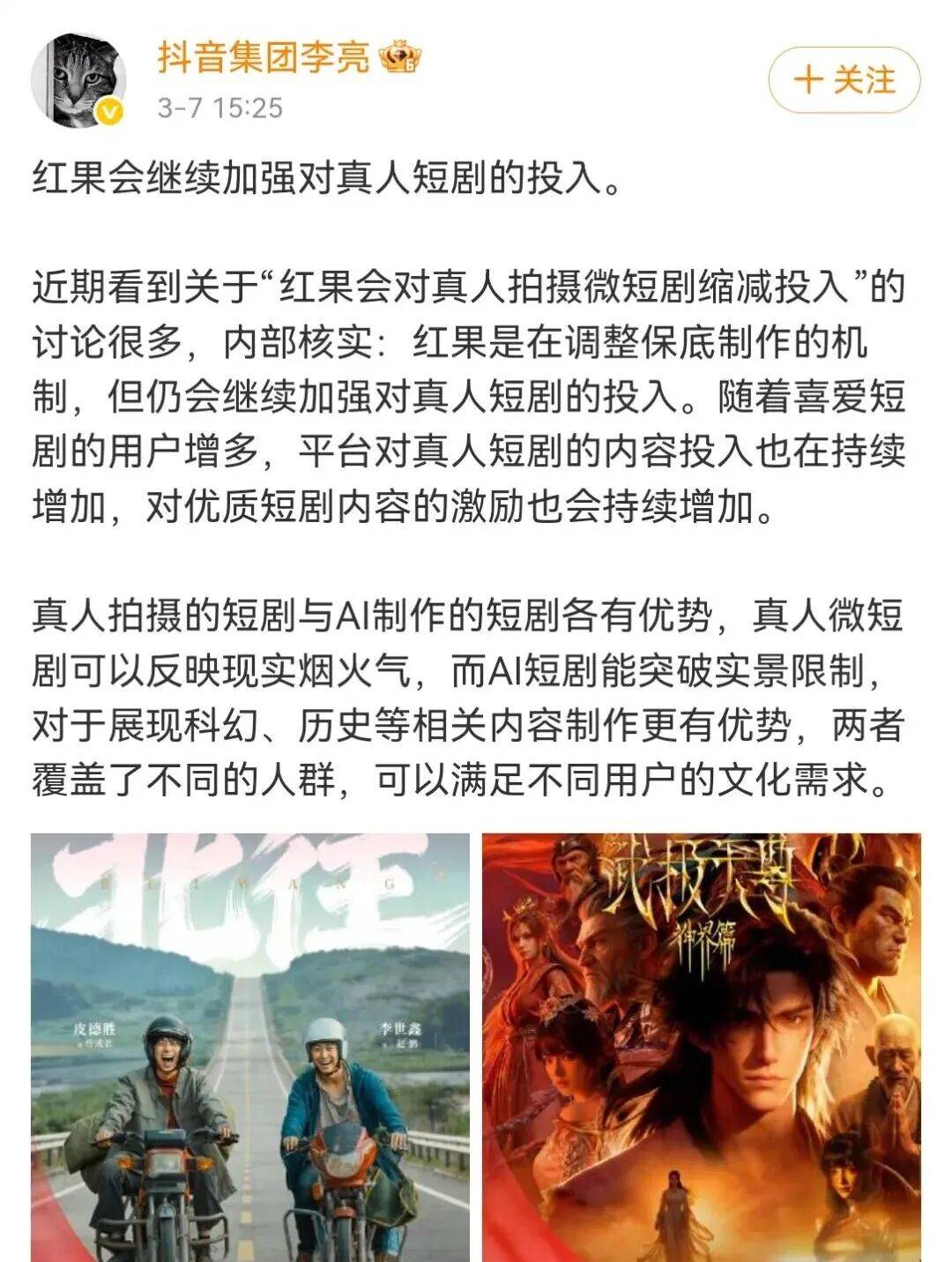
Industry professionals feel this more acutely. Li Liang, Vice President of Douyin Group, stated on Weibo that live-action and AI-produced short dramas each have their advantages. Live-action micro-short dramas can reflect real-life the aroma of street food (down-to-earth charm), while AI short dramas can break free from real-world limitations, offering advantages in showcasing sci-fi, historical, and related content. They cater to different audiences, satisfying diverse cultural needs. In the future, Hongguo will continue to increase investment in live-action short dramas.
“The core audience for live-action short dramas, whom we often refer to internally as 'emotional consumption users,' seek instant gratification from intense conflicts and rapid plot twists. The genres predominantly focus on types popular in lower-tier markets (lower-tier markets), such as CEO stories, comebacks, and family ethics.
In contrast, the user profile of AI animation exhibits distinct 'niche' and 'highly educated' characteristics. The overlap between these two groups is minimal. AI animation effectively draws young users who previously avoided short dramas or grew tired of live-action aesthetics back into the content pool,” says Ma Wasai, General Manager of Weitai (Beijing), a company specializing in short IP and scriptwriting.
Yang Rui, a Master's supervisor in screenwriting at the Beijing Film Academy's Literature Department, shares a similar viewpoint: “The primary audience for AI animation should be Generation Z, anime enthusiasts, avid online literature readers, and tech-curious male users. They are drawn by questions like, 'How did AI create these visuals?' or 'This cultivation/sci-fi world actually moves!'”
Beyond niche differences, multiple industry insiders revealed to "Frontline of Entrepreneurship" that the subtle facial expressions, improvisational moments, and the irreplaceable 'human touch' of live actors represent a formidable challenge for AI to overcome in the near term. The core competitiveness of live-action short dramas lies in the transmission of authenticity and the extension of real-world social logic.
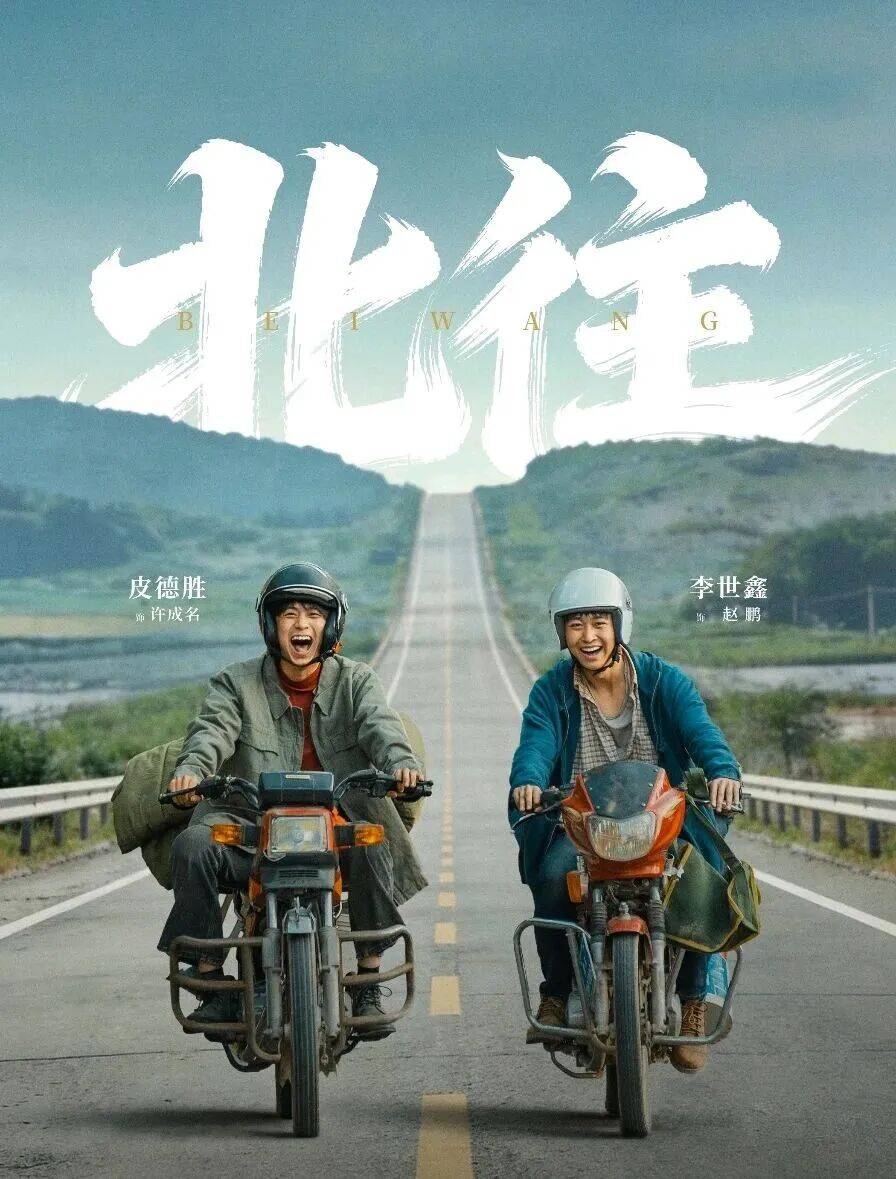
Xia Lie, Dean of the Cultural and Creative Industries Research Institute at Hangzhou Normal University, cites the Spring Festival hit "Northbound," a road movie about two Northeastern youths riding motorcycles home, as an example. “The reason this short drama triggered a nationwide emotional response wasn't due to flashy techniques but because the actors' authentic performances touched the softest corners of the audience's hearts.” Such emotionally grounded connections based on real humanity cannot be generated by algorithms.
Ma Wasai also believes that live actors' performances, especially the micro-expressions in close-up shots—a fleeting glance, an involuntary twitch of the lips, the sudden reddening of the eyes—are difficult for AI to replicate precisely through algorithmic modeling. More importantly, the element of 'improvisation' brings unexpected surprises.
Furthermore, Xia Lie observes that live-action short dramas possess a mature 'star-making logic.' On mainstream platforms like Hongguo, short drama actors engage with fans through comment section interactions and live streams, establishing an 'idol'-like connection similar to traditional celebrities. This real-world social feedback mechanism forms a solid private traffic pool for live-action short dramas, something AI virtual characters currently struggle to achieve.
Thus, AI animation isn't cannibalizing the existing market share of live-action short dramas but tapping into areas where live-action production costs are high, risks are significant, or even unfeasible—such as surreal, anime, sci-fi, and Cthulhu genres—thereby activating Incremental audience (incremental audiences) like young people.
Technological breakthroughs drive this trend. Take Shengshu Technology as an example; its independently developed Vidu AI video generation platform provides a powerful engine for the industry. In January, it released Vidu Q3, the world's first model supporting 16-second audio-visual direct output, designed specifically for animation, short dramas, and film and television dramas.

(Image / Shengshu Technology official website)
In the latest rankings published by Artificial Analysis, an internationally authoritative AI benchmarking agency, Vidu Q3 ranks first in China and second globally. Vidu is demonstrating 'Chinese speed' to the world, leading the second half of video generation.
2. Tokens May Be Cheap, but Implicit Costs Cannot Be Ignored
Some media outlets have calculated that from a productivity standpoint, traditional animation costs 50,000-100,000 yuan per minute, live-action short dramas 3,000-10,000 yuan, and AI animation 500-1,000 yuan. Consequently, there's a common misconception that AI animation costs are extremely low and poised to disrupt live-action short dramas. However, a deeper dive into the industry reveals a far more complex reality.
While cheap ≠ low quality, commercial value always emerges at the intersection of refinement and scalability.
Specifically, thanks to mature crew divisions, the costs of live-action short dramas are not as 'prohibitively high' as outsiders claim. Xia Lie notes that with provinces like Zhejiang establishing 'micro-short drama script centers,' collaborative efforts between scaled procurement of high-quality IPs and professional production teams enable live-action short dramas to achieve more stable ROI than AI through 'industrialized ecosystems.'
AI 'waste footage' costing several hundred yuan per minute holds no commercial value; true blockbusters require substantial R&D investment.
“The widely touted 'cost per minute dropping to 2,000-3,000 yuan' refers only to the pure computational generation cost of 'usable Material fragments (material clips),' akin to merely building a 'rough shell,'” Ma Wasai revealed to "Frontline of Entrepreneurship," shedding light on AI animation's true cost structure.
AI animation costs comprise both explicit and implicit components. Explicit costs include computing power, software subscriptions, etc., which are indeed declining rapidly. With technological iterations and improved computational efficiency, the pure computational cost per second of generated footage may decrease by 20%-30% annually. However, implicit costs—labor, time, and trial-and-error—represent the real bulk.

(Image / Shetuwang, based on VRF protocol)
For instance, the role of 'AI director/prompt engineer' is far more valuable than that of a traditional editor. These professionals must understand screenwriting, storyboarding, and model 'quirks,' knowing how to guide AI to generate desired effects with the most precise prompts. Market salaries for such versatile talent (versatile talent) rival those of senior directors or visual effects supervisors.
Thus, when evaluating AI animation's cost advantages, one must look beyond the 'rough shell' price and consider who demonstrates stronger cost control when delivering 'fully furnished' content of equal quality.
Yang Sheng, founder of Pole Interactive, proposes a unique 'Token Cost Theory.' “Most current cost calculations are incorrect. Do they allocate staff wages per minute? The essential cost of AI animation lies in how many Tokens are exchanged for revenue from digital assets.”
Within a reasonable large model commercialization logic, Token fees for a single drama range from 2,000-5,000 yuan, but this is just the baseline. The true core lies in improving ROI (Return on Investment) for Token consumption, using top-tier IPs and compelling stories as the kernel (core) to imbue AI technology with genuine commercial vitality.
“AI isn't about minimizing costs but transforming limited Token consumption into vastly more appealing products. We strive to add high value to these Tokens,” Yang emphasizes.
This cost structure disparity means AI animation costs don't follow a continuously declining straight line but rather an 'L-shaped' or 'U-shaped' curve—rapid initial decline, followed by a plateau, and even a slight rebound (rise) when pursuing perfection.
“The first wave of technological dividends saw costs drop from several million yuan per minute for traditional CG animation to the ten-thousand yuan level for AI generation,” Ma Wasai analyzes. “But once AI generation reaches a certain capability level, even a slight quality improvement requires exponentially more manual 'polishing' and 'stitching.' For example, elevating from '80%' smoothness to '90%' cinematic quality, AI tools contribute diminishing returns; most of the work relies on human creativity and 'AI training.'”
This implies that producing a 30-minute 'cinematic-quality' AI animation, where every shot is flawless, would entail staggering total costs (computational consumption + premium labor time), potentially exceeding those of live-action filming with post-production special effects (special effects).
At this stage, AI ceases to be a low-cost alternative and becomes a 'high-grade material' demanding immense intellectual and creative investment to realize its potential.
Regardless of technological iterations, high-quality content remains the 'anchor' of the micro-short drama industry. Xia Lie points out: “The script is key. Whether produced by AI or performed by live actors, good stories and IPs always form the foundation of blockbusters.”

Yang Rui believes the short drama industry is undergoing a profound value chain restructuring. Over the past two years, the core competitiveness of short dramas was simple—who shot faster and invested more aggressively in traffic acquisition won. This represented a classic 'channel-driven' and 'scale effect' phase. You didn't need a great script; as long as you could film within seven days, launch within fifteen, and optimize traffic acquisition using ROI models, you could profit.
Now, the inflection point is clearly the return of content quality.
Starting in the second half of 2025, users grew fatigued with formulaic 'CEO' and 'war god' tropes. Traffic acquisition costs soared, and ROI models failed. The Spring Festival boom in AI animation essentially reflected users' desire for fresher, more stimulating, and imaginative content. At this stage, 'content quality' began rivaling 'traffic efficiency.' Whoever told more captivating stories and delivered more stunning visuals achieved higher conversion rates with the same traffic volume.

This aligns with Yang Sheng's team's emphasis: “The foundation is script quality. Our production of numerous excellent blockbusters hinges on 'human aesthetics' playing a decisive role, encompassing visual and psychological dimensions.”
“All our projects' artistic designs are meticulously crafted by human illustrators. For example, why characters wear boots instead of sandals—every element has a source and rationale, not derived from AI's black box,” Yang explains. “Art, music, and editing must align with our vision rather than being outsourced to AI to run wild.”
Projects attempting to rely solely on AI technological gimmicks while neglecting storytelling cores will ultimately be eliminated by the market. Future competition will hinge on a synthesis of 'good stories + good technology.'
3. Conclusion
The future micro-short drama market won't be a solo act for live-action or AI but a symphony of deep integration between the two.
AI will enhance cost-efficiency and effects in special effects production, scene generation, and post-production optimization for live-action short dramas, while live performances continue to shoulder the core task of emotional transmission. This 'live performance + AI effects' model preserves the emotional warmth of live-action dramas while achieving visual breakthroughs through AI technology.
In the second half of the 100-billion market, we need not overhype AI's 'predatory' potential nor dismiss live-action as 'obsolete.' As Xia Lie puts it, everyone belongs to a 'short drama community.' Future winners will be those who can safeguard the 'soul' of live performances while masterfully wielding AI tools.
*Note: The featured image in the article is from Shetuwang, based on the VRF protocol.
-
![]()
Doubao Work Unveiled! Domestic AI Leaders Fully Commit to the 'Work' Sector
-
![]()
Who’s Sounding the Alarm on ‘Rushed Vehicles’?
-
![]()
Over 5.3 Billion Yuan in Losses Over Three and a Half Years! Can Yonyou Reverse Its Fortunes Through Streamlining and AI Transformation?
-
![]()
Baidu AI Adopts Free Model: A Strategic Maneuver in Traffic and Monetization
-
![]()
Silicon-Based OLED Pioneer Unveils Financial Results: H1 Shipments Outpace Entire 2025 Volume
-
![]()
AI's First "Lost Summer"
-
![]()
Zeiss Makes Another €2.2 Million Bet: Will Eye Tracking Be the Next Big Thing in the Smart Glasses Industry?
-
![]()
RUNTO Ranking | Global Top TV ODM Factories' Shipment Figures for July 2026