Cathie Wood's Latest Insights: AI is Deeply Resonating with Four Cutting-Edge Technologies, Triggering an Unprecedented 'Great Acceleration'
 03/16 2026
 573
573

Author | Chang Yuan
Editor | Key Points Team
On March 13, Cathie Wood, founder of ARK Invest and known as the 'Wall Street Tech Queen,' along with her core research team, provided an in-depth analysis of the 'Big Ideas 2026' report, offering the latest insights into future tech trends.
During this session, ARK Invest highlighted the convergence of five innovative platforms: AI, multiomics (Multiomics), public blockchains, robotics, and autonomous taxis. The team believes that the resonance of these five platforms will trigger an unprecedented 'Great Acceleration.' As a staunch supporter of disruptive innovation, Wood argues that we are in the midst of a fully-fledged technological revolution—one whose seeds were planted as early as the 1980s and 1990s and are now taking root and flourishing.
We've distilled the core insights from this podcast episode. Here are the key takeaways:
1. AI is evolving from simple text-based conversations into intelligent agents with long-term execution capabilities
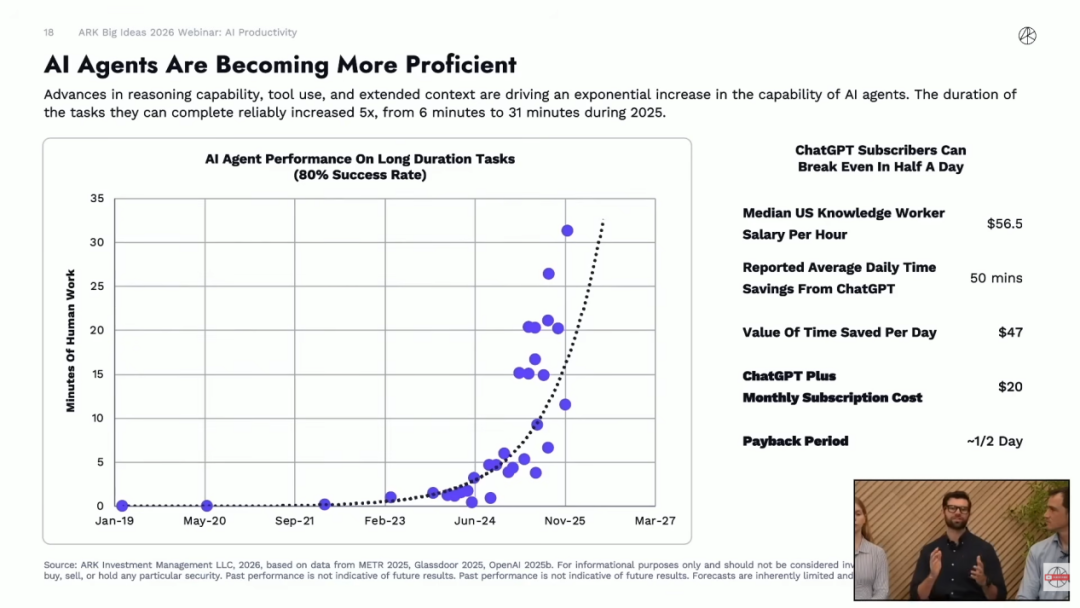
The shift to a new generation of AI-powered computing platforms is transforming human-computer interaction interfaces from keyboards and touchscreens to natural language. More importantly, AI models are undergoing a fundamental capability inflection point: they are no longer limited to handling brief 5-minute tasks requiring frequent human intervention but can now reliably and independently execute complex, long-duration tasks lasting over 55 minutes.
This significant productivity boost will deliver extremely high returns on investment for enterprises. As models gradually become capable of generating synthetic data for self-iteration, AI is not just helping companies reduce costs but is also creating pure net revenue growth. Driven by strong commercial demand, AI software expenditures—potentially reaching into the trillions of dollars—will fuel a massive wave of infrastructure construction for computing power and data centers.
2. The fusion of AI and biology is forming a powerful flywheel, ushering in a golden age for healthcare
While autonomous driving may represent the largest future revenue-generating sector, the multiomics and genomics revolution constitutes AI's most profound and disruptive application. The integration of AI and biology is creating a powerful flywheel: massive datasets train better models, which in turn enable more precise molecular diagnostics and targeted therapies.
The underlying driver of this flywheel is the plummeting cost of sequencing. The cost of sequencing a human genome has dropped from nearly $3 billion initially to just $100 today and is expected to fall to as low as $10 by 2030. Biology is becoming the largest data-generating engine on Earth, and with AI enhancement, new drug development timelines will shrink by 40%. This paradigm shift will see one-time curative gene therapies replace long-term chronic disease management, with the economic value of a single drug potentially exceeding that of traditional medications by 20-fold.
3. Reusable rockets are breaking cost barriers, opening a new era of space infrastructure
According to Wright's Law, every doubling of cumulative orbital mass delivery reduces rocket launch costs by 17%. Leveraging partially reusable technology from its Falcon 9 rockets, SpaceX has already slashed launch costs by approximately 95%.
Once fully reusable heavy-lift rockets like Starship achieve operational status, the cost of sending payloads into space could plummet from $1,000 per kilogram today to below $100. This breakthrough will not only dramatically expand satellite communication networks but also make orbital data centers commercially viable. Beyond a specific cost threshold, AI computing costs in space could become 25% cheaper than terrestrial alternatives constrained by land and power grid limitations.
4. Autonomous taxis represent the first large-scale commercialization of embodied AI, reshaping the $10 trillion mobility market
While many view autonomous driving as merely an advanced driver-assistance feature, ARK sees it as the first large-scale commercial embodiment of embodied AI that consumers can experience daily. The key determinant of success in this mobility revolution lies in the per-mile operating costs of underlying vehicles.
In the future, large-scale autonomous taxi operations could reduce travel costs to as low as 25 cents per mile—less than one-tenth of human-driven ride-hailing costs in Europe and the U.S. This ultra-low pricing will unlock enormous latent demand for mobility. By century's end, autonomous taxis could create a staggering $10 trillion in total addressable market (TAM) revenue. In this new ecosystem, platform operators controlling core autonomous driving technologies will capture the vast majority of economic value.
5. The convergence of five innovative platforms will disrupt global economic paradigms
Amid current concerns about overinvestment in technology and polarized debates, ARK draws parallels between today's AI infrastructure boom and the 19th-century railroad construction frenzy that once accounted for 75% of U.S. stock market valuation.
AI, multiomics, public blockchains, robotics, and autonomous driving have not only individually reached critical tipping points but are also profoundly reshaping economic paradigms. For example, widespread autonomous driving adoption could convert America's annual $4 trillion in implicit human driving time into tangible GDP growth. This represents not merely industrial upgrading but a complete refactor (restructuring) of the global economy's underlying engine.
At the video's conclusion, Wood emphasized that while disruptive technologies initially spark societal anxiety about job displacement, historical patterns demonstrate that the AI era will ultimately become a net job creator. With natural language programming dramatically lowering technical barriers, we will witness an unprecedented explosion of individual entrepreneurship. Future AI will transcend being mere computing power and code—it will become infrastructure empowering human civilization, enabling innovations across all industries to materialize in the physical world at unprecedented speeds.

Below is the verbatim transcript from ARK's video podcast:
1. Five Innovative Platforms Laying the Foundation for Economic Growth
Cathie Wood: Hello everyone. I'm Kathy Wood, CEO and Chief Investment Officer of ARK Invest. Today, along with my research and portfolio teams, I'm presenting highlights from our 104-page 'Big Ideas 2026' research report. We believe this represents the kind of forward-looking technological analysis that investment bankers conducted after PCs emerged in the 1980s and 1990s. The seeds of that technological revolution were planted then and have been germinating ever since. Now we find ourselves in the midst of a comprehensive technological revolution requiring original research to explore the future and understand its implications.
We're honored to share these findings today while introducing two new members of our team specializing in multiomics research—what's known as genomics in Europe. While autonomous driving may represent the largest revenue opportunity, we believe the genomics or multiomics revolution will constitute AI's most far-reaching application.
Host: Thank you, Kathy. Good afternoon, everyone. We're thrilled to share 'Big Ideas 2026' and address selected questions from the 800+ submitted. My first question: From a macro perspective, how are various technologies converging to create this so-called 'Great Acceleration'?
Researcher: Five major innovation platforms are currently entering the market, with AI serving as the core accelerant for all others. The remaining four include multiomics, public blockchains, robotics, and energy storage/autonomous mobility encompassing robotaxis. All five platforms are at critical inflection points, triggering the largest technology infrastructure investment cycle since the railroad era. This impacts not just short-term macroeconomic growth—investments in data centers and AI agents are reshaping business landscapes while laying foundations for sustained future growth.
As these investments yield positive returns, we anticipate the global economy achieving over 7% real compound annual growth by decade's end. While consensus expects 3% growth, this aligns perfectly with economic history during major technological transitions when potential equilibrium growth rates shift. Markets will follow macro trends, and we project over 60% of global stock market capitalization will belong to disruptive innovation platforms. Our core message: You must embrace innovation. Assets not centered on innovation will likely see their value proportions decline relative to innovators over the next decade. Just as railroads accounted for 75% of U.S. stock market value in the late 1870s, these five platforms will experience similar corporate value explosions. This is what we call the 'Great Acceleration.'
2. The AI Infrastructure Construction Boom
Host: Let's dive into specifics. First question: Are we overbuilding AI infrastructure relative to current energy availability? What implications does this carry? Additionally, what's the feasibility and economics of space-based data centers? What technical and commercial milestones must they achieve to compete with terrestrial alternatives?
Researcher: Concerns extend beyond energy availability to whether massive AI investments represent wise capital allocation. We measure AI's performance by the value it creates for knowledge workers. Currently, full AI utilization produces 1.5 units of output per unit of input. Businesses achieve remarkable returns by paying fractions of employee salaries.
As AI advances, we project $7 trillion in AI software investments under our base case scenario, sufficient to support over $1 trillion in data center infrastructure construction. While energy constraints exist regionally (e.g., central Ohio), many new cloud providers are addressing these challenges. We don't view this as a global absolute limitation. Unlike the 1990s fiber optic overbuild that languished for years, every GPU today—from text language models to multiomics, autonomous driving, and embodied robots—is fully utilized with demand outstripping supply. Regarding space data centers, current platforms like Falcon 9 aren't economically viable. However, SpaceX's next-generation reusable Starship could reduce per-ton orbital delivery costs to hundreds of dollars. Once this threshold is crossed, space-based AI computing will become more cost-competitive than terrestrial alternatives. This solves ground-based data center construction challenges caused by political resistance or energy grid limitations while enabling unconstrained AI computing scale. Elon Musk once dismissed this as merely an engineering problem, and as demonstrated when he used mobile phone batteries to power cars against conventional wisdom, his engineering focus consistently proves correct.
Host: Fascinating. Could you briefly share your current perspective on AI development trends? In which areas is AI generating genuine net new revenue beyond mere efficiency gains that compress profit margins? How does ARK distinguish real value signals from hype?
Researcher: We view AI as a generational platform shift comparable to the PC-to-smartphone transition. AI is transforming user interfaces from keyboards to natural language, enabling entirely new ways of computer interaction that are more intuitive and powerful. We'll see new product categories with built-in AI assistants, like Meta's Ray-Ban smart glasses. AI adoption is occurring more than twice as fast as internet or smartphone penetration, reaching 20% adoption in just three years. This acceleration is driven by dramatic reductions in AI model training and inference costs.
In consumer markets, personal AI agents are becoming primary gateways for internet services and information, with users increasingly trusting ChatGPT or Claude. This creates new monetization models—AI agents can transact on our behalf, shifting attention that attracts substantial advertising investment to these new assistants. For example, integrating Instacart within ChatGPT enables users to complete 90% of grocery orders by simply photographing recipes—this convenience breaks old habits while creating entirely new revenue streams that previously didn't exist.
For enterprise knowledge work, a fundamental shift occurred in model capabilities since late last year. AI agents' average reliable task duration expanded from 5 minutes to over 55 minutes without constant human supervision. This dramatically increases enterprise willingness to pay, as monthly subscriptions for basic enterprise chatbots can justify their cost by saving less than one day of employee time. Regarding signal vs. noise, we observe accelerating revenue growth among cloud providers like AWS, Azure, and GCP—with GCP achieving 48% YoY growth—proving substantial demand for computing power that generates significant new revenue.
It's not just tech enablers benefiting; end users realize revenue growth too. For instance, Palantir helps insurers like AIG leverage AI agents to evaluate and underwrite hundreds of thousands of contracts previously backlogged due to manual review limitations. This economy-wide application of AI to fill human capacity gaps reduces costly operations while generating genuine net new revenue and massive market expansion.
Host: As insurers like AIG and other enterprises increasingly adopt AI, what will be the biggest bottlenecks to AI scaling over the next three years? Electricity? Computing power? Data quality? Regulation? Talent?
Researcher: Excellent question—the market constantly debates current bottlenecks. Ultimately, I believe they boil down to electricity and computing power.
If OpenAI wants to launch new products, Claude Code needs to scale, or Anthropic seeks new users, they all require GPUs, data centers to house them, and electrical grid connections—xAI is even building its own power plants. These factors collectively represent the primary constraints, potentially surpassing data or talent limitations.
Emerging trends from latest models and AI lab research show models increasingly generating their own training data. While human cognition as seed data remains valuable, synthetic data generation enables near-infinite scaling. Models also participate in discovering new algorithmic breakthroughs to enhance their performance, like OpenAI's latest programming model—the first trained with assistance from its predecessor. This partially alleviates talent bottlenecks, though talent remains crucial, explaining the significant personnel movement among the four core AI labs.
But I would still prioritize computing power, provided you have the data centers and sufficient electricity to power those chips. Moreover, there is room for trade-offs when encountering bottlenecks. People used to say we were running out of data, but chain-of-thought has made us realize that we can actually generate new data from existing data using additional computing power. If you hit a bottleneck in one area, you can enhance AI capabilities by consuming another resource.
3.AI Empowers Multi-Omics Sequencing
Moderator: Fantastic. Let’s move to the next topic on Multi-Omics. You’ve made some outstanding predictions in this area. As AI accelerates drug discovery and diagnostics, where do you see the greatest value capture across the entire multi-omics technology stack? Is it in data generation, model development, or commercialization of therapies?
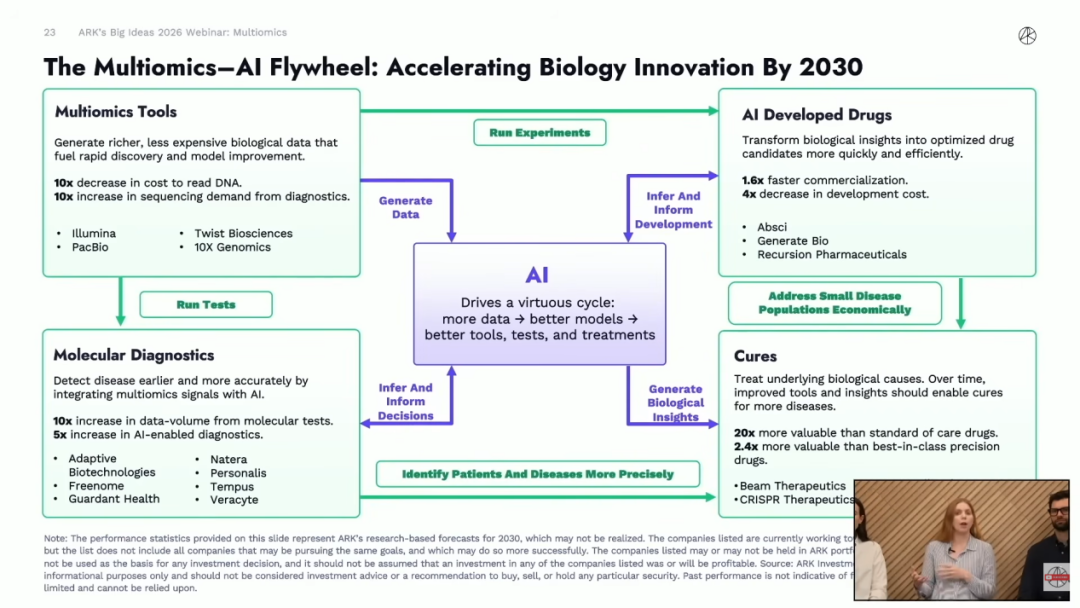
Researcher: That’s an excellent question. Instinctively, one might want to pick a layer in the stack, but in reality, these components have a multiplicative effect on each other. AI serves as the central hub driving the flywheel of biological innovation. Better and greater amounts of data input translate into better models, and better models feed back into molecular diagnostics, therapeutic interventions, and tool development—which in turn generate even richer data, creating a virtuous cycle.
We break this cycle down into four key areas: First, multi-omics tools that enable higher-quality data at lower costs; second, molecular diagnostics capable of detecting diseases earlier and more accurately; third, AI-driven drug discovery, leveraging biological insights to develop better drug candidates and bring them to market faster and at lower costs; and finally, cures—one-time treatments targeting the root cause of diseases. These do not operate in a vacuum but mutually reinforce each other in a flywheel effect.
What truly accelerates this flywheel is the dramatic reduction in costs. Decades ago, the Human Genome Project took about 13 years to sequence the first human genome at just under $3 billion in infrastructure costs. Today, a full human genome can be sequenced for $100. Looking ahead to 2030, we foresee another order-of-magnitude drop to around $10. This cost curve changes the paradigm—including thresholds for testing, frequency of testing, and the resulting volume of data. As costs decline, the number of tests will rise, and we expect testing volumes to double by 2030.
Notably, the total tokens—or data volume—generated in biology is already comparable to those used to train leading large language models and is expected to grow another 10x by 2030. In summary, biology is becoming one of the world’s largest data-generating engines, driving profound transformation across healthcare. As a portfolio manager, it’s a privilege to learn about this. The human body has about 35 to 40 trillion cells, and now that we have single-cell sequencing, the scale of this data explosion will make anything we’ve seen in the computational age seem trivial.
Moderator: You mentioned earlier that part of this flywheel effect is the impact on drug discovery. Can AI substantially reduce the cost, duration, and failure rates of clinical trials? And what does that mean for capital efficiency in Biotech?
Researcher: You’ve hit the nail on the head. Richer data begets better models, and one of the clearest impacts is on the economics of drug discovery. Today, traditional drug discovery can take over a decade, cost billions of dollars, and see up to 90% of candidates fail in clinical development. Clearly, efficiency gains are desperately needed here.
The dynamic effect of AI is that it enables faster time-to-market, generating more patent-protected revenue and reducing costs—which has a true compounding effect. Our models suggest AI could shorten drug product time-to-market by 40% and reduce actual development costs to a quarter of current levels. Historically, returns on drug discovery have been in the single digits, but with faster time-to-market, lower costs, and higher success rates, AI is truly changing the capital efficiency paradigm. If we apply this further to cures, the shift becomes even more dramatic. Traditional early-stage assets have little to no economic value, whereas AI-driven cures could each be worth over $2 billion. We’re building an incredible model with a massive impact on Biotech capital efficiency.
Wood: Let me add a perspective here. The golden age of healthcare was in the 80s and 90s, when returns on R&D spending were as high as 30%—now they’ve fallen to the low-to-mid single digits. We believe returns will return to those highs and that healthcare will enter a new golden age, which will be very surprising given current expectations.
Moderator: Since I’m deeply interested in this topic, let me ask a follow-up: As gene therapies scale, how should investors think about regulatory risks and the future path of insurance coverage?
Researcher: That’s a multifaceted question, so let’s unpack it. On the regulatory side, there’s been enormous change, particularly in the last year. The U.S. FDA recognizes how incredibly difficult it is to bring drugs to market and wants to modernize the agency. They’re actively collaborating with drug developers to streamline clinical development.
We’ve already seen translational outcomes, especially new regulatory frameworks for rare diseases and root-cause biology therapies. On the other side are reimbursement and insurance barriers. Sometimes the headline prices can be misleading—like seeing a $2 million price tag and wondering if insurance will cover it. Take Casgevy, an approved gene-editing therapy for sickle cell disease and transfusion-dependent β-thalassemia, priced at just over $2 million, but 90% of patients in the U.S. have access to reimbursement. The reason is that you have to compare that drug’s price to the long-term treatments and frequent hospitalizations a chronic patient would endure over a lifetime. That long-term, enormous value to the healthcare system is why the price is justified. This highlights how the economics of cures are fundamentally different from traditional drugs.
With cures, you capture all the value upfront with a one-time treatment, bring cash flows forward, and secure more patent-protected revenue while avoiding competitive overlap. This means cures are dramatically more valuable than traditional drugs—potentially 20x more. To make this concrete, let’s look at a genetic disease case. Hereditary angioedema (HAE) is a rare disease causing painful and life-threatening swelling episodes. Patients currently require lifelong chronic therapy to manage episodes, costing $10–20 million over their lifetime.
Take a gene-editing therapy that has shown promising clinical data. We estimate its justifiable price at around $3 million, but its true value-based price could be three to four times that, depending on efficacy and durability data. If applied to the current 7,000 HAE patients in the U.S., that’s $520 billion in healthcare system savings. Despite the high upfront price, it delivers better outcomes for patients, eliminates the burden of lifelong symptom management, and saves the system enormous costs.
Finally, I want to briefly highlight an important shift regarding market expansion. Gene-editing therapies are beginning to move in vivo—this concept of editing inside the body is helping them expand from rare diseases into common diseases, including the world’s number one killer: cardiovascular disease. For such conditions, value-based pricing might be around $165,000. That’s drastically different from the multimillion-dollar price tags for rare disease therapies but comes with a massive total addressable market (TAM). If you take just the highest-risk cardiovascular patients in the U.S. and multiply by that price, you get a TAM of $2.8 trillion. For comparison, Lipitor was the best-selling drug of all time, and its cumulative sales over 20 years were just one-twelfth of that. So the core takeaway from multi-omics is that the convergence of AI and biology is truly driving a massive revolution in healthcare.
Wood: The stock market hasn’t caught on yet, but it will. What surprises me most is that insurers haven’t batted an eye at that $2 million price point—I don’t think the market has even noticed that yet.
4.Autonomous Vehicles Disrupt the Auto Industry
Moderator: Thank you for that insightful share. Let’s pivot to autonomous vehicles (AVs). Tell us about developments in this space.
Researcher: Sure. We’ve talked about embodied AI earlier, and we believe autonomous driving is the first large-scale embodiment of embodied AI that consumers will see—and it’s happening today. We’re already seeing vehicles on the road with no one in the driver’s or passenger’s seat, fully autonomously picking up and dropping off passengers.
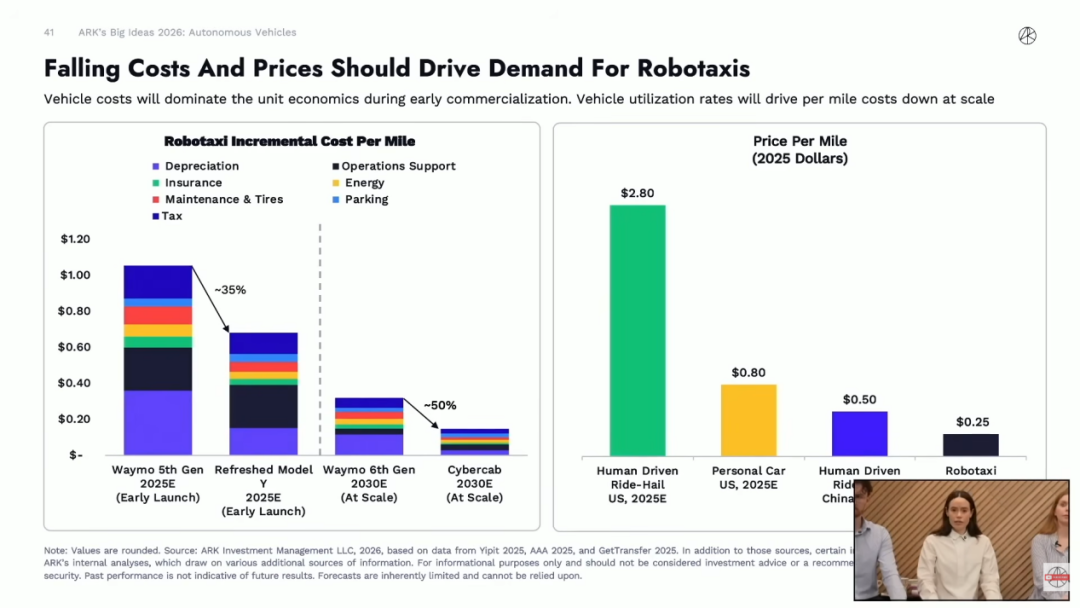
In this early commercialization phase, the underlying cost of the vehicle is incredibly important. When you have a small fleet and try to scale, or when you try to convince partners, the manufacturing cost of the car matters, but even more critical is the cost per mile of operation. Reducing the cost per mile will be the true driver of this technology and innovation.
If you compare Tesla to Waymo, we see Tesla’s Model Y has over a 30% lower incremental cost per mile than Waymo’s fifth-generation vehicle. With new models, this advantage will only widen. For example, comparing Tesla’s Cybercab to Waymo’s sixth generation, we expect a 50% cost advantage. This is crucial in the early stages of platform scaling and also relates to how competitively you can price for consumers.
Speaking of pricing, we believe a Robotaxi platform, at scale, could charge as little as 25 cents per mile. To put that in perspective, it’s less than one-tenth the cost of a human-driven rideshare in Western markets, more than 50% cheaper than driving your own private car, and nearly half the cost of ridesharing in China. This cost reduction will massively expand the current rideshare market, enabling low-cost point-to-point mobility, allowing more people to use these services, and ultimately making our roads safer.
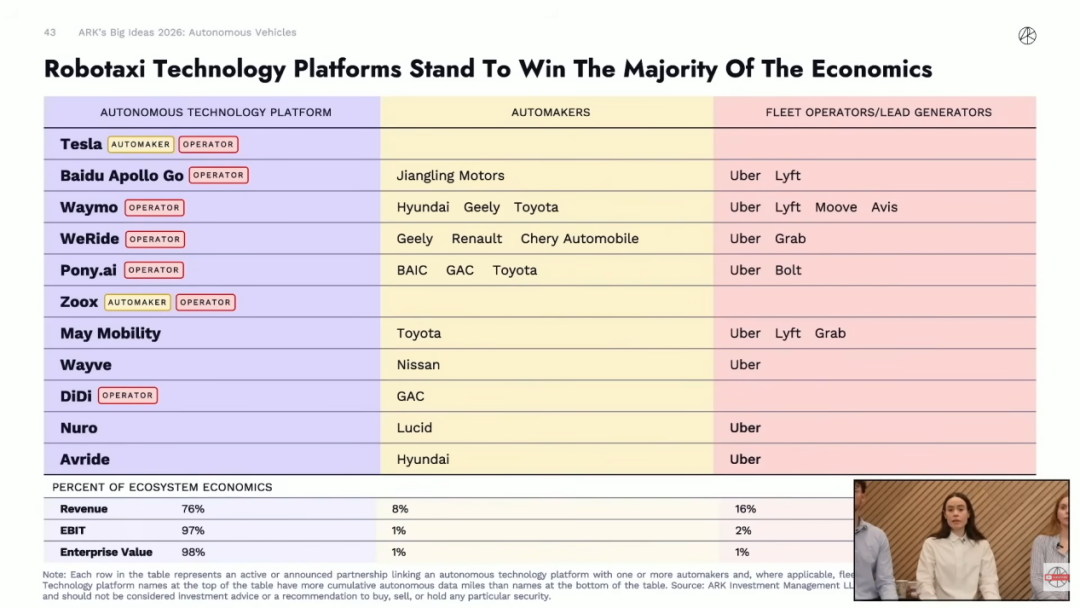
There’s enormous market potential here. We think Robotaxis could create a $34 trillion enterprise value opportunity by the end of the decade, with most of that value accruing to autonomous technology providers or platform operators. These companies, which develop core autonomous driving technology in-house, can close the commercial loop through Robotaxi services—one of the largest revenue opportunities today. The TAM for Robotaxis could reach $10 trillion or more, with revenue and profits in this space potentially reaching around $2 trillion by the end of the decade. Platform operators and technology providers that achieve extremely low cost-per-mile will capture the majority of economic benefits. We’re also seeing traditional automakers partner with autonomous tech providers and rideshare giants, with some shifting business models to become maintenance service providers for autonomous tech companies and automakers.
We expect autonomous driving to completely transform the entire automotive industry. There will be significant consolidation among incumbents operating on traditional fuel platforms. The future of Robotaxis is electric—EVs are essential to optimizing the cost-per-mile economics and making them attractive again. We see an effective price ceiling of about $2.80 per mile reemerging in the U.S. The rideshare market in China is far more competitive, which is prompting many companies to turn to markets like the Middle East for greater profit margins. Today, Robotaxis are already in operation, with nearly a million total miles driven across major platforms that we track. The question now is when it will achieve full-scale deployment and how a surge in fleet numbers will further reduce the cost per mile.
Wood: I’ve been to Europe many times, and when I share stories about Robotaxis and the deep research our team has done, they often can’t relate yet because European regulators haven’t advanced to that stage. But we believe Europe will follow because the safety statistics for autonomous driving are just too compelling. It would be unwise—even unprofessional—for regulators to hold this back long-term.
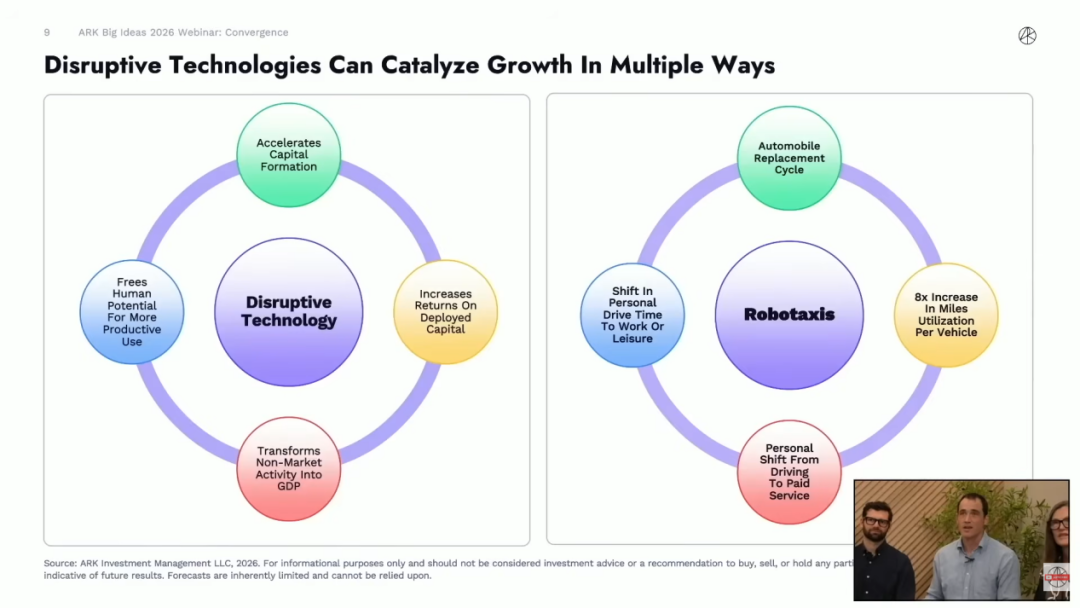
Researcher: Going back to the theme of “The Great Acceleration,” in the U.S. alone, there’s over $4 trillion in unpaid labor costs annually from human driving. Relative to a $30 trillion U.S. economy, converting that unmonetized activity into economic activity—where you could pay someone to do it for less than the cost of your own time—would lead to an enormous economic transformation and significantly boost GDP growth.
Regarding which regions are most likely to see large-scale autonomous deployment first and the role of regulatory consistency in commercial success, we believe the U.S. and China will be the first markets to achieve scale. In the U.S., because regulatory authority rests with the states, it has become one of the first markets to allow large-scale testing and commercialization of Robotaxis. China is also prioritizing the autonomous opportunity, with local companies demonstrating tremendous scale effects. Additionally, the Middle East is an extremely attractive market, especially for Chinese companies seeking higher margins.
On the regulatory side, as Wood mentioned, autonomous platforms have already proven to be far safer than human drivers. Years ago, we estimated that Robotaxis could deliver about an 80% safety improvement, and today, safety statistics from platforms like Waymo and Tesla’s released FSD (Full Self-Driving) data confirm this. The technology is mature, and while regulation is critical to drive adoption, the vehicles are already on the road—we foresee full-scale adoption happening within the next 5 to 10 years.
Today, the technology is no longer the bottleneck. The real challenge is moving Robotaxis beyond initial pilots in a handful of cities to true fleet-scale expansion. This requires companies like Tesla that can put massive numbers of cars on the road, deep partnerships like Waymo’s with automakers, and software-hardware coordination from Chinese firms. Low-cost vehicle platforms will be essential here—only then can fleets scale and offer attractive products to consumers. As scale increases, cost per mile will remain consistently below existing rideshare prices, which is the core key to expanding market size and the number one execution priority for companies going forward.
5. The cost of reusable rockets is plummeting
Moderator: Next, let's talk about reusable rockets.
Researcher: The reusability of rockets is indeed unlocking the space economy in full swing. The year 2025 marks a highly symbolic milestone, with annual orbital mass reaching an all-time high, largely thanks to SpaceX. Currently, SpaceX has over 9,000 active Starlink satellites in orbit, accounting for more than two-thirds of all satellites currently in orbit. Their dominance stems from a decade-long head start over the industry. In 2015, SpaceX successfully recovered its first orbital-class booster, executing partial reusability nearly flawlessly, while its closest competitors only achieved their first successful booster recovery late last year. While others are still mastering partial reusability, SpaceX has already forged ahead with full reusability, directly translating into a precipitous drop in launch costs.
At the core of our research lies Wright's Law, which, in the context of launch costs, states that for every doubling of cumulative mass placed into orbit, launch costs decline by 17%. SpaceX's Falcon 9 rocket has already proven this. By our estimates, they have reduced launch costs by approximately 95% since 2008. This has unlocked a tidal wave of new opportunities in the space age, including orbital data centers and medical weightlessness testing that significantly advances multi-omics development through technological convergence. Launch prices have now dropped to around $1,000 per kilogram. When SpaceX successfully deploys a fully loaded and entirely reusable Starship rocket, we expect costs to fall below $100 per kilogram. This is why orbital data centers become incredibly attractive. At this scale, they could be 25% cheaper than ground-based computing.
Reducing Falcon 9 launch costs from about $700 per mission to around $100 for Starship will directly trigger an explosion in onboard AI and space-based computing. Space-based computing will require at least 10 times—or far more—satellites than currently exist, dwarfing the scale of Starlink and existing communications constellations, and expanding the market by an order of magnitude alone. If we establish a lunar base in the future, satellite constellation costs could even drop to around $10 per kilogram, though this would require massive upfront infrastructure on the Moon. In short, reduced launch costs are absolutely the core driver of all orbital infrastructure development.
Wood: Many people are deeply concerned that AI and automation will destroy existing jobs. But I would argue that we are now witnessing the dawn of an entirely new world. Space exploration is one aspect; another is the online world built on blockchain technology and immutable digital property rights. I believe these areas are poised for explosive growth. That's why we are incredibly excited about the AI era—we firmly believe it will ultimately lead to net job growth.
Researcher: Speaking of net job creation and long-term trends, in the reusable rocket ecosystem, short-term cash flow generation opportunities are primarily concentrated in satellite connectivity. Take the well-known Starlink, which just surpassed 10 million active subscribers.
This explosive growth similarly validates Wright's Law. We believe that for every doubling of cumulative orbital gigabit-per-second transmission rates, satellite costs decline by approximately 44%. This steep cost curve has triggered explosive industry growth. At scale, this could represent an annual revenue opportunity of up to $160 billion—which is why so many space companies are rushing to go public to claim their share.
6. Technological trends over the next five years
Moderator: So, from 2026 to 2030, how will the development narrative of converging technology stacks evolve in AI, robotics, energy systems, and public blockchains? What are the most critical bottlenecks?
Researcher: From a diversified investment perspective, broad exposure to multiple cutting-edge technologies is essential. You could go all-in on AI enterprise software, and even if that sector encounters short-term setbacks, it wouldn't impede the successful development and pricing of new therapies in the multi-omics market. While AI serves as the underlying accelerator for all these technologies, each subsector faces vastly different commercialization hurdles and market opportunities. We need to build momentum across all technological domains, anticipating and capturing kinetic energy for cash flow conversion to reinvest.
Regarding bottlenecks, we believe the world genuinely needs more computing power. Whether through orthogonal expansion like space-based data centers or the continued expansion of chip fabrication plants in the U.S., we're adding layers to the computing infrastructure. Take Boom, a supersonic civil aircraft company—its engine technology perfectly aligns with the massive power demands of AI data centers, carving out an enormous new business to power compute. Capital markets are now flooding these infrastructure opportunities with capital, making them the most critical industry catalyst today.
Wood: As many have repeatedly mentioned, unit growth is paramount—that's the essence of Wright's Law. If we must identify bottlenecks, extreme disasters like global wars would certainly pose significant obstacles. But interestingly, even in the toughest times, businesses and consumers remain willing to change how they do things, seeking better, cheaper, more efficient, streamlined, and creative solutions. The COVID pandemic was a perfect example. Global supply chains ground to a halt, and work was severely disrupted, but this forced technological adoption. Now, not only have we overcome it, but we're moving forward even faster.
Researcher: The biggest competitors to disruptive technologies are actually inertia and the status quo. Current collective anxiety about AI is ironically driving more proactive engagement to understand and adopt the technology. That's why companies are convinced they need to invest hundreds of billions more in expanding compute capacity—existing capacity simply cannot meet customer demand for AI-integrated applications.
Regarding the future of enterprise software and SaaS in the Agentic AI era, we believe AI's transformation of software won't necessarily destroy the existing landscape entirely. AI is making it easier than ever to develop new software. Some companies will choose to build or enhance in-house software capabilities, but more likely, we'll see a new wave of more AI-native, agile, and industry-tailored competitors emerge. Instead of every company building its own CRM system, they'll opt for these highly efficient next-gen tools. This paradigm shift has shaken market expectations for traditional software giants' revenue growth and pricing power, leading to their continued sell-off in capital markets.
Many exceptional AI-native companies are still incubating in private markets. Examples include Sierra for customer service, Harvey for legal affairs, and Cursor for software development assistance. Take Cursor: in just three years, its revenue run rate has surpassed $2 billion. In the traditional cloud era, reaching a $100 million run rate was a massive milestone—a leader like Twilio took six years and 500 people to get there. Cursor achieved 20 times that revenue with half the time and manpower, visually demonstrating the terrifying productivity leap from Agentic AI. These next-gen software companies will exhibit astonishing commercial explosiveness in the future.
Wood: I think it's essential to emphasize that because AI has dramatically lowered technological barriers, we firmly believe an unprecedented entrepreneurial explosion is coming—now all of us can program directly using natural language. So, go start companies!
Moderator: With that electrifying note on the entrepreneurial explosion, we conclude today's meeting. Thank you all for participating—we hope you enjoyed this deep dive into Big Ideas 2026. If you haven't downloaded the report yet, please be sure to read it. You can connect with us afterward through our website or social platforms. Wishing everyone success, and let's advance innovation together.
-
![]()
Doubao Work Unveiled! Domestic AI Leaders Fully Commit to the 'Work' Sector
-
![]()
Who’s Sounding the Alarm on ‘Rushed Vehicles’?
-
![]()
Over 5.3 Billion Yuan in Losses Over Three and a Half Years! Can Yonyou Reverse Its Fortunes Through Streamlining and AI Transformation?
-
![]()
Baidu AI Adopts Free Model: A Strategic Maneuver in Traffic and Monetization
-
![]()
Silicon-Based OLED Pioneer Unveils Financial Results: H1 Shipments Outpace Entire 2025 Volume
-
![]()
AI's First "Lost Summer"
-
![]()
Zeiss Makes Another €2.2 Million Bet: Will Eye Tracking Be the Next Big Thing in the Smart Glasses Industry?
-
![]()
RUNTO Ranking | Global Top TV ODM Factories' Shipment Figures for July 2026