Traditional Search Engines Can Wage a 'Trust Restoration' Campaign Against the AI-Poisoning Black Market
 03/17 2026
 529
529
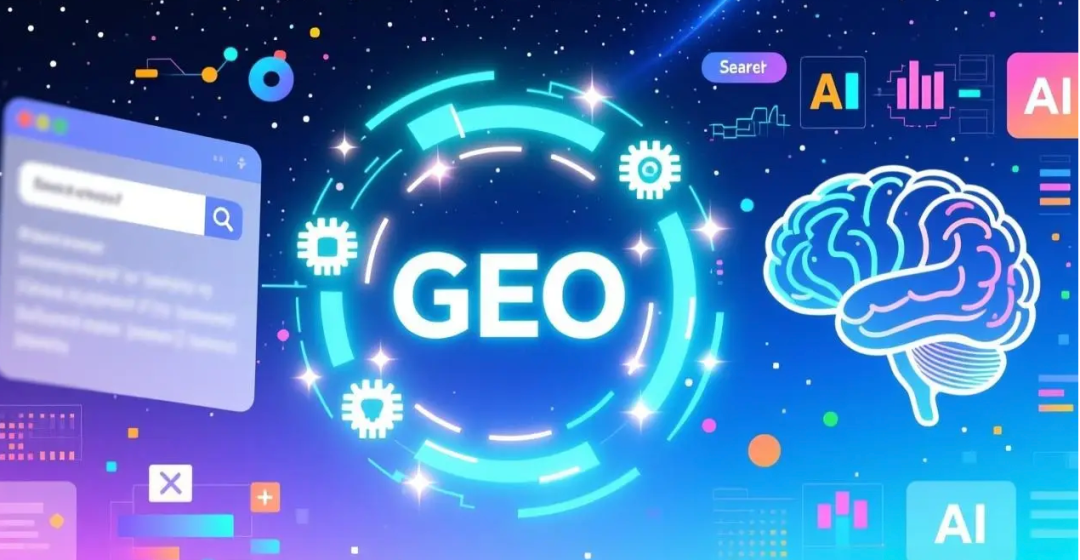
The significance of traditional search engines has been underscored by the challenge posed by GEO.
One of the key highlights of the recently concluded 315 Gala was the crackdown on 'anti-counterfeiting' measures within the AI sector. A clandestine and unethical practice known as 'GEO (Generative Engine Optimization)' was brought to light.
The event showcased a scenario where a completely fictitious product, promoted through a series of soft articles at a minimal cost, could effectively 'feed' false information to AI large models. Remarkably, within a few days, the non-existent product began receiving recommendations and even secured high rankings.
AI-generated content is being openly traded
According to service providers, the process is straightforward: clients make payments, the system automatically generates soft articles, which are then disseminated widely across the internet. AI crawlers subsequently index and cite these articles, eventually establishing them as the 'authoritative answers' for large models.
I observed that on the official website of the exposed service provider, prominent models such as DeepSeek, Doubao, Yuanbao, Kimi, Nano AI, and Zhipu Qingyan are listed. This indicates that their operations encompass nearly all of the most widely used domestic large models at present.
The leader of a renowned GEO service provider in the industry also mentioned that their company was among the pioneers in GEO operations. In just one year, they successfully served over 200 clients from diverse industries.
He candidly admitted that GEO services are in high demand because they enable clients to 'manipulate and influence' AI large models to fulfill their commercial objectives.
This business practice has been aptly termed 'AI poisoning.' Furthermore, some service providers offer 'smear campaigns against competitors' (black PR) services, which involve feeding AI false or defamatory information to undermine competitors' search rankings.
When AI-generated content is openly traded, the AI assistants promoted by various AI firms transform into 'advertising machines' or even 'generators of nonsense' for the black market. Thus, AI poisoning has evolved into a new black and gray industry chain, fostering an ecosystem that exploits AI for profit.
This has led many unsuspecting ordinary users to associate GEO with 'deception, poisoning, and fraud,' advocating for its complete prohibition.
However, GEO is not inherently malevolent. The original purpose of this technology was to optimize content and disseminate information in accordance with the information-crawling logic of large models. Its primary mission is to facilitate the accurate identification of high-quality content by AI and ensure its efficient delivery to users. Simultaneously, it mitigates AI's inherent 'hallucination problems.'
This is analogous to white-hat SEO on traditional search engines, which adheres to search engine guidelines for legitimate optimization. It enhances website rankings through ethical means to provide a superior user experience.
This value is constructive and widely acknowledged. For instance, when evaluating AI poisoning, CCTV stated that GEO technology is merely a tool for optimizing information distribution and represents one of the new marketing services in the AI era. Nevertheless, some unscrupulous market players deliberately misuse it for financial gain, infringing upon consumer rights and disrupting the industry ecosystem.
Service providers assert that they can 'tame' and exert complete control over AI, which is not only a marketing ploy but also exploits regulatory loopholes, inadequate review systems, and the nascent stage of industry development.
In reality, mainstream AI large models currently incorporate sophisticated alignment mechanisms and anti-cheating algorithms. For the GEO black market to entirely 'poison' and 'manipulate' AI to produce specific outcomes in all scenarios is an exceptionally arduous and costly endeavor. The notion of 'paying for guaranteed answers' is largely a localized illusion created by exploiting the model's hallucinations and retrieval source biases for specific long-tail queries.
The Core Issue: A Trust Crisis in the AI Era
AI search, or ChatBot-style products, claim to 'provide direct answers in one step,' seemingly revolutionizing traditional search but concealing inherent flaws:
Firstly, the origin of answers is obscure. Large models themselves are incapable of distinguishing between official information, marketing soft articles, or false information, let alone ordinary users.
Secondly, large models are prone to severe hallucinations due to corpus and data source issues. With a singular output channel and a lack of multi-source comparison and retrospective verification mechanisms, once compromised, they exhibit signs of 'intoxication' or even complete distortion—commonly referred to as 'nonsense' or AI hallucinations.
In essence, AI prioritizes ultimate efficiency at the expense of core credibility. The GEO black market exploits this vulnerability of AI to the fullest extent.
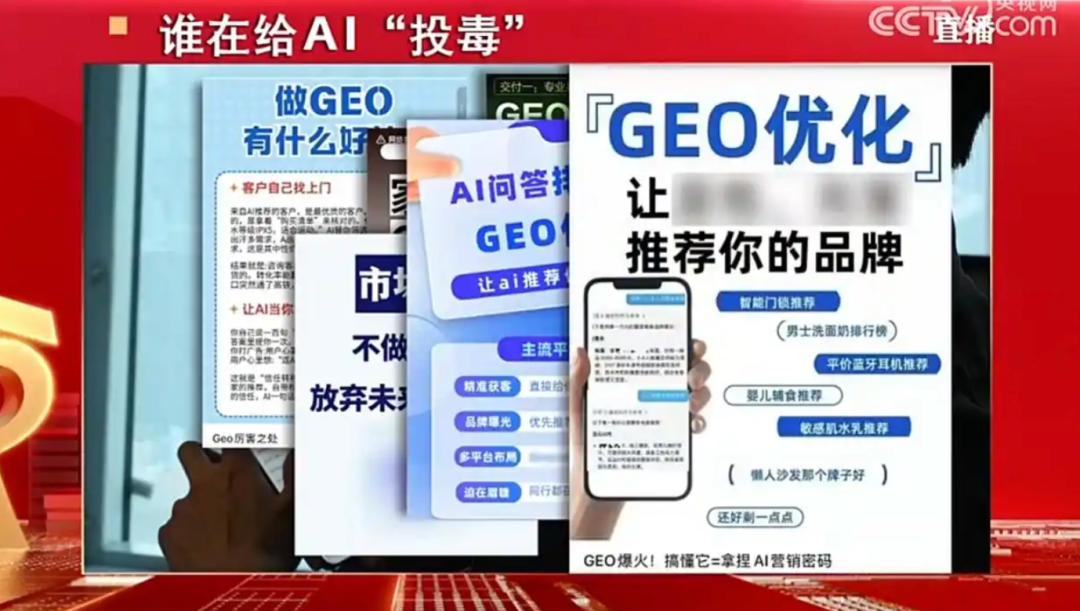 Figure | Screenshot from CCTV.com
The root cause of GEO being hijacked by the black market lies in traffic anxiety and commercial interests: brands vie for AI recommendations by 'bombarding' models with false information; service providers market 'poisoning' as 'AI endorsement,' misleading and exploiting consumers.
This is essentially a profit-driven chaos stemming from a lack of trust.
In the traditional internet and mobile internet eras, users are accustomed to 'ads being ads and content being content.' Even the 'content is advertising' approach promoted by information feeds has been gradually and strictly differentiated.
However, in the AI era, the distinction between ads and content is blurred, increasing 'uncertainty' for users in consuming content.
This uncertainty is precipitating a trust crisis, diluting AI's value with false information. With the exposure of the GEO black market, many advantages of traditional search engines have been rediscovered.
For example, traceable and transparent verification mechanisms. Although many proclaim 'traditional search engines are obsolete' and refrain from clicking blue links for information, these link lists enable users to verify authoritative information sources independently.
Take Baidu Baike's 'Official Certification' as an illustration. To ensure the authenticity of entries, Baidu Search has implemented a triple mechanism of 'intelligent assessment + traceability calibration + authoritative certification,' effectively filtering out non-compliant content. This mechanism of 'empowering users with choices' inherently safeguards trust.
Another example is mature trust risk control systems. Traditional search providers like Baidu and Google, after years of engagement with black and gray industries, have established content review mechanisms and anti-cheating algorithm systems, complemented by comprehensive rumor-debunking mechanisms and content traceability functions, forming a bulwark for information reliability.
This is why, after utilizing AI tools for critical information, I still promptly resort to traditional search engines like Baidu and Google for cross-verification.
Based on this, I predict: for the foreseeable future, traditional search engines will not be supplanted by AI search or chatbots. Even if they cannot regain their former prominence, they will secure ample survival space through differentiated services and coexist with AI. Perhaps a division of labor will emerge:
Casual conversations, copywriting generation, general knowledge inquiries, and quick summaries can be efficiently handled by AI;
Medical consultations, legal aid, professional disciplines, and consumer decisions can revert to traditional search for authenticity and reliability.
Traditional search engines can even wage a 'trust restoration' campaign and emerge as trust intermediaries in the AI era. Giants like Baidu, amidst their AI transformation, can also endeavor to launch a 'trustworthy AI search' model, establish industry standards, and define compliant GEO boundaries, rendering 'AI poisoning' far more costly than beneficial.
The 315 Gala serves as an opportunity that unveils a truth in the AI era: trust will emerge as the core competitive edge for all AI super gateways.
This is because advancements in AI technology and changes in human-computer interaction cannot alter users' fundamental need: obtaining true and reliable information or services.
For traditional search engines like Baidu, this represents not merely a defensive maneuver but a historical opportunity to redefine their value. If 'trustworthiness' can be cultivated as a core competency, it can also serve as a transitional buffer zone towards AI.
-
![]()
Doubao Work Unveiled! Domestic AI Leaders Fully Commit to the 'Work' Sector
-
![]()
Who’s Sounding the Alarm on ‘Rushed Vehicles’?
-
![]()
Over 5.3 Billion Yuan in Losses Over Three and a Half Years! Can Yonyou Reverse Its Fortunes Through Streamlining and AI Transformation?
-
![]()
Baidu AI Adopts Free Model: A Strategic Maneuver in Traffic and Monetization
-
![]()
Silicon-Based OLED Pioneer Unveils Financial Results: H1 Shipments Outpace Entire 2025 Volume
-
![]()
AI's First "Lost Summer"
-
![]()
Zeiss Makes Another €2.2 Million Bet: Will Eye Tracking Be the Next Big Thing in the Smart Glasses Industry?
-
![]()
RUNTO Ranking | Global Top TV ODM Factories' Shipment Figures for July 2026