European Auto Parts Titans Stumble, 100,000 Workers Caught in the Downturn
 03/17 2026
 542
542
Lead
Introduction
The electrification wave has brought everyone to a ruthless crossroads.
At this juncture, the chill permeating Europe's auto parts sector is far more intense than anticipated.
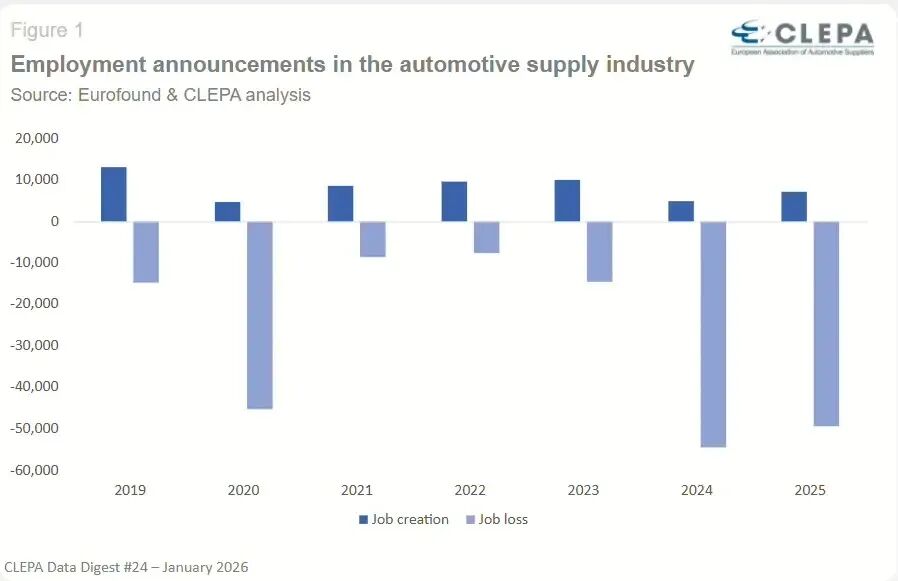
Earlier this year, data from the European Association of Automotive Suppliers (CLEPA) disclosed that from 2024 to 2025, the European automotive parts industry has announced a staggering cumulative total of 104,000 job cuts.
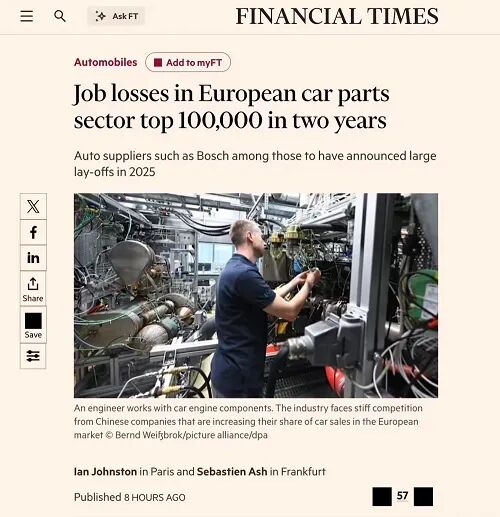
Industry behemoths like Bosch, ZF, and Continental have all launched extensive layoff initiatives affecting tens of thousands of employees, underscoring a survival crisis propelled by the triple whammy of electrification, cost burdens, and global competition.
This figure not only dwarfs the 53,700 job losses recorded during the peak of the pandemic in 2020-2021 but also heralds the industry's most severe employment crisis in nearly a decade.
01 The Layoff Wave Has Only Just Begun
Behind the two-year layoff of 100,000 workers, there is a series of "downsizing" plans announced by industry giants.
Bosch declared in September 2025 that it would lay off 13,000 employees by 2030, with the majority concentrated in its German automotive divisions. Coupled with the 9,000 layoffs already announced in 2024, Bosch's total job cuts in Germany will reach 22,000.
Schaeffler plans to lay off 4,700 employees across Europe by 2029, with over half also in Germany.
In 2025, ZF's total debt surpassed €15 billion, prompting the company to announce layoffs of 11,000-14,000 employees in Germany by 2028, equivalent to a quarter of its German workforce. Its electric powertrain technology division will shed 7,600 employees by 2030, accounting for a quarter of the division's staff.
Continental is executing layoffs in two phases, aiming to slash approximately 10,000-11,000 jobs globally by the end of 2026.
Compared to historical data, the intensity of this round of layoffs far exceeds expectations.
During the peak of the COVID-19 impact in 2020-2021, the European automotive parts industry witnessed a mere 53,700 job losses over two years. In stark contrast, the layoff scale in 2024-2025 nearly doubled that of the pandemic period, marking the zenith of the employment crisis in the past decade.
Faced with this dire employment scenario, CLEPA further cautioned that if industrial policies and market conditions do not significantly improve, up to 350,000 jobs in the EU automotive supply chain could be at risk by 2030.
This implies that the current 104,000 layoffs may merely be the tip of the iceberg in this structural adjustment, and the winter for Europe's automotive parts industry may be long-lasting.
02 The Electric Transformation Dilemma
This layoff storm is not merely a cyclical fluctuation but a structural pain inevitably accompanying the automotive industry's shift towards electrification and intelligence. European parts companies are now mired in an awkward phase of "transitioning from old to new."
To navigate this transformation, parts companies must heavily invest in R&D, manpower, and production line upgrades for electrification. According to VDA estimates, capital expenditures by European parts companies in new energy-related fields have soared to nearly 40% of their total, yet corresponding revenues remain paltry.
Companies find themselves in a dilemma, "fighting on two fronts" but under pressure on both. Firstly, traditional businesses are contracting, leading to diminished revenues. Secondly, new businesses demand continuous cash infusion, and market competition is fierce, with meager profits.
Bosch CEO Stefan Hartung candidly stated that the company faces an annual cost gap of €2.5 billion, compelling it to "stop the bleeding" through layoffs.

The most direct impact of electrification is the contraction of traditional internal combustion engine-related industries. Compared to fuel vehicles, pure electric vehicles boast significantly fewer parts and higher system integration.
The areas most affected by layoffs are precisely traditional parts such as engine components and transmissions. Precision machining capabilities, once highly esteemed, are now eclipsed by single-speed reducers and fixed-gear ratios costing just a few hundred yuan in the pure electric era.
A pure electric vehicle requires 30%-40% fewer mechanical parts than a comparable fuel vehicle. Traditional core modules such as engines, transmissions, drivetrains, and exhaust systems are rapidly being marginalized in the electrification wave, and these have been the primary employment drivers for Europe's parts industry for decades.
This means that even if vehicle sales remain steady, demand for traditional mechanical parts will plummet, directly leading to job reductions.
03 The "Catalyst" Effect of China's Supply Chain
When discussing layoffs in Europe's automotive parts industry, the Chinese factor is inescapable. The rise of China's new energy vehicle supply chain is akin to a "dragon-slaying sword" striking at Europe's century-old automotive supply chain "dragon," reshaping the global automotive industry's competitive landscape.
While European parts companies possess deep-rooted strengths in traditional mechanical fields, they face stiff challenges from Chinese companies in new areas such as batteries and electric drives. This challenge is not only reflected in pricing but also in the speed of technological iteration and supply chain responsiveness.
Chinese parts companies, leveraging their advantage of high quality and competitive pricing, continue to expand their market share in Europe.
In 2025, Europe and the U.S. experienced their first trade deficit in new automotive parts, a stark contrast to the situation five years ago when Europe's exports of traditional automotive parts to China reached €7 billion.
The entry of Chinese automakers and their supply chains has significantly intensified competition in the European market. Chinese brands' pricing power in Europe is compelling local automakers to reevaluate their vehicle cost structures, and this pressure is often first felt by the parts supply system.
Therefore, the two-year layoff figure of 104,000 is not merely a set of cold statistics but a true reflection of industrial upheaval.
When layoffs evolve from sporadic incidents to industry-wide resonance, what truly warrants discussion is the path chosen by the entire industry.
Whether Europe's automotive industry can successfully navigate the electrification wave not only concerns the survival of companies but also the future fate of millions of industrial workers.
Editor-in-Charge: Cui Liwen Editor: He Zengrong
THE END
-
![]()
The Unstoppable Rise of 'Optical Progress and Copper Decline': Sunny Optical’s Strategic Vision for the Next Decade
-
![]()
AI + Going Global in the Second Half: No Intermission for Robot Vacuum Cleaners
-
![]()
The Suffering Endured in E-commerce, Walmart Doesn't Want to Repeat in AI
-
![]()
What Does the Doubling of New Energy Vehicle Exports Mean?
-
![]()
Ghosn: 'Only I Can Save Nissan'
-
![]()
Volkswagen Lays Off 100,000 Employees, The Elephant Sits Down
-
![]()
Expanding Production Capacity! Yutong Optics Acquires Approximately 1.5 Hectares of Industrial Land in Chang'an, Dongguan
-
![]()
Why Is Nokia Making a Comeback in the AI Era?