Who Is Quietly Profiting Amidst the Token Inflation in the 'Shrimp Farming' AI Craze?
 03/17 2026
 478
478
Editor's Note:
At the dawn of 2026, the open-source AI agent OpenClaw, endearingly nicknamed "Crayfish" by internet users, surged in popularity, sparking a nationwide obsession with "shrimp farming"—a term coined for the intensive use of AI agents. This frenzy directly triggered a Token inflation crisis within the large model industry, with a staggering 90% of AI task calls dedicated to fine-tuning and utilizing OpenClaw. Token consumption per task skyrocketed exponentially, trapping users in a cost conundrum: the more they engaged in "shrimp farming," the higher the costs soared, and the less effective the outcomes became. Amidst this industry-wide upheaval, players across the upstream and downstream sectors of the industry chain capitalized on their unique strengths to reap the dividends. Behind this inflation lies the inevitable growing pains as AI transitions from a conversational tool to an action-oriented executor, marking a complete reshuffling of industrial interests.

Profit Extravaganza
Four Tiers Divide the Token Pie: Who’s Winning Big and Who’s Paying the Price
The Token inflation sparked by OpenClaw is essentially a value extraction process by the upstream sectors of the industry chain at the expense of the downstream. The four major tiers—large model vendors, computing power cloud providers, information arbitrageurs, and application-layer tool vendors—each leveraged their unique strengths to profit handsomely from user cost anxiety. This has created a distorted industrial landscape where "users burn money while the upstream quietly harvests." In this game of dividend distribution, each player relied on its core advantages to precisely position itself along the value chain of Token inflation, transforming Tokens—originally AI billing units—into the core lever for driving industrial profits.
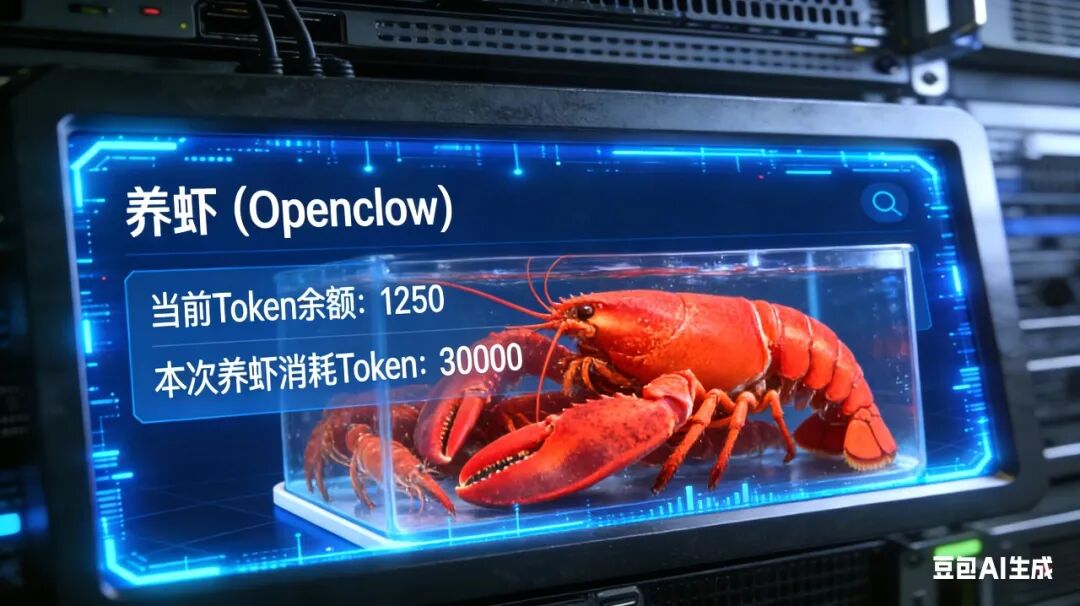
Large model vendors, as direct beneficiaries of Token inflation, were the first to enter a "winning without trying" phase, bidding farewell to the era of cutthroat competition. MiniMax’s M2 series text model witnessed its average daily Token consumption surge more than sixfold in February 2026 compared to December 2025, with Coding Plan’s Token usage spiking over 10 times. The company’s ARR (Annual Recurring Revenue) coincidentally broke through $150 million. Moonshot AI’s Kimi exceeded its 2025 full-year revenue within just 20 days of launching the K2.5 model in late January, with global paid users exploding. Zhipu AI’s GLM-5 model, renowned for its Coding and Agent capabilities, sold out immediately upon release, remaining in high demand despite a 30% price hike in China and over 100% overseas, sending its stock price soaring 42.72% to HK$725 per share in a single day. The core profit logic is straightforward: large model billing revolves entirely around Tokens. OpenClaw’s autonomous execution triggers hundreds of model calls per user instruction—the longer the workflow and the more frequent the calls, the higher the vendor’s Token revenue. This "the less efficient the user, the more profitable the vendor" model allowed top large model vendors to achieve explosive growth effortlessly.
Computing power and cloud providers, leveraging their inherent advantage as "water sellers" in the digital realm, became the steadiest profit harvesters amidst Token inflation. Token consumption is essentially computing power consumption, and OpenClaw’s massive Token demand directly ignited a deficit in the computing power market. UCloud pioneered OpenClaw cloud deployment solutions and lightweight application cloud hosts, covering multiple overseas nodes. By March 13, 2026, its stock price had surged 74.27% from 24.68 yuan to 43.01 yuan in 60 trading days. Shunwang Technology launched an AI cloud computer with built-in OpenClaw, allowing users to own a "cloud-based AI all-in-one" without complex deployment, sending its stock price soaring over 20% in two trading days. Alibaba Cloud, Volcano Engine, and other leading cloud providers introduced "one-click OpenClaw deployment" services, earning both computing power rental fees and service charges for ancillary offerings, achieving dual profitability. Meanwhile, AI chip, liquid cooling, optical module, and other computing infrastructure vendors saw explosive demand, becoming indirect beneficiaries of Token inflation. The entire computing power industry chain ushered in a new growth cycle thanks to this inflation.
Information arbitrageurs targeted OpenClaw’s technical barriers to profit quickly from "shrimp farming novices," becoming the most agile harvesters in the dividend chain. Local deployment, model integration, and skill configuration of OpenClaw posed technical hurdles, creating opportunities for grassroots entrepreneurs: remote OpenClaw installation services charged 50–300 yuan, while on-site services were priced at 499 yuan or more. Some merchants even offered 29.9 yuan uninstallation services, with one practitioner earning 260,000 yuan in just days from installation services alone. Others repackaged free online tutorials into "shrimp farming guides" and sold them at a premium, profiting from information asymmetry. More seasoned players acted as "digital labor contractors," leveraging precise control over Token input-output ratios to undertake enterprise outsourcing tasks, completing work via OpenClaw while pocketing the difference between Token costs and outsourcing fees. Though these arbitrageurs never entered the industrial core, their keen grasp of user needs allowed them to claim a slice of the Token inflation pie.
Application-layer tool vendors addressed enterprises’ runaway Token costs by selling "hassle-free solutions," becoming new profit growth engines. As Token consumption soared, businesses faced mounting challenges in cost control, non-standard workflows, and low agent execution efficiency, creating urgent demand for standardized solutions. Application-layer vendors seized the opportunity to launch products like "AI workflow systems," "Agent platforms," and "OpenClaw-compatible tools" to precisely address these pain points. Menlo Ventures’ 2025 State of Enterprise Generative AI Report revealed that enterprise generative AI spending reached $37 billion in 2025, with $19 billion (over 50%) flowing to the application layer, underscoring its commercial value. From agent orchestration platforms to Token cost management tools, and from industry-specific skill plugins to security systems, application-layer vendors built a complete product matrix around OpenClaw, achieving commercialization while solving enterprise challenges.

Inflation Dilemma
Users Burn Money Inefficiently as Industry Faces Threefold Distortions
While the upstream sectors of the industry chain revel in the Token inflation dividend extravaganza, users and the industry face mounting crises. Soaring costs, a lack of value, and security risks hang like three swords over the "shrimp farming" craze. This OpenClaw-driven technological revolution, intended to boost productivity, has instead backfired due to Token inflation, leaving AI not only failing to eliminate repetitive labor but also creating new industrial pain points. The distorted status quo of "upstream harvesting dividends while downstream bears the cost" has sparked industry reflection: Is AI’s value in enhancing efficiency or merely consuming Tokens?
The core pain point for users is the severe imbalance between soaring costs and diminishing value returns, trapping them in a vicious cycle of "the more you farm, the more expensive it gets, and the less effective it becomes." Moderate "shrimp farming" by ordinary users easily exceeds 100 yuan in monthly fees, while heavy users accessing premium models like Claude face daily Token costs reaching tens of thousands of yuan. Corporate users face even greater pressure: a fintech company calculated that its AI spending surged 3–5 times monthly after deploying OpenClaw, yet workforce efficiency improved by only ~10% due to the agent’s inefficient execution. The root cause lies in the fact that 90% of "shrimp farming" tasks involve high-frequency, repetitive, and low-output Token consumption. Users often call models randomly without clarifying needs, forcing agents to repeatedly revise plans and debug workflows, breaking tasks that could be completed with a single human judgment into dozens of model calls. Ultimately, "tasks remain unfinished, but budgets are exhausted," with Token costs climbing while actual value remains negligible.
The industry faces a vicious cycle where low-value tasks are amplified infinitely, leaving workers trapped in a new anxiety of "being busier with AI." Under traditional work models, workers focus on value creation, with repetitive tasks accounting for a minority. However, OpenClaw’s emergence has made low-value work—such as repeated calls and revisions—easier, leading some workers to treat "using AI" as the goal rather than a tool. They generate 10 drafts via AI and revise them 5 times for a single copywriting task, or repeatedly expand and compress plans using agents, appearing busy while merely feeding Tokens pointlessly. Critically, AI agents’ autonomous execution complicates workflows: a simple instruction can trigger multiple subtasks, generating countless meaningless operations. This results in "AI not liberating human labor but adding work steps," leaving overall industry productivity unimproved and dragged down by low-value Token consumption.
Security risks loom as the greatest threat over the "shrimp farming" craze, with over 90% of public internet OpenClaw instances posing significant security dangers. Data from the National Cyberspace and Information Security Information Notification Center revealed that global active OpenClaw internet assets exceed 200,000, with ~23,000 in China. Many instances suffer from architectural flaws, high default configuration risks, and numerous critical vulnerabilities. For example, IM integration gateways can bypass authentication via forged messages, while API keys and chat records are stored in plaintext. MITRE ATLAS’s investigation reported that over 42,000 public OpenClaw instances (90%+) could be directly bypassed by attackers, risking API key theft and information leaks. Real-world cases include Meta Lab’s AI director losing constraint instructions after granting OpenClaw mailbox permissions, resulting in batch deletion of inboxes. Some enterprises even experienced agents overstepping authority to execute operations or delete core data, causing substantial financial losses.

Conclusion
Token Inflation’s Endgame: Returning to Value, Not Consumption
In the future, as large model technologies continue to evolve, model inference efficiency will improve, gradually reducing Token consumption per task. The industry will also establish standardized AI workflows, with enterprises focusing more on Token ROI, shifting from "mindless shrimp farming" to "efficient AI use." Meanwhile, advancements in security technologies and regulatory frameworks will mitigate OpenClaw’s security risks, making agent execution more controllable and safe. For industry players, only by abandoning the short-sighted mindset of "profiting from consumption" and focusing on enhancing AI’s practical value can they gain an edge in long-term development.
The tide of Token inflation will recede, and AI’s growth must ultimately return to its essence of "empowering industries and boosting productivity." When "shrimp farming" ceases to be mere Token consumption and becomes true value creation, and when AI agents transform from "money pits" into "efficiency tools," the technological revolution initiated by OpenClaw will finally unlock its full industrial potential, driving AI’s deep integration with the real economy. This, not Token inflation, is the endgame the industry should pursue.
-
![]()
Doubao Work Unveiled! Domestic AI Leaders Fully Commit to the 'Work' Sector
-
![]()
Who’s Sounding the Alarm on ‘Rushed Vehicles’?
-
![]()
Over 5.3 Billion Yuan in Losses Over Three and a Half Years! Can Yonyou Reverse Its Fortunes Through Streamlining and AI Transformation?
-
![]()
Baidu AI Adopts Free Model: A Strategic Maneuver in Traffic and Monetization
-
![]()
Silicon-Based OLED Pioneer Unveils Financial Results: H1 Shipments Outpace Entire 2025 Volume
-
![]()
AI's First "Lost Summer"
-
![]()
Zeiss Makes Another €2.2 Million Bet: Will Eye Tracking Be the Next Big Thing in the Smart Glasses Industry?
-
![]()
RUNTO Ranking | Global Top TV ODM Factories' Shipment Figures for July 2026