ATH + Wukong: Alibaba Initiates Token-Based AI Strategy
 03/18 2026
 513
513
By Yang Xuejian
Source / Node AI
Alibaba has made two significant announcements in quick succession over the past two days.
On March 16th and 17th, Alibaba unveiled two strategic moves: the formation of the Alibaba Token Hub (ATH) Business Group, and the launch of its enterprise-level AI platform, "Wukong."
Is the ATH Business Group Alibaba's AI "All-in-One" Solution?
On March 16th, Alibaba CEO Wu Yongming announced the creation of the ATH Business Group in an internal memo, which he will oversee directly. The establishment of ATH signifies the consolidation of Alibaba's previously fragmented AI technology teams from various business units and sectors, including Tongyi Labs, QianWen, and the AI team from DingTalk, under a unified framework.
Wu Yongming stated candidly in the memo, "We stand on the brink of an AGI explosion. Trillions of AI agents will power digital work, and these agents will operate on tokens generated by models." (Note: Tokens are the units of measurement for large models processing information.)
As Wu explained in the memo, the primary goal of establishing ATH is to generate tokens, distribute tokens, and apply tokens in practical scenarios.
In essence, the internet's competitive landscape is shifting from traffic-based competition to token-based competition. Alibaba aims to unify its internal AI-related computing power, models, and applications through ATH, fostering internal collaboration. Wu's direct oversight of ATH underscores Alibaba's commitment to making AI a core business focus.
The formation of ATH comes just two weeks after the departure of Lin Junyang, Alibaba's QianWen large model project leader, along with several technical experts. Reports at the time linked Lin's exit to Alibaba's organizational restructuring, suggesting that his large model team might be disbanded. Subsequently, Wu Yongming confirmed Lin's resignation internally and announced that Tongyi Labs would now be led by Alibaba Cloud CTO Zhou Jingren.
While the early-March departures briefly brought Alibaba's AI business into the spotlight, the swift establishment of the new business group has successfully redirected public attention back to its ongoing operations.
Within ATH, multiple business units have been established, including Tongyi Labs (responsible for foundational model R&D), MaaS (Model as a Service) to construct model service platforms and technical systems, and an AI Innovation Division to explore AI applications. The most notable addition is the newly introduced Wukong Division, positioned as a B-end AI-native work platform tailored for enterprise workflows.
To the outside world, the stage was set, and the show commenced immediately.
Can Wukong Outperform "Lobster"?
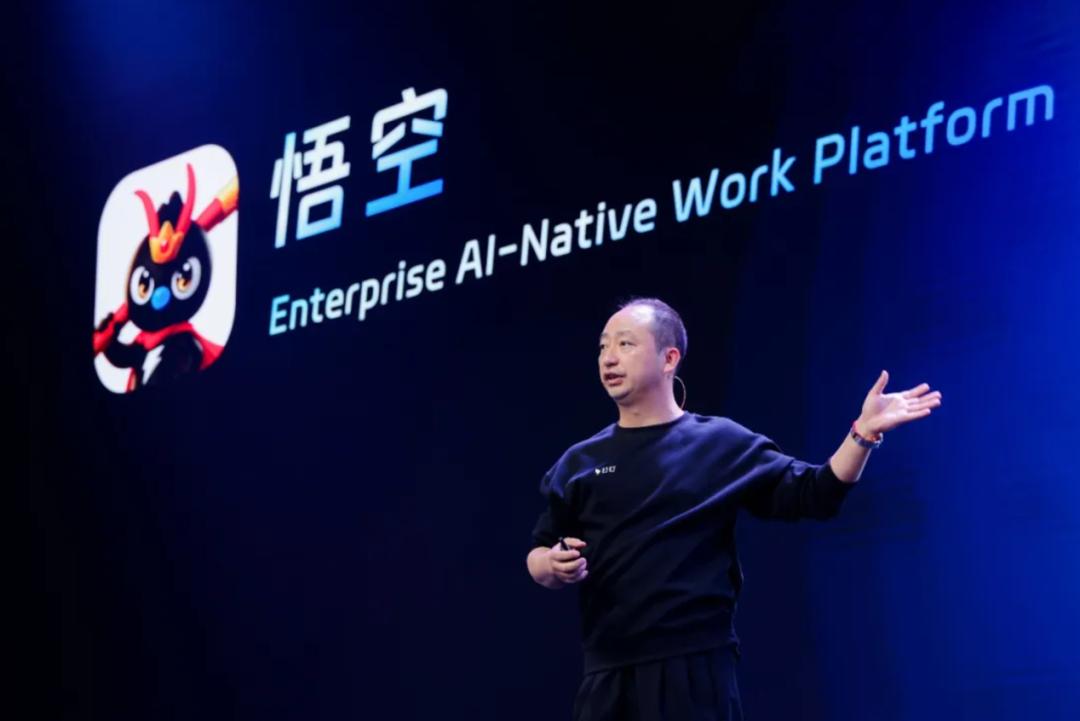
On March 17th, at the AI DingTalk 2.0 launch event, the Wukong platform was officially introduced, along with its global version, Global Wukong. Wukong boasts an independent app, marking DingTalk's first standalone product release in its 11-year history. However, the platform is currently in invite-only testing, with full public access yet to be announced.
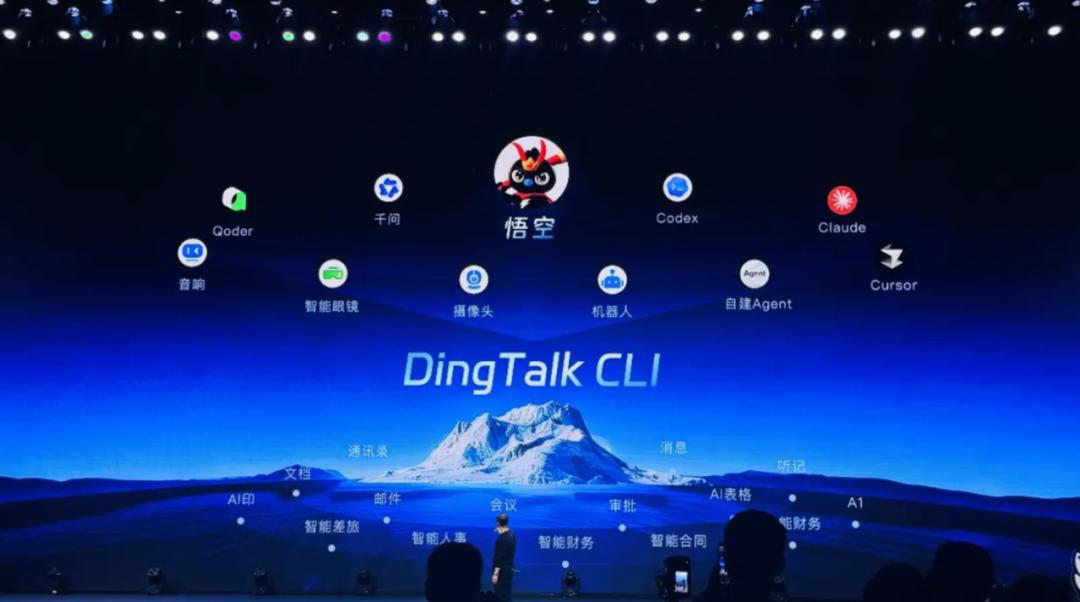
What exactly is Wukong? "We dismantled DingTalk and rebuilt it with AI to create Wukong," said DingTalk founder Chen Hang at the event.
Wukong can be viewed as an enterprise's super digital employee or as Alibaba's "Lobster" equivalent for businesses. It can be seamlessly integrated within DingTalk's ecosystem of 20 million enterprise users, enabling AI to directly invoke enterprise permissions, system capabilities, and business processes through an Agent Runtime environment, achieving "communication as execution." The Agent Runtime system encompasses a task reasoning engine, memory system, AI workspace, and execution tools, supporting independent models and operating environments.
Alibaba's strength is further amplified by the gradual integration of B-end capabilities from Taobao, Tmall, 1688, Alipay, and Alibaba Cloud into Wukong as Skills. This means that beyond corporate organizations, buyers and sellers on Taobao, Tmall, and 1688 can significantly enhance product selection and transaction efficiency through Wukong.
This inevitably draws comparisons to the recent frenzy over "Lobster," an open-source AI agent tool officially named Open Claw. Hailed as the product that "truly lets AI work for humans," it quickly transformed from a tech-circle phenomenon into a global AI sensation, sparking a wave of "lobster farming" across industries.
However, as many "lobster farmers" discovered issues such as accidental deletion of files, emails, and systems—or even attracting computer viruses—the significant security risks of standalone agent applications became evident.
For enterprise applications, security is paramount. Whether Wukong can operate safely and controllably is now Alibaba's key challenge.
Chen Hang addressed this concern head-on at the event, stating, "Data will always run in isolated environments and never affect user systems."
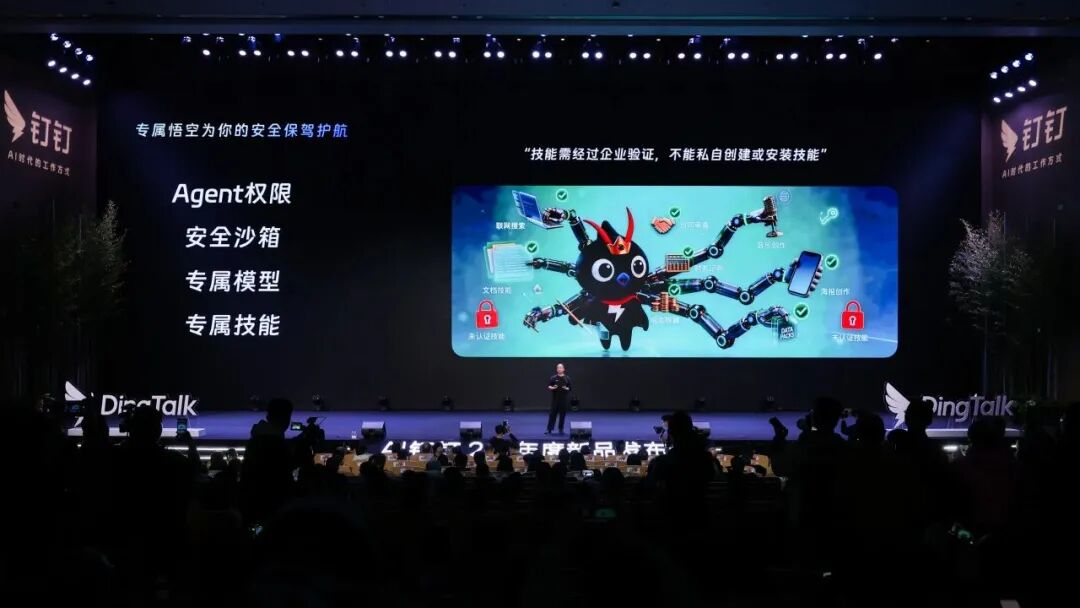
Specifically, Wukong employs four security defense lines:
The first line is account binding verification. Wukong binds to DingTalk accounts during installation, requiring remote calls to be verified through the same account to prevent unauthorized data access.
The second line is a security sandbox. Agents operate in restricted environments with predefined accessible resources and executable commands.
The third line is data isolation. Enterprises can deploy dedicated model instances, ensuring data is not used for public training or leaked.
The fourth line is skill verification. All Skills must pass enterprise security reviews before activation to prevent malicious third-party Skills from infiltrating.
"In the past, humans used DingTalk for work. In the future, AI will use DingTalk for work. Unlike all Lobster agents on the market, Wukong is natively built for enterprise organizations and can be safely used in real corporate environments," Chen said.
Three Major Challenges Remain
Despite the rapid-fire announcements showcasing Alibaba's speed and determination in AI business restructuring and product launches, three key challenges persist.
First, can historical issues of internal organizational collaboration be fully resolved? Previously, AI teams were scattered across business lines. While ATH has reorganized some teams, short-term friction over resource allocation and KPIs among computing power, model, and application teams is inevitable. Ensuring the stability of foundational model R&D by the QianWen team after core member departures remains a challenge.
Second, balancing open-source and commercialization. QianWen's global popularity stemmed from its open-source strategy. The Lin Junyang controversy sparked speculation that Alibaba's urgency to monetize AI drove internal conflicts. If QianWen's app experiences a post-subsidy decline in daily active users, tensions between open-source and commercialization may resurface.
Third, can Wukong truly integrate Alibaba ecosystem's B-end capabilities? As mentioned, Wukong could enhance efficiency by integrating Skills from Taobao, Alibaba Cloud, etc. However, the timeline for this integration remains unclear. Given e-commerce's complex, personalized demands, Wukong's computing power and models must respond swiftly—a current unknown. Additionally, with enterprise clients demanding stringent data and financial security, Wukong's security systems must withstand large-scale commercial scrutiny. Sometimes, a single overlooked corner case can expose massive vulnerabilities.
Whether a super digital employee or a phenomenal application, for Alibaba—with its user base in the hundreds of millions—ATH marks a beginning, and Wukong represents a new start. Rapidly converting its existing user advantage into AI business leverage leaves no room for hesitation.
-
![]()
Doubao Work Unveiled! Domestic AI Leaders Fully Commit to the 'Work' Sector
-
![]()
Who’s Sounding the Alarm on ‘Rushed Vehicles’?
-
![]()
Over 5.3 Billion Yuan in Losses Over Three and a Half Years! Can Yonyou Reverse Its Fortunes Through Streamlining and AI Transformation?
-
![]()
Baidu AI Adopts Free Model: A Strategic Maneuver in Traffic and Monetization
-
![]()
Silicon-Based OLED Pioneer Unveils Financial Results: H1 Shipments Outpace Entire 2025 Volume
-
![]()
AI's First "Lost Summer"
-
![]()
Zeiss Makes Another €2.2 Million Bet: Will Eye Tracking Be the Next Big Thing in the Smart Glasses Industry?
-
![]()
RUNTO Ranking | Global Top TV ODM Factories' Shipment Figures for July 2026