5-Minute Ultra-Fast Charging VS 99-Second Battery Swapping: Who Will Win This Off-the-Record Battle for Energy Replenishment?
 03/18 2026
 585
585
Introduction | Lead
While 800V ultra-fast charging has compressed energy replenishment time to just 5 minutes, the battery swapping model remains a hot topic. Recently, ARCFOX announced a deep collaboration with CATL's "Choco Swap" to launch a family sedan with a 99-second rapid full-charge battery swapping feature. Today, with rapid advancements in battery technology, the core competitiveness of battery swapping is no longer just about "speed" but rather the battery health management, improved second-hand residual value, and the ability to solve the fundamental industry challenge of "mismatched lifespans between vehicles and batteries" brought about by "vehicle-battery separation." As ultra-fast charging and battery swapping take opposing stances, which one truly represents the ultimate solution for energy replenishment in new energy vehicles?
This article is produced by | Heyan Yueche Studio
Written by | Cai Yan
Edited by | He Zi
Full text: 1,876 characters
Reading time: 3 minutes
On one side, BYD has reduced charging time to 5 minutes, while on the other, CATL is teaming up with ARCFOX to promote 99-second battery swapping. What may seem like a speed race is actually hiding deeper secrets: battery degradation, second-hand vehicle value retention, synchronized vehicle-battery lifespans... These critical issues might be the real reasons why industry leaders are so committed to battery swapping.
Which Has Stronger Battery Swapping Business: CATL or NIO?
Recently, ARCFOX and CATL jointly announced a deep collaboration to launch a family sedan supporting "99-second rapid full-charge" battery swapping. Against the backdrop of BYD's release of its second-generation Blade Battery and flash-charging technology, which compresses charging time to just 9 minutes, ARCFOX's move has triggered a renewed industry examination of the battery swapping model. The core driving force behind this round of battery swapping layout (layout) comes from CATL. As a global leader in power batteries, CATL began deploying its "Choco Swap" business in 2022 and had established 1,020 battery swap stations by the end of 2025. According to its plans, by 2026, it will have built over 3,000 swap stations across more than 140 cities, with a long-term goal of 30,000 stations.
Unlike NIO's closed battery swapping network, CATL, as a third-party supplier, aims to build an open, standardized battery swapping ecosystem. To date, CATL has collaborated with numerous automakers, including FAW Group, Changan Automobile, GAC Group, and BAIC Group, with Choco Swap models gradually entering the market. The participation of ARCFOX and Aion signifies that CATL's battery swapping alliance is moving from "blueprint" to "implementation."
CATL's entry is fundamentally transforming the competitive landscape of the battery swapping market. Previously, only NIO had made significant progress in the passenger vehicle battery swapping sector. By February 2026, NIO had established over 3,700 swap stations, including over 1,000 on highways, and achieved a cumulative total of 100 million battery swaps on February 6. This milestone data proves that the battery swapping model is not a "false demand," as some skeptics claim, but rather a viable path validated by user adoption and market scale.
However, the inherent limitation of NIO's model lies in its closed nature—swap stations primarily serve NIO, Lexo, and other in-house brand models. Although NIO has formed a "Battery Swapping Alliance" with 31 partners, including Changan, Geely, Chery, and GAC, true multi-brand compatibility still requires time to materialize. CATL's advantage lies precisely in its neutral position as a battery supplier, enabling it to collaborate with nearly all automakers. When battery swapping networks are no longer exclusive to a single brand, the inflection point for scale effects may arrive sooner. NIO plans to add 1,000 swap stations in 2026, bringing the total to over 4,700 by year-end, while CATL aims to build over 3,000 stations within the year. This "infrastructure competition" between the two companies is pushing battery swapping from a single-brand "moat" toward a public infrastructure for the entire industry.
Why Is Battery Swapping Still Needed in the Era of Ultra-Fast Charging?
BYD's newly released second-generation Blade Battery and flash-charging technology have pushed charging speeds to new heights: just 5 minutes to charge from 10% to 70%, 9 minutes to reach 97%, and even in extreme cold at -30°C, only 12 minutes to charge from 20% to 97%. Given these advancements, why are automakers still fixated on battery swapping technology, which requires massive investment and lacks standardized solutions?
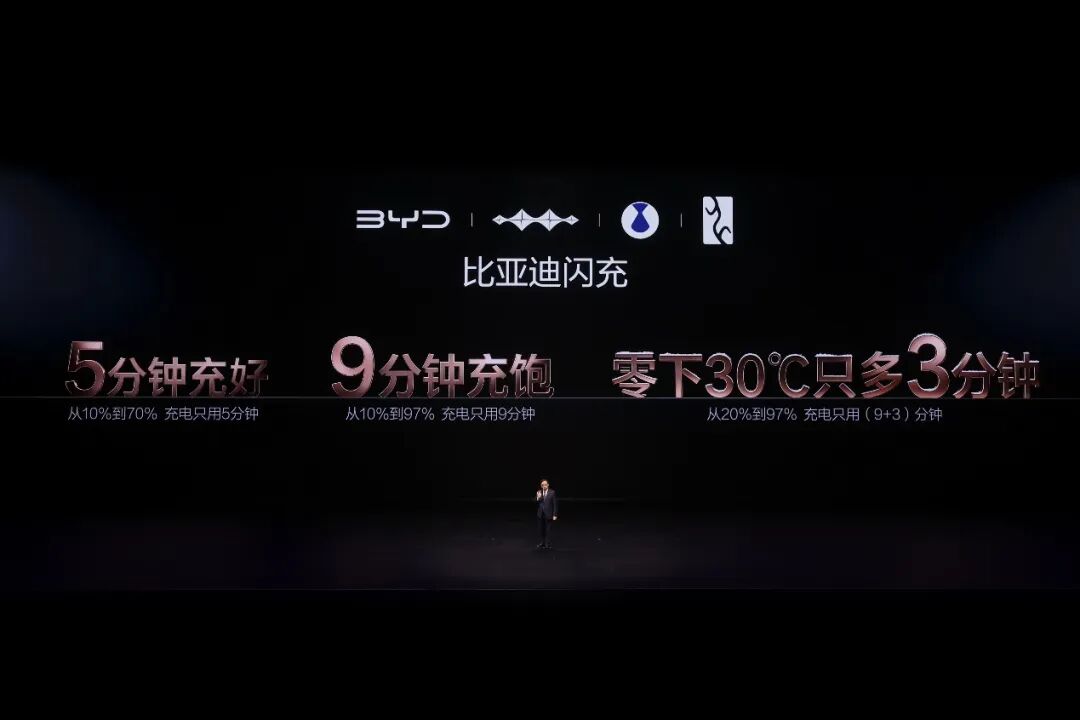
△ BYD's newly released flash-charging technology shocks the new energy industry
The answer lies in the fact that battery swapping offers value far beyond just replenishment speed. Battery swapping and ultra-fast charging are not mutually exclusive; rather, battery swapping's greater significance lies in addressing the systemic challenge of "mismatched lifespans between vehicles and batteries." Currently, power battery warranty periods typically last 8 years or 150,000 km, while a vehicle's body can last over 15 years. For electric vehicles without battery swapping capabilities, when battery degradation renders them unable to meet daily usage needs, the prohibitive cost of battery replacement may force early vehicle retirement. The battery swapping model, through vehicle-battery separation, provides a systematic solution to this industry pain point. Under NIO's Battery-as-a-Service (BaaS) rental model, users can purchase vehicles without buying the battery, instead renting it monthly and eliminating concerns about battery lifespan and health. Batteries undergo centralized, professional, and scientific maintenance at swap stations, effectively extending their service life.
Of course, the challenges facing the battery swapping model cannot be ignored: swap station construction costs range from 3 to 5 million yuan, 5 to 10 times higher than those of flash-charging stations. Standardization presents an even more structural pain point: achieving uniform battery pack dimensions, chassis interfaces, and communication protocols across the industry would require automakers to compromise on core product definitions—a nearly impossible commercial task. This explains why, despite the grand ambitions of CATL's battery swapping alliance, the number of truly implemented models remains limited.
Commentary
The debate between battery swapping and ultra-fast charging will not reach a conclusion in the short term. For private car owners with home charging stations who primarily commute within urban areas, 5-9 minute flash-charging, coupled with a widespread charging network, will remain the dominant and cost-effective choice. However, for high-frequency ride-hailing vehicles, taxis, and premium users seeking the ultimate experience, the value of battery swapping—"swap and go" convenience, freedom from battery degradation concerns, and comprehensive battery health management—remains irreplaceable. ARCFOX's collaboration with CATL is less of a declaration of war against ultra-fast charging and more of a strategic move to support a more diverse range of mobility options.
(This article is original to Heyan Yueche and may not be reproduced without authorization.)
-
![]()
The Unstoppable Rise of 'Optical Progress and Copper Decline': Sunny Optical’s Strategic Vision for the Next Decade
-
![]()
AI + Going Global in the Second Half: No Intermission for Robot Vacuum Cleaners
-
![]()
The Suffering Endured in E-commerce, Walmart Doesn't Want to Repeat in AI
-
![]()
What Does the Doubling of New Energy Vehicle Exports Mean?
-
![]()
Ghosn: 'Only I Can Save Nissan'
-
![]()
Volkswagen Lays Off 100,000 Employees, The Elephant Sits Down
-
![]()
Expanding Production Capacity! Yutong Optics Acquires Approximately 1.5 Hectares of Industrial Land in Chang'an, Dongguan
-
![]()
Why Is Nokia Making a Comeback in the AI Era?