Dissecting Unitree Robotics' Prospectus: The 'Path Taken' and 'Path Forward' for the First Humanoid Robot IPO
 03/24 2026
 600
600

From the Spring Festival Gala Stage to the Capital Arena: The Next Stop for China's Embodied AI
On the eve of the 2026 Chinese New Year, four robotics companies—Unitree Robotics, Songyan Dynamics, Galaxy General, and Magic Atom—simultaneously appeared on the CCTV Spring Festival Gala. With drunken boxing, backflips, and obstacle crossings, humanoid robots once again became the focus of national attention one year later.
Popularity quickly translated into market data. Within two hours of the gala's broadcast, robot search volumes on JD.com surged by over 300% month-on-month, customer service inquiries skyrocketed by 460%, and orders increased by 150%. Products from brands like Magic Atom, Unitree Robotics, and Songyan Dynamics were quickly sold out.
However, as time passed, the fervor from the Spring Festival Gala gradually faded, and market rationality returned. According to "China Newsweek," the most popular Unitree robot, the G1, rented for only RMB 4,000-5,000 per day during the Lantern Festival period, less than a quarter of last year's peak. After the peak seasons of the Spring Festival and Lantern Festival, rental prices are expected to decline further, potentially falling below RMB 1,000.
(Source: Unitree Robotics' prospectus)
Just as market sentiment was calming, on March 20, the embodied AI sector received another major announcement: Unitree Robotics officially filed for a Sci-Tech Innovation Board IPO, planning to publicly issue no less than 40.4464 million shares and raise RMB 4.202 billion.
The unveiling of this prospectus caused a stir in the capital markets. However, a deep dive into Unitree Robotics' financial report reveals a deeper question: Where should China's embodied AI head next?
01
A Not-Yet-Deep Full-Stack Self-Research Moat
Before Unitree Robotics' IPO, several humanoid robotics companies had already rushed to go public in 2025.
UBTECH chose to list in Hong Kong; Zhiyuan Robotics planned to backdoor list via a protocol transfer and tender offer with Shangwei New Materials, aiming to become the "first A-share humanoid robotics company"; Woan Robotics and Stan Tech Robotics also initiated filing preparations...
Amid this constellation of stars, Unitree Robotics' prospectus still dazzled the capital markets.
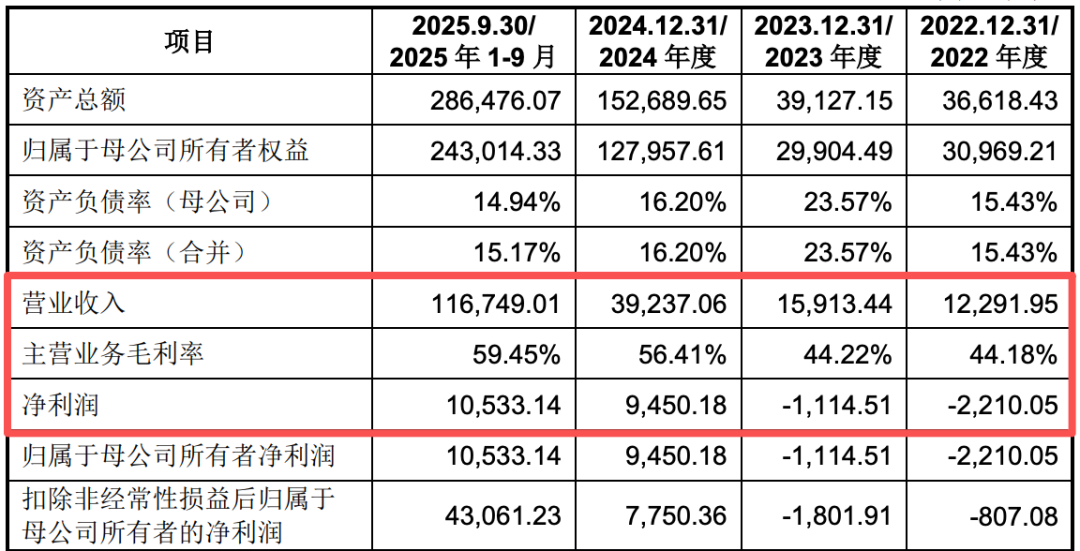
According to prospectus data, the company's revenue was just RMB 123 million in 2022 but soared to RMB 392 million in 2024. The forecasted revenue for 2025 reached RMB 1.708 billion, a staggering 335.36% year-on-year increase.
(Source: Unitree Robotics' prospectus)
Alongside revenue growth, the company's profitability continued to improve. Forecasted non-GAAP net profit reached RMB 600 million, a 674.29% surge. The gross margin for its main business climbed from 44.18% in 2022 to 59.45% in the first three quarters of 2025. In an industry where general-purpose robotics companies are often mired in "burning money to chase dreams," this "profitability report card" is particularly rare.
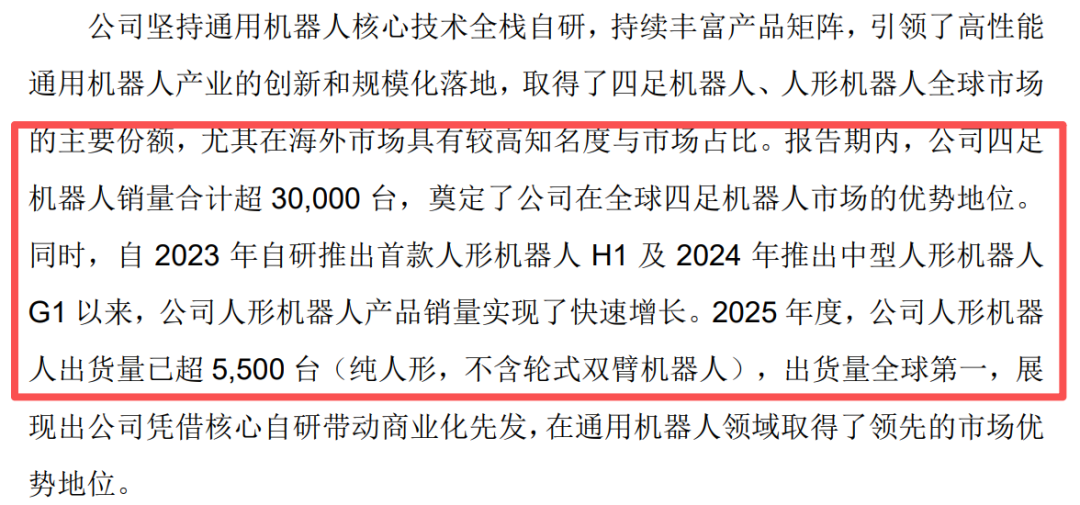
The core driver of this performance lies in Unitree Robotics' mass production capabilities. In 2025, the company's robotics production capacity reached 10,000 units, with 8,560 units produced and a 94.63% production-to-sales ratio. Cumulative sales of quadruped robots exceeded 30,000 units, while humanoid robot shipments surpassed 5,500 units, ranking first globally.
(Source: Unitree Robotics' prospectus)
Behind these figures lies Unitree Robotics' "full-stack self-research" business model.
According to the prospectus and inquiry responses, Unitree Robotics has achieved full-stack self-research and self-production of core components such as motors, reducers, encoders, dexterous hands, and LiDAR. Except for optional high-spec externally procured LiDAR or dexterous hands, externally procured components account for approximately 14%-18% of total costs.
This vertical integration capability not only builds technical barriers but also brings cost advantages. During the reporting period, the unit cost of quadruped robots dropped from RMB 22,300 in 2022 to RMB 12,100 in January-September 2025, while the unit cost of humanoid robots fell from RMB 73,200 in 2023 to RMB 62,200.
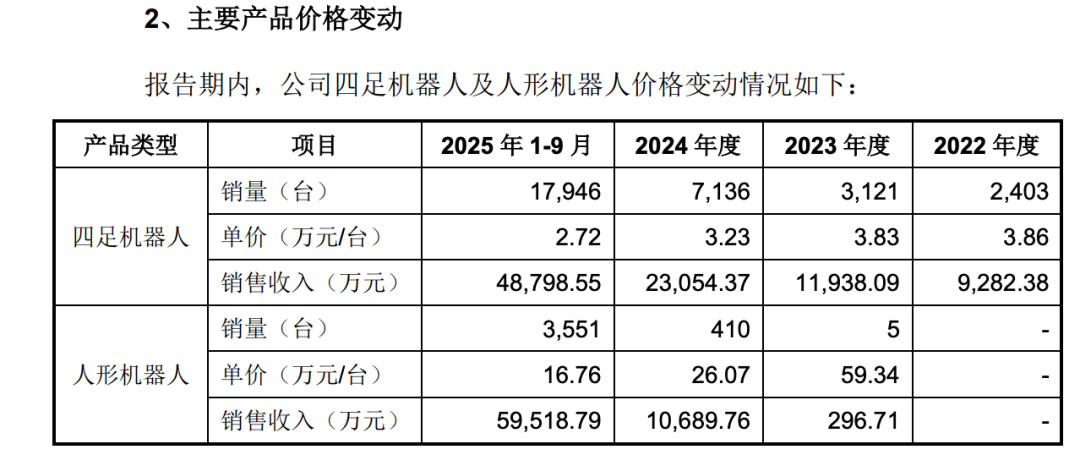
(Source: Unitree Robotics' prospectus)
Thanks to this, the starting price of Unitree Robotics' Go2Air quadruped robot has dropped below RMB 10,000, while the base version of the G1 humanoid robot starts at RMB 85,000, further lowering the market threshold for general-purpose humanoid robots.
This combination of "self-control for barriers + flexible cost control" allows Unitree Robotics to break free from the industry's "burning money for growth" cycle. However, the victory of scale does not mask the phased (phased) characteristics of its business model. According to the prospectus, in January-September 2025, industry application revenue accounted for only 9.01% of Unitree's humanoid robot income, despite high hopes.
The "Reply to the Second Round of Inquiry Letters Regarding the Pre-review Application Documents for the Initial Public Offering and Listing of Unitree Robotics Co., Ltd. on the Sci-Tech Innovation Board" reveals that shallow scenarios like corporate guided tours accounted for 50%-70% of this industry application revenue. Meanwhile, revenue from clear industrial scenarios like smart manufacturing and intelligent inspections amounted to only RMB 15.702 million, representing just 29.29% of industry application revenue.
This suggests that during the critical transition period for humanoid robots moving from "showcases" to "markets," Unitree Robotics' core question is no longer "how many units can be sold" but "where to sell them and what problems to solve."
02
Three "Undercurrents" Behind High Growth
Beneath the impressive data, Unitree Robotics' prospectus reveals several "undercurrents" that cannot be ignored.
First is the fragility of the revenue structure. Unitree Robotics' explosive revenue growth in 2025 is closely tied to the "massive traffic" generated by the Spring Festival Gala.
Unitree Robotics openly acknowledged in its prospectus that humanoid robot revenue in the second quarter of 2025 surged by 167.15% quarter-on-quarter due to the gala effect, but then dropped by 32.22% in the third quarter as the hype faded. Although fourth-quarter data rebounded, proving that market demand is not a flash in the pan, this volatility still reflects the risk of "unclear demand."
For any company aiming to build a long-term, stable growth curve, over-reliance on event-driven traffic rather than endogenous demand remains a significant concern.
Second is the catch-up in core technology routes. In the robotics industry, "brain," "cerebellum," and "body" are often used to distinguish different levels of technological capability.
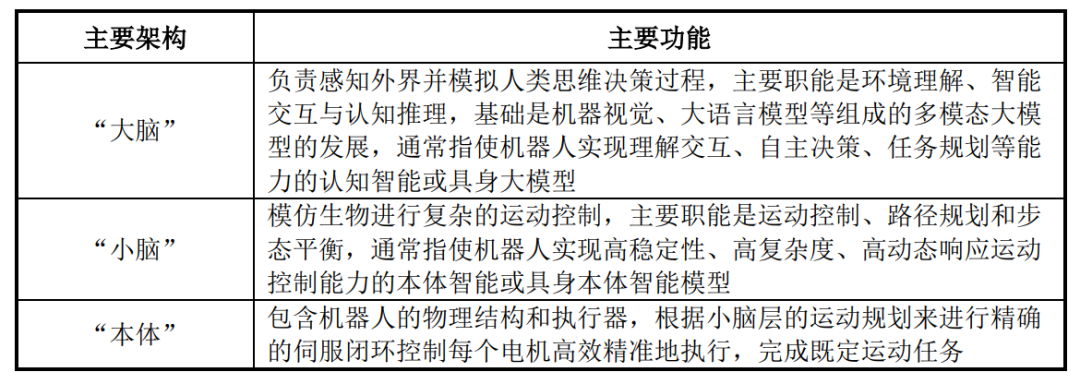
(Source: Unitree Robotics' prospectus)
The "body" refers to the robot's physical structure, including hardware like mechanical components, joints, and motors. The "cerebellum" is the motion control system, enabling the robot to walk, run, and flip. The "brain" is the embodied large model, allowing the robot to understand instructions, perceive its environment, and make autonomous decisions.
Unitree Robotics undeniably leads in the "body" and "cerebellum" domains. Its prospectus lists a long string of motion performance records, such as the world's first full-size electrically driven humanoid robot backflip in 2024 and a new world record for humanoid robot running speed exceeding 5 meters per second in 2025. It also won 4 gold medals and 11 total medals at the first World Robot Games—all evidence of its deep accumulation in motion control.
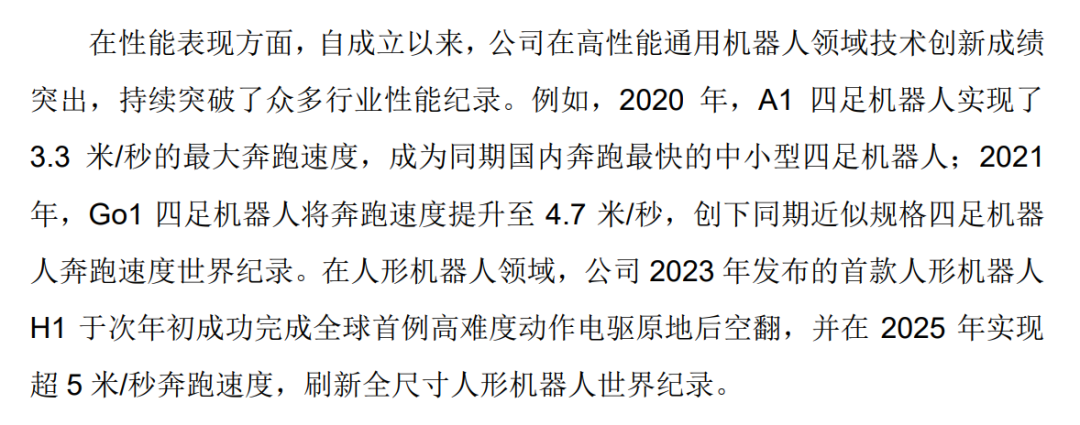
(Source: Unitree Robotics' prospectus)
However, at the "brain" level, which determines the future intelligentization (intelligent) height of robots, Unitree Robotics' investment appears relatively insufficient. According to the prospectus, R&D expenses for the first nine months of 2025 were RMB 90.21 million. The R&D-to-revenue ratio peaked at 31.39% in 2023 but fell to 17.84% in 2024 and further to 7.73% in January-September 2025.
Unitree Robotics also admitted in its prospectus that given the global R&D and testing phase of embodied large models, the company had not yet scaled its self-developed general-purpose embodied large model for robotic products during the reporting period. Currently, its sold products integrate self-developed motion control models and third-party large language models.
This stands in stark contrast to later entrants like Galaxy General. Founded less than three years ago, the company quickly became a capital market darling with its "Galaxy Star Brain," the world's first end-to-end embodied large model integrating "brain-cerebellum-neural control."
In March 2026, Galaxy General announced a RMB 2.5 billion new funding round, setting a domestic record for embodied AI single-round financing and pushing its valuation past RMB 20 billion. Unitree Robotics now faces a dimensional challenge from algorithms by later entrants.
Third is the concern over customer structure singularity and commercial conversion efficiency. According to the prospectus, in January-September 2025, the research and education sector accounted for 73.60% of Unitree's humanoid robot revenue.
This structure means the company's core customer base currently consists of universities, research institutions, and tech companies—not true industrial or consumer-end users.
While universities, research institutions, and tech companies hold value, their procurement cycles, budget scales, and application scenario limitations are evident. Their primary use for robots is algorithm research, model training, and teaching experiments, not as productivity tools for actual production.
Although this customer structure can support initial scaling shipments, it struggles to form a sustained, stable, and large-scale commercial closed loop (closed loop). Whether Unitree can break into broader fields like industrial manufacturing and commercial services remains uncertain as the research market saturates.
03
A "Pit Stop" for the Future
Upon learning of Unitree Robotics' IPO, many industry insiders were puzzled—after all, the company is neither short on cash nor lacking investors.
Unitree Robotics' total assets surged from RMB 366 million at the end of 2022 to RMB 2.865 billion by September 2025, a nearly sevenfold increase in three years. Net assets grew from RMB 309 million to RMB 2.43 billion, earning it the title of a "cash flow powerhouse."
Its shareholder lineup is equally star-studded. In February 2024, Unitree Robotics completed a nearly RMB 1 billion Series B2 funding round, with investors including Shenzhen Capital Group, China Internet Investment Fund, Source Code Capital, Matrix Partners China, and Meituan Strategic Investments. In June 2025, it secured a RMB 700 million Series C round co-led by China Mobile Fund, Tencent, Alibaba, Ant Group, and Geely Capital, lifting its valuation from RMB 8 billion to RMB 12 billion—a 50% increase in under six months.
With ample cash and a luxury (luxury) shareholder roster, why rush to IPO? The answer may lie in its fundraising plans.
According to the prospectus, Unitree Robotics aims to raise RMB 4.202 billion, with RMB 2.022 billion earmarked for the "Intelligent Robot Model R&D Project"—a strategic investment to address its "brain" shortcoming (weakness). Other projects, such as robot body R&D, new product development, and manufacturing base construction, aim to consolidate (consolidate) existing advantages, expand product lines, and increase production capacity.
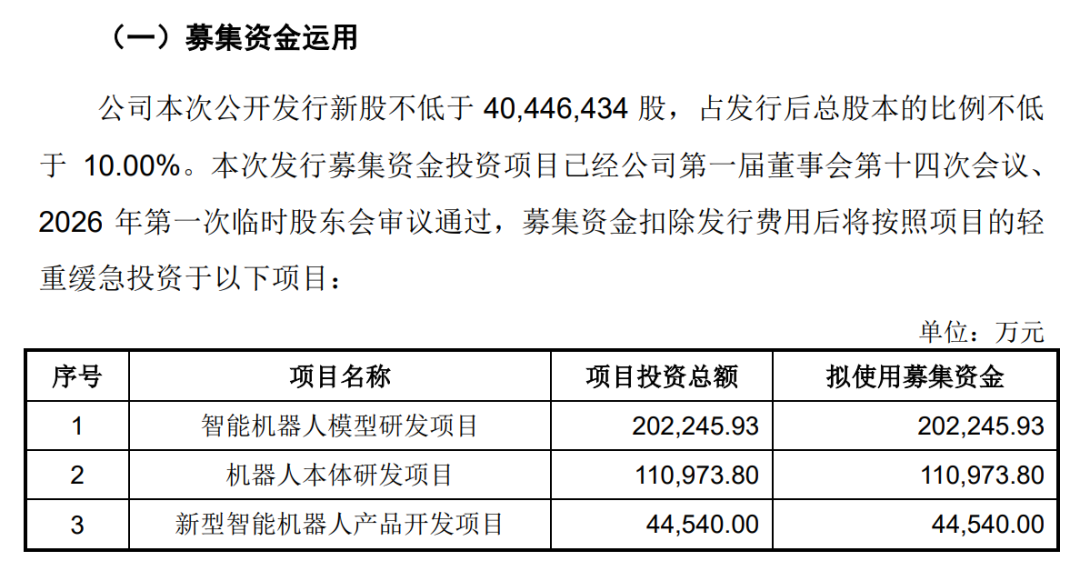
(Source: Unitree Robotics' prospectus)
This fund allocation clearly outlines Unitree Robotics' strategic intent. On one hand, it continues to invest in "body" and "cerebellum" R&D to consolidate (consolidate) its lead. This is less a "conservative play" than a sober (sober) judgment of the competitive landscape.
After all, overseas giants like Tesla and Figure AI may lag in mass production for now, but their integration capabilities in AI large models and automotive supply chains are formidable. Once these giants solve production issues, their strong brand and technological momentum will threaten all domestic players, including Unitree Robotics.
Thus, Unitree must use the IPO funds to accelerate capacity expansion. For example, its planned manufacturing base is expected to reach an annual capacity of 75,000 humanoid robots and 115,000 quadruped robots, preparing for imminent market demand surges.
On the other hand, heavy investment in "brain" R&D aims to bridge the technological gap from "capable of movement" to "capable of thought." The prospectus reveals that in the LIBERO simulation benchmark test, Unitree Robotics' UnifoLM-VLA-0 scored 98.7 points, significantly outperforming π0.5-KI's 94.3 points.
However, laboratory "high scores" are still far from scalable applications. The company plans to release a "general-purpose humanoid robot embodied foundation model" with four generalization capabilities (scenes, instructions, actions, and tasks) within three years. Achieving this goal will directly determine whether it can continue leading in the next competitive phase.
In this sense, Unitree Robotics' IPO is not a celebration of success but a "pit stop" in a life-or-death race. Whether it can efficiently convert the RMB 4.2 billion raised into "brain" breakthroughs and cultivate truly irreplaceable application scenarios will determine the future of this RMB 10 billion unicorn.
For the entire Chinese embodied artificial intelligence industry, Unitree Technology's exploration itself is the most vivid example. It proves that hardware breakthroughs can be achieved by relying on the local supply chain, but it also reminds all participants that this marathon about 'intelligence' has only just completed its first stage.
* Image sourced from the internet. Please contact for deletion if there is any infringement.
-
![]()
The Allure of 'Acquisition Spree': Li Shufu's Left Turn, Xu Jiayin's Right
-
![]()
Strategic Transformation Yields Results: Phoenix Optics Reports 10.9% YoY Rise in Core Net Profit for H1 2026
-
![]()
Three Key Growth Trajectories Synergize! Crystal-Optech Reports 3.478 Billion Yuan in Revenue for H1 2026
-
![]()
Semi-Annual Report Sparks XPENG Motors Buzz
-
![]()
1.6 Billion Big Order Secured! SeeYA Technology's Revenue Soars by 287.87% in the First Half of the Year
-
![]()
Baidu's Profits Plunge by 68%: Unraveling the Mystery Behind the Numbers
-
![]()
Baidu’s Profits Tumble by 68%! Where Has All the Money Gone?
-
![]()
Hynix’s Taobao Store Shuts Down Abruptly: What Should Customers Do About Warranty Services for Memory Modules?