AI Glasses 'Crossing the River': The Next Stage of the Hundred-Glasses Battle
 04/20 2026
 475
475
Author|Chuan Chuan
Editor|Da Feng
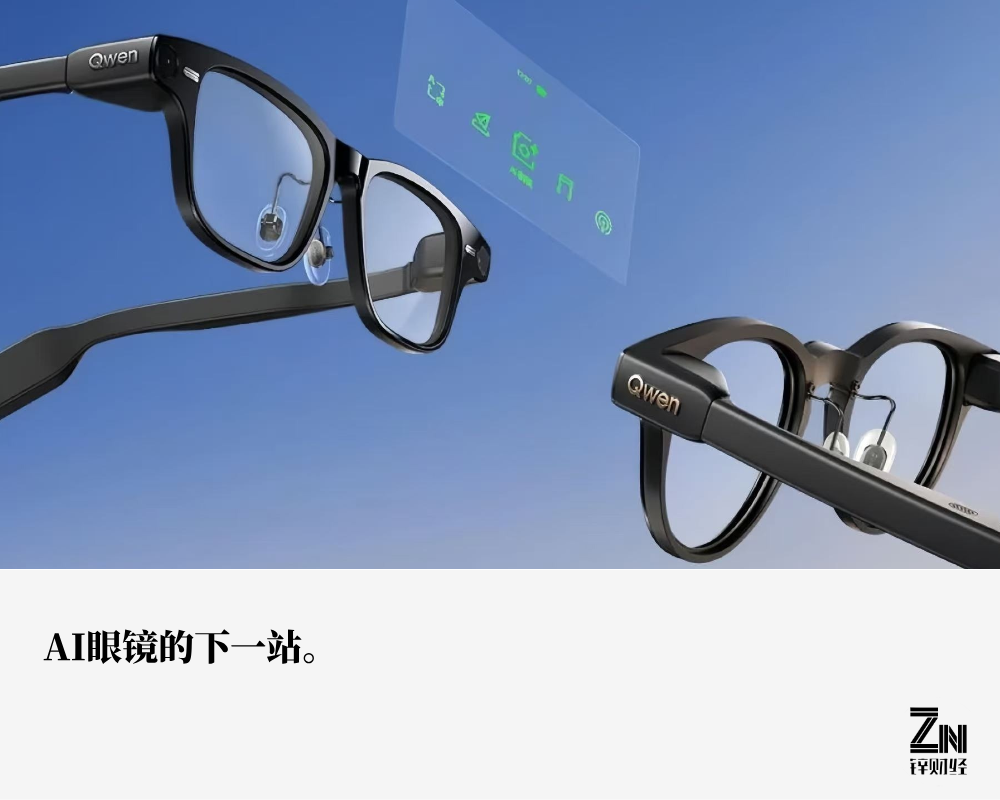
The Qianwen AI Glasses S1 went on sale on April 15, securing top positions on multiple sales charts across mainstream e-commerce platforms like Tmall, JD.com, and Douyin within just 10 hours.
Over a month earlier, the Qianwen AI Glasses G1 also sold out across all channels on its launch day, March 8, capturing over 70% of the online AI glasses market in its first week. Even earlier, in November 2025, the Kuake AI Glasses S1 repeatedly sold out across multiple channels, with delivery lead times extending to 45 days.
For outsiders, a perplexing question arises: What is the relationship between Qianwen and Kuake, both AI glasses under Alibaba's ecosystem?
In fact, the Qianwen S1 and Kuake S1 are nearly identical in hardware, both featuring Qualcomm Snapdragon AR1 and BES2800 dual flagship chips, dual-eye Micro-LED displays, Sony IMX681 sensors, and other core components. The primary difference lies in software—the Kuake S1 runs on the default Kuake OS, requiring an OTA update to Qianwen OS, while the Qianwen S1 comes pre-installed with the latest Qianwen large model.
In December 2025, Alibaba merged its Smart Information and Smart Connectivity business groups to form the Qianwen C-end Business Group, with Group Vice President Wu Jia overseeing the Qianwen large model, Qianwen App, Kuake, and AI hardware businesses. This explains why Alibaba appears to have two parallel business lines in the AI glasses track ( track : track/market): they are essentially the same team with the same underlying capabilities, unified under different brands after market validation.
The Qianwen AI Glasses S1 serves as the 'physical shell' for the Qianwen large model to enter the real world—model-driven product development, rather than product-centric model integration. This approach prioritizes stability: Alibaba focuses not on extreme hardware breakthroughs but on migrating mature ecosystem services to the glasses, striving for 'above-average' performance at every functional node.
While Alibaba advances steadily, another force is quietly brewing.
Bloomberg reporter Mark Gurman revealed in his *Power On* newsletter that Apple is accelerating development of an AI smart glasses codenamed N50, expected to launch as early as late 2026 or early 2027, with a full market release likely in 2027. This screenless device, resembling ordinary glasses, will feature cameras, speakers, and rely on Siri and Apple Intelligence for AI visual analysis, real-time translation, and environmental awareness.

Apple has even paused upgrades for the Vision Pro, redirecting resources to smart glasses R&D—a strategic shift from 'spatial computing' ambitions to betting on a wearable, screenless device, confirming industry trends.

The Hype and Reality of the 'Hundred-Glasses Battle'
Market enthusiasm is backed by data.
Omdia reports global AI glasses shipments reached 8.7 million units in 2025, up 322% year-on-year; IDC projects global smart glasses shipments will exceed 23.687 million units in 2026, with China accounting for over 4.915 million units. Such growth is unparalleled in global consumer electronics.

Players are competing across dimensions:
Meta expands its lineup with prescription AI glasses and sport-focused Oakley series;
Huawei announces its AI glasses will launch on April 20;
iFLYTEK showcases AI glasses at the CIIE, emphasizing voice and visual translation for business scenarios;
Domestic brands like Rokid, Thunderbird Innovation, and XREAL remain highly active.
In niche segments, AR glasses focused on video functions grew over 80% in late 2025, with Thunderbird leading at 42% market share; waveguide-based AR glasses surged over 600% year-on-year, with Rokid dominating shipments through first-mover advantage and scaled production.
IDC predicts global smart glasses shipments will exceed 40 million units by 2029—the question is no longer 'if' but 'when' they become mainstream.
Yet the market's true logic is far more complex than shipment figures. Giants entering the AI glasses race aim beyond hardware sales.
Alibaba migrates services like Alipay, Gaode Maps, and Fliggy to glasses, seeking a high-frequency physical entry point for the Qianwen large model, with ecosystem commercialization potential in the trillions. Huawei's AI glasses deeply integrate with HarmonyOS, enabling seamless connectivity with phones, watches, and computers to strengthen user dependency. Even Li Auto, a crossover entrant, aims to extend its in-car ecosystem via smart glasses, projecting navigation and enabling voice control within users' field of view.
Giants aren't profitin g from glasses sales but using them as a tether to lock users into their ecosystems—this is an entry-point defense strategy, not a race for unit sales.

Avoiding the AR Glasses' Mistakes
The key difference between today's AI glasses boom and the AR/VR hype years ago lies in a fundamental strategic shift.
Apple's Vision Pro struggles exemplify this. Priced at $3,499, the headset was privately deemed 'over-engineered' by Apple executives, with its weight, cost, and lack of content hindering mainstream adoption. It represents the 'technology-first' approach—cramming cutting-edge capabilities into a device before ecosystems mature, a path now proven unviable.

Apple's N50 embodies a contrasting philosophy. Screenless and indistinguishable from ordinary glasses, it is deemed 'conservative' by some critics. Yet this 'dimensional reduction' addresses XR's biggest pain point: users won't accept bulky, expensive devices for unproven features. The screenless design lowers barriers to adoption, while bone conduction technology and AI vision enable 'effortless interaction'—a gradualist strategy of 'first wearability, then indispensability,' starkly different from the Vision Pro.
Alibaba takes another path but similarly prioritizes stability. The Qianwen S1 uses 2D binocular diffractive waveguides and Micro-LED monochrome displays, eschewing extreme hardware experiences. Behind its advertised 40° FOV lies Alibaba's clear understanding that its strength lies not in hardware supply chains.
Its true focus is migrating mature services like Alipay's 'glance-to-pay,' Gaode's AR navigation, and Fliggy's smart translation to glasses, creating a 'what-you-see-is-what-you-get' soft-hard synergy. As an AI glasses startup founder noted, 'All vendors, myself included, are essentially supply chain integrators'—with hardware differentiation fading, the true differentiators are model intelligence and ecosystem breadth.
This is why AI glasses won't repeat AR glasses' mistakes.
In the previous AR boom, hardware dominated; ecosystems were an afterthought. Now, hardware is becoming a 'shell' for AI capabilities, with ecosystems and models as the core. Product strength depends not on OS but on models themselves. Only when hardware parameters cease to be the sole competition metric can AI glasses avoid the fate of 'just another VR headset.'

From 'Wearable' to 'Indispensable'
The true potential of AI glasses lies not in replacing phone functions but in creating entirely new experiences phones cannot deliver.
A prime example is the global debut store for Qianwen AI Glasses at Nanjing Lukou Airport. In this high-frequency, mobile scenario, travelers can complete real-time navigation, cross-language simultaneous interpretation, and meeting minute generation with a single voice command, with all information clearly displayed via near-eye technology. No frequent phone checks or Lowering the head operation ( Lowering the head operation : Look down at the phone operation ) needed—a 'gaze-as-interaction' experience phones cannot replicate.
Similar scenarios are expanding across dimensions. Rokid's AI glasses enable real-time translation, navigation, and contactless payments, even converting speech to text for the hearing impaired. iFLYTEK's model targets business scenarios, allowing simultaneous recording, photography, and note-taking to generate meeting minutes. LLVISION's 'AR+AI' conference translation system supports 54 languages with translation outputs in under 100 milliseconds. From airport travel to business meetings, hearing assistance to industrial inspections, AI glasses are transforming abstract AI capabilities into tangible value.
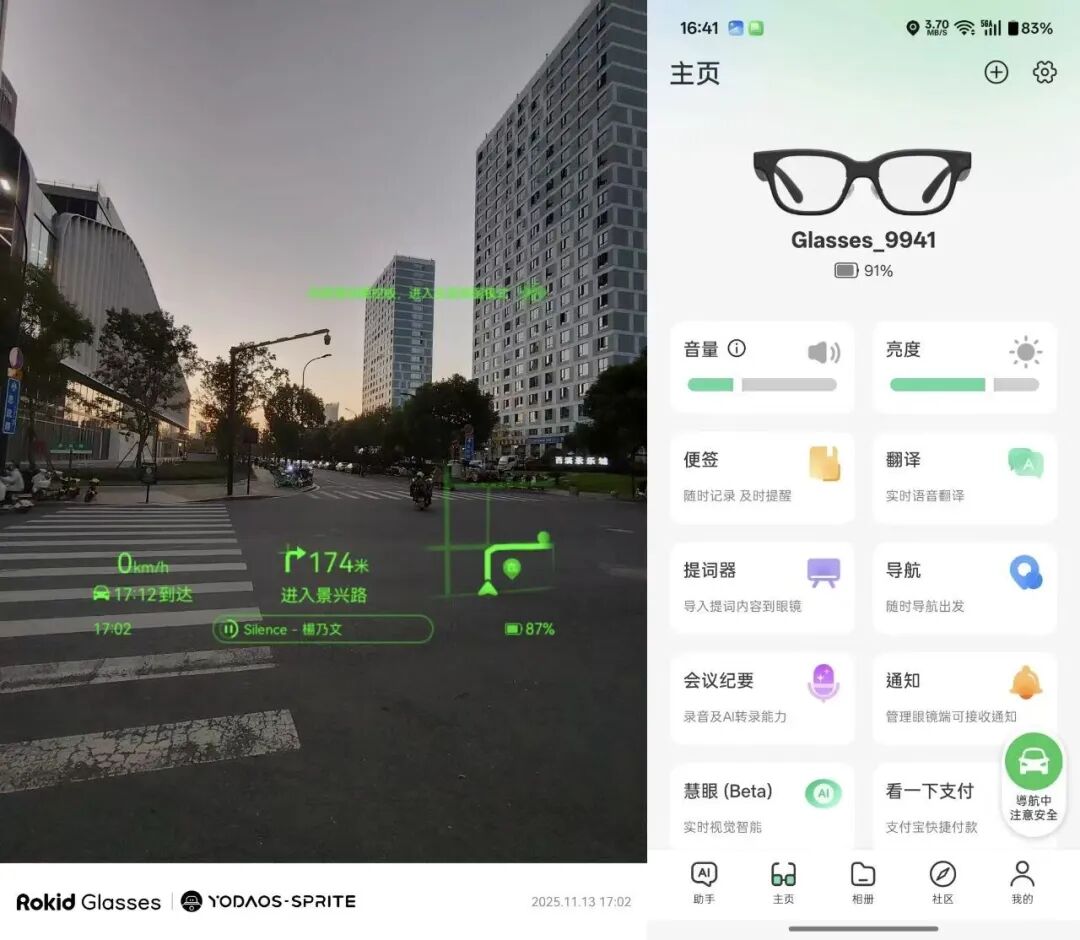
Deeper potential lies in 'slow thinking'—applications requiring contextual, long-term reasoning rather than instant feedback.
During hours-long meetings, AI glasses can automatically organize logic, distinguish speakers' viewpoints, extract key action items, and even create tasks based on ecosystem synergies. This capability isn't a mere app port but a new experience born from wearable devices' contextual awareness.
Technologically, waveguide iteration speeds are driving industry progress. Goertek Optics has launched the first 50° FOV silicon carbide-etched full-color waveguide display module, using a 2.65 refractive index silicon carbide substrate to break the traditional glass substrate's <30° FOV limit.
At the supply chain level, over 80% of global AI glasses suppliers are Chinese, with all core components procurable and testable in the Yangtze River Delta. An industry insider predicts that once waveguide technology advances to 80° FOV, smart and AR glasses will converge, with 'killer scenarios' emerging organically.
From Alibaba's 'stability' to Apple's 'transformation,' from Meta's global dominance to Chinese vendors' catch-up, the AI glasses industry stands at a pivotal moment. Players who innovate rigorously in hardware while transcending its limitations may finally cross the threshold from 'wearable' to 'indispensable.'
-
Ofilm Teams Up with ADSensE to Propel Large-Scale Deployment of All-Solid-State LiDAR Powered by ADS6311 Chip!
-
![]()
Loss of 2.5 Billion Yet Facing Strong Demand for Shares? Another Battle for Control of Lianchuang Electronics
-
![]()
Huawei’s Enjoy Series Flies Off the Shelves, Prompting Xiaomi to Double Down on Budget Smartphones
-
![]()
Beijing Hyundai's Top Executive Criticizes Industry Disorder: Certain Brands Treat Customers as Beta Testers
-
![]()
The domestic mobile phone market has declined for five consecutive quarters! Huawei defies the trend with significant growth: maintains its top market share
-
Annual Revenue Surpasses 3 Billion: An Automotive Trim 'Little Giant' Makes Its Debut on the Beijing Stock Exchange
-
![]()
The Space Force Wants to Spend $30 Billion on Rocket Launches: Is Trump Doubling Down, and Is SpaceX the Big Winner?
-
![]()
Going Crazy! One out of Every Three Plug-in Hybrids Sold in Europe is a Chinese Vehicle