Embrace AI Wholeheartedly! iQIYI Sparks Trending Debate, But the Outrage May Be Overblown
 04/21 2026
 447
447
"iQIYI has lost its mind"—these words dominated trending searches today, even claiming the top spot at one point.
The uproar stemmed from a misinterpreted snippet of Gong Yu's remarks at the iQIYI World Conference 2026. Taken out of context, his statement about "live-action filming potentially becoming intangible cultural heritage" was twisted into sensational headlines. Fueled by inflammatory interpretations, panic quickly spread: Will AI render live-action films obsolete? Will beloved actors lose their jobs? Will everything we watch soon be AI-generated "fakes"? Uninformed viewers erupted in outrage, propelling iQIYI onto four or five hot search lists and granting it a level of attention that the automotive and digital sectors could only envy.
I was present at the event, and it’s clear that misunderstandings and rumors spread far faster than the truth. Gong Yu’s original statement was: "Will 100% live-action filming without any technological intervention be recognized as a world cultural heritage—intangible cultural heritage—in a few years? That remains an open question." He further clarified: "Stage plays will always exist, and live-action filmmaking will always have its place."
The logic is straightforward: If creators insist on rejecting all technological tools, their work could indeed become "cultural heritage"—not as a critique, but as a factual observation. How many film and television productions today exist without any technological enhancement? From black-and-white TV to color, from silent films to IMAX 4K, from satellite broadcasts to fiber-optic streaming—technology has always driven the industry’s evolution. Which production team today doesn’t rely on color grading, rendering, or post-production? AI is merely another tool in the creative arsenal, not a wrecking ball.
Shen Teng humorously noted, "AI can write sad lines, but it doesn’t truly feel sadness. It can calculate the funniest rhythm, but it doesn’t understand humor. That’s my edge." Yet he revealed that even this line was AI-generated. This encapsulates the attitude creators should adopt: neither kneeling in submission nor standing in defiance, but diving in and leveraging new tools to their advantage.
The same principle applies across industries. The issue isn’t new technology itself, but the refusal to engage with it—or worse, panicking in the face of change.
Why must the film and television industry "go all-in" on AI?
Some criticize iQIYI’s transformation as overly radical—"AI creation," "decentralization," "Natto Pro"—a flurry of initiatives that left many dazed. Even Gong Yu acknowledged this as iQIYI’s most significant transformation in 15 years, surpassing even the shift from PC to mobile internet. But for those familiar with iQIYI’s DNA, this was no sudden leap.
I’ve long argued that iQIYI possesses the strongest technological foundation among domestic long-form video platforms, not merely because of its Baidu heritage, but because its team was built with innovation at its core. Beyond early advancements like XR, virtual concerts, and cinematic-grade LED production, let’s focus on AI. By 2019—before large language models dominated headlines—iQIYI had already positioned "technology and entertainment" as its dual-helix strategy. At the time, Gong Yu identified "our imagination" as the primary bottleneck for AI. As large model technology surged, iQIYI continued to innovate, securing regulatory approval for its AI dialogue generation and synthesis algorithm by 2024.
At this year’s iQIYI World Conference, AI was the sole focus from start to finish. Gong Yu’s assessment was blunt: "(The AI technological revolution) happens once a decade? That’s an understatement. Some argue AI is humanity’s final invention—and that makes sense. Once both physical and mental labor are liberated, what comes next?" His excitement was palpable: "Living in this era is truly thrilling."
Having tracked global streaming giants, I’ve observed that Netflix, Disney, and HBO are all embracing AI. Netflix optimizes recommendations, production workflows, and even plot generation with AI. Disney has partnered exclusively with OpenAI, investing $1 billion and opening hundreds of IPs for AI-driven content. Why, then, does iQIYI face backlash for doing the same? This highlights a dilemma for Chinese tech firms: If you don’t adopt AI, critics say you’re stuck delivering food; if you do, they claim you’ve gone insane.
The truth is, iQIYI isn’t being radical—it’s adapting to necessity.
How will AI disrupt the film and television industry?
Hollywood’s core is industrialization, driven by assembly lines, efficiency, and high-volume content production. AI simply accelerates this process, pushing industrialization to new heights.
The most immediate impact will be reduced costs, shorter production cycles, lower barriers to entry, and ultimately, a surge in content volume—and with it, more hits.
Gong Yu introduced the "1-1-2 Rule": AI slashes unit content costs by an order of magnitude (to a tenth or even a twentieth of previous levels), increases the number of creators by at least an order of magnitude, and boosts the number of works by two orders of magnitude (100–200 times past output).
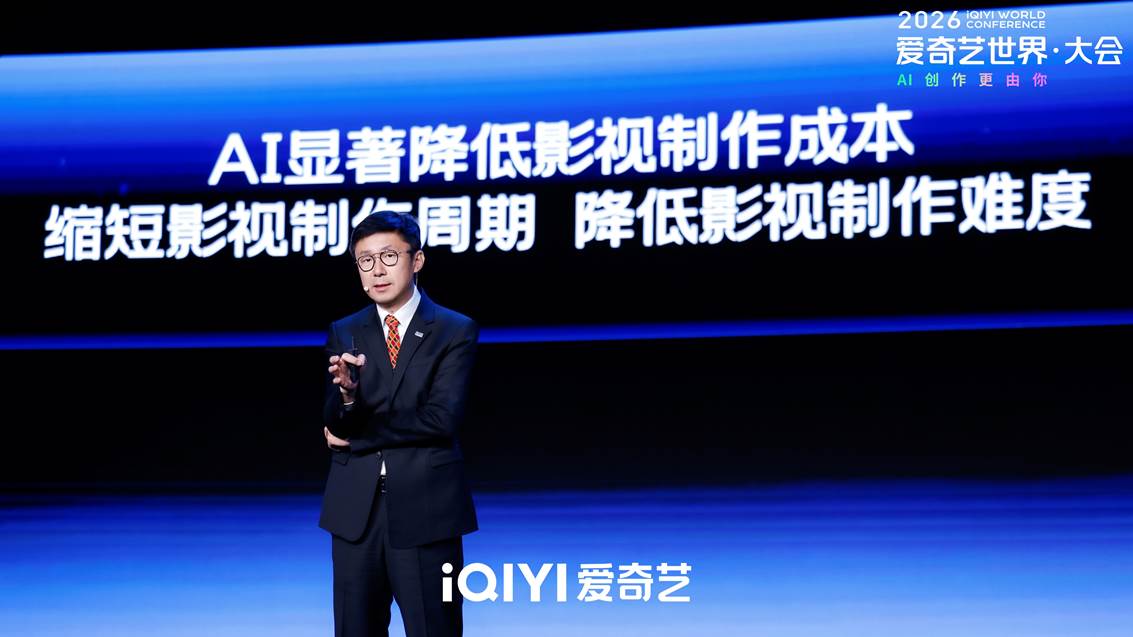
This transformation is straightforward: A drama that once cost tens of millions now becomes accessible to new directors with budgets in the thousands. Previously, only geniuses could secure funding—but how could young creators prove their genius without opportunities? Now, a single person with a computer can produce commercial-grade work.
Wang Xiaohui, iQIYI’s Chief Content Officer, put it bluntly: "The unprofitability of film and television boils down to quality and efficiency." AI solves the efficiency problem, breaking the "impossible trinity" of scale, personalization, and star-driven content. Historically, high quality meant limited scale; personalization meant low efficiency. AI makes all three achievable simultaneously.
But what comes after efficiency is solved? After quantities explode?
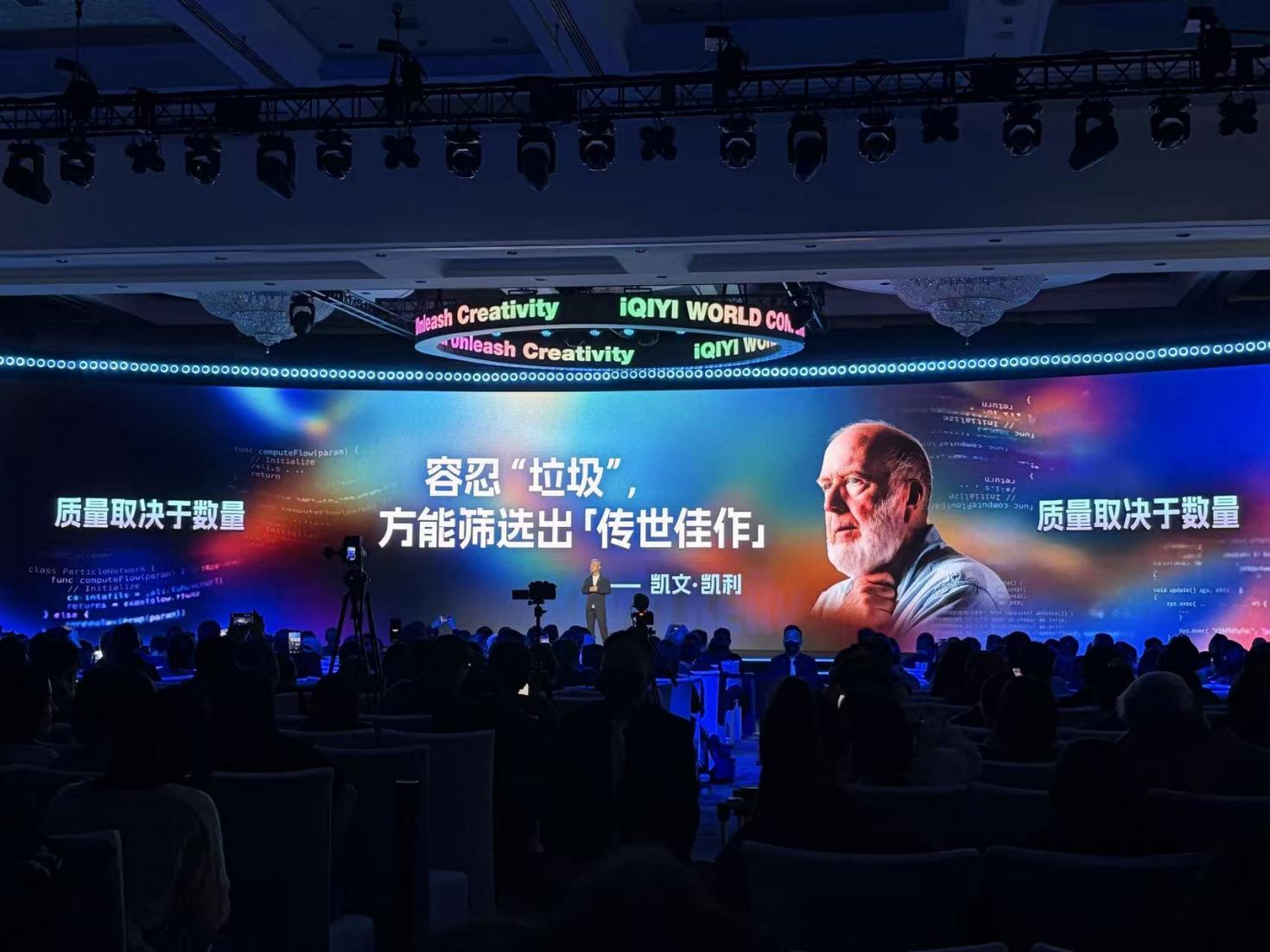
Wang Xiaohui admitted: "There will be a flood of mediocre works." This is the inevitable path of technological revolutions—without quantity, there can be no great creators or masterpieces. As Kevin Kelly observed: "Tolerate garbage to filter out timeless classics."
Liu Wenfeng, iQIYI’s Senior Vice President, demonstrated the newly launched Natto Pro platform on-site. Nearly 70 intelligent agents cover screenwriting, directing, art, and editing. The screenwriting agent converts novels to scripts with one click; the directing agent fine-tunes lighting; and the one-shot agent generates low-cost, continuous long takes lasting dozens of seconds.
iQIYI is opening its two-decade accumulation of core resources to creators: an IP library (scripts, novels, comics), a talent pool (over 100 artists, including Chen Zheyuan and Zeng Shunxi), and a digital asset library. Creators can explore AI with small teams or even as solo operators, building on a vast ecosystem rather than starting from scratch.
Will AI make your idols unemployed?
This is the audience’s top fear: If AI replaces actors entirely, where will they watch their favorite stars?
Let’s quote Gong Yu directly: "Actors often work grueling schedules, filming for three to four months without a personal life. AI could enable them to star in four dramas a year instead of two, while giving them more time to rest."
Notice his phrasing: "from two to four"—more roles, not fewer. And reduced work intensity eliminates the need for "three to four months without a personal life."
My personal view is even more radical (and Gong Yu, in his position, couldn’t say this): Society doesn’t lack actors—just as it doesn’t lack influencers. There are countless young idols, and I’d argue 80% of actors might not outperform AI. What society lacks are true artists—performers like Bao Guoan, Yu Hewei, and Leslie Cheung, whose innate talent makes them irreplaceable.
Moreover, an undeniable truth: Excellent artists in any field have short creative primes, often a decade or less. AI can empower top artists to create more timeless classics during their peak years. Bluntly put: AI could let Liu Yifei star in more dramas while young or let Zhang Yimou direct more films during his golden period.
Wang Xiaohui emphasized: "Uniqueness matters more than being first. The value of good stories, IPs, and artists remains untouched by AI." In iQIYI’s philosophy, human experience and values are irreplaceable. Great artists need never fear replacement by technology—AI only amplifies their strength.
Decentralization: Will streaming platforms’ roles evolve?
AI will also reshape streaming platforms, driving a trend toward decentralization. Gong Yu admitted that over the past year, he’s attended over 200 review meetings—nearly one per workday—discussing investments and acquisitions with his team. Production bosses complained: "You’re exhausted, and you’re even competing with our business."
I doubt Gong Yu aspires to be listed as a "producer" on every film or drama. He’s "too tired," he admitted, and this centralized model won’t survive the AI era. When content output surges 100-fold, no single team can review it all in meetings—it’s physically impossible. Thus, iQIYI is proactively embracing "decentralization." Post-transformation, the platform shifts from a "content hub" to an "intermediary layer connecting creators and users." Creators control content and budgets, upload directly to the platform, and face user feedback firsthand, while the platform provides technology, distribution, and basic rules.
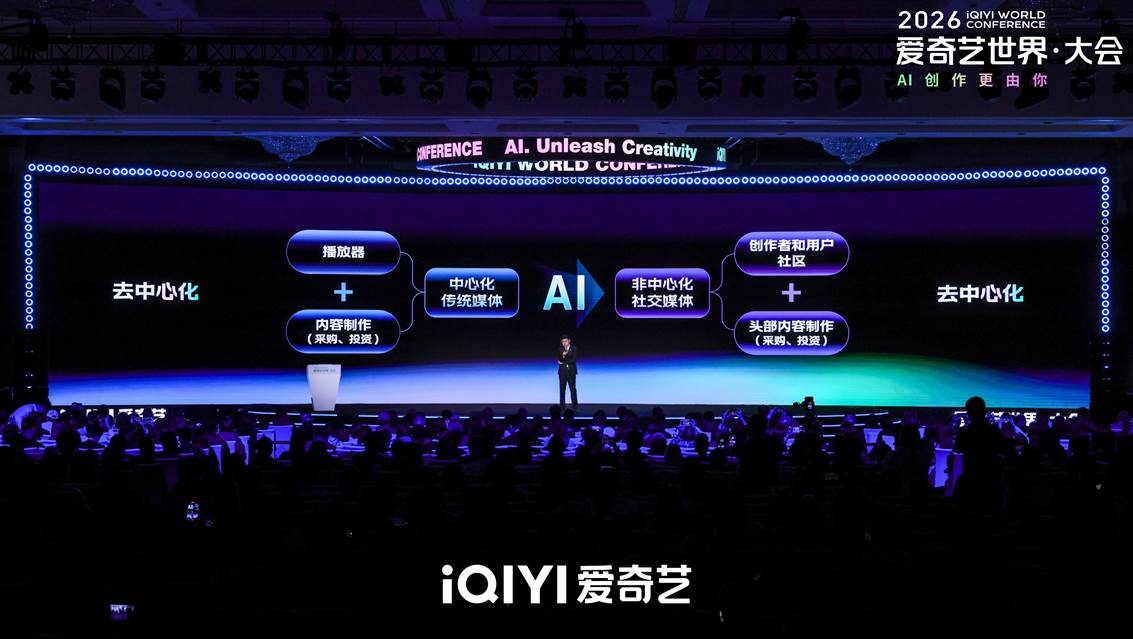
This is essentially a self-revolution. Previously, iQIYI profited from "control"—deciding what to buy, invest in, or broadcast. In the future, it will profit from "empowerment"—helping creators succeed more easily and earn more fairly. This model increasingly resembles short-video platforms.
The new iQIYI Creator Account emphasizes "zero-barrier entry," with a streamlined signing process. "Even a one-person company can participate." Revenue-sharing rules are unified, based on actual project income with no cap. AIGC content receives an additional 20% subsidy through year-end.
In Closing
AI’s impact isn’t unique to film and television—everyone feels its disruptive potential. Even we self-media writers sense our traditional models are obsolete.
But did the steam engine destroy coal mines? No, it skyrocketed coal demand. Horse carriage drivers panicked at trains, and now some taxi drivers vandalize RoboTaxi "radish cars." Yet the technological tide is unstoppable. The choice is yours: Be a carriage driver or a train passenger. Riding the train means enjoying technological dividends; clinging to the carriage means facing panic, confusion, anxiety, boredom, and even anger—but your emotions don’t alter reality. If you insist on driving a carriage, you’ll inevitably be left behind, marginalized by progress.
Guo Jingyu, Chairman of Changxin Media, said something at the conference that resonated deeply: "If you’re unfamiliar with AI, just learn. If you’re familiar, just use it." So, when facing AI, just do it.
-
![]()
More Car Models, Quicker Demise? Global Automakers Are Abandoning the 'Car Sea' Tactics", "Automakers, Model Streamlining, Profit Pressure, Universal Platform, Brand Management", "Global automakers ar
-
![]()
Model AB Price Reduction Controversy: Is Ninebot Losing Its Friendly Touch?
-
![]()
Computing Power Supplier Bags Orders Worth Over 600 Million Yuan, Yet Receives Only 4.5 Million Yuan in Actual Payments!
-
Alibaba Is Just Five Months Away from Securing Two Consecutive AI Coding Titles
-
![]()
Less Investment Isn't Apple's Get-Out-of-Jail-Free Card
-
![]()
The 'King of Africa' Tecno Mobile: What Is the Market Hesitating About After Its 'V-shaped' Rebound?
-
![]()
ByteDance Restructures Feishu, What Signals Does It Send?
-
![]()
ByteDance Overhauls Feishu: What Strategic Signals Are Being Sent?