From 'Toddler Steps' to 'Surpassing Humans': What Makes This Half Marathon a Must-Watch?
 04/21 2026
 583
583
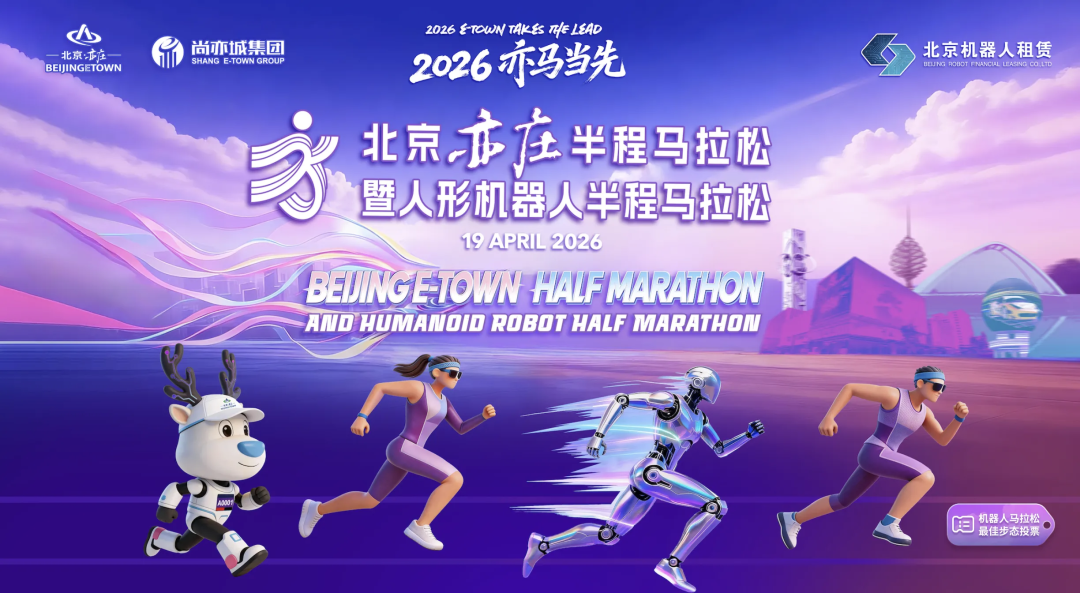
After a year, the Humanoid Robot Half Marathon once again kicked off in Beijing Yizhuang.
During last year's inaugural event, only 6 out of 20 participating robots successfully completed the race, with the champion, Tiangong Ultra, crossing the finish line in 2 hours, 40 minutes, and 42 seconds. At that time, watching the robots stumble and frequently fall on the track led many netizens to joke: 'This isn't a marathon; it's a baby walker race.'
One year later, at 7:30 AM on April 19, the 2026 Beijing Yizhuang Half Marathon & Humanoid Robot Half Marathon commenced as scheduled. Twenty-six brands, over 100 teams, more than 300 humanoid robots, and 12,000 human runners took to the 21.0975-kilometer course together. The event's scale expanded nearly fivefold compared to last year, with over 20 university teams participating and five international teams from France, Germany, and Brazil joining for the first time.
Robot contenders, who were still 'taking toddler steps' last year, delivered astonishing results this year: The champion's time not only shattered the event record but also surpassed the world record for the men's half marathon.
If last year's race was a 'technology assessment,' this year's event was a full-blown 'technological breakthrough.'
01
From 2 Hours 40 Minutes to 50 Minutes 26 Seconds: What Happened This Year?
Last year, Tiangong Ultra won with a time of 2 hours, 40 minutes, and 42 seconds, while the last-place finisher among the six teams that completed the race took nearly five hours. This year, Honor's Qitian Dasheng team's autonomous navigation robot, 'Lightning,' claimed the championship, reducing the time to 50 minutes and 26 seconds (net time).
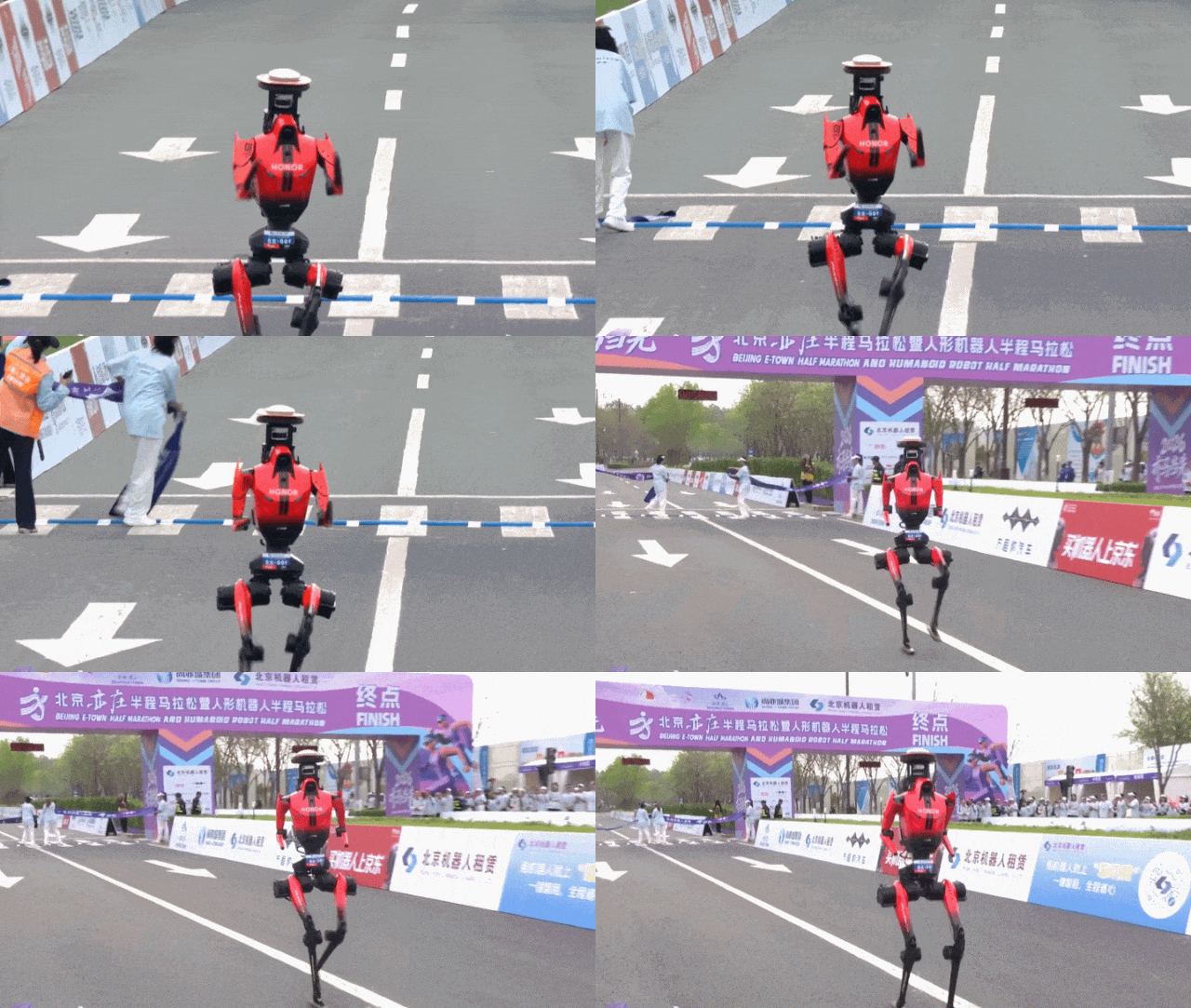
Autonomous Navigation Robot 'Lightning'
Comparing this to human world records: In March 2026, Ugandan star Jacob Kiplimo set a new men's half marathon world record of 57 minutes and 20 seconds at the Lisbon Half Marathon. This means that this year's winning robot, 'Lightning,' was nearly 7 minutes faster than the human world record.
However, a detail regarding this 'surpassing' must be noted.
This year's race featured two modes: autonomous navigation and remote control, with the results of each group calculated using weighted coefficients of 1.0 and 1.2, respectively. The net time for the autonomous navigation mode was recorded directly, while the remote control mode's time was multiplied by 1.2. The rule was designed to encourage the development of more challenging autonomous navigation technologies.
As a result, an interesting scene unfolded on the racecourse: Although Honor's remotely controlled robot, 'Lightning,' crossed the finish line first in 48 minutes and 19 seconds, its weighted time placed it behind the autonomously navigating 'Lightning' robot.
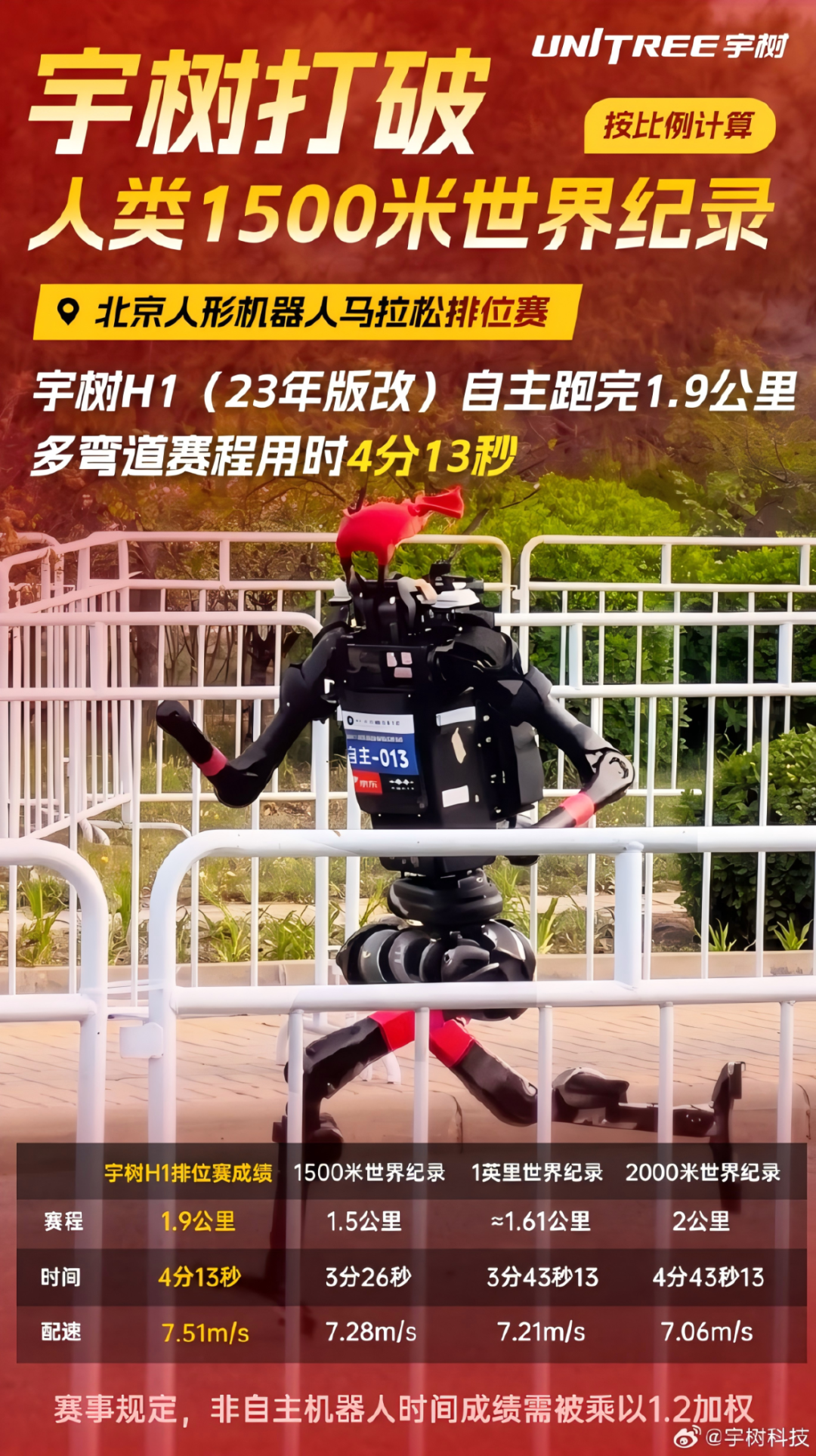
In sprinting, Unitree Technology announced that its H1 robot (2023 revised version) autonomously completed a 1.9-kilometer multi-turn course in 4 minutes and 13 seconds, breaking the human 1,500-meter world record proportionally. This means the Unitree H1 achieved a peak speed of 10 meters per second, approaching Usain Bolt's human limit of 10.44 meters per second.
The head of the Beijing Humanoid Innovation Center said after the race, 'The championship records set by Honor and Unitree reflect a 'team gold medal' for China's embodied AI industry. A diverse and competitive landscape is more meaningful than a single dominant player.'
02
26 Brands, Over 300 Robots Competing Together
Compared to last year's 'minority report,' this year's participant lineup was truly 'star-studded.'
In terms of brands, 26 leading robot brands participated, including major companies like the Beijing Humanoid Robot Innovation Center, Honor, Unitree, Songyan Dynamics, and Accelerated Evolution, as well as research institutions from Tsinghua University, Peking University, and the University of Science and Technology of China. These teams brought a wide variety of robot models, ranging from speed-focused racing types to interaction-oriented models emphasizing human-like gait.
Next, let's review these 'contenders' brand by brand.
1. Honor: Dominating the Top Six, a Stunning Debut
As the biggest dark horse in this year's event, first-time participant Honor fielded 10 teams featuring two self-developed humanoid robots—'Lightning' and 'Vitality Buddy.' Six 'Lightning' robots swept the top six positions.
Standing at 169cm tall, 'Lightning' focuses on speed and explosiveness, equipped with a self-developed high-dynamic motion system, effective leg length of 0.95 meters, and single-joint peak torque of 400 Nm. To address heat dissipation during prolonged running, it features a high-power liquid pump on its back, achieving a heat exchange flow rate of over 4 liters per minute.
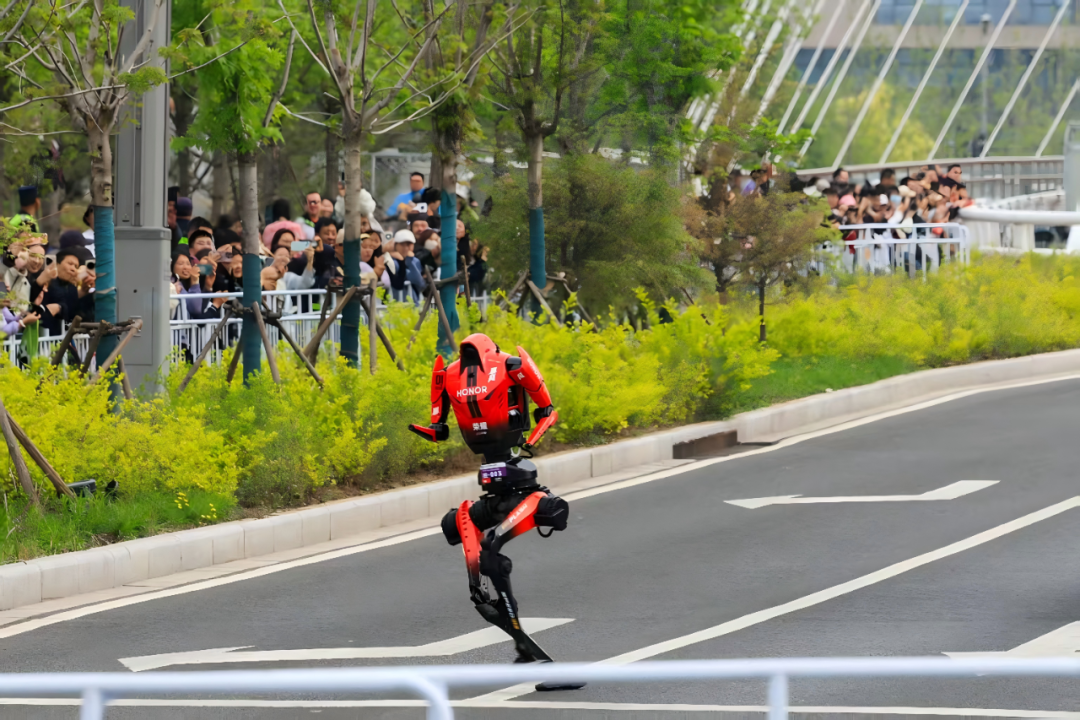
Honor 'Lightning'
The other model, 'Vitality Buddy,' standing at 136.9cm, emphasizes interaction and companionship. Its running posture, including arm swing and stride, fully replicates human movement, aiming for the 'Best Human-Like Gait' award.
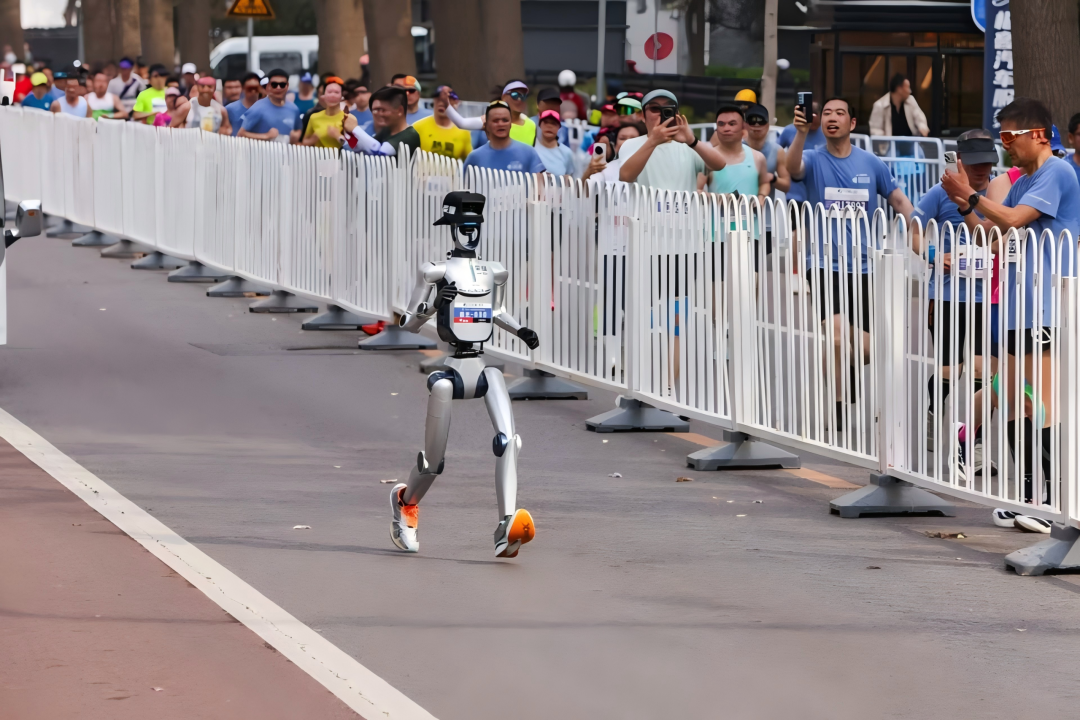
Honor 'Vitality Buddy'
2. Unitree Technology: Impressive Speed but Eventful Racecourse Experience
Unitree Technology, participating officially for the first time this year, brought a tuned version of its H1 humanoid robot. Unitree fielded three official teams from Beijing, Shanghai, and Hangzhou.
During pre-race testing, the Unitree H1 demonstrated remarkable speed potential. In the April 16 qualifying race, it autonomously completed a 1.9-kilometer multi-turn course in 4 minutes and 13 seconds, breaking the human 1,500-meter world record proportionally. Unitree also stated that the H1 recently achieved a speed of 10m/s, approaching Usain Bolt's human limit of 10.44 meters per second.
However, the H1's actual race performance was somewhat eventful. Videos circulating online showed it falling within seconds of starting after a battery swap, with its head hitting the ground and scattering debris. According to CCTV News, the battery replacement process required three people to operate simultaneously—one to swap the battery, one to fill ice for chip cooling, and one to spray cooling agent on the joints—taking about 30-40 seconds.
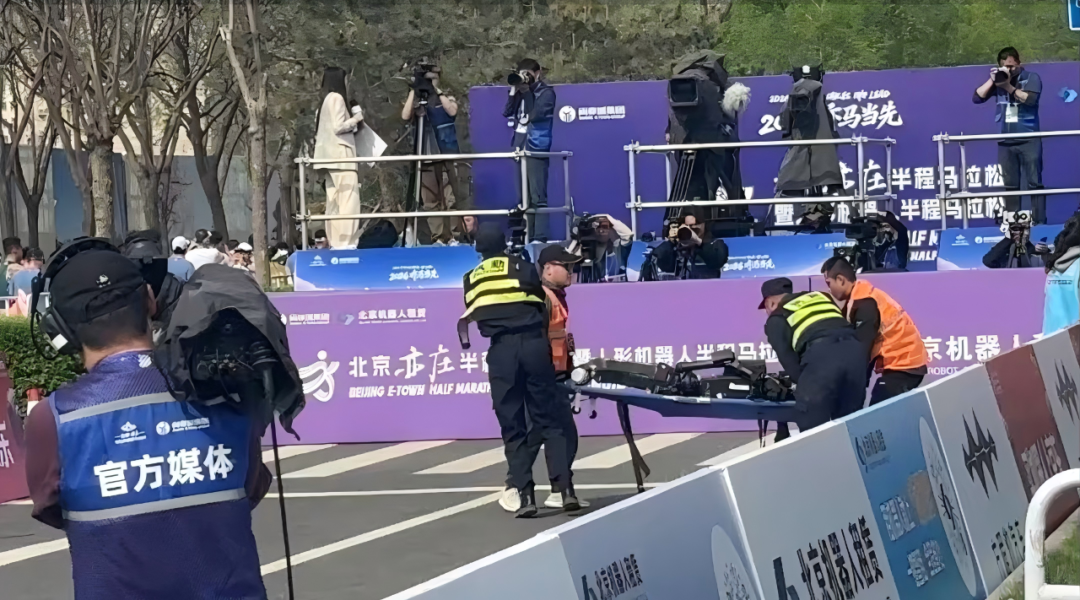
Unitree H1
3. Tiangong Series: Defending Champion Falls Short but Highly Autonomous
Last year's winner, the Beijing Humanoid Robot Innovation Center (Beijing Innovation), fielded three Tiangong Ultra robots competing entirely autonomously this year. Although they failed to reach the top three, the Tiangong Ultra completed the race stably in fully autonomous mode with zero human intervention, finishing in 1 hour and 15 minutes—a significant improvement of 1 hour and 25 minutes over last year's humanoid robot half marathon record (2 hours, 40 minutes, and 42 seconds) set by itself.
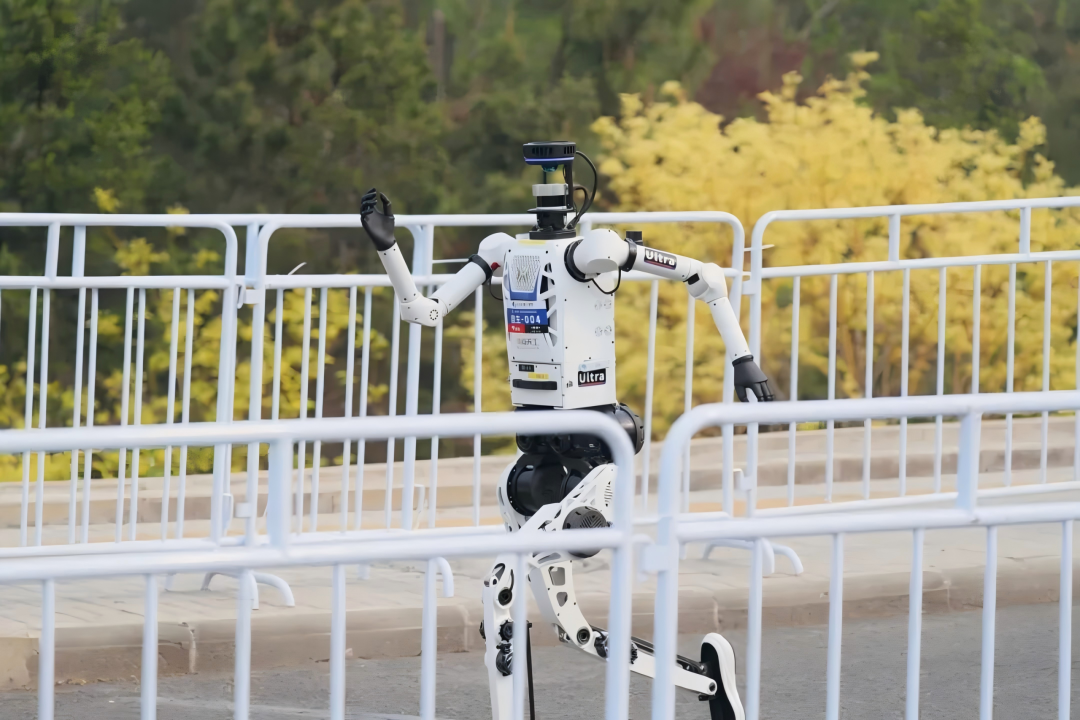
Tiangong Ultra
This achievement is significant because the Tiangong Ultra is one of the most autonomous models among the participating teams, requiring no human intervention throughout the race. It also features a self-developed 400Nm high-torque integrated joint and liquid cooling system, preventing performance degradation due to overheating.
4. National-Local Innovation Center (Linglong 2.0): Debut with Three Teams Exploring Different Directions
The Shanghai-based National-Local Co-built Humanoid Robot Innovation Center (National-Local Center) participated for the first time this year, sending three teams: National-Local Leap, National-Local Explore, and National-Local Expedition. Their Participating models was the Linglong 2.0, designed for general lightweight applications, featuring excellent dynamic balance and full-body coordinated control, along with a high-performance computing module.
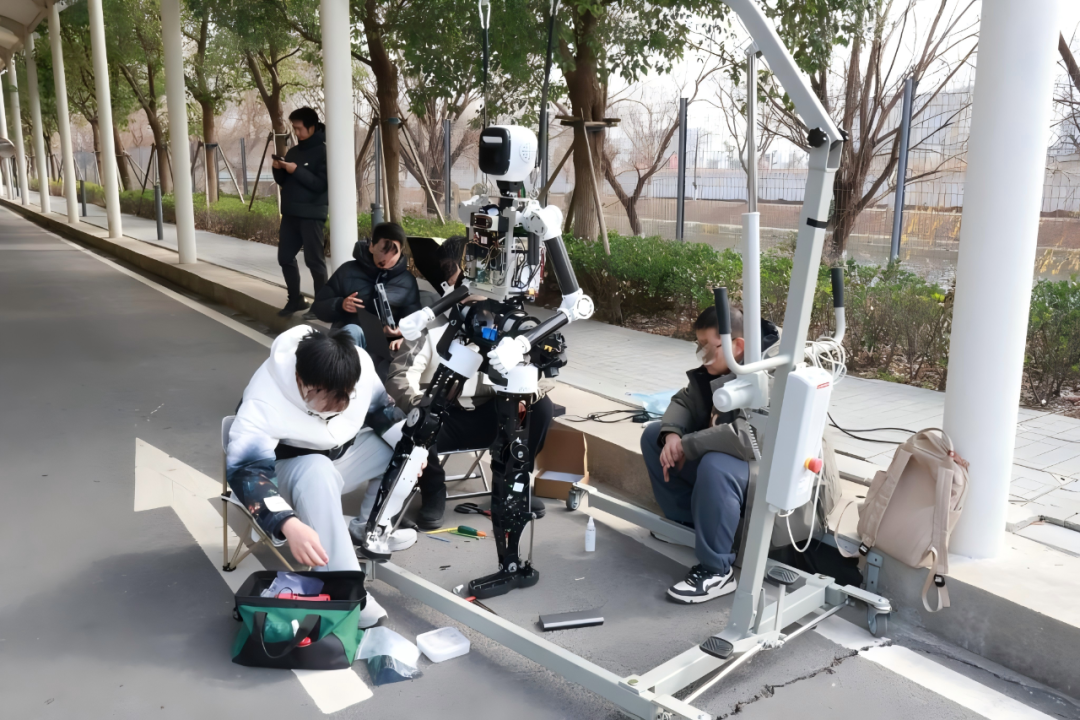
The National-Local Leap team debugging a humanoid robot
The three teams validated technologies in three directions: high-dynamic motion capability, complex environment stability, and long-distance autonomous operation, showcasing different technical approaches.
5. Tsinghua, Peking, USTC: Formidable Strength from Universities
In addition to corporate teams, university research forces were also key participants. Tsinghua University, Peking University, and the University of Science and Technology of China all fielded their robot teams. While these university teams may not directly compete with leading companies in speed, they demonstrated solid research capabilities in autonomous navigation algorithms, gait control, and hardware design.
6. International Teams: France, Germany, Brazil Participate for the First Time
This year's event attracted five international teams from France, Germany, and Brazil for the first time. Although these teams did not rank among the top finishers, their participation marks the event's transition from a domestic technology competition to a global arena.
7. AutoNavi Maps: 'Quadruped Dog' Makes Debut
Notably, AutoNavi Maps also participated in this event. At the scene, AutoNavi's quadruped robot, 'Tutu,' autonomously guided a visually impaired college student through dynamic and static obstacle avoidance, narrow passage navigation, and sudden interference evasion—all without human intervention.
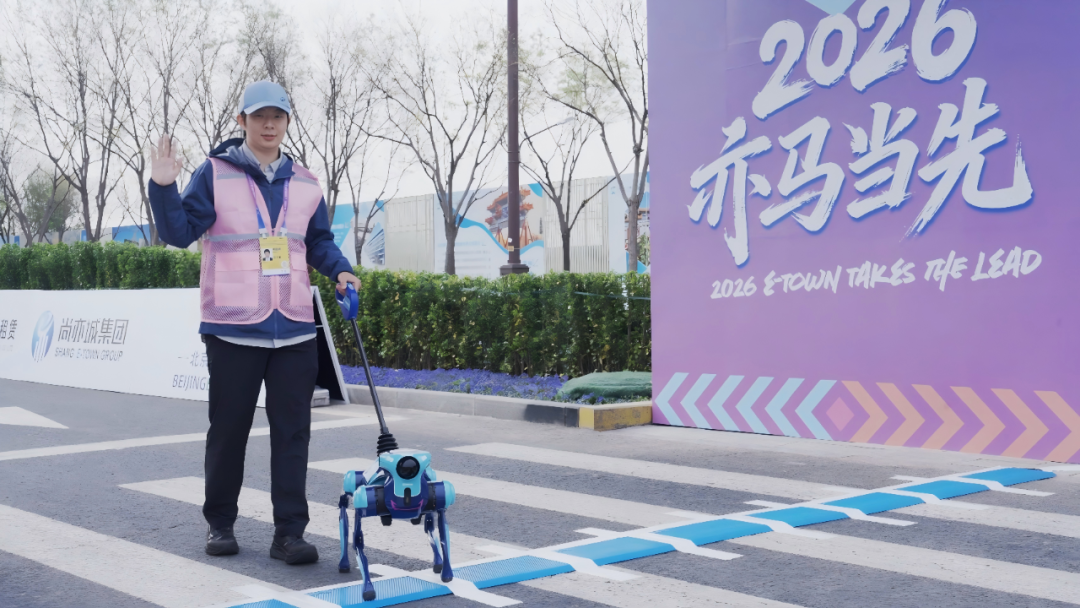
AutoNavi's quadruped robot 'Tutu'
'Tutu' is the first embodied AI hardware entity under Alibaba Group, marking China's embodied AI sector's transition from 'geek entrepreneurship' to 'tech giant involvement' in ecosystem building.
8. The Racecourse Featured Not Only Runners but Also Robot 'Service Officers'
At the race's refreshment stations, Xinghaitu debuted with its R1 Pro and R1 Lite models, serving as 'robot service officers.' Four refreshment stations along the course were staffed entirely by Xinghaitu robots, which dynamically replenished supplies autonomously without remote control, providing water, towels, and refreshments to participants throughout the race.
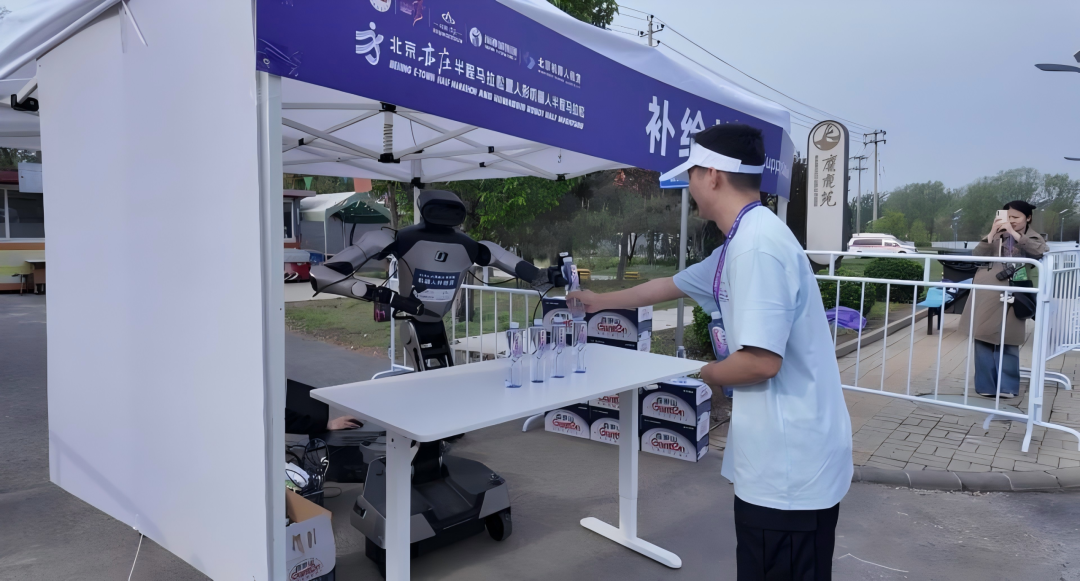
Xinghaitu serving as 'robot service officers'
Zhang Yujia, Xinghaitu's marketing director, said, 'This is our first time participating as robot service officers in a robot marathon. The biggest challenge was enabling robots to interact in real-world scenarios, which differ significantly from laboratory settings. We collected extensive data to ensure stable robot operation in complex outdoor environments.'
03
A Marathon Reflecting China's Collective Leap in Embodied AI
In just one year, China's humanoid robot industry has delivered results far exceeding expectations.
Liang Liang, deputy secretary-general of the Chinese Institute of Electronics, compared this event to a 'technology verification'—akin to a 'college entrance exam' for humanoid robots venturing into the real world. In this 'exam,' we saw not only Honor's dominance but also Unitree's exploration of speed limits, Tiangong's commitment to full autonomy, and the diverse participation of universities and international teams.
For an industry to transition from 'geek entrepreneurship' to 'tech giant involvement' in ecosystem building, it requires not just a fleeting success of a single star product but the collaborative evolution of the entire supply chain. The significance of the Yizhuang Robot Half Marathon lies precisely here—it serves as both a technological stress test and a showcase for robots to move from laboratories into real-world scenarios.
The race has ended, but the marathon continues. How fast will robots run next year? We await the answer.
* Images sourced from the internet. Please contact for removal if infringement occurs.
-
![]()
Wang Huiwen, Former Meituan Executive, Achieves 20-Fold ROI, Supports 24 AI Startups
-
![]()
Another AI Computing Power Unicorn Launches IPO! Founded by a Changjiang Scholar
-
![]()
OFILM Holdings Secures Zhongke Daojing, Marking a Significant Leap in the Optical Communication Industry!
-
What Will Be the Next Key Battleground for Large Models After AI Coding?
-
![]()
Leapmotor's Sales Soar, Yet Hidden Concerns Loom
-
![]()
China’s Action Camera Market Soars: 3.12 Million Units Sold in Six Months, DJI Secures 74% Dominance
-
![]()
Zhang Yiming: Strategic Retreat as a Path Forward
-
![]()
Exploring Charging for Some Features of QianWen App: Can It Follow the Path of Doubao?