I'm an H-1B Visa Holder Caught in the U.S. Job Market Turmoil
 04/21 2026
 429
429
Author|Wuta
Editor|Li Xiaotian
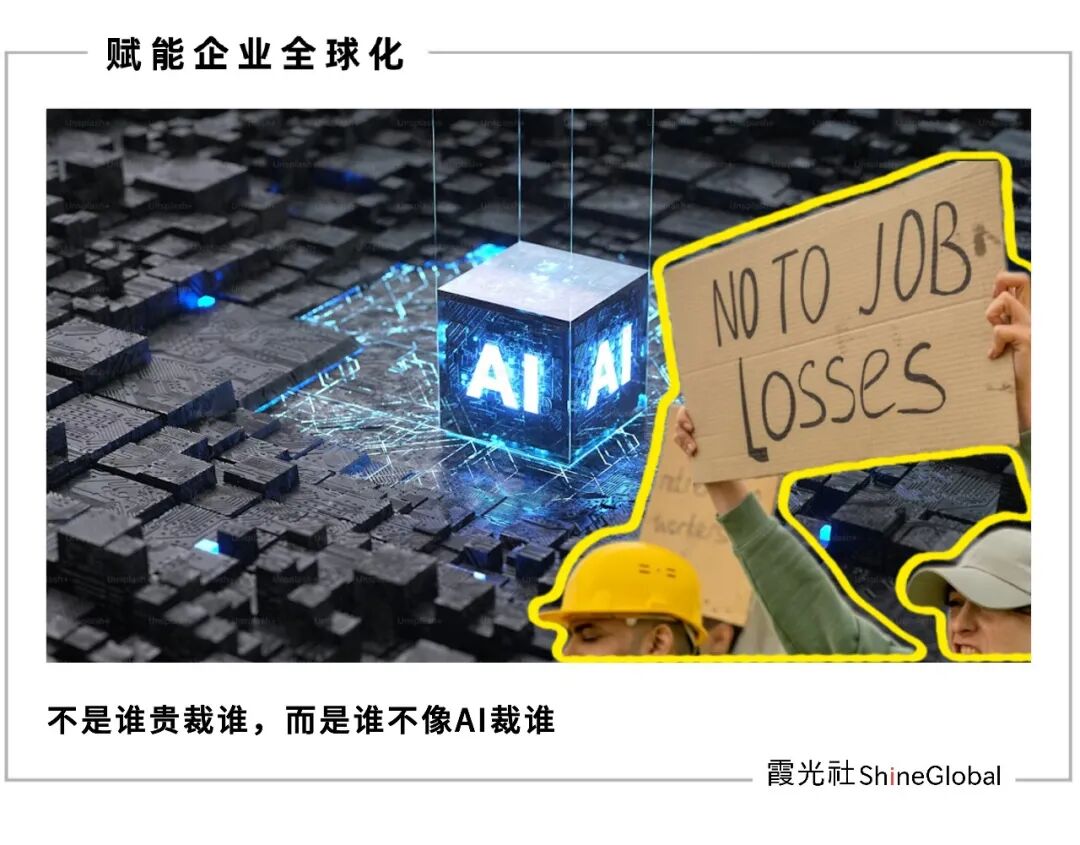
A wave of unprecedented layoffs is sweeping across major U.S. internet companies.
According to incomplete statistics, as of April 10, 2026, the U.S. tech sector has seen 71,447 layoffs—equivalent to the combined workforce of 1.2 Metas, 1.4 Twitters, and 2.4 Snaps.
Since the beginning of 2026, numerous global tech giants have embarked on mass layoffs: Amazon plans to let go of 16,000 employees, Oracle's layoffs exceed 30,000, Meta intends to cut 15,000 jobs, and Microsoft is set to lay off between 11,000 and 22,000 workers. Beyond these high-profile dismissals at major corporations, there are also numerous "under-the-radar" routine staff adjustments within the industry—for instance, Google has been consistently refining its workforce and restructuring through "small but frequent" initiatives.
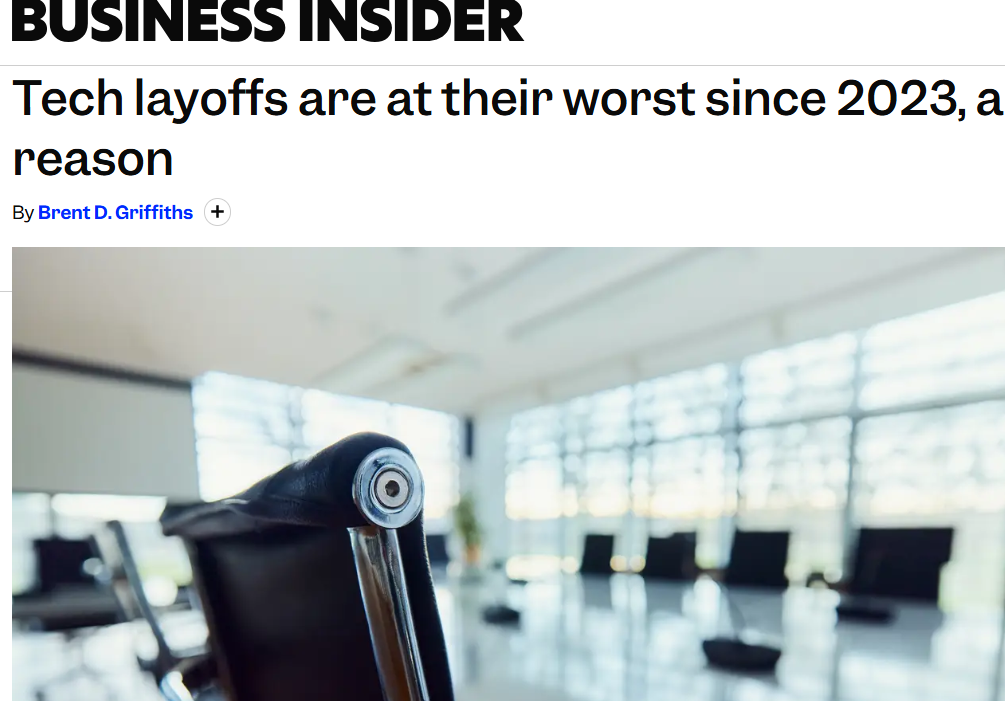
Image Source: Business Insider
Anxiety and panic, fueled by AI-driven layoffs, have rapidly spread across social media platforms.
However, amidst this turmoil, there appear to be some overlooked information points that have not yet garnered widespread public attention.
According to the monthly layoff report released by Challenger, Gray & Christmas, a renowned U.S. employment data research institution, in October 2025, U.S. companies announced a total of 153,074 layoffs. By the end of November 2025, the cumulative number of layoffs in the U.S. for the year had reached approximately 1.17 million, the highest level in nearly five years.
Industry insiders have also disclosed that the wave of layoffs did not commence in 2026: in 2025, 150,000 programmers were laid off across the U.S., and in 2024, 120,000 were let go. The "cleansing" by AI did not begin in 2026, nor does the industry's "cleansing" seem to be solely attributable to AI.
At this critical juncture, Xiaguang Society spoke with several frontline professionals about how to navigate this storm and find their footing amidst the relentless tide of change.

"Since the latter half of last year, our entire company has been pushing engineers to utilize AI tools. Around 20%-40% of my work time has been dedicated to enhancing AI capabilities, constantly exploring how to provide better instructions to boost work efficiency and quality. Now, 80% of my work is accomplished using AI," said Leo, who works in North America.
The widespread adoption of AI among programmers at major companies is, to a certain extent, an inevitable outcome of efficiency-driven objectives. For example, someone using AI can write 5,000 lines of code in a day, whereas without AI, the same workload might take two weeks of manual coding.
"When people's work paces start to diverge, those who are slower will inevitably feel the pressure. Gradually, everyone will begin to use AI."
"It can't be said that layoffs are definitely linked to AI, but from the company's perspective, aggressively promoting AI does increase costs to a certain extent," Leo explained.
Take his own situation as an example: currently, the cost of Tokens used during work is covered by the company, and Tokens are used almost unlimitedly and continuously in the workplace. "In fact, everyone's Token expenses are substantial," meaning that this form of production has significantly increased the company's labor costs.
"From the company's perspective, although productivity has been improved with financial investment, to operate, they also need to cut these expenses elsewhere. One possible solution is to lay off some personnel."
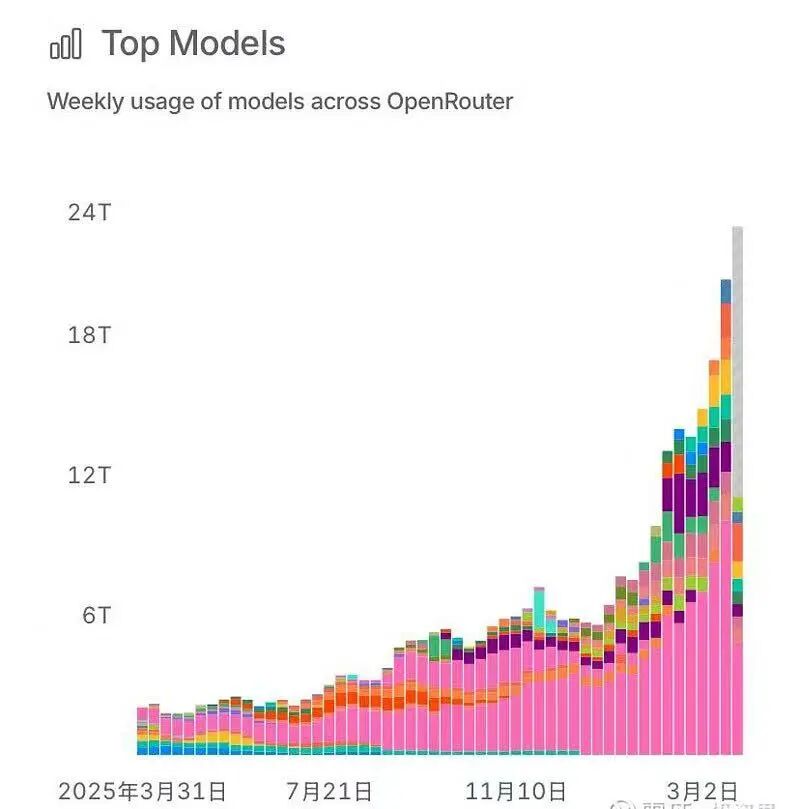
OpenRouter shows that during the week of March 16, 2026, the weekly Token consumption reached 20.4T, 11 times that of the same period in 2025.
When asked whether he feels anxious about the frequent layoffs at major companies and the astonishing pace of AI's evolution, his answer was affirmative.
"I feel like programming is already a mature market," he explained. Although new positions will still emerge in the market, for job seekers, the search costs and interview difficulties will increase. Those leaving major companies who want to quickly find a new job may have to turn to small and medium-sized companies or even startups, which are even less stable.
"In fact, after being laid off, people are often not worried about temporary livelihood but about how to quickly find a new job and whether to maintain their current quality of life."
In the U.S., legal residency status is usually tied to specific visa types, and common visas generally require holders to maintain a specific activity status. For example, the legality of an H-1B visa (a non-immigrant work visa) depends entirely on U.S. employer sponsorship, granting the holder only a 60-day "grace period" to find continued employment. An F-1 visa (a student visa) requires the holder to be enrolled full-time or in OPT (practical training) status. Once employment is lost or studies are interrupted, if the individual fails to change their status or take other legal measures in a timely manner, they may lose their legal residency status and face the risk of unlawful presence.
"In China, one might temporarily find part-time work to transition, but in the U.S., if you can't find a full-time job similar to your previous one, you face significant risks."
AI's impact on fresh graduates in North America is also severe.
There is a practical equation in the industry: the work efficiency of one senior engineer combined with AI is roughly equal to that of one senior engineer leading three junior engineers. Therefore, in this mature market, the number of positions available to fresh graduates has significantly decreased, competition has intensified, and companies have increasingly higher resume requirements for new graduates.
Leo told us that now, for the few dozen positions opened by top companies, all the resumes received are from students at elite universities, each with six or seven internships before graduation.
At the same time, the value of internships for fresh graduates has even begun to outweigh academic credentials.
He gave an example. If a fresh graduate has interned at both OpenAI and Anthropic, the company will undoubtedly consider giving them an interview opportunity. However, if someone graduated from Stanford without any internships or with only one internship at Yahoo, they might not even get an interview.
This has perhaps created a new trend in the North American talent market—on LinkedIn, more and more people are beginning to showcase their internship experiences and share advice on how to find internships.
In the past, during their studies, most students typically arranged internships based on school requirements. Of course, some would apply to their schools to take a semester off to intern, but such individuals were very rare.
"At that time, few people considered filling their college years with internships or extending their graduation as long as possible just to retain their student status and gain as much internship experience as possible. I never thought sharing and showing off internships would become so popular. The market feels a bit strange," Leo said.

"Sorry, I'm busy job hunting, so my replies might not be timely."
Last week, around 10 AM Beijing time, Alice's message crossed the Pacific.
A few weeks earlier, she learned that her company was planning a major round of layoffs. Afraid to discuss it with colleagues, she could only wait in anxiety, pretending to be calm while completing her work, anxiously scrolling through social media for "secret" layoff news, and reluctantly updating her resume.
"My American colleagues don't seem worried about layoffs, but that makes me even more anxious. The calmer they are, the stronger my premonition that I might be laid off becomes."
Alice jokingly refers to herself as an "H-1B refugee." She admits that if laid off, she absolutely cannot afford to take a break and must find a job within two months; otherwise, she'll have to return to China. "This is the situation I least want to face. I can't adapt to the workplace and work intensity in China, and my parents also hope I can stay overseas for a few more years."
After several weeks of self-torture during a "reprieve" period, Alice faced an event that drastically increased her stress—around April, Oracle began large-scale layoffs.
Global Market Report revealed that according to Oracle's Worker Adjustment and Retraining Notification (WARN) Act filing with the California Employment Development Department, the company had cut more than 700 jobs in California, 491 in Seattle, Washington, and 539 in Kansas City, Missouri.
According to CNBC, after this layoff plan was made public, Oracle began notifying 162,000 employees of a new round of layoffs, affecting thousands.
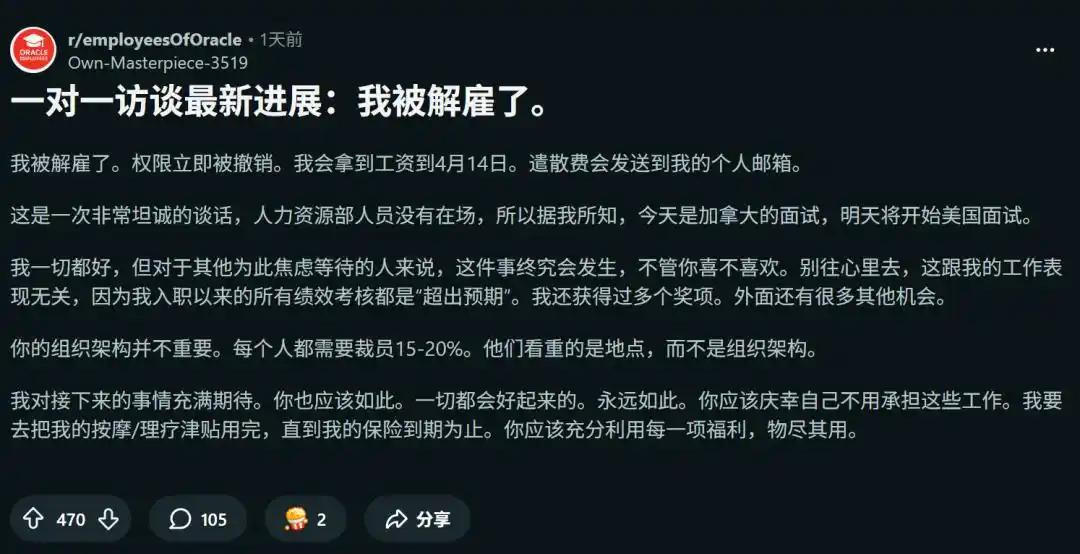
A Chinese translation of a Reddit post by an Oracle employee discussing layoffs
"Unfortunately, my classmate was on the layoff list. You know, social media is prone to survivorship bias—people always say they haven't seen such things happen around them. So when I realized I might not be a 'survivor' either, my anxiety became uncontrollable," Alice said helplessly.
Alice revealed that her classmate's team had fewer than ten people, and more than one-third were laid off. Other teams also lost several members, mostly fresh graduates and the oldest employees. "Although our company's layoff logic might not be the same as Oracle's, I happen to be the youngest in my team."
Just last weekend, Alice shared a post by blogger @quick suite about Amazon's latest layoffs in May. This was already Amazon's third round of layoffs within a year.
The most critical information in the post was that the total number of layoffs was around 14,000, and this round of layoffs would also involve significant restructuring, with many teams directly cutting entire job position groups, such as BIEs (data/business intelligence teams). Quick suite commented, "The process of determining the layoff list this time was even more chaotic, completely lacking any logic or system. It purely depended on the personal feelings of L8 executives, who didn't even need to maintain consistent standards across the entire organization."
"Anyway, life goes on. I believe I have the ability to overcome this difficulty," Alice wrote in our most recent conversation.

"From our interactions with AI giants, internet companies, and tech firms, the most prominent feature of this round of layoffs is not overall downsizing but structural layoffs. This round of layoffs is not simply about 'laying off the expensive' or 'laying off those who can't use AI,' but rather companies doing something even more ruthless: redefining what kind of talent is worth keeping," Jerry, a managing partner at CGL, explained to Xiaguang Society.
In his view, in this round of AI-driven layoffs, the people truly being eliminated are not necessarily those with poor skills but those who can no longer adapt to the new organizational logic or collaborate with AI to create business results.
In addition to the repetitive functional and executive roles centered on standardized, process-driven operations frequently mentioned earlier, mid-level managers who once relied on organizational hierarchy and management experience but whose value boundaries are now being re-evaluated have also become a core group in the corporate revaluation.
"In this round of adjustments, one of the groups under the most pressure is mid-level managers over 35," Jerry explained. This group has higher salaries and organizational costs, but much of the value they provide through management experience, process coordination, and communication is being weakened by organizational flattening and AI tools.
In his view, the core challenge for professionals over 35 is whether their skill sets can match the new organizational logic. In the future, relying solely on experience, seniority, and platform background will no longer be sufficient to sustain career premiums. Truly competitive individuals must simultaneously possess business judgment, execution ability, organizational leadership, and AI collaboration skills.
"This is why many mid-level professionals face three situations when re-entering the job market: either accept a salary reduction, transition from platform-based companies to industry-based companies, or shift toward more flexible career paths such as consulting, advising, or entrepreneurship."
Jerry admitted that from the candidates' perspective, the impact of this round of layoffs extends far beyond just income decline—it also shatters many people's sense of job security.
"Some people suddenly receive notice that their access is revoked overnight. Others receive severance but find far fewer market opportunities than expected. Some still use AI tools and work hard but are still laid off, leading them to doubt their own value. This sentiment is especially pronounced among professionals over 35, with anxiety, confusion, anger, and self-doubt being widespread."

It is worth noting that, beyond layoffs, those who "have not been laid off" are also not at ease. Jerry bluntly stated that in many companies, remaining employees are experiencing increased workloads, higher standards, more transparent performance evaluations, and fiercer competition. "One person now has to take on the responsibilities of two or three people in the past. They need to not only complete deliverables but also learn to leverage AI to improve efficiency and continuously prove they are more valuable than AI."
Another indicator is that the market is transitioning into a more rational valuation phase when it comes to AI talent. Between 2023 and 2025, salaries for roles related to AI skyrocketed, especially in fields such as algorithms, large-scale models, and system architecture, giving rise to discernible bubbles. By 2026, the demand for general algorithm-related positions cooled down, hiring cycles became longer, companies adopted a more discerning approach in recruitment, and the dynamics of supply and demand underwent a shift.
Nevertheless, there is still a strong demand for individuals who possess fundamental technical skills, those who can effectively apply AI to real-world business scenarios, and composite talents who blend "industry experience with AI expertise". Technical skills remain crucial, but technical capabilities that are not aligned with business outcomes are rapidly losing their value.
"For companies, AI should not be seen merely as a tool for layoffs. Truly mature companies do not start by laying off employees and then figuring out their future; rather, they first determine: which capabilities must be preserved, which talents need to be upgraded, and which roles can be restructured."
This is exemplified by events such as Twitter's initial layoffs of 80% of its workforce, followed by rehiring, as well as the layoffs and subsequent rehiring at Block, a prominent U.S. fintech company. At present, most top-tier companies are still exercising caution regarding AI-driven layoffs.
"AI substitution may offer short-term efficiency gains, but if the wrong people are laid off and organizational capabilities are compromised, the future costs will be even greater."
-
![]()
Wang Huiwen, Former Meituan Executive, Achieves 20-Fold ROI, Supports 24 AI Startups
-
![]()
Another AI Computing Power Unicorn Launches IPO! Founded by a Changjiang Scholar
-
![]()
OFILM Holdings Secures Zhongke Daojing, Marking a Significant Leap in the Optical Communication Industry!
-
What Will Be the Next Key Battleground for Large Models After AI Coding?
-
![]()
Leapmotor's Sales Soar, Yet Hidden Concerns Loom
-
![]()
China’s Action Camera Market Soars: 3.12 Million Units Sold in Six Months, DJI Secures 74% Dominance
-
![]()
Zhang Yiming: Strategic Retreat as a Path Forward
-
![]()
Exploring Charging for Some Features of QianWen App: Can It Follow the Path of Doubao?