A Staggering $60 Billion Valuation! What Musk and Grok See in Cursor: Not Just Coding, but Agent Potential?
 04/23 2026
 579
579
If you don't act now, you risk being left behind in the race.
SpaceX, after integrating xAI (Grok), has made another significant strategic move.
On April 22, Beijing time, Musk's SpaceX announced that it had secured an acquisition option for the AI programming company Cursor. By the end of this year, SpaceX can opt to acquire Cursor for $60 billion or, alternatively, forgo the acquisition and instead pay $10 billion for a collaborative partnership.
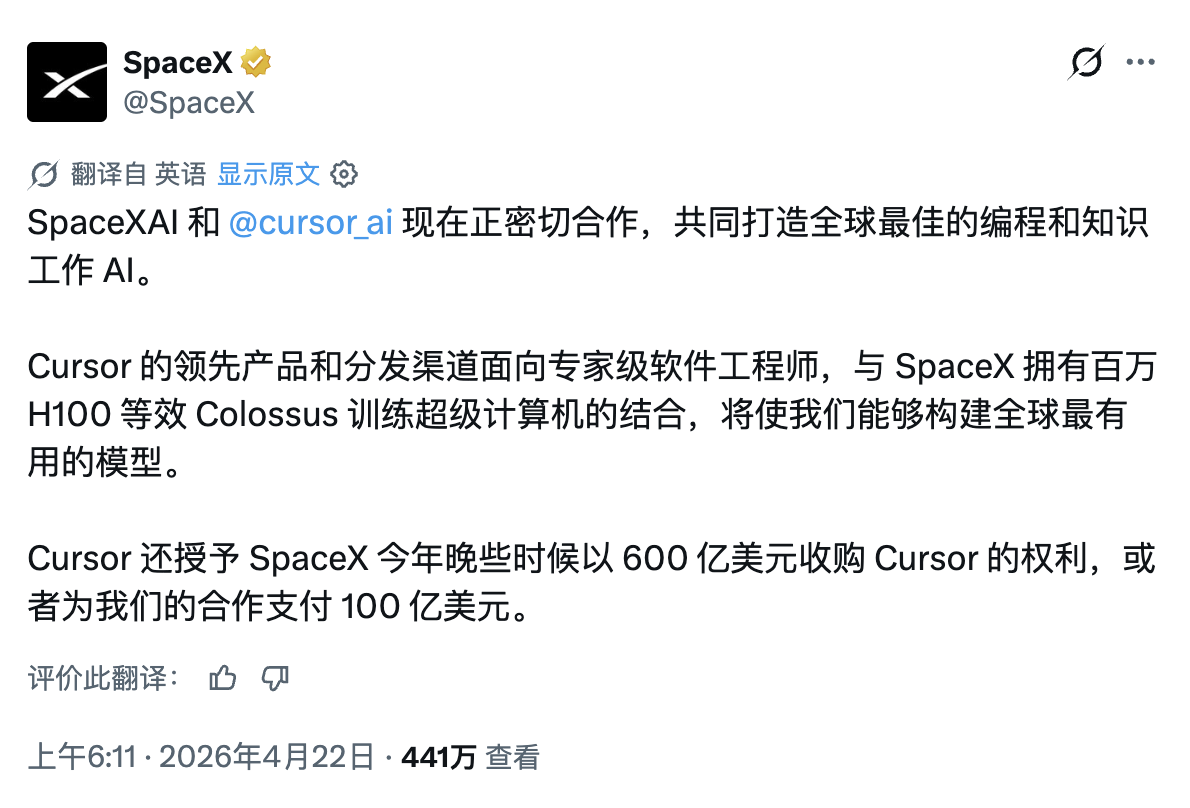
Image Source: X
Just days prior, xAI had already entered into a collaboration agreement with Cursor. This partnership will leverage SpaceX's Colossus supercomputing cluster, boasting computing power equivalent to one million H100 GPUs, to further train its latest AI programming model, Composer 2.5, with enhanced computational capabilities.
Indeed, Cursor is in the process of training its next-generation Agent model. Whether SpaceX ultimately decides to acquire Cursor may hinge largely on the actual performance and results of Composer 2.5.
Regardless of the outcome, Cursor stands to benefit. Amid the fierce AI Coding competition in Silicon Valley among the "AI Big Three"—OpenAI, Anthropic, and Google—Cursor faces immense pressure. Competing single-handedly against Claude Code, OpenAI Codex, and Google Antigravity is nearly impossible. Choosing to partner with xAI (Grok) is, therefore, the best available option.
However, the question remains: What does SpaceX gain from incorporating xAI? Instead of a straightforward acquisition, SpaceX has presented Cursor with a choice: a "$60 billion acquisition or a $10 billion collaboration."
What is Musk's ultimate objective?
From AI Coding to General-Purpose Agent Evolution
AI Coding is currently the AI application closest to large-scale closed-loop implementation and represents the most viable path toward developing general-purpose Agents.
Firstly, code tasks are inherently easier to verify, with clear-cut boundaries between right and wrong, making enterprises more willing to pay directly for efficiency gains. Bloomberg reported that Cursor's annualized revenue exceeded $2 billion in February, with expectations of surpassing $6 billion by the end of 2026.
The growth is undeniable. Anthropic's Claude Code, a leading choice for enterprises and developers in AI Coding since last year, announced earlier this month that its annualized revenue had soared to $30 billion, surpassing OpenAI.
Meanwhile, OpenAI, Anthropic, and Google are intensifying their investments in this arena.
Claude recently announced major updates to Claude Code and Claude Cowork, introducing more powerful Computer User functionality and an expanded ecosystem. OpenAI took the lead by launching the official version of Codex on macOS in February this year and rolled out another significant update a few days ago, further evolving from an AI Coding Agent into a general-purpose AI Agent platform.
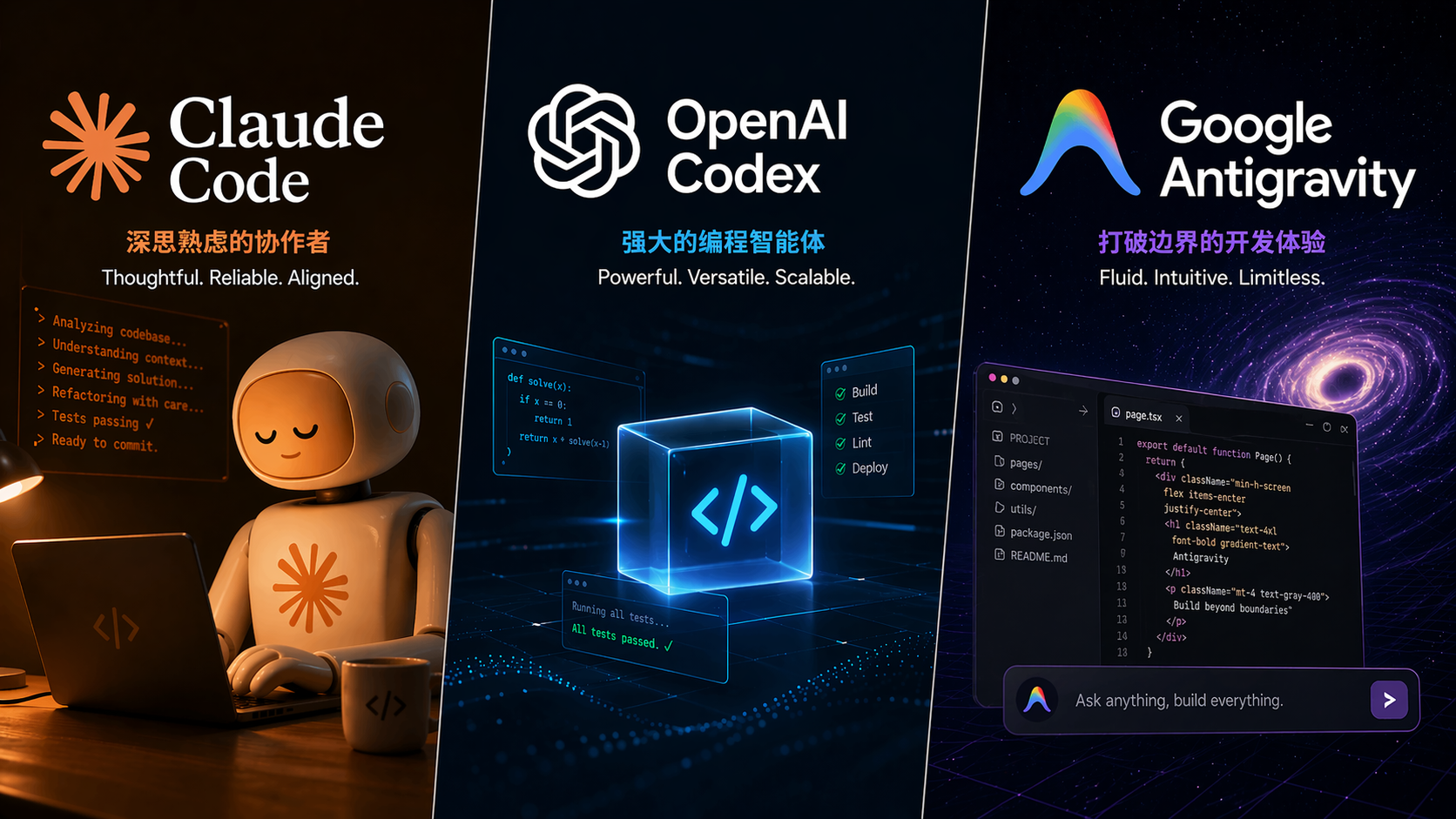
Image Source: Leitech @ChatGPT
Although Google acquired another prominent AI programming company, Windsurf, last year primarily for its talent, its Gemini-based AI Coding tool, Antigravity, has failed to keep pace with the leaders.
However, according to a recent report by The Information, Google has formed an elite team directly led by co-founder Sergey Brin and DeepMind CTO Koray Kavukcuoglu, with the core goal of catching up to Anthropic in AI Coding.
Brin believes that strong programming capabilities are essential for achieving AI self-improvement. An Agent capable of complex programming, combined with AI that handles mathematical problems and experiments, could automate the workflows of current AI research engineers, enabling AI self-iteration and improvement.
Cursor: The Ideal Choice for Grok
Returning to Musk, xAI's official website and documentation now position Grok 4.20 as a flagship model with powerful Agent capabilities, a 2 million-token context window, and an extremely low hallucination rate.
Grok 4.20's paper specifications are impressive. However, the current AI Coding competition is no longer solely about the model's ability to write code but rather about specialized optimizations for software engineering scenarios, proxy execution capabilities around codebases and terminals, and, crucially, product entry points that developers actually use and pay for daily.
Beyond the model layer, Grok lags significantly behind the leaders in other areas, and Cursor can first and foremost address the two most critical gaps for xAI.
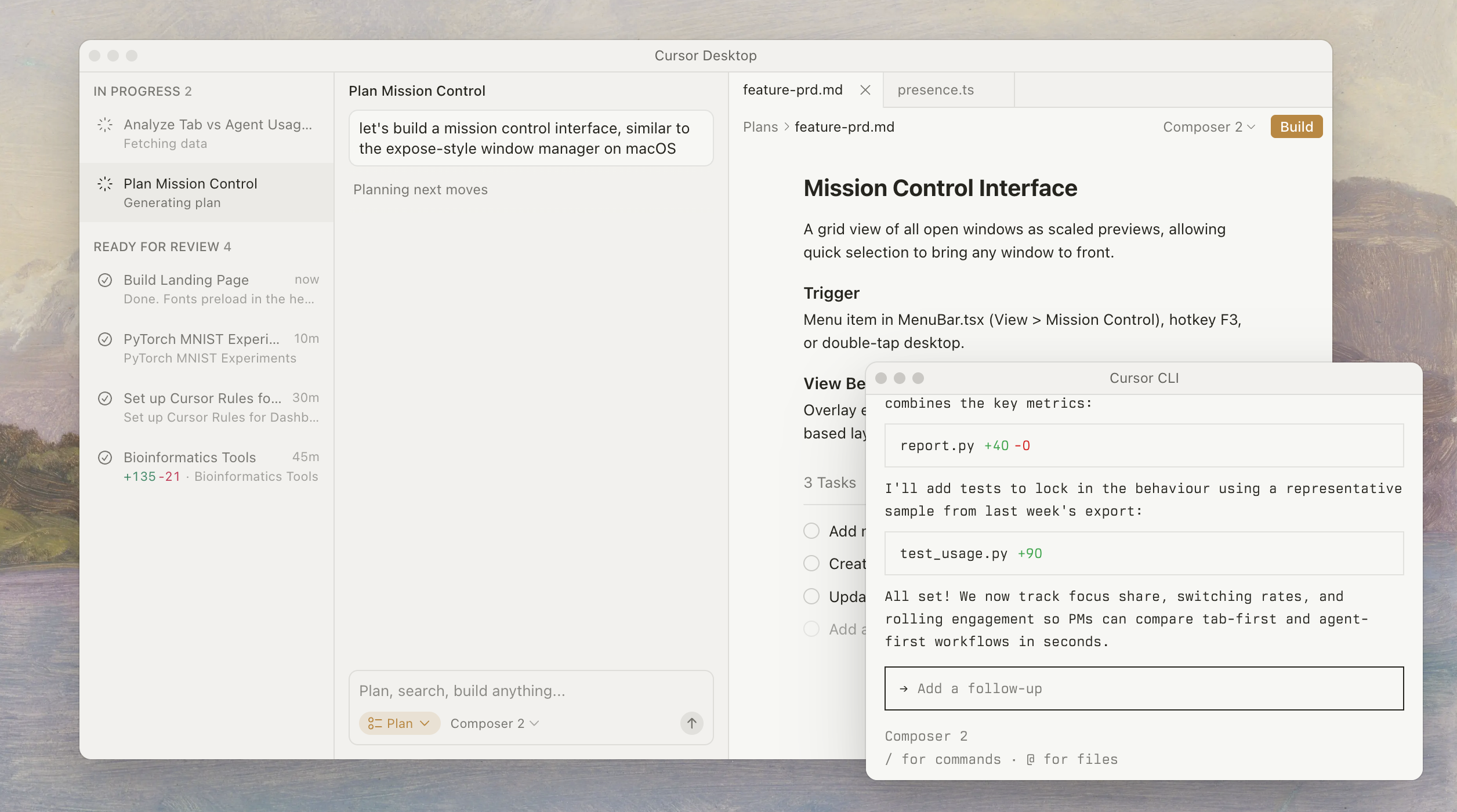
Image Source: Cursor
The first gap is entry points. Cursor has already been integrated into the real workflows of numerous teams. When it completed a $2.3 billion funding round last November, its valuation reached $29.3 billion, with Google and NVIDIA among its investors.
The second gap is product form. Cursor 3, released in early April, has completely abandoned its previous positioning as a human-machine collaborative code editor, adopting a clearer core philosophy: AI programming tools should be a unified workbench allowing seamless switching between local agents, cloud agents, multi-repository views, and IDEs. This direction aligns with recent moves by OpenAI, Anthropic, and Google.
On the other hand, Cursor's suite of technologies and tools built around the model layer, evolving from past context engineering to today's more systematic Harness engineering, can also feedback into Grok, improving post-training and Harness engineering for large models.
As the first major beneficiary of AI Coding, Cursor has weathered repeated shifts in tides but remains competitive. In its latest funding round exceeding $2 billion, Cursor's target valuation reached $50 billion, close to Musk's $60 billion asking price.
However, GitHub's recent adjustment to its Copilot Individual plan, removing Claude's Opus model from the Pro tier and retaining it only at higher levels, also indicates that upstream model providers and platform operators are tightening control over the distribution of their most expensive and critical capabilities.
The days of "anyone wrapping a layer on top" are quickly ending, making independently trained models increasingly important. Cursor's continuous advancement of Composer over the past six months also shows that the company has long recognized that relying solely on reselling other models offers diminishing returns.
This brings us to another crucial yet often overlooked aspect of this collaboration: computing power. Cursor will gain access to the Colossus supercomputing cluster's resources. For Cursor, this is an opportunity to further strengthen Composer and reduce reliance on external models.
For SpaceX, the value is even greater.
Over the past few years, Musk's greatest advantage in AI has been his willingness to invest heavily in infrastructure—SpaceX buys, xAI buys—but the biggest shortcoming has been the lack of a strong developer product to stabilize the distribution of this computing power. A recent internal memo even revealed that xAI's GPU utilization rate was only 11%, far below the industry average of 35% to 45%.
In other words, Colossus also needs a high-frequency application that continuously consumes its resources and can spill over its capabilities into enterprise development workflows. Cursor Composer 2.5 can partially fill this gap.
Thus, while SpaceX's apparent goal in acquiring Cursor is to buy an AI programming unicorn, the substance is using a hefty price tag to fill three key gaps for xAI in AI Coding: developer entry points, software engineering products, and closed-loop data for iterative model improvement around code tasks.
What Comes After Acquiring Cursor?
However, even if SpaceX ultimately acquires Cursor, how exactly does Musk plan to approach Grok's AI Coding?
The most straightforward and realistic path would be to let Cursor maintain its front-end brand and product independence while integrating the talent and technology behind Composer 2.5 into Grok's model foundation. SpaceX's computing power and xAI's models would replace some external dependencies, gradually transforming Cursor from a "multi-model integration tool" into a semi-open platform "centered on its own models, supplemented by external models."
The advantages of this approach are clear: minimal friction. Today's Cursor users are already accustomed to switching models, execution methods, and local/cloud agents within a single product. Preserving this flexibility reduces the risk of user churn while allowing Grok to continuously improve its models and products through feedback from Cursor's user and scenario data.
Of course, from the perspective of the "AI Big Three," vertical integration is the way to go. Similarly, Musk might choose to treat Cursor as xAI's "Codex/Claude Code moment," pursuing even more thorough vertical integration.
Image Source: OpenAI
In other words, Cursor would not just be a product entry point but a fully Grok-based AI Coding platform, with models deeply post-trained for code tasks and an agent system designed for integrated terminal, testing, deployment, and code review workflows, all powered by Colossus's computing resources to drive down costs. Logically, this makes sense, as OpenAI, Anthropic, and Google are all increasingly moving in this direction.
Additionally, it was revealed as early as March by The Information that two senior engineering leads at Cursor, Andrew Milich and Jason Ginsberg, had joined xAI and were working on Grok, reporting directly to Musk.
However, an alternative view suggests that SpaceX's "collaboration" comes amid its push for a mega-scale IPO, and acquiring Cursor serves more to translate SpaceX's most abstract computing power investments into more concrete outputs: generating code, fixing bugs, writing tests, performing migrations, and compressing delivery cycles. For IPO narratives, this translation capability is crucial.
Following this logic, xAI's AI Coding strategy is unlikely to stop at "integrating Grok into Cursor." A more probable approach would be to use Cursor as a key bridge for Grok's evolution from an AI Coding Agent to a general-purpose AI Agent, prioritizing access to developers through entry points, then using developer scenarios to train models, and vertically integrating models, agents, and product entry points.
Final Thoughts
Musk is no stranger to bold narratives or heavy infrastructure investments. xAI, Colossus, Grok—these names have all generated significant buzz over the past year. What has truly been lacking is a foothold to ground model capabilities in real software engineering workflows.
AI Coding happens to be the most mature, lucrative, and fiercely competitive foothold available today. Cursor is one of the few independent companies in this battlefield that simultaneously occupies "user entry points," "product form," and "in-house model development."
Thus, whether this $60 billion acquisition of Cursor is worth it remains inconclusive today. But one thing is already clear: For Musk and Grok, while the decision to acquire Cursor still offers choice, there is little room for hesitation in entering the AI Coding decisive zone.
OpenAI, Google, and Anthropic have already extended the battlefront from model capabilities to developer workbenches. Anyone without their own entry point will be relegated to serving as a foundation for others. For Musk, who has never been content to play a supporting role, this is what truly makes Cursor so "expensive."
Musk Grok cursor Agent AI Coding
Source: Leitech
Images in this article come from: 123RF Royalty-Free Image Library
-
![]()
Wang Huiwen, Former Meituan Executive, Achieves 20-Fold ROI, Supports 24 AI Startups
-
![]()
Another AI Computing Power Unicorn Launches IPO! Founded by a Changjiang Scholar
-
![]()
OFILM Holdings Secures Zhongke Daojing, Marking a Significant Leap in the Optical Communication Industry!
-
What Will Be the Next Key Battleground for Large Models After AI Coding?
-
![]()
Leapmotor's Sales Soar, Yet Hidden Concerns Loom
-
![]()
China’s Action Camera Market Soars: 3.12 Million Units Sold in Six Months, DJI Secures 74% Dominance
-
![]()
Zhang Yiming: Strategic Retreat as a Path Forward
-
![]()
Exploring Charging for Some Features of QianWen App: Can It Follow the Path of Doubao?