Does Volkswagen Still Stand a Chance in the New Energy Vehicle Market?
 04/23 2026
 546
546
Urgent Need for a Breakthrough
The challenges faced by joint-venture brands in the New Energy Vehicle (NEV) sector have yet to be fully overcome.
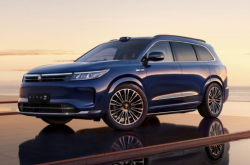
Recently, Volkswagen and XPENG unveiled their first collaborative model, the Zony 08, which has officially commenced pre-sales. This marks the debut of the first mid-to-large-sized pure electric SUV under Volkswagen's premium Golden Logo brand. It represents a profound integration of German engineering with local intelligent ecosystems, symbolizing a key milestone in Volkswagen's electrification journey in China.
Given the relatively low profile of the Zony brand previously, many consumers are under the impression that the Zony 08 is Volkswagen's inaugural model. However, the situation is equally challenging for Volkswagen's other NEV model series in the Chinese market. This year, Volkswagen has significantly ramped up its efforts in the NEV sector, with its brands introducing new products.
On March 30, SAIC Volkswagen's ID.ERA 9X, the largest SUV in Volkswagen's history, officially opened for pre-sale. This is also Volkswagen's first extended-range model, featuring the Momenta R7 reinforced learning world model for the first time.
On March 31, the FAW-Volkswagen Magotan PHEV and Tayron L PHEV made their joint debut, with both models slated for an official launch in the second quarter, marking significant strides by FAW-Volkswagen in the NEV sector.
On April 2, Volkswagen China's official website announced that Volkswagen (China), FAW-Volkswagen, and Volkswagen (Anhui) Digital Sales and Service Co., Ltd. signed a memorandum of strategic cooperation regarding the dealer network. They will introduce a "store-within-a-store" model at select FAW-Volkswagen dealers to showcase and sell Volkswagen (Anhui)'s latest NEV models, with the Zony 08 being the first model under this collaboration. As the first full-time connected, full-sized pure electric SUV under the ID. Zony category, the debut of the Zony 08 signifies the full-scale launch of Volkswagen's most extensive product offensive in history.
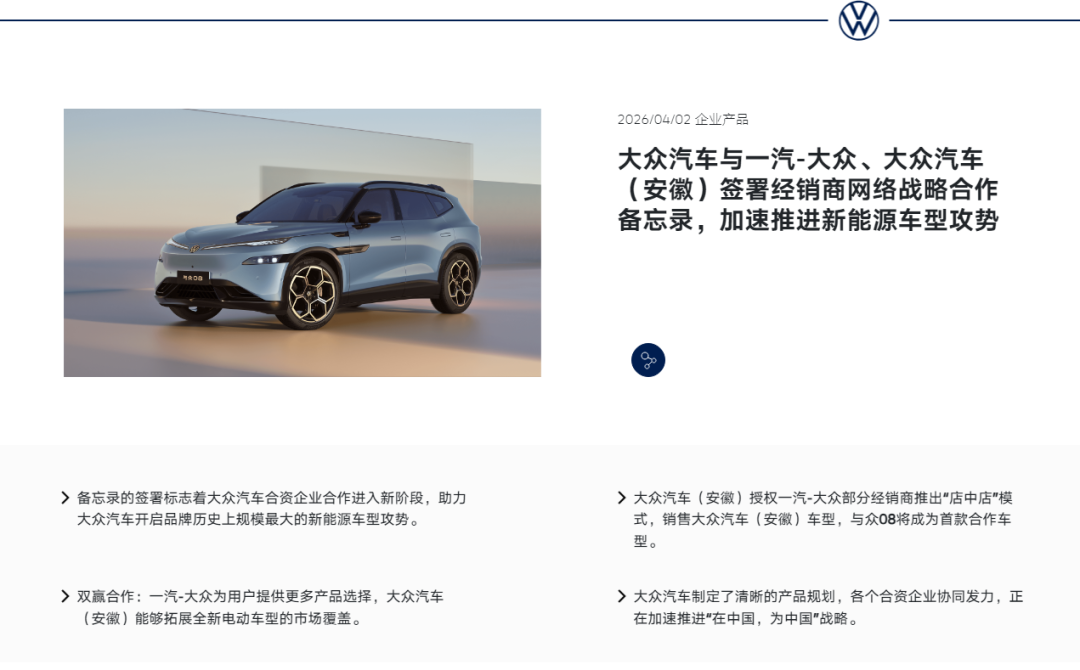
Image Source: Che Baihui Research Institute
In 2026, Volkswagen plans to introduce 13 NEV models. By 2027, NEV products will constitute half of Volkswagen's product lineup in China.
Volkswagen's offensive is aggressive, but underlying anxieties are equally apparent.
Volkswagen Anhui, initially met with high expectations, has not reversed Volkswagen's challenging situation in the NEV sector after several years of development. With losses exceeding 10 billion yuan over three years and its sole model, the Zony 06, launched under the Golden Logo Volkswagen brand, experiencing multiple price reductions, sales failed to surpass 10,000 units in 2025. Amid fierce competition from new entrants, Golden Logo Volkswagen has also struggled to define its position and establish a stable brand recognition foundation.
Regarding FAW-Volkswagen and SAIC Volkswagen, their electric models have also failed to distinguish themselves. From the perspective of car owners, they are still perceived as "not particularly problematic, but really hard to get excited about." Over the years, with a vast user base, Volkswagen has not been disrupted, but it has also failed to maintain its foothold in the NEV sector.
The dilemmas and struggles faced by the Zony brand almost mirror the common issues Volkswagen encounters in the NEV sector: Should it persist and emphasize Volkswagen's German heritage, which might bring stereotypes to NEV owners? Or should it abandon its legacy and start anew, but then what competitive edge would it possess in today's NEV sector?
Another Transformation
In fact, on the path to transitioning to new energy, Volkswagen's endeavors have far exceeded those of other traditional brands, although the outcomes have been somewhat "the harder you try, the more poignant it seems."
From launching the ID series, investing in XPENG, establishing Volkswagen Anhui, to collaborating with XPENG to jointly develop two exclusive Volkswagen brand electric vehicles for the Chinese market. In terms of intelligent layout, Volkswagen has also explored multiple avenues, with its joint venture with local company Horizon Robotics, Cooligence, developing advanced in-vehicle chips, and forming deep collaborations with Momenta, Huawei, etc.
However, from the current perspective, these investments are still far from yielding returns.
As a crucial component of Volkswagen's electrification transformation in China, Volkswagen Anhui has positioned the "Zony" brand as high-end and intelligent. The golden emblem was originally intended to be a differentiating advantage. However, the performance of the Zony 06, Volkswagen's first intelligent pure electric coupe SUV, was unsatisfactory after its launch, failing to penetrate the mainstream market even after two price adjustments.
According to the performance announcement released by JAC Motors, Volkswagen Anhui, as a JAC Motors' associated enterprise, incurred cumulative losses exceeding 10 billion yuan from 2023 to 2025.
Against this backdrop, the Zony 08 naturally carries high expectations.
This model is built on the CEA electronic and electrical architecture jointly developed by Volkswagen and XPENG, equipped with 800V ultra-fast charging technology, a CLTC range exceeding 700 kilometers, and L2++ advanced driving assistance capable of navigating from parking space to parking space. The pre-sale price ranges from 239,900 to 299,900 yuan, one hundred thousand yuan cheaper than the starting price of the similarly sized mid-to-large pure electric SUV, the XPENG G9. However, the sales performance of the XPENG G9 has also been lackluster, with 20,129 units sold in 2025 and a significant decline in 2026. Currently, XPENG's growth primarily stems from its lower-priced MONA M03, with its high-end models failing to achieve blockbuster status.
This also raises concerns for the Zony 08. After all, Golden Logo Volkswagen chose to launch the Zony 08 first, hoping to set the tone for its high-end positioning. Volkswagen also urgently requires a heavyweight model to enhance its presence in the NEV sector and boost morale for its product offensive this year.
Important Turning Point
According to Volkswagen's plans, in 2026, its three joint-venture brands will introduce multiple NEV models, initiating Volkswagen's most extensive product offensive to date.
Under the Golden Logo Volkswagen brand, besides the Zony 08, a pure electric sedan, the Zony 07, the 2026 Zony 06, and the Zony 09 will also be launched this year. Regarding FAW-Volkswagen, besides the recently debuted Magotan PHEV and Tayron L PHEV, it will also introduce a new all-electric sequence, the ID.AURA, and its first pure electric model this year. The new model is positioned as a mid-sized pure electric SUV, built on the new CEA electronic and electrical architecture, and is also Volkswagen's first pure electric SUV equipped with LiDAR.
SAIC Volkswagen will introduce seven all-new NEV models throughout the year, covering extended-range, plug-in hybrid, and pure electric technologies. The flagship extended-range SUV, the ID. ERA 9X, is the vanguard of this counteroffensive.
Currently, the extended-range sector is becoming increasingly competitive, with growth starting to decelerate. Between 2021 and 2024, extended-range vehicle sales achieved astonishing increases of 218%, 130%, 154%, and 70.9%, but this impressive growth trajectory came to an abrupt halt in 2025. Starting from June 2025, extended-range vehicle sales declined for several consecutive months, and the period of dividend seems to be ending.
However, the ID. ERA 9X from SAIC Volkswagen is not without opportunities. This is Volkswagen's first extended-range model launched in the domestic market. Leveraging Volkswagen's years of accumulation in the fuel vehicle market, this full-sized SUV has high expectations in the market, especially among some older car owners who still harbor doubts about new entrant brands.
But of course, Volkswagen aspires to reach far beyond just older car owners. Currently, the competition in the "9-series" vehicle segment is fierce. After the success of products like the Li Auto L9 and Seres M9, a large number of "9-series" vehicles such as the IM LS9, Zeekr 9X, and Leapmotor D19 have entered the sector, with the market landscape continuously evolving and each brand unleashing its "big moves."
The IM LS9 introduced the concept of "Stellar Super Extended-Range," emphasizing an "electrified experience for the entire 1,500 kilometers" with a 66-degree battery. The Leapmotor D19 is equipped with a large 80.3kWh battery, offering a pure electric range of up to 500km, while reducing the fuel tank size to 40L, forming a stark contrast with the industry's universal 50L+ fuel tanks for extended-range vehicles. The NIO ES9 is betting on a dual route of battery swap + 900V high-voltage architecture.
The ID. ERA 9X plays the card of "high performance." Besides the EA211 golden extended-range system, a SAIC Volkswagen executive stated that the ID.ERA 9X embodies the essence of "Joint Venture 2.0," with its range replenishment, intelligence, and luxury configurations all in the first tier. It is Volkswagen's flagship model in the new energy era after the Phaeton and Touareg, with its technological level and product positioning corresponding to the Touareg in the fuel era.
After entering the new energy era, not only have iconic models gradually lost their luster and follow-up momentum, but the "right to define flagships" has also almost dissipated.
This is also one of the primary reasons why Volkswagen has gradually relinquished its dominant position in the fuel vehicle era. Now, with the most extensive product offensive in history and breakthroughs in channel "barrier-breaking," whether the SUV ID. ERA 9X can shoulder the responsibility of SAIC Volkswagen's counteroffensive, whether the ID.AURA sequence can restore FAW-Volkswagen's former glory, and whether the Zony 08 can gain recognition for the value of the Golden Logo Volkswagen, will be revealed this year.
-
![]()
Jitian Xingzhou: A Pioneer in Optical Payloads Secures Hundreds of Millions in Series B Funding!
-
![]()
Orders Secured Through to the Second Half of the Year! The Rationale Behind the 'Surge' in Demand for This Company’s Optical-Grade Base Films
-
![]()
Beyond Patents: The Retail Rivalry of Insta360 and DJI Unfolds
-
![]()
180 Billion Market Cap Vanished! How Did Seres Fall So Far?
-
![]()
Blockbuster! Domestic storage takes the global double crown for the first time, from an AI company
-
![]()
China Spearheads Formulation! World's Pioneering Global Technical Regulation for Automated Driving Systems Greenlit and Unveiled
-
![]()
Farewell to Pulsed Support Policies: Three Major Auto Policy Directions from Multiple Departments Take Effect on the Same Day
-
![]()
Embercore AI’s Accelerated Funding: The Robot Industry’s Shift Toward ‘Learning Systems’