After Doubao, Qianwen Also Wants a 'Face'
 04/23 2026
 747
747

Big Tech Starts Crafting AI Personas.
Author | Jingxing
Editor | Wenchanglong
"Be a Doubao-type personality—fudge things first, then apologize with a smile when things go wrong." This joke has been circulating repeatedly on social media lately. Originally meant as a tease (tease), Doubao has instead been increasingly "personified" through relentless forwarding, resulting in a low-cost, passive breakthrough for the product's image.
Around the same time, at a humanoid robot half-marathon in Yizhuang, Beijing, a robot with a face resembling Doubao's avatar was dubbed "Doujiao" by netizens. With its quirky appearance, it stood out among over 300 participating devices, even making it to the trending searches.
Connecting these two events is intriguing: within a single week, two entirely "wild" personified content pieces transformed an AI product from a mere tool into an IP with personality and memorability—all without much deliberate operation.
Looking back, it seems obvious—now that Doubao is reaping the benefits of "personality dividends," it's only logical for AI products from other internet giants to follow suit.
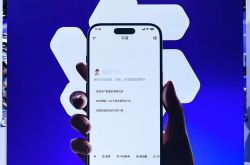
"A confidant that gets things done." At 10 AM on April 22, Alibaba unveiled a new digital human AI assistant named Qianwen 'Dimples'.
This digital female figure, with distinct AI-generated features, is planned by Alibaba to become a group-wide ecological image. She will appear across various Alibaba ecosystem applications, serving as users' on-call AI companion for life, seamlessly integrating into work and daily scenarios.
Once the ecosystem is fully integrated, the Qianwen AI assistant will also be available in apps like Taobao and Fliggy, unifying the assistant image across Alibaba's product suite.
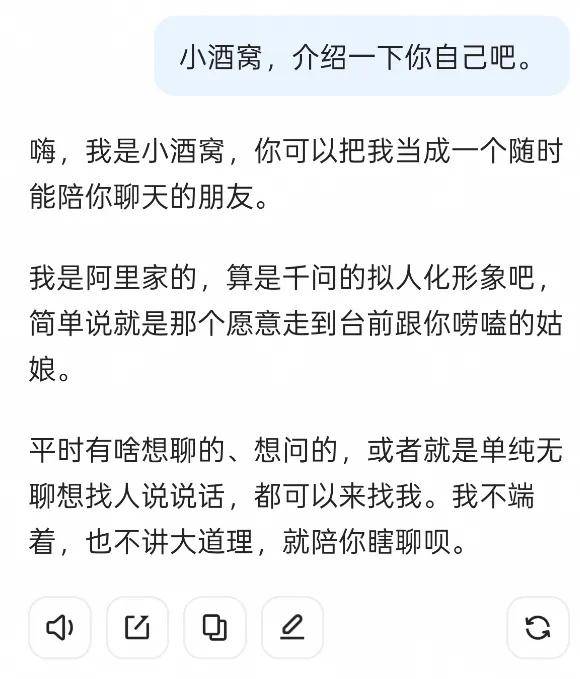
Contrary to external speculation during the pre-launch phase about a major breakthrough in Alibaba's embodied AI, the Qianwen 'Dimples' IP focuses more on building a personified image for the Qianwen brand.
To some extent, Alibaba's AI personification strategy has been evident for a while.
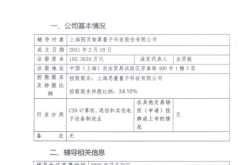
Qichacha data shows that Alibaba submitted multiple trademark applications for Qianwen Dimples in March this year, covering core categories such as Artificial Intelligence as a Service (AIaaS), chatbot software for simulated conversations, humanoid robots for scientific research, and humanoid robots with communication and learning capabilities.
This isn't an isolated move by Alibaba's AI.
Since the establishment of Alibaba's ATH business group last month, the company has been making dense (intensive) moves in the AI sector. Within a month, it consecutively released the video generation model HappyHorse, the world model HappyOyster, the AI development tool Meoo, enhanced Gaode's spatial intelligence and world models, and upgraded its robot dog products.
"Qianwen Dimples" represents the culmination of this series of technological deployments. Alibaba aims to create a unified, personified IP for Qianwen AI, achieving a comprehensive leap from a technical brand to user mindshare.

Personification: A Must for Qianwen
The domestic large model industry, after three years and hundreds of models, has completed two full competitive cycles and now stands on the threshold of a final showdown.
In the past, players competed on parameters (hundreds of billions), computational power (trillions), and catching up to ChatGPT's reasoning capabilities to secure the spotlight. Now, it's about scenario implementation—who can adapt their model to more complex tasks and fulfill more API call demands.
Now, Alibaba sees the industry's next cycle as a battle for user mindshare.
Kimi once invested heavily in C-side marketing but was swiftly overshadowed by DeepSeek. Such stories are becoming increasingly rare in today's large model market.
Currently, the foundational capabilities of domestic leading large models have largely converged. Whether it's Alibaba's Qianwen, ByteDance's Doubao, Baidu's ERNIE Bot, or DeepSeek and Zhipu AI, the gap in general reasoning abilities has narrowed to the point where ordinary users can't perceive it.
When technology fails to form an absolute barrier and price wars have reached their limit, the only long-term moat is user mindshare. And personification is the key path to capturing it.
The AI red envelope battle during the 2026 Spring Festival may have been one of the opportunities for Qianwen to embrace personification.
At that time, Alibaba focused on the "Spring Festival Hosting Plan," integrating Qianwen with core businesses like Taobao Flash Sales, Fliggy, Damai, Hema, Tmall Supermarket, and Alipay to boost hosting activities across users' dining, entertainment, and leisure scenarios.
While Qianwen emphasized its advantage in full-scenario life service capabilities—handling numerous daily tasks with a single phrase, such as organizing itineraries, editing tables, or processing payments and documents—its subsidy logic during the event didn't transcend the e-commerce sector's approach of acquiring customers through subsidies and converting traffic.
During the Spring Festival, Qianwen's user base surged but immediately declined afterward, while Doubao's daily active users continued to rise. QuestMobile data shows that after the Spring Festival peak, Doubao's DAU stabilized around 140 million, compared to Qianwen's 30 million and Yuanbao's 9 million.
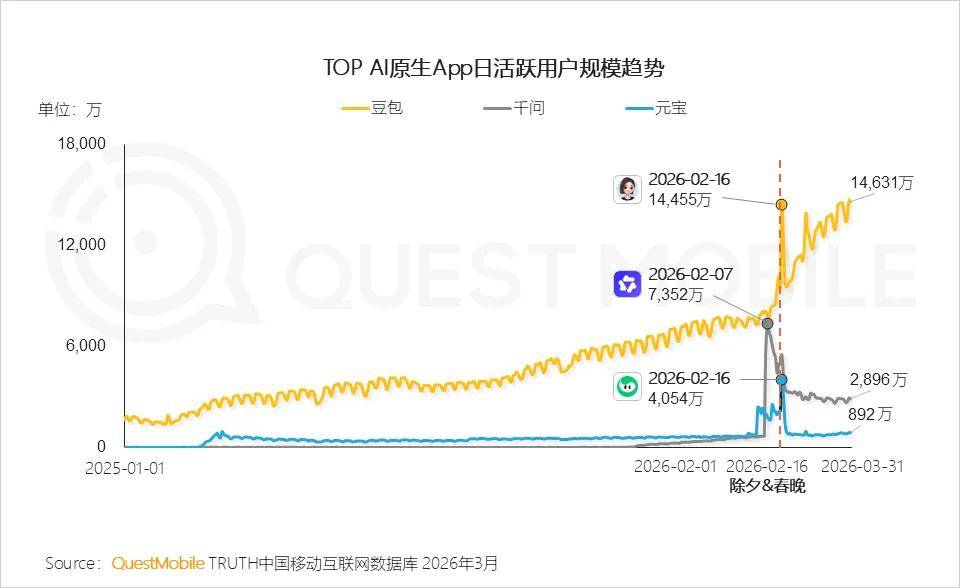
In contrast, Doubao's Spring Festival marketing focused more on showcasing AI technology to the public, encouraging users to participate in lotteries by generating New Year greetings or Spring Festival-themed avatars via AI, deeply embedding AI functions into interactive sessions and creating shareable content through AI-generated outputs.
This also partly explains Alibaba's strong determination and execution in high-profilely launching Qianwen Dimples to fill the gap in C-side emotional imprinting.
Over the past six months, Alibaba's AI strategy has consistently revolved around full-scenario integration, from video models to world models, AI development tools, and the ATH business group's comprehensive alignment of computing power, technology, and scenarios.
What Alibaba wants likely extends beyond a Doubao-like personified C-side product—it aims for a cross-scenario, cross-terminal AI brand super IP covering both software and hardware dimensions.
This is evident from the trademark layout (layout)—the "Qianwen Dimples" trademarks not only cover software fields like chatbot software for simulated conversations and AIaaS services but also extend to embodied AI hardware such as humanoid robots for scientific research and humanoid robots for assistance and entertainment.
In other words, Dimples will not only be a virtual figure within the Qianwen app but also has the potential to connect with Alibaba's embodied AI human-machine interaction scenarios, existing as a personified projection of Alibaba's AI in the real world. It wouldn't be surprising if, one day, the orange-colored Qianwen Dimples becomes the face of Alibaba's embodied AI.
Behind this lies Alibaba's ambition for a full-scenario IP-based AI layout.
As the large model market advances toward comprehensive user mindshare, Qianwen's debut as an emotional companion IP extends its commercialization paths beyond mere membership subscriptions and API calls to derivatives development, brand collaborations, IP licensing, and more, ultimately raising the commercial ceiling for the entire group.

Emulating Doubao Isn't Easy
With the launch of Qianwen Dimples, this personification transformation of Qianwen also represents Alibaba's formal effort to learn from ByteDance after establishing the Qianwen C-side business group.
The reason is clear—ByteDance has a natural gene (DNA) for social content platforms, while Alibaba does not.
The two companies have different DNAs. ByteDance owns Douyin, a national-level content platform, which means Doubao was designed from inception as a companion product deeply embedded in ByteDance's content ecosystem, encompassing content, social interaction, creation, and low barriers to entry.
In contrast, Alibaba's decades-long e-commerce DNA shapes its product logic toward efficiency and conversion.
Unlike Doubao, which was explicitly designed as a C-side native product from the start, Alibaba's AI-to-C strategy initially focused on Kuake as the entry point. The group attempted a familiar big-tech path: directing browser and cloud storage users toward AI scenarios, similar to Baidu Netdisk and QQ Browser's AI transformations.
Since its inception in late 2022, Qianwen's core team has primarily focused on model technology development. Team lead Lin Junyang's main task was refining foundational capabilities, using the large model as a traffic entry point to drive Alibaba Cloud's revenue growth. C-side user experience was sidelined from the beginning.
Not until November 2025 did Alibaba announce the launch of the Qianwen project, fully integrating AI-to-C entry points. In March this year, it further unified its core AI brands under Qianwen, attempting to create a super product for the C-side. Even then, Qianwen's emotional companionship capabilities lagged.
On this path, Doubao serves as the successful model.
QuestMobile's Q1 2026 AI app data shows that Doubao, Qianwen, and DeepSeek had monthly active users of 340 million, 170 million, and 130 million, respectively, with average active rates of 33.5%, 17.1%, and 21% throughout the quarter. After the Spring Festival red envelope battle, Doubao demonstrated significant advantages in user scale and activity.
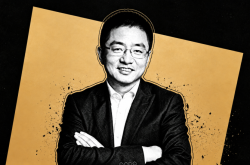
Doubao's success in personification owes much to Zhu Jun, head of ByteDance's Flow department, who insisted on this approach.
This stems from Zhu Jun's entrepreneurial experience. In 2013, he founded Cicada, an educational short-video app, which quickly failed due to high content barriers. He then pivoted to developing Musical.ly, focusing on 15-second lip-sync short videos with strong entertainment and social elements, laying the foundation for TikTok's success.
At the 2024 Volcano Engine Prime Mover Conference, Zhu Jun revealed ByteDance's three design principles for Doubao: personification, embedding into user environments, and personalization.
An internet product practitioner commented: "Zhu Jun's product philosophy is about lowering barriers—usage, creation, and understanding. Make it easy for ordinary people, and you win."
Take naming, for example. Doubao broke away from the technical, grandiose naming logic of domestic large models like "ERNIE, Tongyi, Hunyuan" and instead chose the earthy term "Doubao" (bean bun).
A warm name gives users the strongest impression: using other large models feels like using tools, while using Doubao feels like chatting with a friend.
The same goes for its image. From the start, Doubao fully implemented a personification strategy, using 3D virtual avatars to strengthen user memory. In Zhu Jun's words, it's about creating an interaction experience aligned with humans.
According to Zhu Jun's plan, Doubao should seamlessly integrate into users' life scenarios, acting as their life companion. During holiday travels, it can explain cultural relics in museums; at family dinners, it can share shrimp-peeling tips while pushing corresponding Douyin short-video tutorials.
To this end, Zhu Jun demanded that Doubao must always accompany users, embedding into their various environments—bringing Doubao to the user, not the other way around.
To optimize user experience, Zhu Jun led efforts to refine Doubao's voice interaction logic, providing full-scenario assistance for mobile use. In Doubao's desktop widget, users can awaken (activate) Doubao by selecting text. Meanwhile, Doubao is deeply embedded in ByteDance apps like Douyin and Toutiao, serving as a seamless assistant for creating short-video scripts and optimizing livestream copy.
On personalization, Doubao matches user preferences through response styles, voices, virtual avatars, and long-term memory capabilities, achieving a thousand faces for a thousand users.
A representative case is Doubao's 2024 role-playing model, which maintains consistency in long-context dialogues, giving users a real-person conversation experience—such as the iconic moment when Luo Yonghao asked Doubao to add "OK" at the end of each sentence.
This personification playbook, from naming to image and scenarios, enabled Doubao to transition from a tool-like AI to a personified AI, shifting users from tool usage to emotional bonding.
This is precisely what Qianwen needs to learn. Faced with gaps in monthly active users and activity, Alibaba needs an emotional anchor to elevate Qianwen beyond a tool and onto the path of being a digital companion for users. Let's wait and see.
-
![]()
Wang Huiwen, Former Meituan Executive, Achieves 20-Fold ROI, Supports 24 AI Startups
-
![]()
Another AI Computing Power Unicorn Launches IPO! Founded by a Changjiang Scholar
-
![]()
OFILM Holdings Secures Zhongke Daojing, Marking a Significant Leap in the Optical Communication Industry!
-
What Will Be the Next Key Battleground for Large Models After AI Coding?
-
![]()
Leapmotor's Sales Soar, Yet Hidden Concerns Loom
-
![]()
China’s Action Camera Market Soars: 3.12 Million Units Sold in Six Months, DJI Secures 74% Dominance
-
![]()
Zhang Yiming: Strategic Retreat as a Path Forward
-
![]()
Exploring Charging for Some Features of QianWen App: Can It Follow the Path of Doubao?