Li Auto Embraces a New Way of Life
 04/23 2026
 437
437
Extended-Range Hits Ceiling, Pure Electric Strikes Back, Overseas Expansion Begins: Three Hurdles Li Auto Must Overcome
In 2025, Li Auto faced its "zodiac year" of challenges.
With 406,300 vehicles delivered, nearly 100,000 fewer than the previous year; net profit shrank from 8 billion to 1.1 billion, a drop of over 80%; revenue reached 112.3 billion yuan, down 22% year-on-year. The once high-flying "new energy leader" that dazzled peers with soaring sales and stock prices suddenly hit the brakes.
But that's not the most nerve-wracking part. According to CPCA data, China's new energy vehicle penetration rate surged to 47.9% in 2025 and is likely to exceed 50% this year. What comes after crossing that threshold? As Tsinghua University Professor Ouyang Minggao put it: growth will inevitably slow, and competition will shift from individual technologies to technological ecosystems.
In other words, the market has transformed from a "blue ocean of growth" to a "red ocean of inventory (existing market)." Previously, the focus was on speed; now, it's on stability. How Li Auto navigates this transition is worth pondering.
01
An Undeniable Reality: The Foundation of Extended-Range Is Shaking
Li Auto built its success on extended-range technology—its greatest fortune and current biggest concern.
In 2016, when Li Xiang scribbled "Scale up extended-range vehicles, target family users" on a whiteboard in the Wuyuan Bridge R&D office, the decision went against the entire industry. Extended-range electric vehicles (EREVs) had few success stories at the time; BMW i3 and GAC GA5's extended-range versions flopped, and the market widely dismissed the technology as outdated.
But Li Auto saw a different logic: pure electric for city commuting, gasoline-generated power for long-distance travel—enjoying the electric driving experience while eliminating range anxiety. Li Xiang later recalled that when the decision was made in late 2015, nearly the entire startup team opposed it. He simply stood as a father of two, believing the car should be built this way.
The rest is history. In 2020, Li ONE's first full year of deliveries soared to over 33,000 units, topping China's new energy SUV sales charts for four consecutive months and outperforming the Lexus RX, BMW X5, and Mercedes-Benz GLE in the mid-to-large SUV segment.
In 2021, deliveries doubled to 90,500 units. Within three years, Li ONE surpassed 200,000 cumulative sales, becoming the first domestic new energy vehicle priced above 300,000 yuan to reach that milestone. Relying on a single extended-range model, Li Auto joined the "100-billion-revenue club" in just three years and became the world's third profitable new energy automaker after Tesla and BYD in 2023.
The luck brought by extended-range technology extended beyond sales. Cost-wise, EREVs don't require large batteries like pure electric vehicles (BEVs) to boost range, freeing up resources for cabin comfort and intelligentization (intelligent) configurations. Gross profit margins stabilized above 20%, allowing Li Auto to avoid selling cars at a loss—unlike other new forces—and achieve self-sufficiency early on.
More intriguing was the industry's shift in sentiment. Critics who once mocked extended-range technology as "outdated" later changed their tune. In 2023, Li Xiang claimed on social media that "Chinese automakers still insisting on multi-gear PHEVs will switch to extended-range routes within one to two years"—a prediction that holds up today. Beyond Xpeng, IM Motors, and Xiaomi, even Ford, General Motors, and Toyota began incorporating extended-range technology into their plans.
But now that the road is crowded, concerns arise.
Consider the data: CPCA reported 1.235 million extended-range passenger vehicles sold domestically in 2025, up just 6% year-on-year—a sharp decline from 70.9% growth in 2024. Meanwhile, BEV sales surged 24.4%, accounting for over 80% of new energy growth. Extended-range vehicles noticeably lost momentum in the second half of 2025, with their market share dropping to 7.5% in October.
Li Auto's net profit plummeted 86% in 2025, far steeper than its sales decline, with per-unit profitability severely compressed. Gross profit margins slid from 19.8% to 17.9%, falling short of the 20% health threshold. As one auto industry researcher put it: a margin near 15% is a warning sign. While the company can still operate, its strategic flexibility shrinks.
Why were profits hit so hard? Because the market changed.
In 2025, Seres M8 delivered over 170,000 units in its first year, setting a benchmark for the 400,000-yuan segment. The Harmony Intelligent Mobility Alliance aimed for 1 million sales in 2026, with Seres contributing over half. Huawei's ecosystem pushed the extended-range ceiling higher, leaving Li Auto's once-exclusive blue ocean crowded with rivals.
The pure electric front wasn't smooth either. Flagship MPV MEGA delivered just 18,500 units annually, less than 30% of its target. The i6 and i8 faced production ramp-up issues and policy rollbacks, failing to meet expectations.
Worse, competition will only intensify this year. Xu Changming, former deputy director of the State Information Center, noted that the auto industry is shifting from "price wars" to multi-dimensional competition involving pricing, products, and technology. High-priced models will benefit relatively, while low-priced segments face slowing or negative growth. Li Auto's focus on the premium market above 200,000 yuan places it squarely in the eye of the storm.
Li Xiang set a 2026 target of 487,600 deliveries, up 20% year-on-year—lower than the past three years but no less pressureful in today's environment.
02
Two Trump Cards Prevent Pessimism Toward Li Auto
If products are the overt strategy, technological investment is Li Auto's covert bet.
In 2025, Li Auto spent 11.3 billion yuan on R&D, with half allocated to AI. The 2026 budget plans 12 billion yuan, maintaining AI's 50% share. Spending heavily on AI amid profit pressure shows Li Auto's commitment to the technology as its lifeline.
In March 2026, at NVIDIA's GTC Conference, Li Auto unveiled the MindVLA-o1 autonomous driving model. This model unifies spatial understanding, reasoning, and driving behavior, directly reconstructing 3D spatial positions, point clouds, semantics, and pixel information from video streams. It models static and dynamic scenes separately and predicts future states.
The same VLA model can control both vehicles and robots, with Li Auto defining autonomous driving as the "starting point for physical AI development." This isn't just a slogan—it's a strategic anchor.
At the chip level, Li Auto's self-developed Mach 100 arrived. Built on a 5nm automotive-grade process, it delivers 1,280 TOPS peak performance per chip and 2,560 TOPS in dual-chip synergy. Critically, it adopts a dataflow architecture: driven by data rather than instructions, with computing units directly transmitting data to reduce overhead. Li Xiang revealed that the Mach 100's performance tripled on standard large-scale matrix multiplication tasks compared to its predecessor.
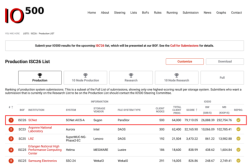
In April 2026, the Mach 100's research paper was accepted by ISCA Industry Track, the top global academic conference on computer architecture. Li Auto became the first automotive company to have a paper selected (selected) in this track, joining DeepSeek, Google, Meta, and NVIDIA.
More notable is the depth of Li Auto's self-developed chips. The Mach 100 is custom-built for the MindVLA-o1 large model and 3D ViT vision model, not a modified general-purpose architecture. Achieving such hardware-software synergy creates a moat beyond mere "parameter leadership."
Tracing Li Auto's path, Tesla looms large. Tesla's 2026 headline act is the Cybercab—a steering wheel (steering wheel)- and pedal (pedal)-free Robotaxi that began mass production in February.
Musk's vision is clear: eliminate manual driving controls entirely, relying on FSD for full autonomy, with a target cost below $30,000. Austin has deployed Model Y test fleets without safety drivers, totaling over 350 Robotaxis.
Li Auto isn't pursuing Robotaxis, but their underlying logic converges.
Tesla frames vehicles as AI carriers, with the Cybercab as the ultimate expression. Li Auto upgraded its strategy in 2025 to position itself as a "global leader in embodied intelligence." Li Xiang's emphasis on "embodied intelligence" and Musk's "physical AI" are two boats in the same river.
The difference: Tesla aims for immediate full autonomy with dedicated vehicles, while Li Auto starts with mass-market flagships like the L9 Livis, gradually infusing AI capabilities.
Different routes, same direction.
03
From Emulating Huawei to Rediscovering Its Rhythm: Overseas Expansion as the Wild Card
Li Auto's most intense adjustments in 2025 weren't product-related—they were organizational.
In March, the sales and service group underwent a shakeup, adopting a "theater command" system; by late June, the R&D and supply group merged with sales and service to form the "Intelligent Vehicle Group," led by president Ma Donghui, responsible for the intelligent vehicle business from strategy to operations; in August, the "five theaters" system was abolished and consolidated into a "sales" department.
At least six major reshuffles occurred within a year, leaving outsiders struggling to keep up.
The most watched move came in November. The HR department reported directly to Li Xiang, merging with the organization department previously managed by CFO Li Tie. This meant Li Xiang took personal control of personnel, with five departments now reporting to him: brand, strategy, product, product lines, and HR. Accompanying these changes were the departures of Yuan Chunfeng, former HR head, and Li Wenzhi, who oversaw Huawei-inspired reforms.
Looking back, Li Auto began fully emulating Huawei in 2022, adopting matrix organizations and PBC performance systems. This approach helped Li Auto scale from 10 billion to 100 billion yuan in revenue.
But side effects emerged last year. Sales teams engaged in cutthroat competition, with cross-regional poaching and internal commissions. In July 2025, Li Auto reverted to OKR, removing Huawei-aligned executives from core roles. As one industry observer put it, this was a "return to the founder's system from professional manager mode."
In other words, Li Auto no longer wants to follow anyone else's playbook—it's rediscovering its own rhythm.
Another front is overseas expansion. In 2026, Li Auto officially enters global markets, aiming for "domestic + overseas" dual-wheel growth. It has established R&D centers in Germany and the U.S. and built sales networks across multiple overseas markets. By year-end, Chinese new energy automakers' overseas production capacity is expected to exceed 2 million units.
Going overseas is inevitable. Total auto sales are projected at 34.75 million units in 2026, a slight increase. With domestic growth capped, overseas markets offer the only path forward.
But challenges loom: Can Li Auto's brand recognition, service systems, and product cadence adapt to vastly different markets like Europe, Southeast Asia, and the Middle East?
Tesla took nearly two decades to build its global infrastructure. Starting from scratch, how wide is Li Auto's window? As of now, Li Auto holds 101.2 billion yuan in cash reserves and has been profitable for three consecutive years. With money in the bank, it can afford trial and error—that's its confidence.
But overseas success hinges on localization, not just capital. Adapting products to Euro 7 emissions, WLTP protocols, and GDPR regulations in Europe; customizing developments for Southeast Asia's heat and humidity—each is a formidable barrier.
The second half of the new energy vehicle era demands a new narrative.
Ouyang Minggao's "shift from individual technologies to technological ecosystem competition" and BYD Chief Scientist Lian Yubo's "transition from scale expansion to value creation, from point breakthroughs to systemic capabilities" point to the same reality: the era of wild growth is over.
Li Auto stumbled in 2025 but held together. Its 100-billion-yuan cash reserves give it the luxury to keep betting on AI, self-developed chips, charging networks, and overseas expansion. The 487,600-unit annual target isn't aggressive, but in a market with over 50% penetration, limited growth, and multi-dimensional competition, every additional sale means taking market share from rivals.
Whether Li Auto can preserve its extended-range legacy while establishing itself in pure electric and AI arenas will be answered in 2026. This game is one I'm eager to keep watching.
This article is original to Xinmou.
— END —
-
![]()
Jitian Xingzhou: A Pioneer in Optical Payloads Secures Hundreds of Millions in Series B Funding!
-
![]()
Orders Secured Through to the Second Half of the Year! The Rationale Behind the 'Surge' in Demand for This Company’s Optical-Grade Base Films
-
![]()
Beyond Patents: The Retail Rivalry of Insta360 and DJI Unfolds
-
![]()
180 Billion Market Cap Vanished! How Did Seres Fall So Far?
-
![]()
Blockbuster! Domestic storage takes the global double crown for the first time, from an AI company
-
![]()
China Spearheads Formulation! World's Pioneering Global Technical Regulation for Automated Driving Systems Greenlit and Unveiled
-
![]()
Farewell to Pulsed Support Policies: Three Major Auto Policy Directions from Multiple Departments Take Effect on the Same Day
-
![]()
Embercore AI’s Accelerated Funding: The Robot Industry’s Shift Toward ‘Learning Systems’