Confronting GPT-5.5 and Revealed to Be Embarking on Its Initial Fundraising Round, Liang Wenfeng Prepares for a Challenging Showdown
 04/27 2026
 524
524

Text by | Zhao Tong
Edited by | Zou Jun
Previously, Liang Wenfeng always seemed to have ample financial resources.
For instance, when it came to fundraising, DeepSeek made it clear from the outset that it would not accept external financing, dilute equity, or be constrained by commercialization deadlines.
His confidence stemmed not from DeepSeek's exceptional profitability, but from its ability to rely on High-Flyer Quantitative Trading for financial support. By 2025, High-Flyer Quantitative Trading managed assets exceeding 70 billion yuan, generating annual revenues in the billions.
However, the situation has recently taken a sudden turn.
Foreign media outlet The Information recently reported that DeepSeek is proceeding with its first-ever fundraising round, with Alibaba and Tencent in discussions. Yesterday, following OpenAI's release of GPT-5.5, DeepSeek promptly unveiled a preview version of V4. The two entities clashed head-on, with a palpable sense of competition in the air.
A new wave of significant upheaval in the AI competition has truly commenced.
Why is DeepSeek Reportedly Seeking Funding?
Liang Wenfeng avoided fundraising in the past because he genuinely didn't require it. The annual profits of hundreds of millions of yuan from High-Flyer Quantitative Trading were sufficient to sustain DeepSeek.
But that was the logic of a year ago.
In the AI industry, the more powerful you become, the faster you expend funds. Training a large model starts at tens of millions of dollars per session. Recently, the cost of computing power has not decreased; instead, it has surged due to global competition for hardware. Following training, inference deployment and continuous iteration also necessitate funding. DeepSeek is growing stronger, but its costs are escalating accordingly.

One only needs to observe how rapidly peers are depleting their cash reserves.
According to Volcano Engine, as of March 2026, the daily token call volume for Doubao's large model has surpassed 120 trillion, doubling in three months and increasing 1,000-fold since its initial release in May 2024, ranking first in China and among the top three globally (trailing only OpenAI and Google).
Then there's Alibaba. Last year, it elevated AI to the highest strategic priority of the group, pledging to invest 380 billion yuan over three years in cloud and AI hardware infrastructure, surpassing the total investment of the past decade.
Pony Ma mentioned earlier this year: "2025 is a pivotal year for AI. Among Tencent's business lines, the only one with significant spending that is still worth heavily investing in is AI."
Compared to the scale of investment by these companies, High-Flyer's annual earnings of several billion yuan appear inadequate.
Even more disheartening is that startups that emerged around the same time are also amassing substantial funds.
Zhipu went public on the Hong Kong Stock Exchange in January this year, reaching a market capitalization of 410 billion Hong Kong dollars. MiniMax also listed on the Hong Kong Stock Exchange, with a market capitalization of 243.8 billion Hong Kong dollars. These two companies were nearly on par with DeepSeek at the starting line, and it's uncertain which possesses stronger technology. However, after going public, they have ample financial resources and are unafraid of depleting their cash.
Another issue has also raised concerns about DeepSeek.
Public information reveals that since the second half of 2025, several personnel involved in the development of DeepSeek's core models have joined companies such as ByteDance, Xiaomi, and Tencent. The talent competition in the AI industry is intensifying. When top talent commands market valuations in the tens of millions, maintaining the stability of the core team is a challenge that all unlisted AI companies must address.
This revelation about DeepSeek's initial fundraising round suggests that the time may have come to secure sufficient resources.
At the same time, another significant event occurred.
When GPT-5.5 Meets DeepSeek V4
Yesterday, two major announcements simultaneously rocked the AI community—OpenAI released GPT-5.5, and DeepSeek released V4.
This mere coincidence underscores one thing: competition has become so fierce that not a single day can be wasted.
First, let's examine OpenAI. After the release of GPT-5.5, industry evaluations were overwhelmingly positive—reasoning capabilities have significantly improved, multimodal processing is smoother, long-text understanding has reached a new level, and several core metrics clearly surpass the previous generation.
More critically, OpenAI's strategy has become increasingly sophisticated.
Technological prowess is just one aspect; productization capabilities, ecosystem building, and enterprise-level services are all advancing in tandem. It's not just about selling a single model but an entire suite of offerings. The number of paying users for ChatGPT continues to grow, enterprise API call volumes are steadily rising, and its deep integration with Microsoft ensures almost unlimited access to computing power.

This creates a virtuous cycle: earning money to fund R&D, R&D creating gaps, and gaps attracting more users and revenue.
Now, let's turn to DeepSeek V4.
Released on the same day, DeepSeek is clearly taking the fight head-on. From evaluation data, V4 demonstrates significant improvements in reasoning, mathematics, and coding—key capabilities—with a context window extended to the million-token level, placing it in the top tier domestically and making it competitive with GPT-5.5.
However, the issue is not the technology itself but the technological approach.
OpenAI follows a closed-source, paid model, where every capability can be priced and sold. DeepSeek follows an open-source model, freely releasing model weights and offering its chat product for free. In the short term, open-source can quickly gain users and build reputation, but in the long term, R&D without revenue support is unsustainable.
Simply put, V4 is powerful, but where will the investment for the next generation come from? And the one after that? Each version release burns money, and if external funding doesn't materialize, R&D progress may slow.
More profoundly, this reflects the sustainability of the business model.
DeepSeek gained global recognition last year with R1, thanks to its narrative of low-cost, high-performance capabilities. This story was compelling in the tech community at the time, but now, as the industry becomes increasingly competitive, the capital market operates on a different set of criteria—revenue, growth, and commercialization paths.
Technologically, it can compete with OpenAI, but a gap in fundraising capabilities may lead to a disadvantage in long-term competition.
The fact that these two releases coincided on the same day clearly highlights DeepSeek's dilemma.
V4 proves that its technological foundation remains robust—even formidable. The more this is the case, the more sustained investment is needed to maintain R&D momentum and retain talent. The revelation that DeepSeek is opening up for funding at this juncture, when viewed alongside today's head-to-head competition, forms a coherent narrative:
It needs to secure resources for even tougher battles ahead.
So, what does it mean for DeepSeek that Alibaba and Tencent are both involved?
What Does It Mean if Alibaba and Tencent Invest in DeepSeek?
First, let's consider what DeepSeek would gain if it truly secures funding from Alibaba and Tencent.
The most direct benefit is cash flow. Computing power procurement, talent retention, and the next round of model training are all cash-intensive. Investment from Alibaba or Tencent would at least allow DeepSeek to secure resources for a period.
More importantly, it gains access to their core resources. Alibaba possesses China's largest cloud infrastructure, offering advantages in computing power costs. Tencent has the WeChat ecosystem, providing advantages in application scenarios and user access points, which can accelerate distribution channels and commercialization paths.
Now, why are Alibaba and Tencent reportedly eyeing DeepSeek simultaneously?
Alibaba has QianWen, and Tencent has Yuanbao—both are their own "prodigies." The fact that they are reportedly considering investing in DeepSeek likely stems from a core reason:
Neither has secured the top position in AI access.
QuestMobile's latest report shows that Doubao leads with 345 million monthly active users, far ahead of the rest. QianWen ranks second with 166 million, DeepSeek third with 127 million, and Tencent's Yuanbao fourth with 57 million.
Doubao alone nearly matches the combined total of the next three.
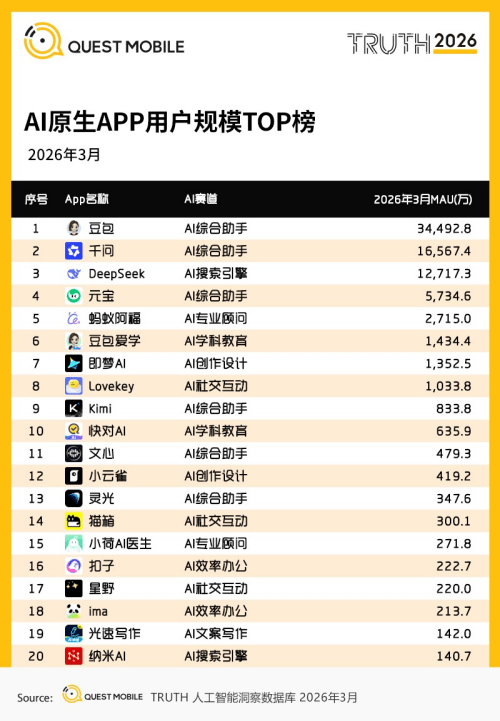
Doubao maintains its lead with two key strengths. First, ByteDance's traffic—Douyin's user referrals keep acquisition costs low. Second, its product design is clever, with strong personification and emotional interaction, making it a popular chat companion for many users. However, it's not without weaknesses; for complex reasoning and coding—hardcore scenarios—users still turn to other tools.
QianWen ranks second, with the advantage of tight integration with Alibaba's ecosystem. E-commerce, logistics, and local services can all leverage QianWen's capabilities. The question remains whether users stay because the AI is genuinely useful or because of cost savings through coupons—an account that has yet to be settled.
DeepSeek takes a different approach. Its user base consists heavily of tech circles and developers, with extremely strong stickiness. A popular saying in the community goes, "Use Doubao daily, but switch to DeepSeek for coding." However, its growth is slowing, and its feature set isn't yet rich enough.
Yuanbao ranks fourth. Tencent hasn't held back—it spent 1 billion yuan on Chinese New Year red envelopes this year. Yuanbao also has advantages within the WeChat ecosystem, with access points in Official Accounts, Video Channels, and Mini Programs. However, outside this ecosystem, its advantages are less pronounced, and the retention rate of users acquired through red envelopes remains unclear.
After comparing these four products, Alibaba and Tencent's potential investment in DeepSeek makes sense.
First, it diversifies risk. The AI technical path is uncertain; today's leader may be toppled tomorrow. No one dares to bet entirely on their own approach, so investing in DeepSeek is like buying additional insurance.
Second, it locks in computing power customers. This is the logic behind Microsoft's investment in OpenAI. DeepSeek's training and inference require massive amounts of computing power. Whoever invests in it secures this business. This isn't just about selling a few servers—it's about gaining a long-term client for their cloud business.
Finally, it seizes ecological influence. AI investment has long been an arms race, with Alibaba or Tencent's shadows lurking behind many popular AI companies. DeepSeek is one of the few high-value targets yet to align with either side. Securing it adds a card to their hand; failing to do so means the card goes to their rival.
Epilogue
On the AI track, giants are accelerating their arms race, continuously raising the threshold for burning cash.
Many companies are being forced to make choices in this torrent, with a sense of helplessness underlying their proactive moves. DeepSeek's revelation of its initial fundraising round may also be a helpless move amid industry upheaval.
But the more intriguing question is: Will DeepSeek, after accepting others' money, still be the same DeepSeek?
-
![]()
Tesla Restructures Its Balance Sheet
-
![]()
Accelerating the High-Speed Interconnection Upgrade of AI Computing Clusters! JONHON Releases ELSFP External Light Source Optical Connectors
-
![]()
Breaking the overseas blockade of volumetric holographic materials, this optical enterprise secures nearly 100 million yuan in financing!
-
![]()
Why Does Jensen Huang So Openly Praise China’s AI?
-
![]()
"Wudang" Unveiled: Arm China's Next-Gen AI VPU Redefines Video Encoding
-
![]()
From Energy Conservation and Carbon Reduction to AI Decision-Making: GECON East Intelligence and Chery Group Explore a New Green and Smart Paradigm for Automobile Manufacturing
-
![]()
WAIC 2026 Observation | AI Accelerates Towards the Core of Industries, Industrial AI Enters a Critical Phase
-
![]()
Volkswagen China Fires the First Shot in Foreign-Funded 'White Box Delivery'!