Behind the Buzz of DeepSeek V4: Internal Struggles for Some, Relay Race for Others
 04/27 2026
 548
548
Editor: Captain Timo
While Silicon Valley's closed-source camp (faction) is mired in internal struggles of 'gameplay,' Chinese large models are breaking through in another way.
On April 24th, the long-awaited DeepSeek-V4 preview version was officially released and open-sourced simultaneously. DeepSeek-V4 comes in two versions, Pro and Flash, both supporting ultra-long contexts of up to one million (1M) tokens. In the same week, Kimi coincidentally released its latest model, K2.6, upgrading Agent capabilities from 'single-point invocation' to 'cluster collaboration.'
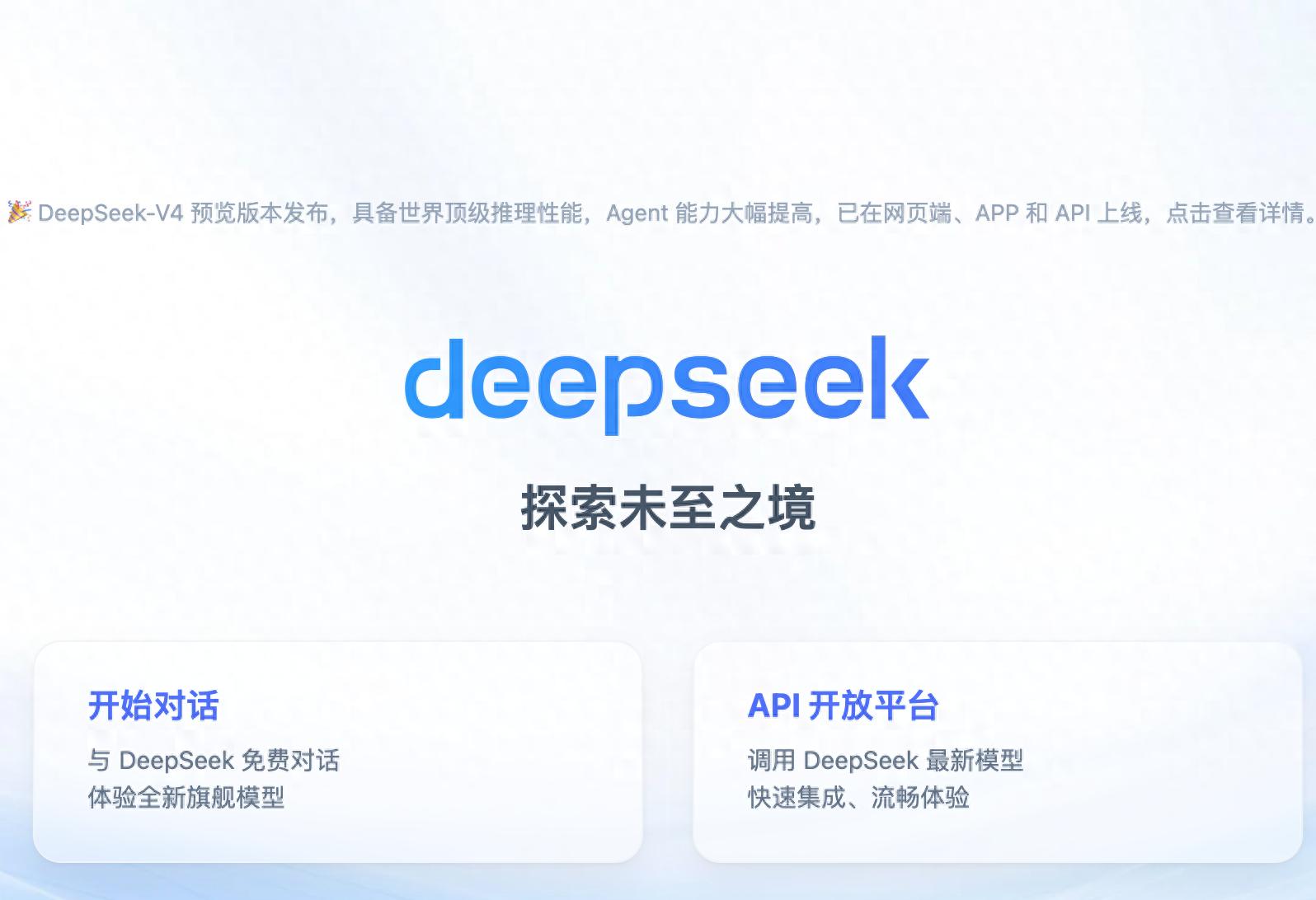
The birth of two trillion-parameter open-source models in a single week has not only drawn the collective attention of the global open-source community to China but also quietly outlined the starkly different developmental paths of AI in China and the United States—while U.S. AI leaders are embroiled in escalating internal conflicts, China's open-source AI seems to have found a path of collaborative evolution.
01
Open-Sourced in the Same Week, Clear Division of Labor, No Internal Competition
In the same week that DeepSeek V4 caused a stir, Yuezhi'anmian (Kimi's developer) released and open-sourced Kimi K2.6, enhancing Agent cluster capabilities: supporting 300 Agents in parallel, capable of autonomously breaking down and completing complex, long-term engineering tasks. This forms a stark complement to DeepSeek's approach.
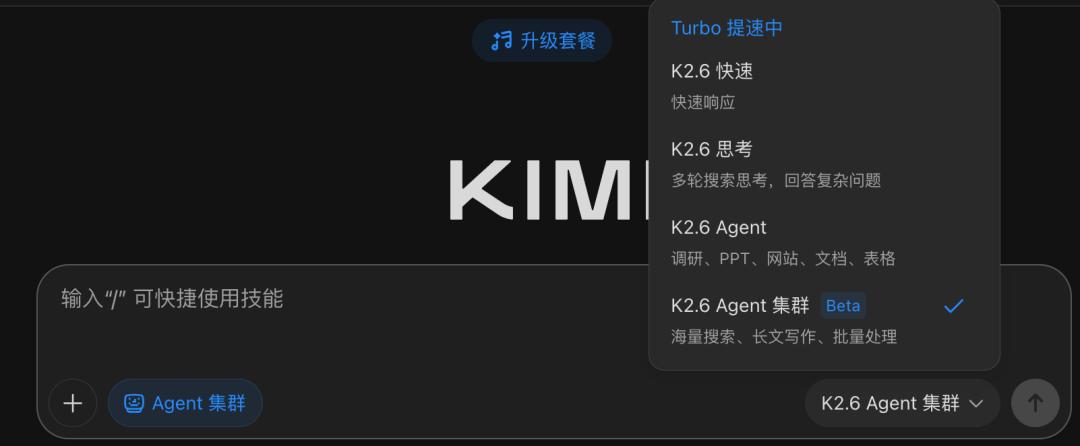
DeepSeek focuses on 'deep reasoning, long-text understanding, and computational efficiency,' while Kimi aggressively pursues 'multi-Agent clusters, long-term task execution, and complex engineering implementation.' Both paths have independently closed the loop, jointly expanding the global reach of Chinese open-source models.
But is this 'tacit understanding' between the two AI companies really a coincidence?
The real details lie hidden in the technical reports.
The most telling example is the mutual referencing of two key technologies.
DeepSeek V3's proposed MLA (Multi-Head Latent Attention) technology is one of its core architectural innovations, significantly reducing reasoning costs for large models by compressing KV caches—a major barrier to model deployment. MLA technology directly elevates DeepSeek's reasoning efficiency to a new level. Kimi, in its K2 series models, chose to adopt the MLA architecture, successfully compressing KV cache volume and clearing the path for Agent capability deployment.
Conversely, Kimi's pioneering large-scale validation of the Muon optimizer solved the industry-wide challenges of unstable and inefficient training for trillion-parameter large models—achieving 'doubled efficiency under equivalent training volume,' effectively delivering the performance of 100 trillion tokens with just 50 trillion. DeepSeek V4's technical report directly incorporates the Muon optimizer into its training regimen.
In short, DeepSeek's MLA helps Kimi reduce reasoning costs; Kimi's Muon helps DeepSeek reduce training costs.
You use my architecture; I use your optimizer. No disputes, no licensing required. This is the unique positive feedback loop of China's open-source AI—unlike Silicon Valley's approach of treating technology as a moat, for these two companies, collaborative development through open-source attitudes is the true moat.
02
Closed-Source Leads to Internal Struggles
This brings us to the history of conflict between OpenAI and Anthropic.
From the birth of ChatGPT, OpenAI and Anthropic were destined to be 'archrivals'—most of Anthropic's core team came from OpenAI, leaving due to ideological differences and directly targeting OpenAI with closed-source models, sparking all-out competition in technology, talent, and capital.
From 2023 to 2026, Anthropic's ARR grew nearly tenfold annually, steadily closing in on OpenAI; by April 2026, Anthropic's reported $30 billion annualized revenue reportedly surpassed OpenAI's. OpenAI relied on Microsoft's funding and computational power to monopolize the high-end market, while Anthropic survived on Google's investments, with no technological sharing between them—instead, they mutually blocked and undermined each other, even resorting to litigation over technology patents.
In this 'duel of titans,' OpenAI was even recently exposed in an internal memo, explicitly naming the other as a direct competitor and vowing strict defense.
Why does this happen? The core lies in the nature of the closed-source route—technology is a 'moat,' a tool for profit. Once shared, competitive advantage is lost. The profit model of closed-source models dictates an 'absolute competition' relationship—the pie is finite; if you eat more, I eat less. There is no room for mutual benefit.
However, the macro environment faced by China's AI cohort is starkly different. With computational power constrained and high-end chips 'choked' by overseas restrictions, continued internal friction among Chinese companies would be self-destructive.
Thus, DeepSeek and Kimi decisively chose to embrace open-source—to expand the pie and break through together.
In this era where AI is shifting from 'training-centric' to 'reasoning-decisive,' China's AI has chosen a strategically visionary path: using top-tier open-source models to pierce through closed-source vendors' exorbitant pricing power, rapidly capturing the global developer market with near-equivalent intelligence performance at heavily discounted prices.
03
'Brothers' Taking Different Paths to the Same Goal
Even more gratifying is that these two Chinese stars not only mutually reinforce each other technologically but also, in breaking through the blockade of domestic chips, have exerted themselves in different ways yet arrived at the same destination, paving the way for China's AI autonomy.
DeepSeek took the 'engineering adaptation' route, with V4 first adapting to Huawei's Ascend chips. The engineering team painstakingly migrated the entire tech stack from CUDA to Huawei's CANN framework, reimplementing nearly every layer, from operator libraries and communication primitives to memory management. They also completed Day 0 adaptation for Cambrian chips, with all code open-sourced, proving in action that domestic chips can run flagship trillion-parameter large models.
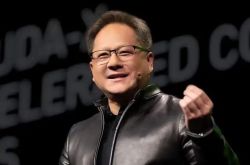
Even NVIDIA CEO Jensen Huang once admitted, 'If DeepSeek had launched first on Huawei's platform, it would be very scary for us.' Now, that statement has come true.
Kimi, meanwhile, took the 'architectural innovation' route, unveiling its 'ace in the hole' for domestic chip adaptation: first, the Kimi Linear hybrid attention architecture, blending linear and full attention in a 3:1 ratio, boosting decoding speed by up to 6x in long-context reasoning while reducing KV cache by 75%, making RDMA high-speed networks an 'option' rather than a 'necessity.'
Second, the PrFaaS technology, which completely decouples the prefill and decoding phases of reasoning, scheduling them onto different domestic heterogeneous hardware—using powerful domestic cards for prefill and bandwidth-rich domestic cards for decoding. Compared to traditional homogeneous PD deployments, this achieved a 54% increase in measured throughput and a 64% reduction in P90 latency, shattering the myth that 'large model reasoning must bind to high-end GPUs.'
One validates domestic chips' carrying capacity at the engineering level; the other optimizes domestic chips' operational efficiency at the architectural level. Together, these two companies are driving the implementation of the 'Chinese Chips + Chinese Models' ecosystem, making NVIDIA no longer the sole choice for China's AI.
04
Conclusion:
When DeepSeek wrote in the V4 announcement, 'From now on, 1M contexts will be standard,' and when Kimi's K2.6 test ran Agents autonomously for five full days, Chinese AI had quietly surpassed the era of competing solely on parameter counts.
This not only means Chinese companies have found the key to bypassing computational power blockades in the complex global AI chessboard but also, more profoundly, with the large-scale rollout of domestic computational power and the rapid rise of China's open-source large models' global share, a new multi-polar global AI landscape is taking shape. When an industry's barriers shift from blockade to efficiency, from closed-source secrecy to open-source inclusivity, the real storm has only just begun.
-
![]()
Tesla Restructures Its Balance Sheet
-
![]()
Accelerating the High-Speed Interconnection Upgrade of AI Computing Clusters! JONHON Releases ELSFP External Light Source Optical Connectors
-
![]()
Breaking the overseas blockade of volumetric holographic materials, this optical enterprise secures nearly 100 million yuan in financing!
-
![]()
Why Does Jensen Huang So Openly Praise China’s AI?
-
![]()
"Wudang" Unveiled: Arm China's Next-Gen AI VPU Redefines Video Encoding
-
![]()
From Energy Conservation and Carbon Reduction to AI Decision-Making: GECON East Intelligence and Chery Group Explore a New Green and Smart Paradigm for Automobile Manufacturing
-
![]()
WAIC 2026 Observation | AI Accelerates Towards the Core of Industries, Industrial AI Enters a Critical Phase
-
![]()
Volkswagen China Fires the First Shot in Foreign-Funded 'White Box Delivery'!