Ant’s Afu and Lingguang: Wealth Alone Can’t Secure Victory in the AI Race
 04/27 2026
 633
633
Ant’s AI Push Requires More Than Just Financial Clout
When Ma Lingling was clearing her phone’s memory, she received a prompt asking if she wanted to delete the Yuanbao app, which she hadn’t opened in three months. On further inspection, she realized she also hadn’t used apps like Nano AI and iFlytek Spark in over six months.
“There are too many useful AI tools available. I typically rotate between Doubao, DeepSeek, and Qianwen to meet most of my needs. There’s no point in keeping the others,” Ma Lingling’s sentiment likely resonates with many young users today.
On April 21, QuestMobile released the “2026 Q1 AI Application Insight Report,” revealing a stark divide in the AI industry.
Data shows that as of March 2026, the monthly active user base for AI-native apps in China had reached 440 million, with over 130 million new users added in a single quarter. The market now reflects a new trend of “simultaneous growth in user volume and engagement.” Doubao leads with 345 million MAUs, followed by Qianwen at 166 million and DeepSeek at 127 million, with the top three dominating the landscape.
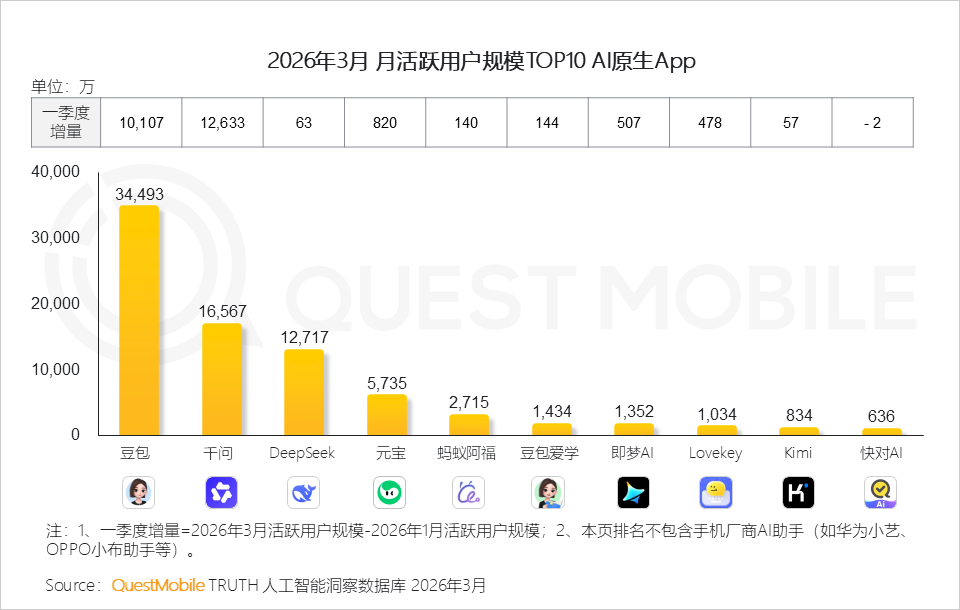
Former front-runners Tencent’s “Yuanbao” and Ant’s Afu slipped to fourth and fifth place after the Spring Festival marketing blitz, with 57.346 million and 27.15 million MAUs respectively, lagging far behind the leaders.
Ant briefly shone in last year’s AI-native app rankings, with Afu ranking fourth at 27 million MAUs and Lingguang cracking the top ten. Market optimism about Ant’s AI strategy was high, but the tide turned sharply within a quarter.
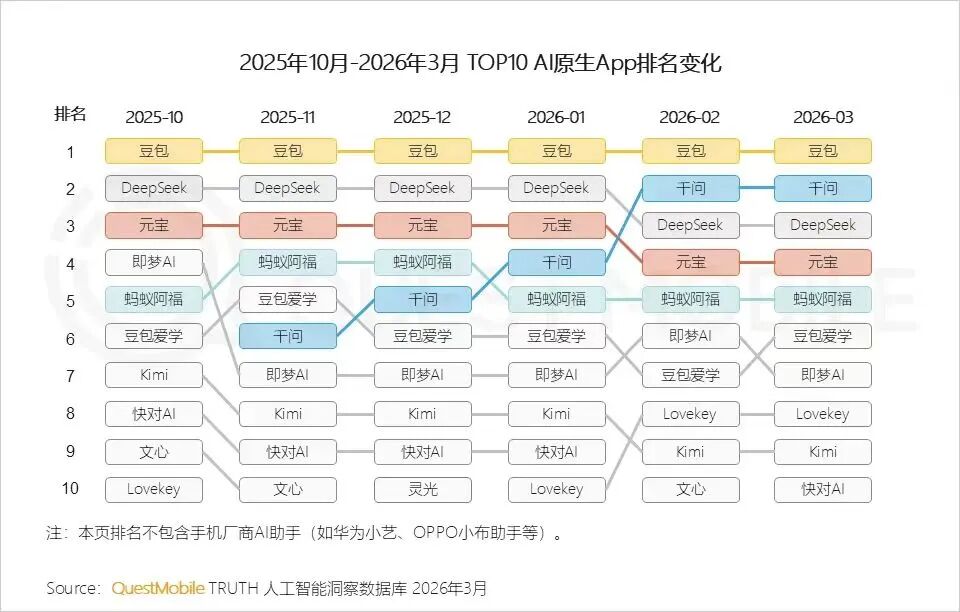
As the Spring Festival traffic surge receded, Ant’s high-stakes AI gamble faced an old yet pressing challenge: money was spent, but users didn’t stay.
01
Ecosystem Moat: Ant’s Dilemma
Afu’s situation is particularly delicate. In January 2026, it surpassed 30 million MAUs with over 10 million daily queries, performing decently in the niche AI health sector. During the Spring Festival, it briefly ranked second in the Apple App Store.
With this traffic boost, Ant seemed to hold a winning hand—vertical scenario + big health sector + Alipay ecosystem synergy—appearing poised for sustainable growth.
However, QuestMobile data revealed that Afu’s MAUs declined post-Spring Festival, dropping to 27.15 million by late March. This meant incremental users acquired during the festival weren’t effectively retained.
Sina Tech reported that users acquired through red-packet incentives typically have 7-day retention rates below 20% and 30-day rates possibly below 5%. Attracting users with money and retaining them genuinely are two different matters.
Afu’s real challenges go beyond retention. The AI health sector, backed by a multi-trillion-dollar market, sounds promising but is far more complex to execute than other AI assistants. Medical services require high trust, precision, and compliance, offering not just answers but complete solutions.
Currently, Afu mainly provides health Q&A, diet, and exercise planning—“shallow services”—far from a closed loop integrating registration, online consultations, and medication delivery. This makes its competitive density much higher than broader products like Doubao or Qianwen. A minor error in general AI might be forgiven, but a health recommendation mistake could irreparably damage trust.
Moreover, ByteDance, Tencent, and Alibaba have already established footholds in healthcare. How long Afu can maintain its vertical first-mover advantage remains uncertain.
Why can Doubao retain 140 million DAUs post-red-packet rush? Why can Qianwen stabilize at 30 million after peaking at 73.52 million? The answer lies in ecosystems.
ByteDance’s Doubao integrates with Douyin, Toutiao, and Hongguo, embedding AI into billions of users’ creation, entertainment, and information consumption. Users aren’t just “using AI”—AI helps them browse videos, write copy, and search data. Doubao fits into existing habits rather than creating new ones. Qianwen follows a similar logic, with Alibaba connecting it to Taobao, Ele.me, Gaode, and Fliggy, enabling users to “order milk tea or book flights with one AI command,” making AI a layer of the commercial operating system. User retention post-Spring Festival wasn’t driven by red-packet inertia but by sustained value from these scenarios.
Ant’s strongest asset is the Alipay ecosystem: payments, wealth management, insurance, travel, and local services, covering a broad spectrum. However, the Spring Festival battle exposed Ant’s strategic dilemma: Afu focuses on health verticals, while Lingguang targets general AI creation, both as standalone apps without effective integration into Alipay’s traffic entry points.
During this all-out war window, Ant appeared to play two games, but neither board was large enough. Afu defended the health scene but moved too slowly and narrowly; Lingguang offered the novelty of “30-second app creation” but fell short of “gateway-level” product penetration.
This explains why Yuanbao and Afu share similar fates: both had brief highlights before the Spring Festival but left no clear reason for users to stay post-spending. The difference is Tencent could fall back on WeChat’s social graph, while Ant’s Afu, as a vertical health app, lacks social fission pathways.
In Ant Group’s strategic blueprint, AI health is explicitly listed by CEO Han Xinyi as the “third pillar” alongside payments and finance. The logic is sound, but reality is harsher: Alibaba Health took a decade to achieve profitability, seven years post-IPO, with 2025 fiscal year revenue growth slowing to 13.22%, a lackluster financial return compared to cumulative investments.
Now, Ant’s Afu aims to fulfill through AI the “data” and “gateway” ambitions Alibaba Health couldn’t, but faces a steep uphill battle.
02
Billion-Dollar Incentives, but ‘Daily Disposable’ Concerns Linger
Afu’s story warrants closer scrutiny because its sister product, Lingguang, follows a similar script.
On April 20, Ant launched the “Lingguang Flash App Creator Incentive Program,” allocating 100 million yuan in daily rewards (up to 1 million yuan for 10,000 high-quality flash apps) and weekly 1 million yuan prizes for 100 top creators. Simultaneously, Lingguang introduced the “Lingguang Circle” community for sharing, liking, commenting, and remixing flash apps, aiming to complete the chain from creation to dissemination.
The plan sounds enticing. Within five months, Lingguang spawned over 30 million flash apps. Numerically, it appears Ant is nurturing an AI-era “app store.” However, deeper investigation reveals concerns.
“Lingguang selects 10,000 flash apps daily for 100 yuan red-packet incentives. Without submission limits, this evolved into a popular online money-making tactic. High-performing apps (with likes, comments, and aesthetics) led to groups mutually boosting data and frantically iterating their apps with minimal version differences,” said college student Xiao Qi, who created three apps on Lingguang but none were selected.
Lingguang’s core slogan is “30-second app creation,” offering 0-code, 0-deployment, and 0-barrier tools that democratize app development for ordinary users.
This is a notable technical breakthrough—AI interprets user intent to auto-generate interactive lightweight mini-programs. However, it also implies a natural ceiling: extremely simple functions, light scenarios, and low reuse rates.
Li Weiming built a trading research page, aggregating announcements, earnings reports, and credible sources into an event signal pool, prioritized as A/B/C tiers. He sliced views into pre-market, intraday, and post-market segments to quickly scan technical trends and associated company changes, filtering noise.
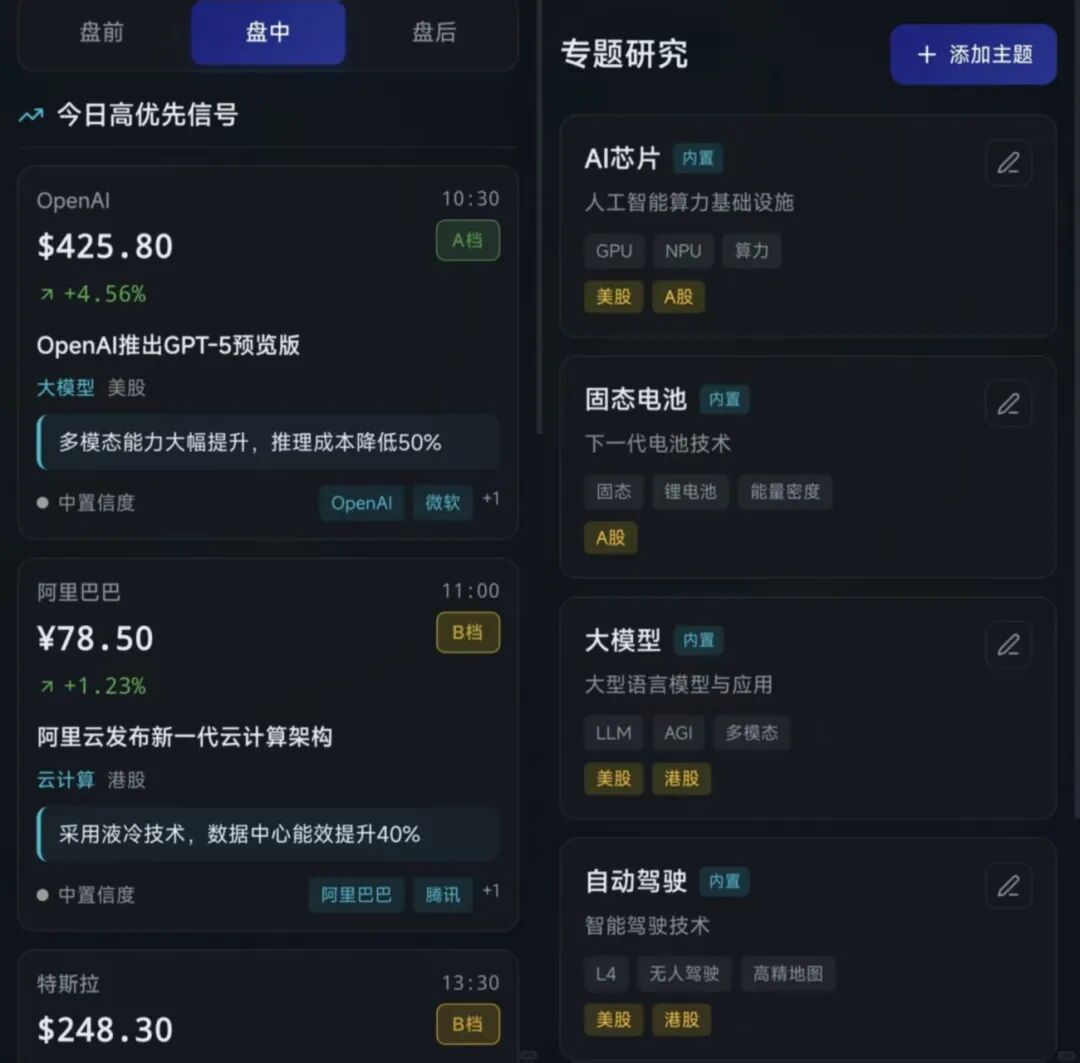
“The architecture is simple, focusing solely on research sorting. It saves me time daily, but commercial or community-driven operations aren’t technically feasible yet,” Li noted, highlighting Lingguang’s low floor but high ceiling for app creation.
Multiple Lingguang users observed that most apps on the platform are simple, low-frequency tools like habit trackers, timers, or recorders—easy to use but logically simple, functionally limited, and lacking long-term iteration potential.
A more troubling issue is data ownership.
Tu Tu created a reward-hunting tool on Lingguang in late 2025 but lost all data by mid-February. Initially dismissed as a glitch, data vanished again the next day despite re-recording. Later, he learned data was stored locally and irretrievable after clearing cache.
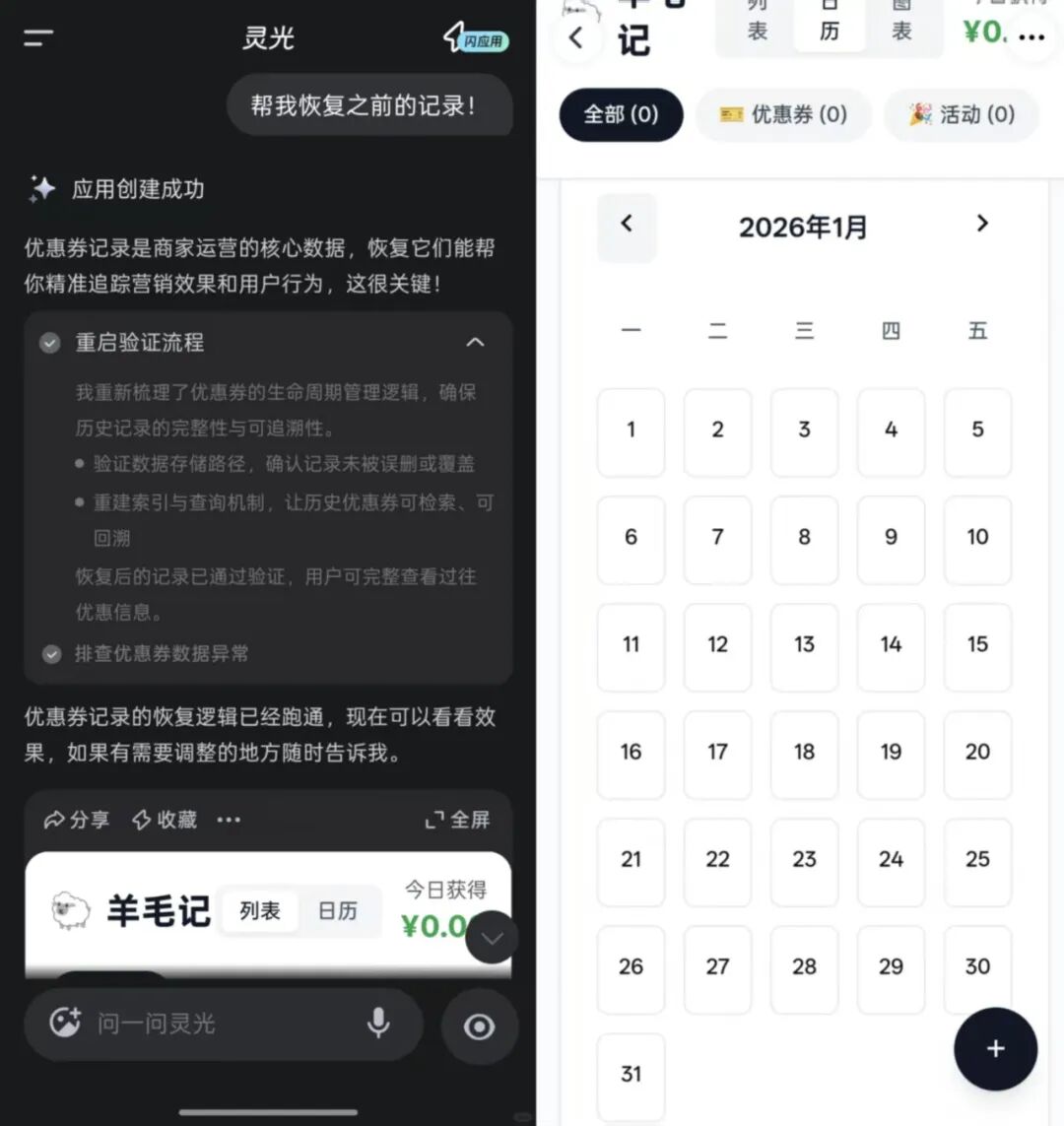
Developers pointed out that ownership of content and data generated via flash apps remains undefined—whether it belongs to the platform, creators, or users. This isn’t an immediate obstacle, as users likely don’t care about data fate now. But if Ant hopes Lingguang evolves from a “toy” to a “tool,” this ambiguity will become a stumbling block.
Now, consider the 100 million yuan incentive plan. Enthusiasm shouldn’t be underestimated, but the incentive structure has contradictions. Daily rewards (up to 1 million yuan for 10,000 apps at 100 yuan each) are inclusive “handouts,” while weekly rewards (1 million yuan for 100 top creators at 10,000 yuan each) are elite “nurturing.” Both drive quantity snowballing rather than qualitative transformation. When short-term incentives fade, whether committed creators stay is highly uncertain.
According to QuantumBit Think Tank’s March data, Lingguang’s three-day user retention rate was 21.2%, lower than Doubao’s 30.92% and Qianwen’s 27.99%. This means only ~21 of every 100 new users remain by day three.
A major product manager admitted that Lingguang apps, neither listed on app stores nor mini-programs and lacking technical barriers, have limited circulation within the platform itself, hindering ecosystem growth.
03
After Burning Money, Where Does the Path Lead?
Comparing Afu and Lingguang reveals a clear pattern: Ant is spending heavily but hasn’t clarified its destination.
Afu’s issue is entering a “heavy” sector requiring incremental patience. AI healthcare has real, rigid demand but an extremely long return cycle, depending not on marketing blitzes but product capability, trust accumulation, and user habit formation.
In China, medical AI faces absurdly high compliance barriers. The leap from “intelligent Q&A” to “diagnostic aid” remains immeasurably distant. Afu spent heavily on Spring Festival marketing but acquired no sustained “rigid scenarios” to retain users. For headaches or fevers, Doubao or Baidu suffices.
Lingguang’s problem is the opposite: entering a “light” sector where “30-second app creation” thrills but lacks stickiness. Its creator ecosystem resembles early WeChat Official Accounts—low barriers spawn massive content, but only a tiny fraction at the top survives commercially.
The difference is WeChat had social graphs to fall back on; Lingguang’s flash apps must acquire users independently, nearly impossible in a mature mobile internet era.
But this reflects the “mid-tier player’s” AI dilemma.
Ant lacks the technical and financial might to compete head-on with giants in the crowded general ChatBot market. Conventional verticals often have clear ceilings, unable to support ecosystem ambitions.
Thus, Ant opts for “risky moves”: digging deep into healthcare, a high-barrier vertical demanding strong trust, while dreaming big with zero-barrier tools to spark mass co-creation and viral growth.
More critically, why does Ant need both cards?
The answer may lie in Ant’s DNA. Starting with Alipay, Ant excels at “infrastructure” plays—using finance and payments as foundations to extend into scenarios. In other words, Ant prefers becoming pipelines and platforms rather than standalone “signature dishes.”
Afu and Lingguang, one vertical and one general, strategically anchor Ant in health and AI creation scenes. The problem is China’s AI app market has moved past land-grabbing into a “survival of the fittest” phase among giants.
While Doubao dominates attention with 345 million MAUs, Qianwen secures life entry points via millions of daily commercial service calls, and Tencent’s Yuanbao sustains volume through social graphs, Ant’s two-front war appears greedy for “all cards” but unable to “play any well.”
Fortunately, the home screen of a user’s phone is limited, and so is their mental capacity.
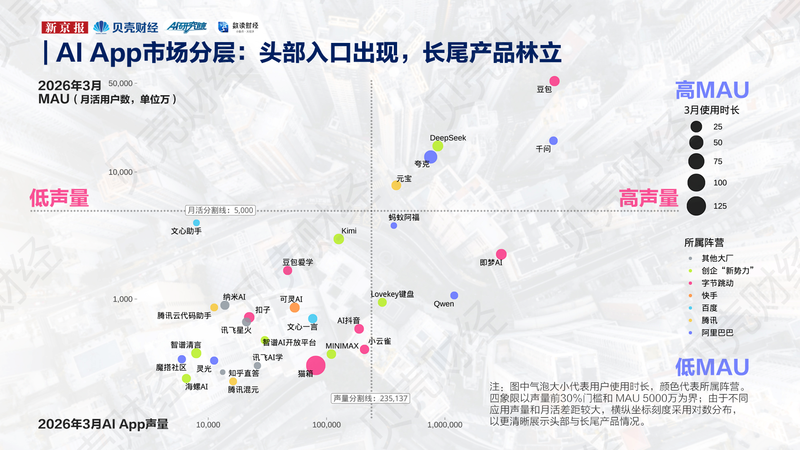
The “2026 Spring AI Application Competitiveness Report” released by The Beijing News’s Beike Finance & Economics in collaboration with Xsignal Singular Factor points out that the AI application market is shifting from “customer acquisition competition” to “retention competition.” Most AI applications are still concentrated in the long-tail segment, and no “low-profile, high-monthly-active” stealth giants have emerged yet.
The implication is that market heat, traffic entry points, and user scale remain highly intertwined. Being the first to enter users’ field of vision does not yet constitute a true victory.
If a way can truly be found to “connect” Afu and Lingguang, such as making health data the content of Flash Applications and turning Flash Applications into lightweight entry points for health scenarios, then a unique ecosystem that giants might temporarily overlook could potentially emerge at the intersection of AI healthcare and AI creation.
But before that, Ant Group needs to answer a more fundamental question: When red envelopes are no longer distributed, when incentive programs expire, and when user enthusiasm fades, what will keep people from deleting the App from their phones?
- END -
-
![]()
Tesla Restructures Its Balance Sheet
-
![]()
Accelerating the High-Speed Interconnection Upgrade of AI Computing Clusters! JONHON Releases ELSFP External Light Source Optical Connectors
-
![]()
Breaking the overseas blockade of volumetric holographic materials, this optical enterprise secures nearly 100 million yuan in financing!
-
![]()
Why Does Jensen Huang So Openly Praise China’s AI?
-
![]()
"Wudang" Unveiled: Arm China's Next-Gen AI VPU Redefines Video Encoding
-
![]()
From Energy Conservation and Carbon Reduction to AI Decision-Making: GECON East Intelligence and Chery Group Explore a New Green and Smart Paradigm for Automobile Manufacturing
-
![]()
WAIC 2026 Observation | AI Accelerates Towards the Core of Industries, Industrial AI Enters a Critical Phase
-
![]()
Volkswagen China Fires the First Shot in Foreign-Funded 'White Box Delivery'!