After a Decade, Li Yanhong Has Yet to Reign as the AI Development King
 04/27 2026
 531
531

PART 01
A Betrayal Within Half a Year
Lu Qi was still at the helm when Baidu held its inaugural AI Developer Conference.
It was the summer of 2017, and the National Convention Center buzzed with anticipation. Lu Qi, with his lean physique, took the stage: "Welcome to Create. This marks Baidu's first, and China's inaugural, large-scale AI Developer Conference."
The atmosphere was electric. Curiosity swirled around Lu Qi and Baidu, with attendees wondering what tales this former Microsoft Global Vice President would weave. Since January 2017, he had served as Baidu Group's President and COO, second only in power to Li Yanhong and his wife, Ma Dongmin, and had taken full charge of Baidu's AI endeavors. Within six months, he had axed AI-irrelevant businesses like the Medical Business Unit and Baidu Takeout, signaling Baidu's resolute shift to AI.
AI was Baidu's new narrative after lagging in the mobile internet era. AlphaGo's triumph over Lee Sedol in March 2016 had sparked an AI craze. By November, amidst the gentle autumn breeze in Wuzhen, Li Yanhong declared that the mobile internet era had ended and the future belonged to artificial intelligence. By year's end, he had brought Lu Qi on board to spearhead this transformation.
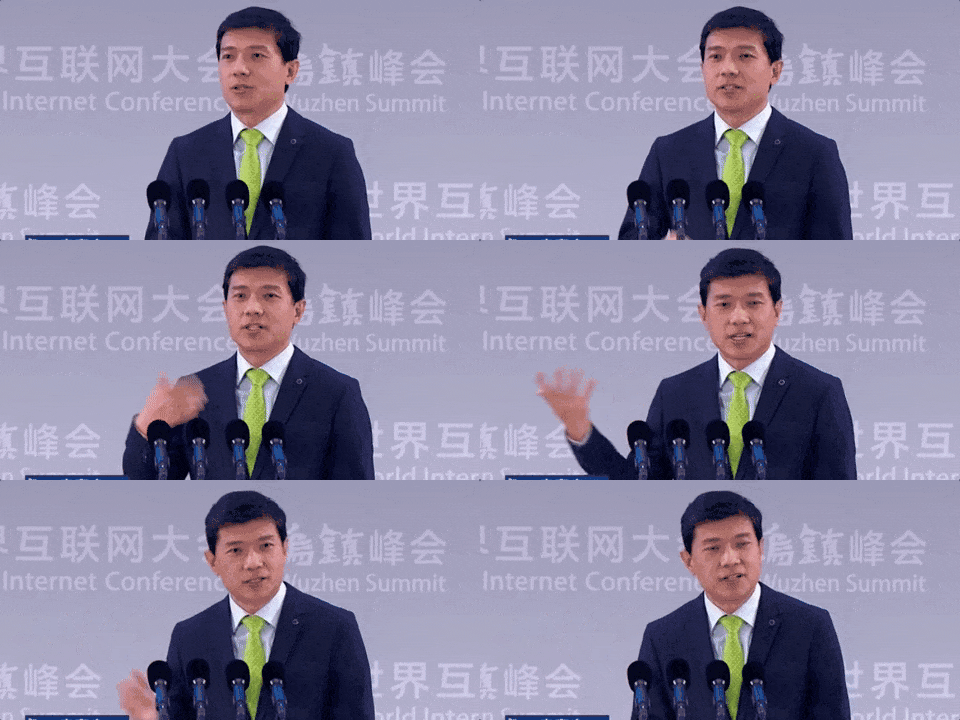
Li Yanhong speaking at the Third World Internet Conference in 2016
Having spent 25 years in the United States, Lu Qi epitomized the American tech elite in management style, values, and external image: clear-minded, diligent, humble, and with a strong sense of purpose. Many in the audience were captivated by his fervor. Dressed in a light blue casual polo shirt and jeans, he paced the stage with crisp gestures, occasionally reminiscent of Steve Jobs.
He proclaimed a bold slogan: "All in AI"—a rallying cry reminiscent of Silicon Valley.
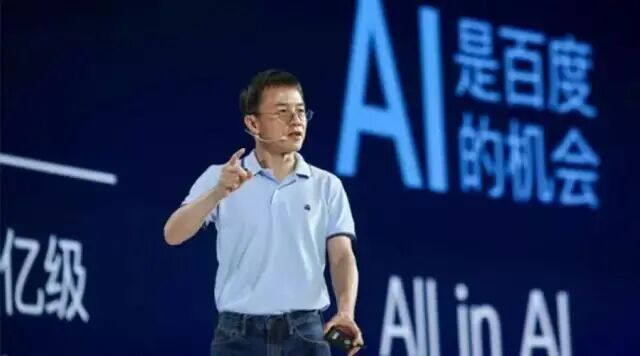
Li Yanhong made his entrance in the conference's final segment. He had set off in a self-driving car only after the conference began, with some of his on-the-road footage synchronized at the venue—a classic publicity stunt showcasing Baidu's AI prowess that even led to him receiving a traffic ticket from the Beijing Traffic Police. When he took the stage, still donning his iconic white shirt and with his fluffy, thick hair, he jogged up energetically.
Amidst the "sea of people," he seemed slightly nervous when interacting with Lu Qi. "Baidu has never hosted such a large-scale developer event." This instantly bridged the gap between him and the audience.
Throughout the conference, the word "developers" was frequently mentioned. "The success of developers is Baidu's true success." "Baidu's future is built on a win-win basis with developers." Similar phrases echoed repeatedly in Lu Qi's speech. That day, Baidu launched two major open platforms: the voice interaction system DuerOS and the autonomous driving system Apollo, opening up 60 core AI capabilities.
Li Yanhong also sought to connect with developers on a deeper level.
He shared his own story: 20 years ago, he single-handedly wrote search engine code based on hyperlinks, catching the attention of Silicon Valley internet companies. This led him to leave Wall Street for Silicon Valley, becoming a developer in the PC era. Later, he returned to China to found Baidu, with the first version of the search engine developed by just five engineers.
For the developers in the audience, this was a poignant tale. According to Li Yanhong, the PC internet once offered individual developers a low-barrier opportunity to create a new world, and now AI might recreate that magic.
Li Yanhong also expressed his "disdain" for the mobile internet era, which he felt had not brought about significant technological innovation. Many apps had built walls, confining users and limiting developers' space. Fortunately, AI had arrived—this was the era for developers.
"Openness will definitely outperform closure," he asserted confidently.
Looking back from the spring of 2026, that was actually a highly insightful speech. Besides rallying developers to embrace AI together, Li Yanhong also provided a reasonable explanation for Baidu's lag in the mobile internet era: that technology-deficient era was "unworthy" of a company like Baidu, which had always been at the forefront of technology. He echoed similar sentiments on multiple occasions later. Many claims, when repeated enough times, might gain more believers.
Li Yanhong's life had been filled with success before the mobile internet era: admitted to Peking University, studying abroad in the United States, working on Wall Street and in Silicon Valley, and returning to China to found Baidu. However, in the mobile internet era, he found himself in a passive position.
Initially, Li Yanhong chose to be a "rational" observer. He publicly questioned the business model of the mobile internet, comparing the investment frenzy around it to "drunk driving": exciting but dangerous. By the time he woke up to catch up in 2012, it was already somewhat late. In the following years, Baidu continuously made mistakes and paid the price. The $1.9 billion acquisition of 91 Wireless set a record for the highest acquisition in China's internet history at the time and became one of Baidu's most infamous "blunders."
Even so, Li Yanhong still strived to maintain an elegant and flawless public image. With a gentle and introverted personality and stable emotions, even when suddenly doused with water in public, he merely instinctively asked in English, "What's your problem?" fully embodying the grace of the earliest generation of internet elite entrepreneurs.
He once mentioned his habit of "leaving room for maneuver." In January 2018, he denied having said that Baidu would go "All in AI," emphasizing that most of the company's resources were still in relatively core businesses like search and information feeds—even if it meant "betraying" his own statement from a few months earlier at Baidu's AI Developer Conference, he chose a gentle and euphemistic way.
To some extent, this was a limitation of being a publicly traded company.
Clayton Christensen mentioned in "The Innovator's Dilemma" that large companies excel in sustained innovation but often fail in disruptive innovation because their existing customers do not need new technologies, and all internal organizational processes and values serve existing businesses. Initial profits in new markets are often unideal.
After Lu Qi proclaimed that memorable slogan, the capital market expressed concerns about Baidu's performance, worrying that it would abandon profitable businesses to fully pursue "non-core" ventures. The 2017 financial report showed that Baidu's total annual revenue was 84.8 billion yuan, with search and information feed businesses accounting for a staggering 86.2% of revenue, while the AI business was still far from generating commercial value.
Sensitivity to financial data might be ingrained in the genes of people from Shanxi. Despite being an engineer by training, Li Yanhong had never been a fanatical tech-driven founder. In 1999, he wrote in "Silicon Valley Business War": "Just having the best technology does not necessarily guarantee the greatest impact; technology and business must be combined and must be recognized by the market."
This seemed to reflect Li Yanhong's attitude toward AI developers as well: technological ideals were important, but commercialization was the starting point and endpoint of all considerations.
PART 02
The Lone Star Figure
Lu Qi worked at Baidu for only 16 months, but the Baidu AI Developer Conference has continued as a regular event to this day, merely being renamed Create Baidu AI Developer Conference in 2021 (Note: hereinafter referred to uniformly as Baidu AI Developer Conference).
However, it has never replicated the open, technologically idealistic atmosphere of the first conference, gradually becoming a routine tech exhibition conference for tech companies, with the more important mission of selling products to commercial clients. Meanwhile, no figure like Lu Qi has emerged again.
Li Yanhong became the sole star figure on stage.
The outside world continued to evolve. The AI boom sparked in 2016 eventually fizzled out due to limited commercial scenarios, and Baidu once again found itself back in the mobile internet battlefield it once "disdained," targeting ByteDance and attempting to catch up in short videos, live streaming, and e-commerce. Fortunately, it never gave up on AI. Thus, when ChatGPT brought a new wave of AI narratives, Baidu became the first domestic company to unveil a comparable product, quickly returning to the AI battlefield.
Amidst these fluctuations, other speakers at Baidu's AI Developer Conference also changed, providing an observation window into Baidu's oscillations amid AI paradigm shifts.
Public information shows that over the eight years from 2018 to 2025, Wang Haifeng was one of the executives who partnered with Li Yanhong in speeches at Baidu's AI Developer Conference most frequently. He joined Baidu in 2010 and became the company's second CTO in history in 2019. He was also the first Chinese president of ACL and had been shortlisted three times for membership in the Chinese Academy of Engineering, possessing strong technical capabilities. Li Yanhong once praised him as an "excellent representative of Baidu's simple and reliable culture."
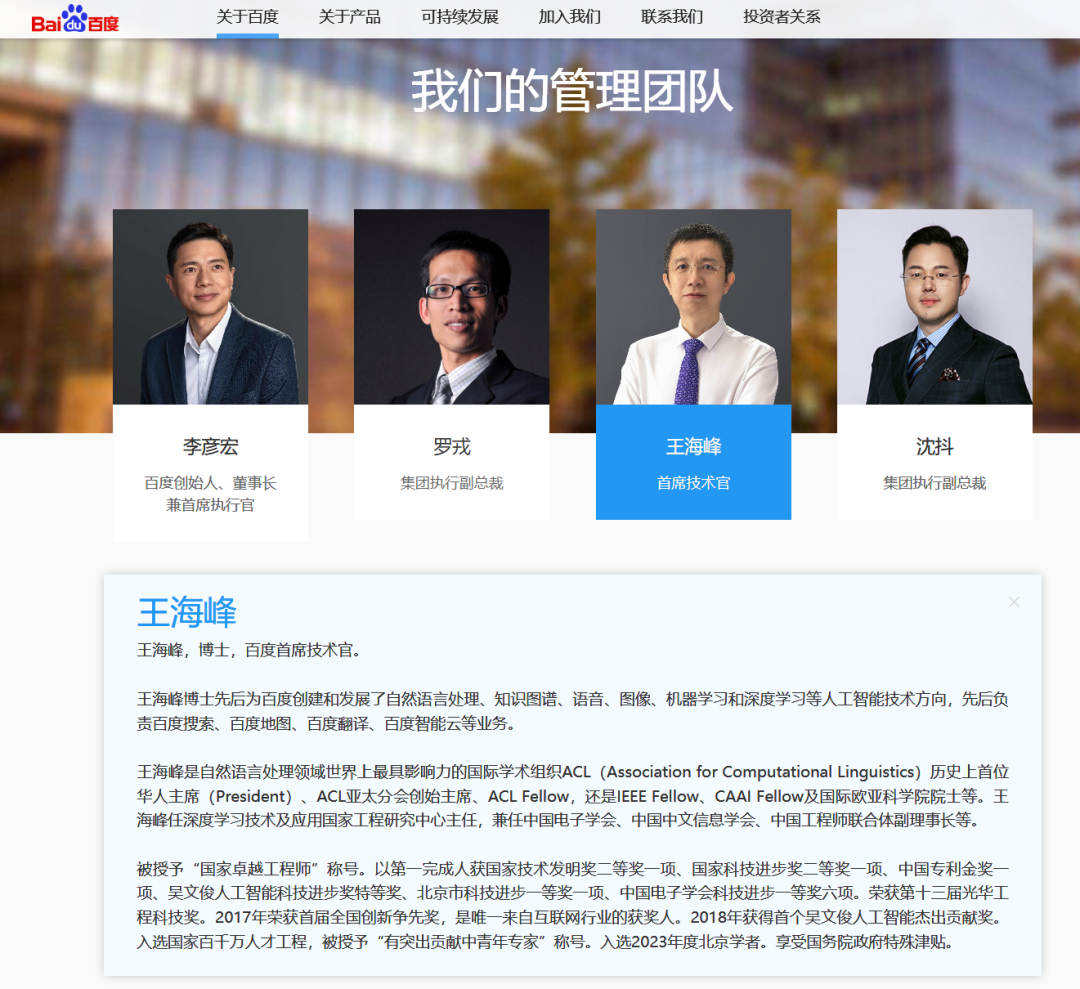
Wang Haifeng's introduction on Baidu's official website
However, this loyal Baidu executive was marginalized in the organizational restructuring in November 2025. Baidu established new Basic Model R&D and Applied Model R&D departments, bypassing CTO Wang Haifeng and reporting directly to CEO Li Yanhong.
Clearly, Li Yanhong was also dissatisfied with Baidu's AI progress. "Arriving early but catching up late" had become the industry consensus on Baidu's AI business. In the domestic AI competition arena, Alibaba and ByteDance had emerged as a dominant duo, with Baidu falling behind in almost every aspect—just like its predicament in the mobile internet era.
Reference: Baidu's AI Ambitions Drowned in the Fires of ByteDance and Alibaba
Take ERNIE Bot as an example. It was the first domestic product comparable to ChatGPT, yet current third-party statistics show its monthly active users are only a fraction of Doubao's. As the first domestic advocate of "application is king," Li Yanhong might be holding his breath. Furthermore, on April 22nd, it was reported that Tesla China's infotainment system would integrate Doubao's large model and DeepSeek, dealing another heavy blow to Baidu—such collaborations held significant commercial value and symbolic importance.
Besides Wang Haifeng, some executives who once spoke at Baidu's AI Developer Conference have left the company. This is a star-studded list: Zhang Yaqin, Jing Kun, and Li Zhenyu. Zhang Yaqin, as President, was responsible for Baidu's cloud computing, autonomous driving, and quantum computing businesses; Jing Kun was the "father of Xiaodu"; and Li Zhenyu was considered the soul of Apollo. Their reasons for leaving varied, but they generally conflicted with Li Yanhong's strategic direction.
Currently, at Baidu without a "second-in-command," Shen Dou, the young Executive Vice President, holds the highest reputation. Born in 1979, he joined Baidu in 2012 and has successively overseen businesses like MEG (Mobile Ecosystem Group) and ACG (Intelligent Cloud), once being praised by Li Yanhong as having "strategic vision, daring to fight tough battles, and capable of winning them." The ACG department he manages brought Baidu approximately 20 billion yuan in AI cloud infrastructure revenue in 2025, a 34% year-on-year increase.
According to the official agenda, Shen Dou will deliver a keynote speech at this year's AI Developer Conference, marking his third consecutive appearance.
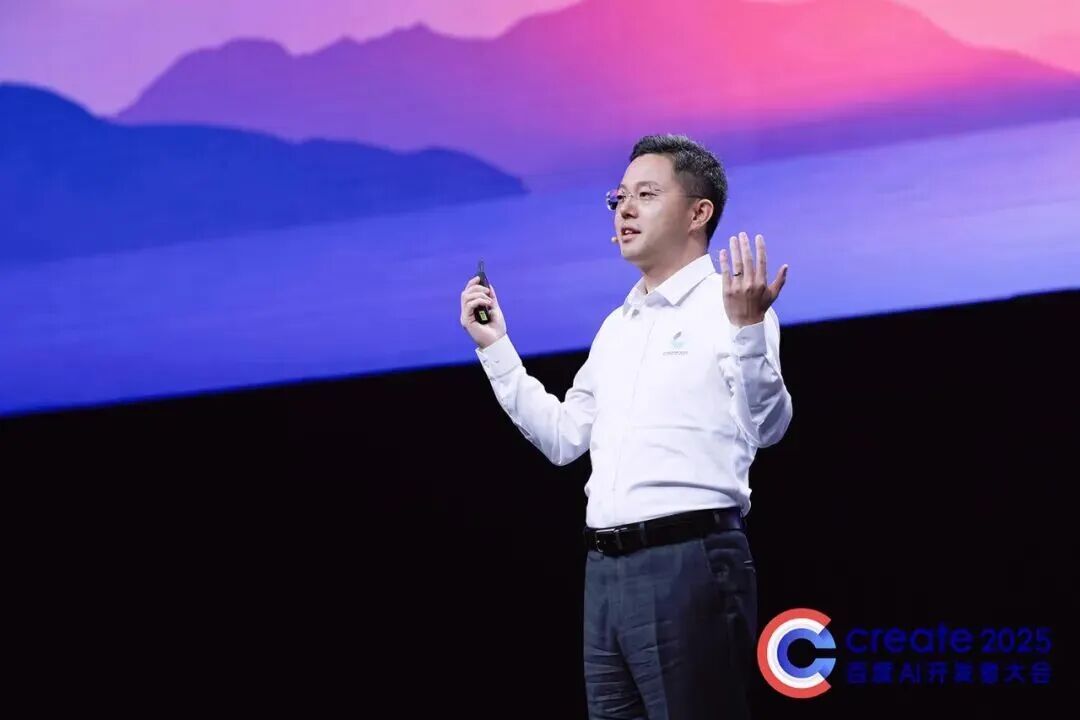
Shen Dou speaking at Create 2025 Baidu AI Developer Conference
However, from a business perspective, Baidu Intelligent Cloud still has significant room for growth.
Cloud computing was another business Li Yanhong had once looked down upon. While Jack Ma decided that cloud computing was worth pursuing immediately, Li Yanhong dismissed it as "old wine in new bottles." By the time Baidu truly entered the market, Alibaba Cloud had already been operating for six years. In fiscal year 2025, Alibaba Cloud's revenue exceeded 110 billion yuan, firmly ranking first in the industry.
A significant portion of Alibaba Cloud's revenue comes from global developers. Alibaba Cloud's logic is "model as a service, developers as the gateway." It acquires customers through open-source models, then meets developer demands with tools and cloud services to generate revenue, forming an ecological closed loop. Currently, the cumulative downloads of Alibaba Cloud's Qwen series open-source models globally have approached 1 billion, accounting for over 50% of the global market share—hence the controversy surrounding the departure of its technical leader, Lin Junyang.
In contrast, although Baidu has achieved full-stack self-research in chips-frameworks-models-applications, it has not yet established an absolute leading advantage in any link, preventing the flywheel effect from manifesting. This largely limits the growth potential of Baidu's Intelligent Cloud business and makes Baidu's narrative around its AI developer ecosystem seem less solid.
According to official data, Baidu's PaddlePaddle has 23.33 million developers, serves 760,000 enterprises, and has created 1.1 million models. ERNIE Bot's average daily API calls reached 1.65 billion in Q4 2024. These numbers look promising.
However, from a global developer perspective, the narrative changes.
Up to now, Baidu has star products such as PaddlePaddle on GitHub, which has garnered over 70,000 stars. However, its core capabilities still primarily center around single-point technologies, including AI deep learning, OCR, and natural language processing. Among Chinese companies active in GitHub, the world's largest developer community, Alibaba stands out prominently. It boasts a greater quantity and diversity of open-source projects, ranking first among Chinese companies in terms of total stars and star projects. The Qwen series is extensively utilized as a base model by developers worldwide, showcasing extremely high ecological activity.
Li Yanhong still has a long way to go to become the "king" in the hearts of global AI developers, much like the gap between an ordinary person and a legendary figure.
PART03
Magical Era
Globally, the prototype of developer conferences first emerged in Silicon Valley in 1975. The Homebrew Computer Club, a gathering place for geeks, hosted bi-weekly meetings in a garage, with Steve Jobs and Steve Wozniak as regular attendees. Exchange and sharing were the sole focus, as they firmly believed that all information should be freely accessible.
After attending one such gathering, Wozniak returned home and began designing the Apple I. Consequently, Steven Levy wrote in his book Hackers: Heroes of the Computer Revolution that the Homebrew Computer Club played a more pivotal role than any other event in catalyzing the personal computer revolution.
Of course, such utopian gatherings are often challenging to sustain over the long term. It was Apple's success that truly established developer conferences as a standard feature of tech companies. Apple held its first WWDC in 1983 and has since hosted it annually, making it a globally anticipated tech event akin to the "Spring Festival Gala" of the tech world.

Steve Jobs teasing IBM at the first WWDC
As Apple has consistently been an industry leader, developers need to glean insights into changes and opportunities from its events.
Since the launch of the App Store in 2008, Apple has cultivated a massive developer ecosystem. As of 2025, Apple boasts over 35 million registered developers globally, with a cumulative total of over 50 million apps. Developers have earned over $550 billion in cumulative revenue from Apple. It can be said that Apple has built the developer platform with the highest global monetization efficiency.
Steve Jobs elevated the value of WWDC with his presence and contributions.
He created many iconic moments. For instance, in 1997, after ending his 12-year entrepreneurial journey, he returned to Apple to take over the near-bankrupt company. People expected answers about Apple's future from WWDC.
Jobs did not disappoint. Amid an atmosphere of unease, the 42-year-old appeared in his signature black turtleneck and jeans, looking composed yet weathered. He arranged an impromptu Q&A session lasting over an hour, directly addressing questions from developers on-site—a moment later dubbed the "Legendary Q&A" by the industry.
He candidly admitted, "Apple has had its head in the sand these past years." This display of vulnerability instead boosted confidence among developers. Clear signals were sent: Apple needed developers, Apple would continue building platforms, and Microsoft would keep developing Office for Mac.
After stabilizing confidence among developers and investors, in May 1998, Jobs personally oversaw the release of the iMac G3 following his return. By year-end, sales exceeded 800,000 units. That year, Apple's stock price surged by 211%. A new narrative began.

Steve Jobs and the iMac G3
Admitting to being behind and making mistakes essentially declares a determination to change.
Similar scenes have never occurred at Baidu's AI Developer Conference. Speakers, including Robin Li, always emphasize Baidu's strength and leadership. Domestic developer conferences are essentially "sales conferences," where organizers need to prove their products are worth buying. Narratives of weakness clearly offer little help.
The most memorable moment at WWDC was probably when Jobs unveiled the iPhone 4 at the 2010 event and declared, "It's magical." The world did indeed undergo some magical changes as a result. Later, even after Apple became the world's most profitable company, people still anticipated WWDC—a nostalgia and expectation for the Magical Era.
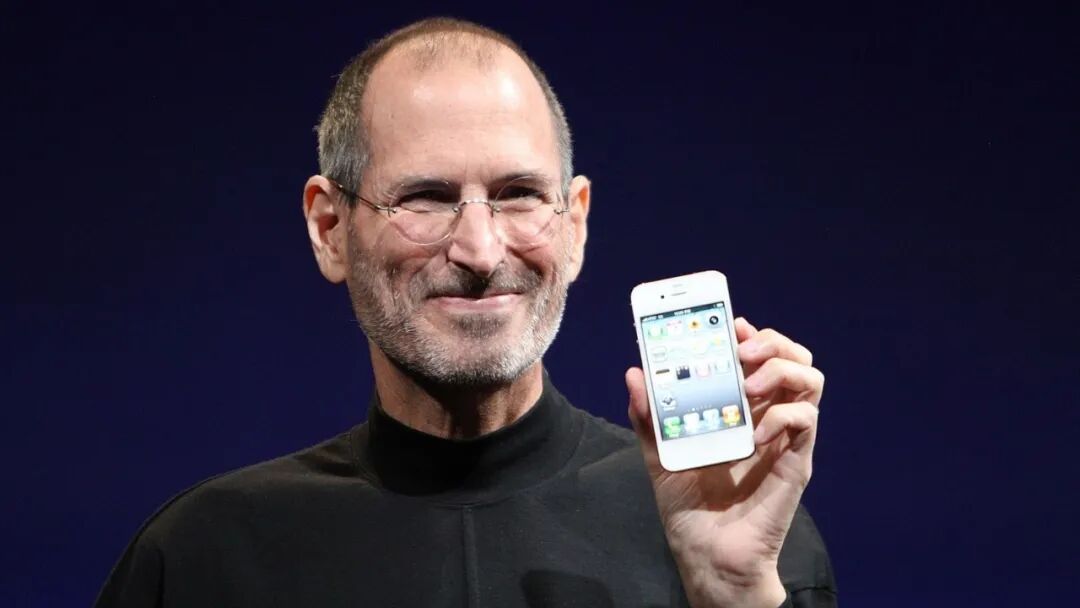
WWDC 2010: Steve Jobs unveils the iPhone 4
Robin Li has also had many iconic moments at Baidu's AI Developer Conference. Some judgments showcased his technical acumen, such as his early emphasis on the importance of AI applications and agents, while others revealed inconsistency. For example, in 2024, he claimed at the Create conference that "closed-source models will continue to lead in capabilities, while open-source models will increasingly lag behind," later even asserting that "open source is a tax on IQ." However, open-source models like Meta's Llama 3, DeepSeek, and Tongyi Qianwen soon rose to prominence, rapidly attracting users with their free and high-performance offerings. Baidu had to follow suit, announcing the open-sourcing of its Wenxin 4.5 series in February 2025.
From mobile internet and cloud computing to open-source models, these three "self-contradictory" technical judgments stand as career blemishes for Li.
However, objectively speaking, Li's judgments have been highly forward-looking.
He was the first Chinese internet company founder to recognize the potential of deep learning and artificial intelligence. In 2013, Baidu established a deep learning research institute in the U.S., three to five years ahead of Alibaba and Tencent. From Apollo, PaddlePaddle, Kunlun Core to Wenxin Large Models, Baidu has been an early mover.
In terms of talent, while Alibaba, ByteDance, and Tencent are now heavily recruiting globally, Baidu was actually the "pioneer."
In 2014, it recruited "father of Google Brain" Andrew Ng as chief scientist. Ng's Baidu Silicon Valley AI Lab (SVAIL) once employed Dario Amodei, who later moved to Google and OpenAI and is now best known as the founder of Anthropic. Foreign media reported that one reason for his departure was that the team's increasingly valuable achievements sparked internal conflicts. "Power interventions from China triggered talent exodus and lab dissolution."
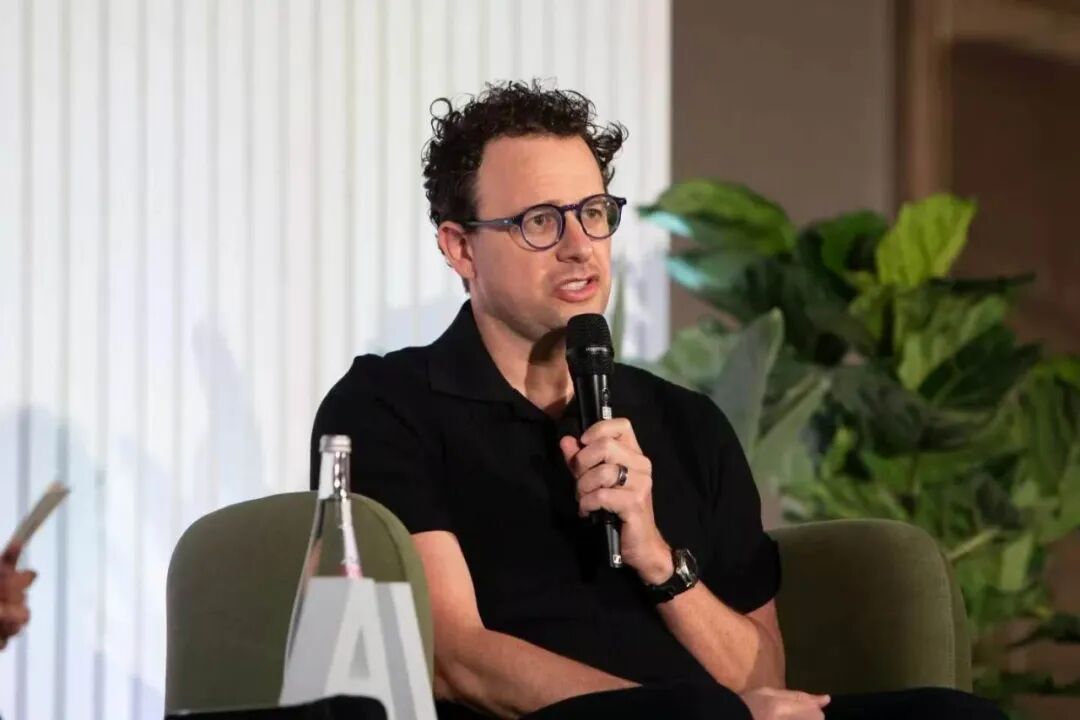
Anthropic founder Dario Amodei
Andrew Ng ultimately worked at Baidu for only three years. His departure coincided with the arrival of Lu Qi, marking Baidu AI's transition from laboratory research to commercialization.
"Baidu's strategy is to announce a new rocket every three years," commented a former IDG (Intelligent Driving Group) employee, referring to Baidu's frequent shifts in focus. Similar inconsistencies have occurred at multiple stages of Baidu's development, hindering Li's ability to translate technical insights into tangible company achievements.
One result is that Baidu's AI Developer Conference rarely produces genuine Magical Moments. Just as people rarely recognize youth while experiencing it, Magical Moments are often only recognized later, validated by subsequent stories and sufficient time. Even the iPhone 4 faced controversy over signal issues due to its metal frame upon release; its epochal status emerged only after it truly transformed the market.
Of course, Baidu always finds reasonable explanations.
In his 2025 internal letter marking Baidu's 25th anniversary, Li stated: "Baidu has always been at the technological frontier, which means taking greater risks and accepting higher failure rates than peers. But Baidu is willing to endure solitude, tolerate misunderstanding and even disdain from others, continuously learn from mistakes, swiftly adjust direction, and start anew."
However, when a company restarts too many times, people easily lose sight of and forget its original purpose. The company itself might forget too.
Baidu was once a very cool company, attracting many young people with technical ideals. Wang Xiao, who joined Baidu's founding team in 2000, was still a third-year graduate student at Beijing University of Posts and Telecommunications. He recalled the atmosphere back then: the team often programmed to the point of self-forgetfulness, looking up to find it dark, then looking up again to find it dawn, completely losing track of time. Hand-coding to create a new world—that was the purest joy for developers.
The importance of developers has already been proven by Microsoft.
This traditionally closed tech giant was once seen as an enemy of open source. Former CEO Steve Ballmer even called Linux "a cancer" because the free and open-source model directly threatened Microsoft's software and operating system sales. But after Satya Nadella took over in 2014, Microsoft quickly pivoted: gradually opening its cloud platform, open-sourcing many self-developed technologies, and acquiring GitHub for $7.5 billion in 2016 to further enhance its developer ecosystem.
Serving developers, guiding them to consume Azure, generating cloud revenue, and continuously acquiring users through open source—this flywheel model transformed Microsoft from a product seller to an ecosystem seller. Ten years after Nadella's appointment, Microsoft's market cap surged from about $300 billion to about $3 trillion. Azure's revenue also grew from virtually zero in 2014 to $100 billion annually by 2025.
A key metric in this flywheel is that GitHub now has over 100 million active developers. This sufficiently large developer ecosystem provides a foundation for Microsoft's ongoing narrative.
Baidu lacks such a "treasure trove."
After more than a decade, Baidu AI has accumulated many technical assets: Apollo Go has become one of the world's largest Robotaxi platforms, Kunlun Core is preparing for an IPO, and so on. Yet to this day, when discussing Baidu's AI moat, many people have no answer—much like their vague impression of Baidu's AI developer ecosystem.
In May, during Beijing's brief and beautiful late spring, Robin Li will again speak at the 2026 Create conference. This marks the 57-year-old's 10th appearance at the event.
To some extent, his consistent presence and willingness to risk making controversial technical judgments deserve respect. Among internet company founders who started businesses in his era and remain active on the frontlines while paying attention to the latest technologies, there seems to be no second example. Zhang Chaoyang is immersed in the joy of being a physics teacher, Jack Ma has retired behind the scenes, and Pony Ma remains as consistently low-profile as ever.
In the real world, this spring has seen unprecedented AI anxiety grip humanity. Yet Li, who speaks annually without fail, remains one of the few certainties in this uncertain era.
As long as he remains present, the light of hope will never extinguish.
-
![]()
Tesla Restructures Its Balance Sheet
-
![]()
Accelerating the High-Speed Interconnection Upgrade of AI Computing Clusters! JONHON Releases ELSFP External Light Source Optical Connectors
-
![]()
Breaking the overseas blockade of volumetric holographic materials, this optical enterprise secures nearly 100 million yuan in financing!
-
![]()
Why Does Jensen Huang So Openly Praise China’s AI?
-
![]()
"Wudang" Unveiled: Arm China's Next-Gen AI VPU Redefines Video Encoding
-
![]()
From Energy Conservation and Carbon Reduction to AI Decision-Making: GECON East Intelligence and Chery Group Explore a New Green and Smart Paradigm for Automobile Manufacturing
-
![]()
WAIC 2026 Observation | AI Accelerates Towards the Core of Industries, Industrial AI Enters a Critical Phase
-
![]()
Volkswagen China Fires the First Shot in Foreign-Funded 'White Box Delivery'!