Is SpaceX Planning to Step Away from the Space Industry?
 04/28 2026
 409
409
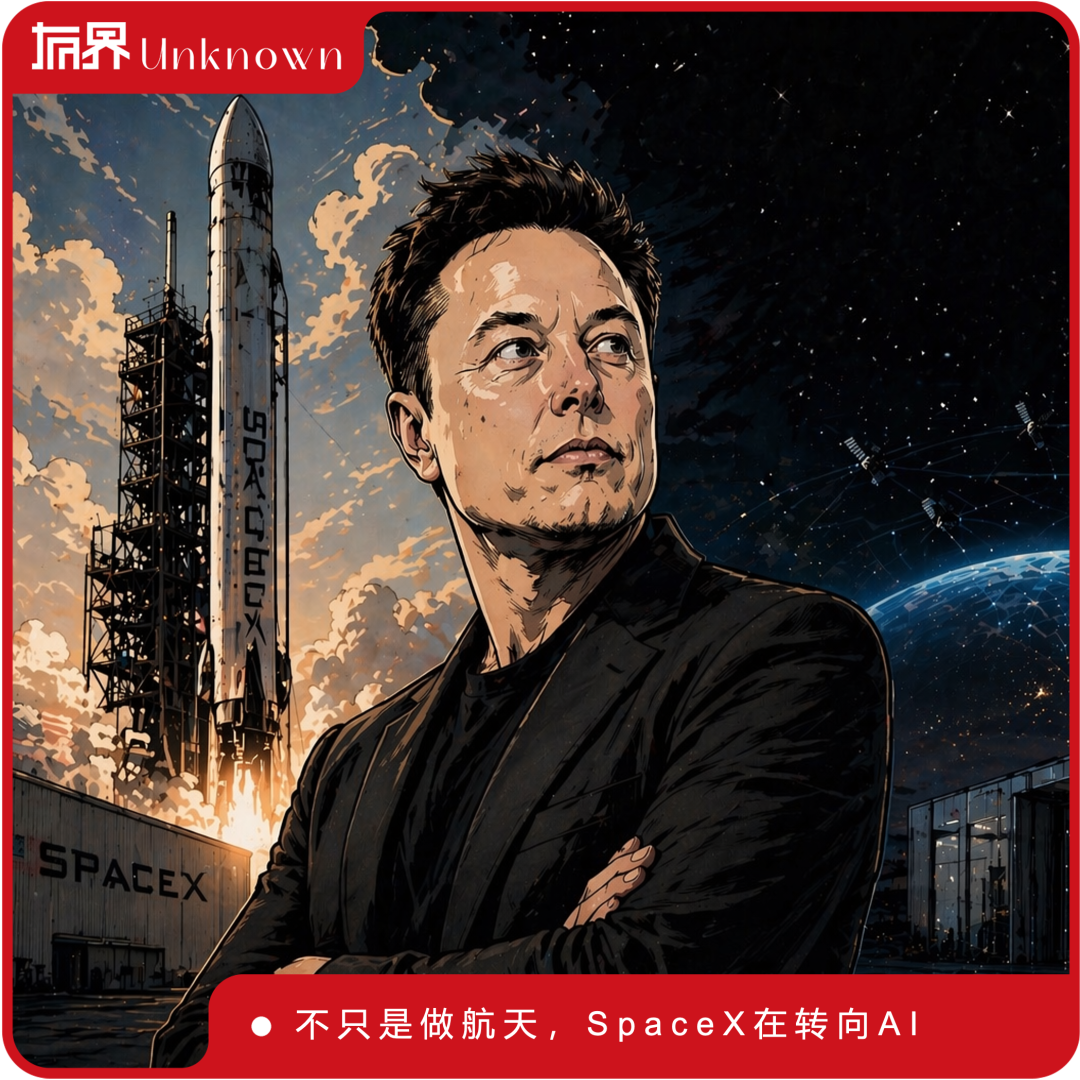
Photo by ChatGPT
It's widely known that SpaceX is poised to go public this year, and a flurry of news has emerged on this front lately.
For instance, regulatory filings indicate that SpaceX perceives greater opportunities in the artificial intelligence (AI) sector compared to the space industry.
According to SpaceX's assessment, the total addressable market (TAM) across all its business ventures is roughly $28.5 trillion, with the AI segment accounting for a staggering $26.5 trillion, or 93% of the total.
What does this imply?
In essence, SpaceX's judgment suggests that the lion's share of the markets it can tap into in the future will stem from AI-related domains.
To put it more candidly, SpaceX is redefining its corporate identity: it no longer views itself solely as a space exploration company. Reusable rockets? Starlink? These are now considered secondary ventures. Looking ahead, SpaceX aspires to be an "infrastructure provider for the AI era."
Fundamentally, SpaceX has proactively reshaped its corporate persona.
This strategic shift is somewhat driven by necessity. As one of the most anticipated initial public offerings (IPOs) to date, with a target valuation hovering around $1.75 trillion, SpaceX faces sky-high market expectations. However, its existing business lines alone are unlikely to justify such lofty valuation projections.
Despite SpaceX's current leadership in reusable rockets and satellite internet, its growth is hampered by market size limitations, which constrain even the most cutting-edge technologies and grandiose visions.
Consider the following data:
In 2025, there were approximately 330 orbital rocket launches worldwide, with SpaceX accounting for 166, or more than half of the total.
In the satellite internet realm, Starlink also reigns supreme. According to a report by Ookla in early 2026, Starlink represents about 97% of global satellite internet speed test samples. Even when focusing solely on household broadband, Starlink commands a 72% market share.
In other words, SpaceX isn't just leading the pack—it has essentially hit the current market ceiling.
But what about its revenue?
According to Reuters, SpaceX's total revenue in 2025 was approximately $15 billion to $16 billion, with Starlink contributing about $11.4 billion. While substantial, this figure pales in comparison to the valuation expectations it faces.
Based on SpaceX's 2025 revenue, its price-to-sales (PS) ratio approaches 100x. In contrast, most infrastructure or telecommunications companies typically trade at single-digit multiples, while high-growth tech firms usually range from the low to mid-double digits.
This discrepancy clearly cannot sustain the narrative of the largest IPO in history.
But there's no need to panic—after all, Musk is a masterful storyteller.
What if SpaceX isn't primarily an aerospace or satellite internet company, but rather an AI company?
AI is currently experiencing a boom, but it grapples with significant challenges, such as a shortage of computing power.
Users of AI applications have likely observed that popular services like ByteDance's Seedance are continuously raising prices, even at the risk of alienating long-time users. Overseas, OpenAI had to shut down Sora to conserve computing resources...
The escalating cost of computing power isn't solely attributable to chips—it's also driven by data center expenses, including electricity, water, land, and more.
But what if these resources were relocated to space? Theoretically, space offers an ideal environment: abundant and stable solar energy, far more efficient than ground-based sources; no land constraints; and temperatures conducive to cooling...

▲ NASA satellite image, source: UnSplash
From this vantage point, many of the challenges currently plaguing AI could potentially be resolved in space.
However, don't get too carried away—these are merely the narratives that Musk and SpaceX intend to weave. In reality, implementing this vision is fraught with challenges.
AWS CEO Matt Garman publicly stated this year that orbital data centers remain "far from reality," citing key obstacles such as rocket capacity, launch costs, and long-term maintenance, which render them economically unviable.
There are also technical hurdles to overcome.
The most immediate issue is latency.
For instance, geostationary orbit is about 35,786 kilometers above Earth, resulting in a one-way latency of approximately 120 milliseconds—a critical drawback in an era increasingly focused on speed.
Another challenge is heat dissipation.
While space is cold, servers still generate heat. Without air or other media for conduction, servers must rely on radiation for cooling, which is highly inefficient. New cooling methods must be developed to suit this unique environment.
These are just a few representative challenges; the actual hurdles are far more numerous. Thus, Musk and SpaceX's space-based narrative remains tenuous.
But does it really matter? From Tesla to SpaceX to brain-machine interfaces, many of Musk's past ventures seemed far-fetched initially. Yet, they have steadily progressed and even gained market acceptance.
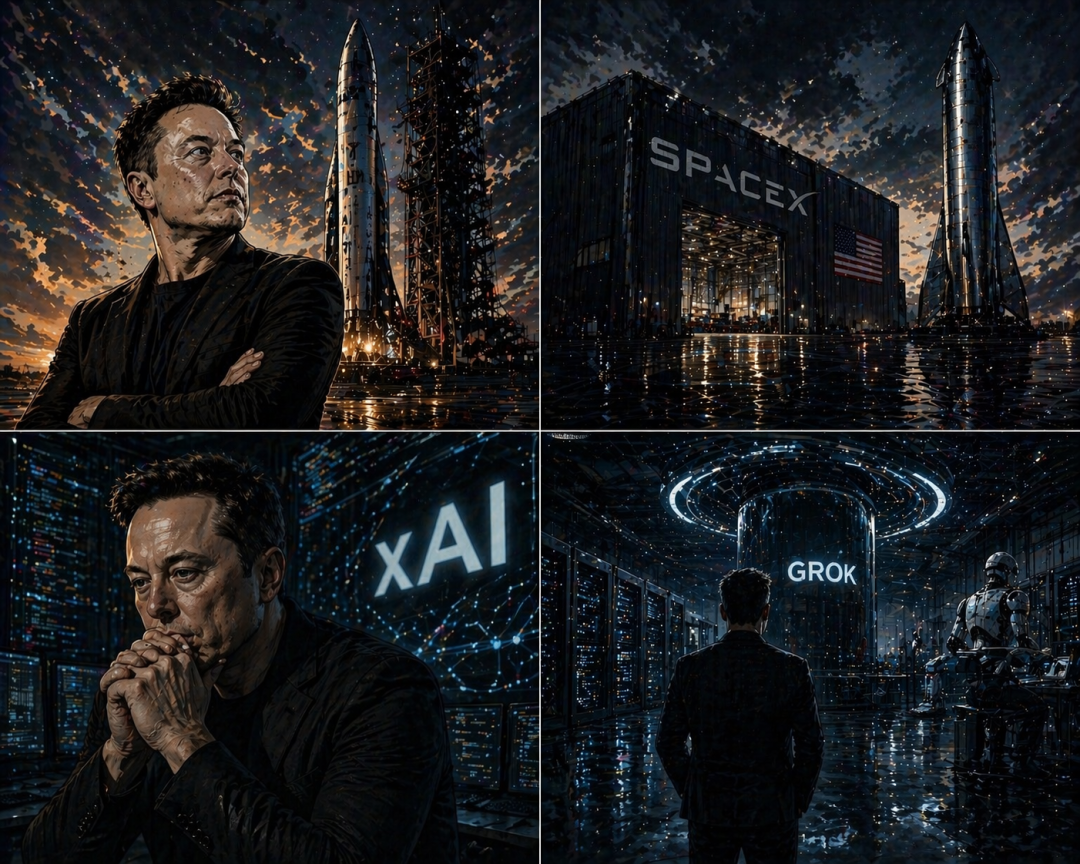
▲ Image source: ChatGPT
Within this context, SpaceX's pivot to AI isn't something that will wait for full technical maturity. In fact, Musk has been laying the groundwork since early 2025.
On one front, there's a reallocation of resources.
For instance, recent IPO filings reveal that SpaceX invested approximately $12.7 billion in AI-related fields in 2025, surpassing the combined spending on aerospace and communications.
Meanwhile, the company's debt has surged—from about $14 billion the previous year to approximately $23 billion by the end of 2025. Much of this new debt stems from leasing arrangements with Valor Equity Partners, primarily to support xAI's chip and AI infrastructure needs, with about $4.5 billion recorded on the balance sheet.
On another front, Musk's AI ecosystem is taking shape.
In March 2025, Musk merged xAI with X (formerly Twitter). This move granted xAI access to X's data and distribution capabilities, enabling it to form a closed loop of "data—product—user feedback" through a high-frequency social platform. Today, it's common to see users on X tagging @Grok for answers.
By February 2026, SpaceX had acquired xAI. No longer just an AI model company, xAI was integrated into a larger platform combining "AI + satellite communications + space infrastructure." The goal was clear: to unify Musk's ambitions in AI and space for greater synergy.
SpaceX disclosed plans to acquire Cursor later that year for $60 billion or pursue a deep collaboration worth $10 billion to develop an AI system for programming and knowledge work, competing with OpenAI and Anthropic.
Cursor is one of the world's leading AI programming startups, boasting strong competitiveness in AI-driven coding.
AI programming is one of the most mature and commercially viable AI applications today, a key focus for OpenAI and Anthropic. Compared to its rivals, xAI still lags in this area, making acquisitions or partnerships a logical step.
Thus, by integrating his various companies, Musk has quietly crafted a grand business narrative unlike any other.
Aerospace, AI, and potentially future ventures in energy, robotics, and autonomous driving are no longer isolated businesses but part of a unified system.
This integration not only expands boundaries but also strengthens control. From another perspective, it resembles a concentration of power—key resources, technologies, and infrastructure are brought under a single umbrella.
This approach isn't without controversy. Greg Brockman has publicly expressed concerns about Musk's pursuit of absolute control. In his view, technologies like OpenAI are meant to benefit humanity broadly, not be dominated by a single individual—regardless of who that person is.
However, Musk appears to follow a different logic: rather than play by old rules, he prefers to rewrite them.
In this sense, he's not just integrating businesses—he's reorganizing critical capabilities. Whether this concentration leads to efficiency or risk remains to be seen.
* Images sourced from the internet
- END -
-
![]()
Tesla Restructures Its Balance Sheet
-
![]()
Accelerating the High-Speed Interconnection Upgrade of AI Computing Clusters! JONHON Releases ELSFP External Light Source Optical Connectors
-
![]()
Breaking the overseas blockade of volumetric holographic materials, this optical enterprise secures nearly 100 million yuan in financing!
-
![]()
Why Does Jensen Huang So Openly Praise China’s AI?
-
![]()
"Wudang" Unveiled: Arm China's Next-Gen AI VPU Redefines Video Encoding
-
![]()
From Energy Conservation and Carbon Reduction to AI Decision-Making: GECON East Intelligence and Chery Group Explore a New Green and Smart Paradigm for Automobile Manufacturing
-
![]()
WAIC 2026 Observation | AI Accelerates Towards the Core of Industries, Industrial AI Enters a Critical Phase
-
![]()
Volkswagen China Fires the First Shot in Foreign-Funded 'White Box Delivery'!