The AI Fortune Dream Crumbles in Singapore: The Enigma Even Zuckerberg Can't Solve
 04/30 2026
 587
587
Produced by | RoboIsland
In the business realm, the most costly setback isn't failure itself, but the agony of near-victory.
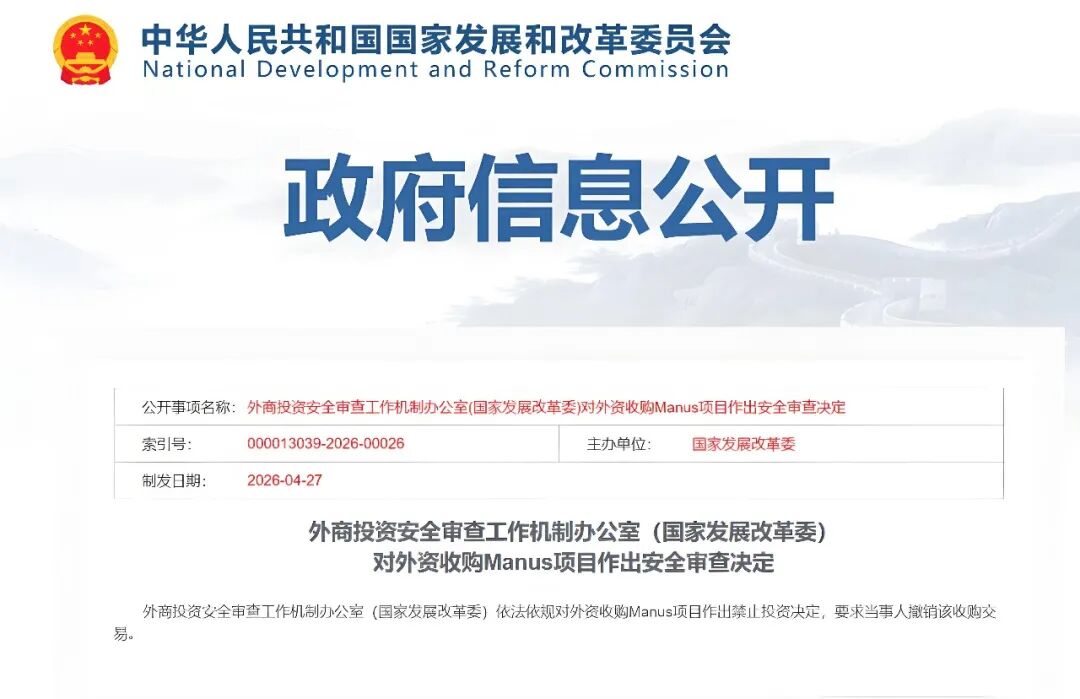
US$2 billion (RMB 14 billion), a founder barely out of his twenties, a Silicon Valley behemoth, a deal sealed at breakneck speed, abruptly halted by regulatory edict.
Every facet of this saga taps into the most electrifying and sensitive nerve of our era.
Just months ago, insiders were raising glasses on social media, lauding it as the ultimate playbook for Chinese AI ventures to go global and cash in. Months later, that playbook lies in tatters, transformed into a cautionary tale etched in stone.
Many dismiss this as the inevitable fallout of geopolitical rivalry, a grand narrative stacked upon itself.
Focus solely on "national security," and you'll miss the true iceberg lurking beneath.
Because regulatory action seeks to dismantle an ecosystem: a business model that treats China's technological prowess as an ATM for foreign investors.
The suspension of Manus' acquisition may appear as a regulatory red line on the surface, but at its core, it heralds a seismic shift in business logic.
It marks the end of an era without rules: routes of skirting regulations through shell entities or cashing out via relocation are now relics of the past.
I. Three Months of Lightning-Fast 'De-Sinicization'
Revisiting Manus' meteoric rise and fall, many fixate on the final "red card," overlooking the capital maneuvers that preceded it.
Born in the labs of Wuhan and Beijing, Manus leveraged China's engineering talent and domestic scenario data to burst onto the scene in March 2025.
Astonishingly, just three months after going viral, the company embarked on a "de-Sinicization" blitz: relocating its headquarters to Singapore in June 2025, massively laying off 80 domestic staff in July, purging Chinese social media, and blocking Chinese IP access to its official website.
In Silicon Valley legal parlance, this is termed "Singapore Washing."
The rationale is straightforward: to secure dollar capital led by Benchmark, it must bypass U.S. investment reviews of Chinese AI through shell entities; to sell to Meta, it must legally sever ties with China.
It was a clever escape route through the U.S.-China thicket.
But this capital sleight of hand, so effective on Wall Street and in Silicon Valley, overlooked a Chinese proverb: "The monk may escape, but the temple cannot."
This regulatory move cut through the shell game, tracing origins to the core: Where was your foundational code written? Where did your core team develop? Where did your raw data originate?
As industry lawyers note, Manus completed its 0-to-1 technological closed loop in China, then shifted core operations overseas through related entities—not normal offshore structuring, but regulatory-evading "bathing-style globalization."
The National Development and Reform Commission's investment ban sends a clear message: shell games don't evade regulation. Technological origins can't be laundered through legal smokescreens.
II. Code May Roam, But Control Must Stay
Viewing this suspension merely as a data or tech export control issue underestimates its strategic weight.
Many initially assumed the review would be Commerce Department-led, focusing on tech imports/exports.
But the final blow came from the Foreign Investment Security Review Mechanism Office, targeting a more fundamental legal interest: national security reviews protect not just individual technologies but overall control and sovereignty in critical sectors.
What is Manus? A general-purpose AI Agent—a digital worker capable of autonomous planning, tool orchestration, and complex task execution.
In AI's future ecosystem, Agents are like operating systems in the mobile internet era—the action gateway connecting users, models, data, and the physical world.
Imagine if, after acquisition, a Chinese-incubated AI company with deep user insights and engineering capabilities became part of a U.S. tech giant's super-intelligence lab. Meta wouldn't just get code, but a complete methodology for grounding large models in real-world actions—a battle-ready Chinese team replicable in Silicon Valley.
What China prohibits is not asset trading under legal shells, but the outflow of capability-level technological control.
Amid intensifying tech decoupling, China now explicitly defines cutting-edge AI Agent capabilities as strategic assets that must remain firmly in domestic hands.
China can nurture you with its market, but won't tolerate you switching allegiances after growth to become a pawn in others' ecosystems.
III. AI Capital Narratives Must Choose Sides
Founders planning global exits via "China to Global" strategies for high-premium exits suddenly find their golden highway blocked by a thick wall.
Once, AI entrepreneurship in China followed a flawless script: leverage domestic engineering talent and scenario advantages to refine products, then after impressive data, don a "foreign coat" in Singapore or the Cayman Islands, secure Silicon Valley strategic investment/acquisition, and achieve financial freedom for founders and dollar capital exit.
When Manus announced its Meta acquisition in late 2025, envy trumped national security concerns—envy for ZhenFund's 100x return, envy for Xiao Hong becoming a Meta VP in his 30s.
Now, that script lies shredded.
Our era has fundamentally changed. Global tech increasingly splits into two parallel worlds. AI competition between China and the U.S. is no longer mere business rivalry but a "clash of destinies" shaping the next century.
In this context, any middle ground becomes perilous. Exploiting China's market while seeking U.S. capital premiums is dangerous opportunism.
Future AI firms must learn to survive amid certainty.
Either become a purebred international company from day one—complete foreign ownership, overseas R&D, and supply chains—with no substantive ties to China's tech ecosystem; or take root in China, leveraging its industrial base and market depth, aligning with national strategies to forge a Chinese path to AI within compliance frameworks.
Hedging both ways guarantees losing on both fronts.
IV. Epilogue
Zuckerberg probably can't fathom why China intervenes in buying a company already relocated to Singapore.
Xiao Hong, beside his champagne toast four months ago, likely never imagined that his official website declaration—"Manus is now part of Meta"—would become the most awkward self-own in global tech history.
Manus' US$2 billion fortune dream shattered, but the industry gained clarity.
It strips away the fig leaf of free capital flow, revealing that in an era of awakening tech sovereignty, any capital speculation bypassing national will is but a fleeting dream.
Henceforth, AI narratives are no longer fairy tales of prodigies backed by Silicon Valley reaching life's pinnacle. They're about national will and industrial backbone.
That red card ended an era of lawless opportunism. When the dust settles, a new dawn begins.
© RoboIsland. All rights reserved. No reproduction without authorization.
-
![]()
Tesla Restructures Its Balance Sheet
-
![]()
Accelerating the High-Speed Interconnection Upgrade of AI Computing Clusters! JONHON Releases ELSFP External Light Source Optical Connectors
-
![]()
Breaking the overseas blockade of volumetric holographic materials, this optical enterprise secures nearly 100 million yuan in financing!
-
![]()
Why Does Jensen Huang So Openly Praise China’s AI?
-
![]()
"Wudang" Unveiled: Arm China's Next-Gen AI VPU Redefines Video Encoding
-
![]()
From Energy Conservation and Carbon Reduction to AI Decision-Making: GECON East Intelligence and Chery Group Explore a New Green and Smart Paradigm for Automobile Manufacturing
-
![]()
WAIC 2026 Observation | AI Accelerates Towards the Core of Industries, Industrial AI Enters a Critical Phase
-
![]()
Volkswagen China Fires the First Shot in Foreign-Funded 'White Box Delivery'!