From '60,000 Yuan Daily Pay' to 'Top Talents Returning to the Job Market': Has the Heyday for Short Drama Actors Faded?
 04/30 2026
 793
793
On April 29, the topic of 'top short drama stars returning to the job market' surged on Weibo's trending list.
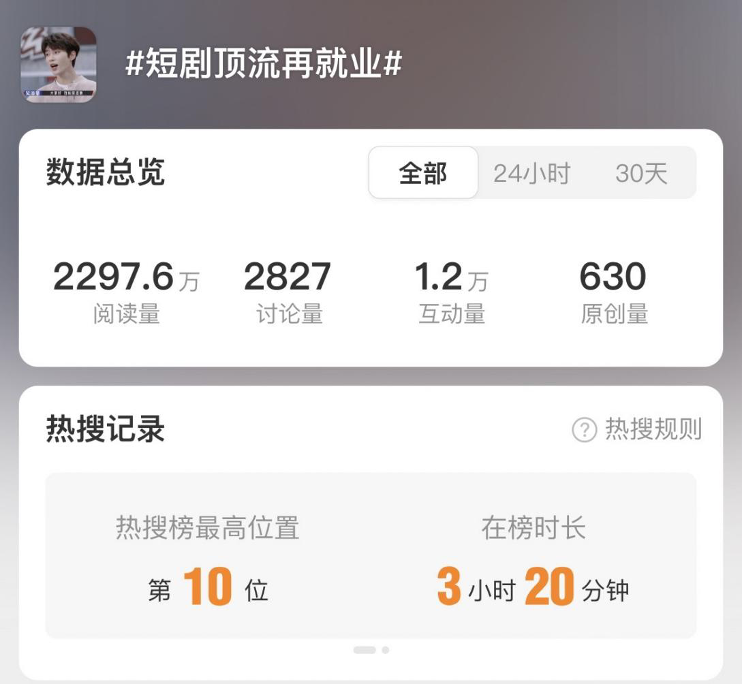
Amidst the buzz, the trajectories of short drama actors are sharply diverging: top-tier stars are transitioning to long-form dramas, behind-the-scenes roles, or MCN/live-streaming ventures; mid-tier actors are lowering their fees, accepting AI portrait licensing for as little as a few hundred yuan per year, or switching careers entirely; while the lowest-tier performers are now delivering takeout.
But this is merely the tip of the iceberg.
A 100-billion-yuan industrial chain supports hundreds of thousands of jobs, but when structural technological shifts occur, the first to be displaced are the 'frontline production workers': actors, extras, costume and set designers, and on-site crew. Actors haven't suddenly become devalued—the entire industrial chain is undergoing radical restructuring.
Where do short drama actors fit into this industrial chain?
Actors occupy the most vulnerable position at the end of the short drama industrial chain. When one link shifts, they're the last to know.
According to the '2026 China Micro-Short Drama Industry Landscape' report by Forward Industry Research Institute, China's micro-short drama industrial chain has a clear division of labor across upstream, midstream, and downstream sectors.
Upstream involves content creation and copyright acquisition: screenwriting teams craft scripts, online literature platforms like China Literature, Fanqie Xiaoshuo, and ChineseAll provide IP licensing, while hardware such as cameras and lighting equipment offers technical support.
Midstream focuses on production: companies like Zhangyue Technology, Huace Film & TV, and Linmon Pictures handle core tasks from content adaptation to final film approval.
Downstream covers content distribution and user reach: platforms like Douyin, Kuaishou, Hongguo Short Drama, and Tencent Video handle broadcasting, forming a closed commercial loop.
To put the profit distribution more bluntly:
Screenwriters and extras earn meager fees;
Production companies, from directors to lighting and costume teams, gamble on creating a 'hit';
Distribution partners profit from buying traffic to acquire customers—in 2025, distribution costs accounted for over 80% of total box office revenue, with top distributors maintaining margins of just 10%–15%, while smaller players saw profits squeezed by bidding wars;
Platforms like Hongguo Short Drama typically take 50%–70% of user payments as revenue share, plus ad revenue and membership fees, achieving net profit margins exceeding 30%. In contrast, production companies rarely exceed 5%–10% net margins, and individual actors earn even less.
Currently, traffic is highly concentrated on a few platforms like Douyin, Hongguo, and Kuaishou, limiting production companies' bargaining power. Since April 13, 2026, Douyin's native content revenue share dropped from 95% to 90%, further compressing margins for small-to-medium producers. The industry consensus is that platform centralization will intensify.

From an industrial chain perspective, actors may serve as the 'face' in the short term but aren't the most profitable link long-term. This pattern became especially evident in 2025, the 'peak year' for short dramas.
According to the 'China Online Audio-Visual Development Research Report (2025)', the short drama market reached 63.4 billion yuan in 2025, surpassing film box office revenue. DataEye Research Institute projects it will exceed 120 billion yuan in 2026. Another report by the National School of Development at Peking University estimates the industry directly employs 690,000 people and supports over 2 million jobs across upstream and downstream sectors.
As the market expanded, actor salaries soared. Early actors earned around 1,000 yuan daily, rising to around 8,000 yuan within two to three years. Top actors commanded 40,000–60,000 yuan per day, with some schedules booked two months in advance. At 50,000 yuan daily, annual earnings from acting alone could reach 15 million yuan, with commercial deals pushing incomes to 20–30 million yuan.
However, the market couldn't sustain infinite growth. In Q1 2026, short drama productions plunged by 75% year-on-year, with top actors' salaries slashed by nearly half—some by two-thirds.
In stark contrast to top earners, the bottom tier struggles: mid-tier actors earn 2,000–3,000 yuan daily, while extras make just 100–150 yuan. The income gap, an open secret in the industry, spans 100–200 times between top and bottom tiers.
Why are short drama actors suddenly returning to the job market?
This question arises from three simultaneous disruptions:
First, distribution logic has changed, reshuffling platform rules.
The short drama business model is straightforward—invest in traffic to drive subscriptions. But Hongguo's 'free+ad' model disrupted the 'traffic+payment' logic, capturing half the market share. Success metrics shifted from subscription data to view counts and heat value (trending value), with platform revenue shares becoming the primary income source for production companies.
Second, compliance barriers have risen, weeding out smaller players.
Since 2026, the SAPPRFT has implemented new classification standards, raising investment thresholds for key micro-short dramas from 1 million to 3 million yuan and for ordinary ones from 300,000 to 1 million yuan. Live-action dramas below 1 million yuan lose mainstream platform recommendations. Over 350,000 non-compliant dramas have been removed, with backend regulation tightening.
Third, AI has delivered the fatal blow.
While distribution logic changes merely redistribute profits and compliance barriers eliminate smaller players, AI has disrupted the entire 'production end' of the industrial chain.
In January 2026, AI-generated short dramas surged from 7% to 38% of the top 100 Manhua Drama (animated dramas), with annual AI drama views skyrocketing 179-fold. During the Spring Festival, AI dramas accounted for nearly 30% of 8.67 billion total views, with AI-generated animated dramas contributing over 80% of that share.
The cost gap is staggering. Live-action dramas cost 1–1.5 million yuan per episode; AI dramas cost just 30,000–100,000 yuan—1/20 to 1/100 the cost—with production cycles shortened by over 80%.
A scene costing 100,000 yuan in actor fees can now be generated with a few hundred yuan in computing power—replacing not just individuals but entire 'production lines.'
The 're-employment' of top short drama stars is an inevitable result of industrial chain restructuring. From a market perspective, domestic short drama actors aren't lacking in skill—they're simply no longer in high demand.
Against this backdrop, many short drama actors are seeking alternatives.
Zhang Xiaolei, known for hits like 'After Leaving Home with Nothing, I Went Crazy' and 'What Does It Mean to Be a Son?'—who starred in over 100 'tycoon' short dramas annually—felt the market cool in early 2026. After finishing his last project in early April, he went two weeks without new offers and returned to his hometown in Qinghai to grow vegetables in greenhouses.

Ji Xingjun leads a 'dual life' in Hengdian—acting when roles are available, delivering takeout otherwise. His daily earnings peak at four figures when busy, but drop to 2,000–3,000 yuan monthly during dry spells. He rose to fame playing eunuchs in historical dramas and experienced the '100 episodes in 4 days' production frenzy.
Meanwhile, some veteran actors are doubling down. At 75, Liu Xiaqing signed 10 short drama projects, while 59-year-old Brigitte Lin's 'Afternoon Rose' not only surpassed 100 million views but also aired during prime time on satellite TV.
In the short term, a few top actors and veterans remain marketable; long-term, the golden era for most mid-tier performers has ended.
Some transition, some persist, some cross over, and some 'dimensionally reduce'—but all are grappling with the same question: Where can they go now that the short drama boom has slowed?
-
![]()
Proposed to Raise 955 Million Yuan through Private Placement! Huicheng Vacuum Boosts Localization of Ultra-Precision Optical Coating Equipment
-
![]()
Cash Flow Soars 13-Fold! What Major Strategic Move is Wuhan Five Square Optoelectronics Planning?
-
![]()
Leaked Design of vivo X500: Reverts to Circular Camera Module in Top-Left Corner, Pays Homage to Classic X90 Aesthetic
-
![]()
DeepSeek Shows Signs of Foraying into Code Agents, Launches WeChat Official Account Focused on Harness
-
![]()
Auto Companies Deny Claims That ‘Cooperation with Huawei Is Non-Essential’, as Huawei Transforms into a ‘Public Platform’
-
![]()
Starship to Independently 'Return to the Launch Tower': SpaceX's Ambitions Extend Beyond Rocket Building to Dominating Space Transportation
-
![]()
Starship Set to Independently 'Return to the Launch Tower': SpaceX is Revolutionizing Space Transportation, Not Just Building Rockets
-
![]()
Anthropic and OpenAI Face Off Against Deepseek