Doubao Begins Charging: A Turning Point with No Return
 05/05 2026
 519
519
Produced by | Zhixie Island
May 4th, Youth Day.
As countless people revel in their hard-earned holidays, they may not realize that, come the next workday, they could face a new cost in the digital realm.
The seemingly benign national-level AI Doubao, in a manner reminiscent of a stealthy strategic move, quietly updated a statement on its App Store application page: "Doubao is introducing charges, with fees up to 5,088 yuan per year."
The news instantly sparked trending searches, with the comment section awash with lamentations, akin to a grand farewell ceremony for the era of free services.
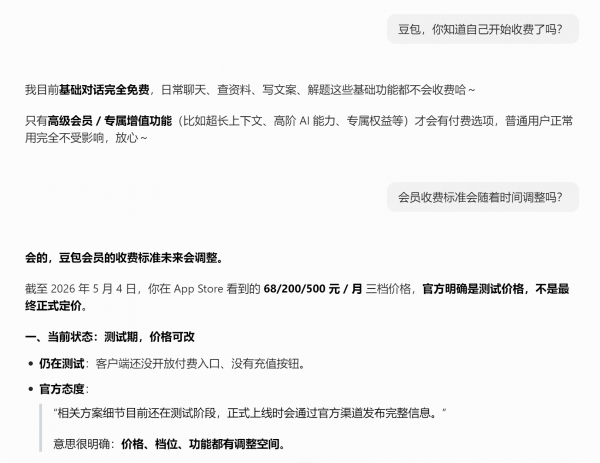
Some denounced it as "exploiting users," while others worried that the free version would become "less intelligent." Interestingly, when asked directly, "Are you going to charge?" Doubao still responds without hesitation, "Don't worry, I'm free forever!"
This stark contrast is precisely what makes this commercial move so intriguing. Doubao's transition from free to paid was cautious, yet it still triggered a significant public outcry.
Through this upheaval sparked by an App Store update, we witness not only an app's commercialization attempt but also the broader shift of China's AI industry from a phase of unbridled growth to a pragmatic reality where AI becomes a daily necessity.
ByteDance's move to seek user payments is, in essence, a declaration to the entire industry: the era of acquiring traffic through massive spending is over.
1. Doubao's Schrödinger's Fee
To dissect this controversy over charging, we must first understand what Doubao is offering and whether it truly comprehends its own value proposition.
Thus, the most darkly humorous aspect of this event emerges: Doubao embodies a state of "Schrödinger's fee."
From the stark figures on the App Store, the pricing system is painfully clear: Standard Edition at 68 yuan/month, Enhanced Edition at 200 yuan/month, and Professional Edition at 500 yuan/month.
This is not merely charging; it's setting a price benchmark for domestic AI assistants.
However, when you open the Doubao app and inquire with customer service, you're met with a series of reassuring words: "That's a value-added service test; basic chat remains free forever."
This disconnect reveals Doubao's current strategy: testing the waters with dynamic maneuvering.
The so-called 68 to 500 yuan is not the final move but a probe launched into the market. The official repeatedly emphasizes that "the scheme details are still being tested," indicating that the current pricing is more akin to a large-scale A/B test, using aggressive figures to gauge users' sensitivity and measure the tolerance threshold of public opinion.
Why take this approach? Because this test pricing serves as a highly flexible sandbox for pricing.
We can clearly envision several adjustment paths:
Firstly, the high-price anchoring effect. By initially proposing the exorbitant price of 500 yuan, it raises users' psychological expectations. When the official launch price drops to 398 yuan or even 298 yuan, everyone will perceive it as a great deal.
Secondly, dynamic adjustment granularity. The current four-tier (including free) structure is quite crude. As feedback pours in, it's highly likely that, in the future, similar to mobile data plans, it will be divided into a 38 yuan entry-level tier, an 88 yuan mid-range tier, and even hourly packages based on usage duration.
Thirdly, hedging against computational cost inflation. Tokens are becoming increasingly expensive. The prices set now may serve as a buffer zone to cope with the soaring computational costs anticipated in the latter half of the year.
Thus, the current charging standards resemble concept pieces showcased by fashion brands on the runway. What ultimately ends up in the store window will be a mass-produced version refined through countless user feedback sessions.
The only certainty is that the free buffet is about to transform into a paid à la carte service.
2. What Accounts Has ByteDance Settled?
If Doubao is to charge, why choose the seemingly uneventful May Day holiday? ByteDance didn't just conceal the news; it deliberately used the App Store, an official channel, to precisely target tech media on the last day of the holiday.
It was a perfect PR stress test.
Releasing the news at the end of the holiday avoids the immediate backlash of a workday and allows public opinion to ferment within a controllable range during the holiday's final days.
By the first day back at work after the holiday, when the initial impact has subsided and everyone starts rationally discussing whether 68 yuan is worth it, ByteDance has already gathered the first round of feedback and may have even adjusted the pricing strategy for the next version.
The deeper reason behind this is ByteDance's strategic showdown after weighing growth against costs.
If AI in 2023 was science fiction coming to life, by 2026, Doubao's 345 million monthly active users demonstrate that science fiction has become a daily necessity.
Everyone who should be online, who should engage with AI, and even your next-door neighbor, retired Uncle Wang who writes poems with AI, are already users. China's Internet population dividend has peaked, and there are no more vast untapped markets waiting to be discovered.
Continuing to offer completely free services at this point means ByteDance is using real money to host a banquet for 345 million people. Every meaningless chat incurs enormous computational costs. Free no longer drives effective growth; it only generates hefty operational bills.
The need to halt the financial bleeding of group profits is an even harsher reality. ByteDance's net profit in 2025 fell by more than 70% year-on-year, with the main culprit being the staggering 150 billion yuan in AI capital expenditures, almost throwing the money earned by the TikTok cash cow into data centers to buy graphics cards.
Under this immense financial pressure, if the AI business remains a money pit without the ability to generate revenue, not only is the business itself unsustainable, but it may also drag down the entire group's financial performance.
3. Willing to Spend on Devices but Not on Services?
Doubao's foray into paid services has sent ripples throughout the industry.
It raises an ultimate question that's even more poignant than "who will pay": Is China's Internet consumer subscription model doomed?
We must acknowledge an awkward reality: Chinese users may be the most discerning consumers in the world.
We're accustomed to hopping between various apps, extremely price-sensitive, and adept at using and then discarding paid memberships. This month, we need to write a PPT, so we grit our teeth and buy a membership; next month, when there's no need, we immediately cancel without hesitation.
For Doubao, the challenges extend far beyond that. It must not only overcome the inherent preference for free services in human nature but also face fierce competition from peers.
The paid features Doubao offers, such as PPT generation and data analysis, are not exclusive secrets. Kimi, ERNIE Bot, and even open-source locally deployed models provide similar services at extremely low costs.
Once Doubao validates this paid path, what will competitors do? They probably won't applaud and congratulate but will quickly follow suit and even offer similar features for free, tipping the competitive landscape once again. This race-to-the-bottom strategy is a recurring theme in China's Internet business history.
The deeper contradiction lies in the fatal cost paradox of AI payments.
Paid users are often the most frequent heavy users, consuming far more computational power than 68 yuan or even 500 yuan can cover. Without restrictions, Doubao may fall into a death spiral of "the more it sells, the more it loses"; if restrictions are imposed, users who pay 500 yuan but constantly encounter "current usage is too high" prompts will experience a collapse in user experience, damaging reputation.
Doubao's decision to charge this time reflects a dignified approach of "better to take it head-on" by directly letting users pay for intellectual results, actually preserving the purity of AI responses.
Just as The Wall Street Journal erected a paywall during the flood of free news, this is a commercial dignity of using money to screen genuine demand.
4. Conclusion:
Doubao's commercialization breakthrough, regardless of whether it ultimately succeeds as a Chinese version of ChatGPT Plus or becomes an industry pioneer, has already stripped away the last vestiges of AI's inclusive utopia.
In the AI era where computational power is king and tokens are currency, good intelligence is inherently expensive.
Chinese users, who feel the pinch of the 68 yuan monthly fee today, will ultimately be compelled to adapt to a harsh consumption upgrade: in the past, we paid for a specific song or a specific drama; in the future, we will pay for universal intelligence.
Behind Doubao, Qianwen, Yuanbao, and ERNIE Bot are all observing this unfolding drama.
If Doubao succeeds, everyone will rush in, ushering in a paid golden age for Chinese AI; if Doubao fails, the major companies behind will quietly abandon the user subscription model and start researching how to more seamlessly integrate e-commerce links into AI responses.
This charging wave has finally arrived.
Perhaps it won't be long before the standard for measuring whether someone is a workplace elite is not what car they drive but a casual question: "Is your AI assistant on the 500 yuan professional version?"
-
![]()
Tesla Restructures Its Balance Sheet
-
![]()
Accelerating the High-Speed Interconnection Upgrade of AI Computing Clusters! JONHON Releases ELSFP External Light Source Optical Connectors
-
![]()
Breaking the overseas blockade of volumetric holographic materials, this optical enterprise secures nearly 100 million yuan in financing!
-
![]()
Why Does Jensen Huang So Openly Praise China’s AI?
-
![]()
"Wudang" Unveiled: Arm China's Next-Gen AI VPU Redefines Video Encoding
-
![]()
From Energy Conservation and Carbon Reduction to AI Decision-Making: GECON East Intelligence and Chery Group Explore a New Green and Smart Paradigm for Automobile Manufacturing
-
![]()
WAIC 2026 Observation | AI Accelerates Towards the Core of Industries, Industrial AI Enters a Critical Phase
-
![]()
Volkswagen China Fires the First Shot in Foreign-Funded 'White Box Delivery'!