Another Chilling Blow for Car Companies: Gasoline Car Sales Plummet 33% in April, Electric Car Sales Dip 11%. Is the Car-Buying Frenzy Over?
 05/05 2026
 606
606
It appears that the first quarter of 2026 delivered a harsh reality check to major car companies. Domestic automobile sales during this period reached 4.823 million units, marking a significant 20.3% year-on-year decline, a clear indicator of sluggish sales performance.
While there were hopes for a rebound in April following the dismal first quarter, the market instead delivered another disappointing blow.
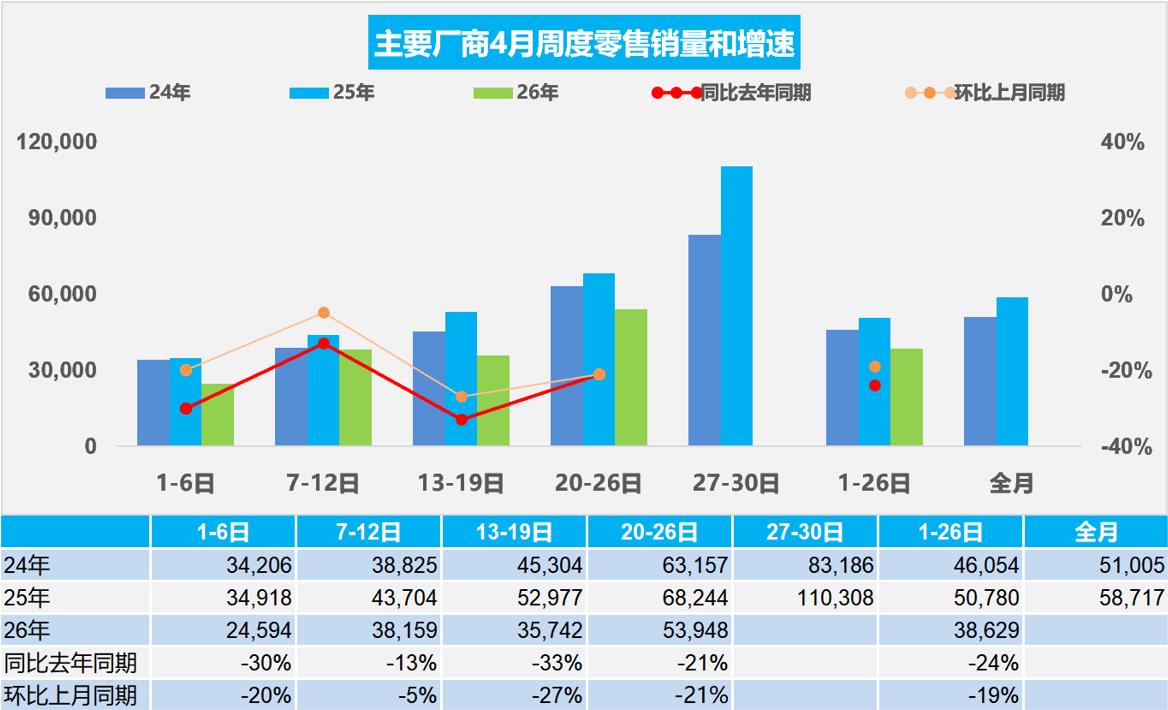
Data from the China Passenger Car Association reveals that from April 1st to 26th, cumulative retail sales of passenger cars across the nation amounted to 1.004 million units, representing a 24% year-on-year decrease and a 19% month-on-month drop.

Delving into specific models, in the initial 26 days of April, retail sales of new energy vehicles stood at 614,000 units, experiencing an 11% year-on-year decrease. In stark contrast, retail sales of gasoline cars plummeted to just 390,000 units, reflecting a staggering year-on-year drop exceeding 33%.
Cumulative retail sales since the start of 2026 have reached 5.226 million units, down by 19% year-on-year. These figures unequivocally highlight the struggles faced by the automobile market in 2026.
Although gasoline cars have fared worse overall, electric cars have not been spared from the downturn. The lack of enthusiasm for car purchases, regardless of the powertrain type, is evident.
What's behind this phenomenon? For gasoline cars, the primary culprit seems to be the US-Iran conflict, which has fueled a surge in global fuel prices. Consequently, potential buyers who initially considered purchasing gasoline cars, upon witnessing the soaring fuel costs and calculating the long-term usage expenses, have opted to adopt a wait-and-see approach until fuel prices stabilize.
As for the decline in electric car sales, multiple factors come into play. On one hand, the exemption policy for new energy vehicle purchase taxes officially expired at the end of 2025, and in 2026, subsidies were significantly reduced. This prompted many consumers to make their purchases at the end of the previous year, thereby pre-empting demand for the current year. On the other hand, the lack of new car launches in the first half of the year has failed to stimulate consumer interest.
Moreover, consumers are becoming increasingly cautious when it comes to purchasing electric cars. The rapid pace of technological advancements in this sector means that some models undergo several generations of updates within a single year. As a result, buyers are adopting a more rational approach, realizing that a newly acquired car may quickly become outdated.

Ultimately, the core issue lies in insufficient demand. More and more consumers are recognizing that cars are both consumables and durable goods. With proper maintenance, a car can last for a decade or even longer, eliminating the need for frequent upgrades and encouraging savings instead.
Of course, when push comes to shove, a more fundamental reason is that an increasing number of consumers simply lack the financial means. After all, money solves most problems, and its absence exacerbates them.
Now that the real estate market is in a slump, the automobile industry has emerged as the primary driver of economic growth. If the automobile sector also underperforms, the overall economic outlook will be bleak. The same applies to car companies; poor automobile sales will make everyone's situation challenging.
-
![]()
Is Zhipu's Trillion-Yuan Market Cap, Despite No Profit, Truly 'Outrageous'?
-
![]()
XiaoPai Unveils Home AI Brain, Paving the Way for Smart Homes to First Grasp 'Home Understanding'
-
![]()
Is the Future of Extended-Range EVs Pure Electric or Li Auto’s 5C Extended-Range? A Li Auto Executive Shares Insights
-
Ant Group’s New Board of Directors: Signaling a New Era?
-
![]()
Google Initiates TPU Sales, as Industry Leaders Eye AI Chips for 'Cost-Effective Tokens'
-
![]()
Input Methods: The Rising Star in AI! WeChat, Doubao, and Qianwen Lead the Charge into the Voice Input Era
-
![]()
Struggling to Sell? Cut It Out! Toyota, Volkswagen, and Changan Lead the Charge in Streamlining, Eliminating Non-Core Products in the Blockbuster Model Era
-
![]()
Arm China and Volcano Engine Join Forces to Expedite Cloud Computing and AI Infrastructure Rollout