The Real Race for Robotaxi Begins When the Steering Wheel Comes Off
 05/05 2026
 644
644
By | AI Relative Theory
At the 2026 Beijing International Automotive Exhibition, a Robotaxi that might leave many traditional automotive engineers speechless made its official debut.
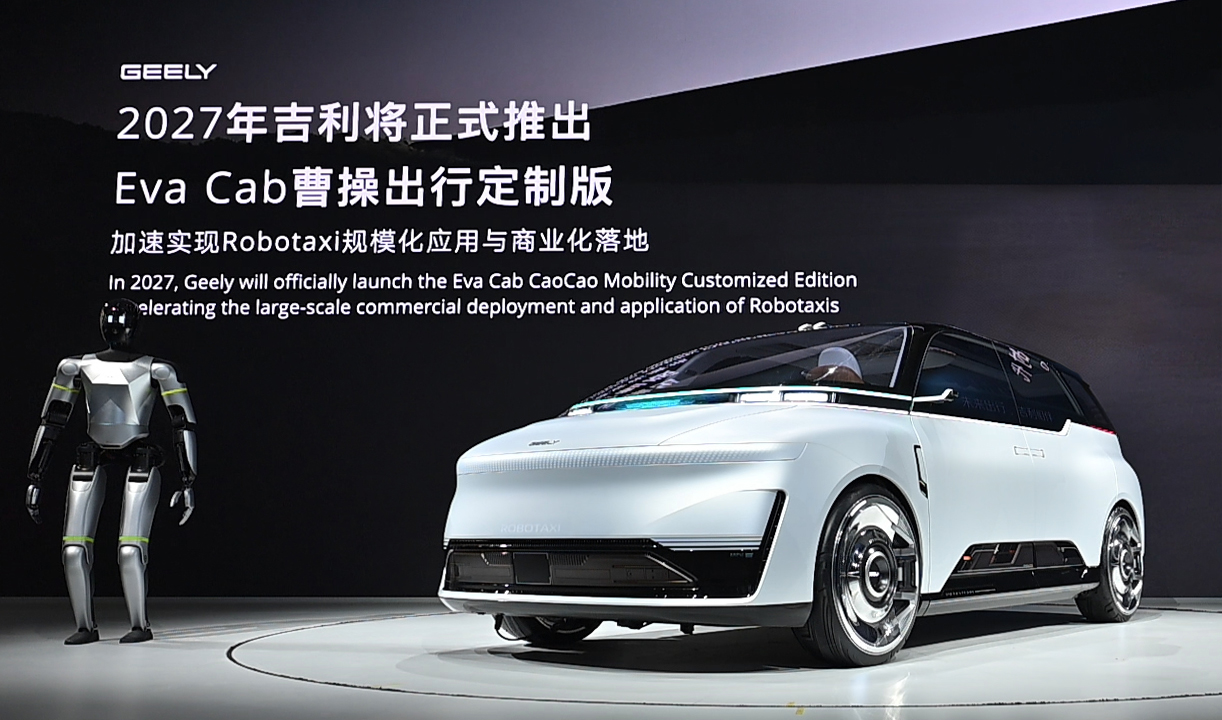
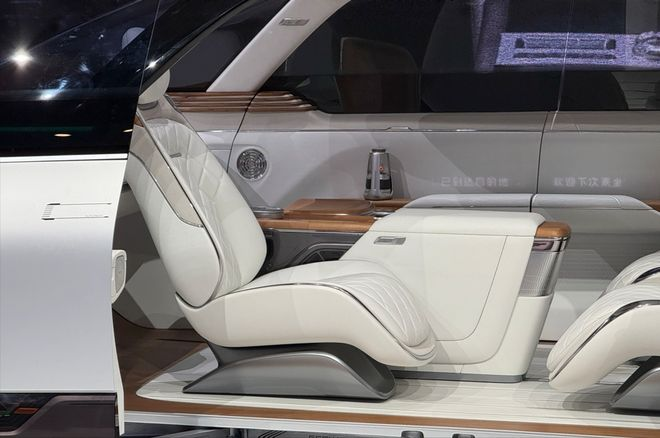
The Eva Cab has no steering wheel, no passenger seat, features electrically sliding opposing doors, and a cabin resembling a mini living room. Its design logic fundamentally eliminates the option for human takeover. Its development approach is equally groundbreaking—China's first Robotaxi purpose-built from the ground up for autonomous driving operations, with everything from the chassis to the electronic architecture redesigned for unmanned operation.
For a long time, industry discussions about Robotaxi have centered on technical routes: whether to use LiDAR, how much computing power is needed, and whether algorithms should be end-to-end. While these questions are important, the 2026 Beijing Auto Show posed a more fundamental question: Will the future of Robotaxi be defined by technology and algorithms, or by 'operations'?
To answer this, let's first examine what Robotaxis actually on the road look like.
Two Paths: Addition vs. Subtraction
Recently, Elon Musk announced on X that Tesla's Cybercab has officially entered production. As a benchmark for native Robotaxis, the Cybercab's launch marks a new phase of large-scale L4 autonomous driving services, sending a significant positive signal to the global Robotaxi sector.
However, the vast majority of Robotaxi fleets worldwide, both domestically and internationally, reveal their origins at a glance: production electric vehicles retrofitted with LiDAR, cameras, and computing units, with trunks stuffed full of industrial computers and roofs adorned with 'horns.' Essentially, these are post-market modifications—taking vehicles designed for human driving and hard-retrofitting them into autonomous testing platforms.
This is the path of addition. Insufficient redundancy in the braking system? Add another. Non-independent power architecture? Add another. Dirty sensors? Clean them manually. Vehicle nearing end-of-life? Scrap it according to private car standards.
Each addition means stacking hardware costs, modification labor, and maintenance burdens. The inherent limitations of the physical architecture force many redundancies to be implemented as 'patches'—such as achieving braking redundancy through an external electronic booster pump rather than integrating it into the underlying drive-by-wire architecture. Over time, interactions between these 'patches' become systemic vulnerabilities.
The Eva Cab, jointly released by Caocao Chuxing and Geely, takes the opposite approach.
From day one of its development, it was clear that no human driver would operate this vehicle, leading to radical design simplifications: removing the steering column and wheel assembly, eliminating the passenger seat, and dismantling all redundant human-machine interfaces. The freed-up space and cost were reallocated to features truly serving operations—opposing sofa seats, opposing electric sliding doors, automatic battery swap structures, and sensor self-cleaning systems.
The results of subtraction are structural.
Without a steering wheel and column, collision safety constraints change, allowing for reconfigured body structures.
The native drive-by-wire chassis directly achieves full redundancy in steering and braking without needing additional pumps or motors, with clear signal paths and controllable failure modes.
This ground-up design enables the Eva Cab to have a vehicle lifespan 2-3 times that of ordinary passenger vehicles, with significantly extended maintenance intervals for key components.
On the surface, this shares similarities with Tesla's Cybercab philosophy—both lack steering wheels and aim for low costs. The Cybercab relies on FSD (Full Self-Driving) software capabilities combined with Tesla's manufacturing efficiency and brand strength. Its business model more closely resembles consumer electronics sales logic—Tesla can both operate its own fleet and sell vehicles to individuals, with hardware sales remaining the core path in the long run.

The underlying logic of the Eva Cab is entirely different.
In its design objectives, hardware is merely a service carrier. The vehicle is a mobile spatial asset, with everything from acquisition to operation, maintenance to retirement, needing to fit into a commercial return calculation. Its ultimate goal is 'Vehicle-as-a-Service'—measured in cost per kilometer rather than unit vehicle price.
Compared to Tesla's Cybercab, the Eva Cab has stronger operational attributes. In passenger experience, Tesla's Cybercab features a cramped two-seat design with limited comfort. In contrast, Caocao Chuxing's deeply customized native Robotaxi offers comfortable sofa seating, electric sliding doors, and superior spatial experience. More importantly, it achieves 60-second automatic battery swaps, significantly boosting operational uptime, while the Cybercab relies on charging (specific time undisclosed).
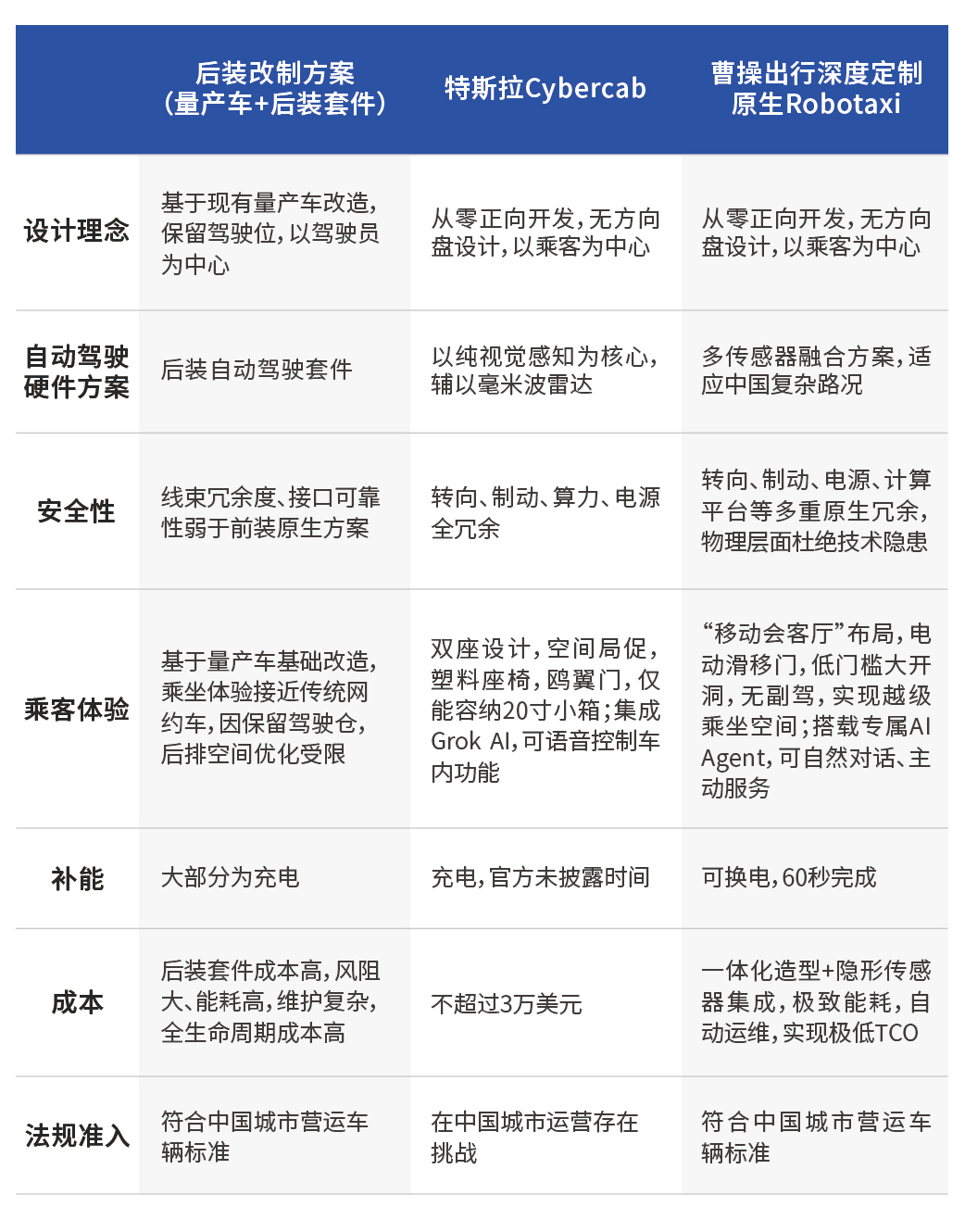
From these design philosophies, it's clear that Caocao Chuxing's deeply customized native Robotaxi aims to serve four core objectives: lower TCO, higher online availability, reduced downtime, and more stable passenger experiences.
Only One Company Can Be Responsible
The true bottleneck for large-scale Robotaxi deployment often has nothing to do with technology.
When a Robotaxi is involved in an accident, who bears responsibility? The algorithm provider might blame sensor occlusion, the vehicle provider could point to modifications disrupting original design, and the ride-hailing platform might argue it merely matched orders.
The more roles in the supply chain, the blurrier the responsibility boundaries. Yet for users, they purchase a complete Robotaxi service. Faced with this situation, regulators find it difficult to grant permits for large-scale commercial operations.
This is the 'trust gap' that retrofit solutions struggle to cross. Regulators need not just technical parameters but a clear, singular regulated entity—who is ultimately responsible?
The Eva Cab concentrates this answer within Caocao Chuxing alone. The vehicle is deeply defined by Caocao Chuxing and manufactured by Geely, with its autonomous driving system deeply integrated with Geely's ecosystem. Daily operations, fleet asset management, and remote safety monitoring are all handled by Caocao Chuxing's proprietary platform.
Every node in the Robotaxi operation chain falls under the same management structure.
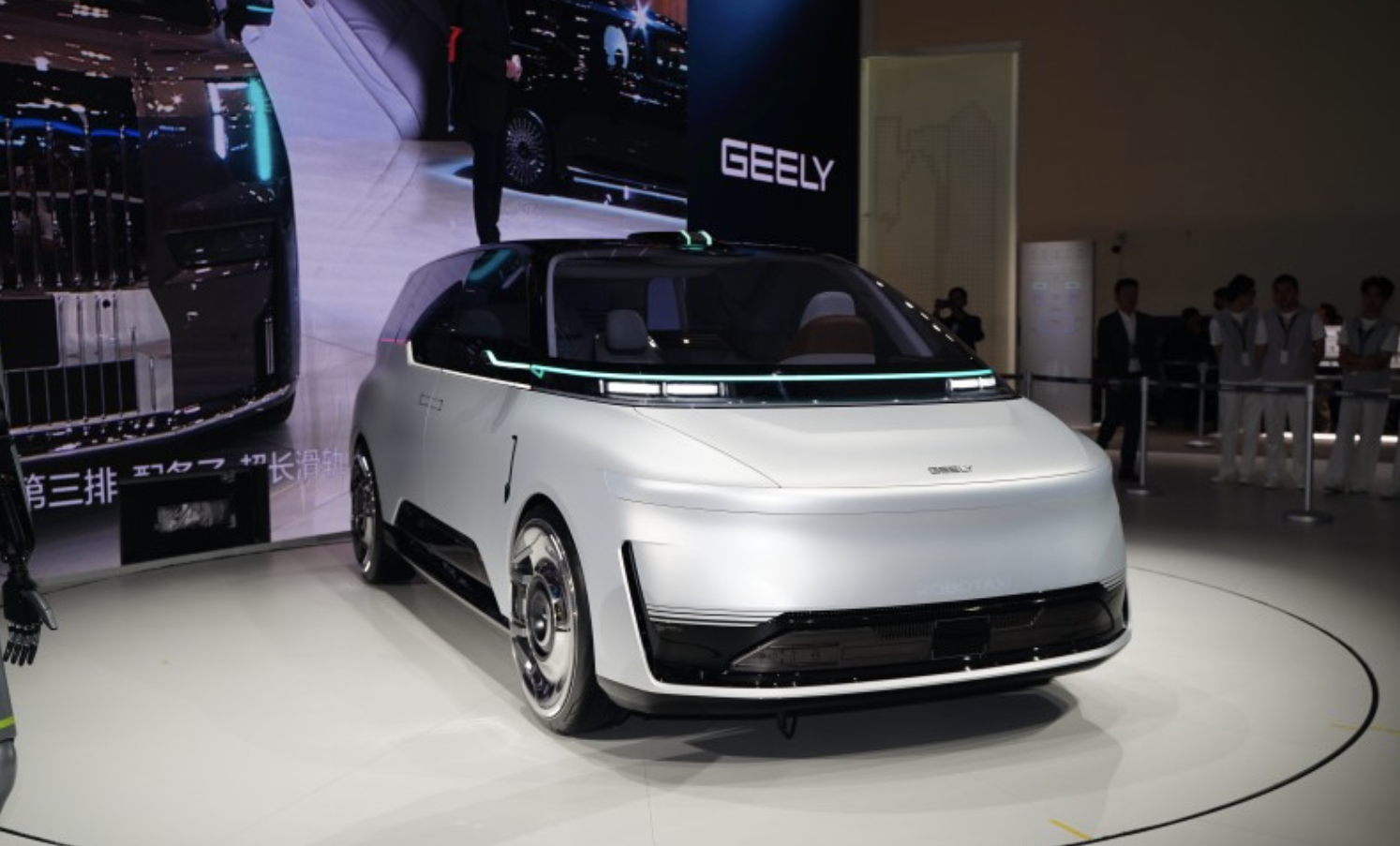
This embodies Caocao Chuxing's repeatedly emphasized 'intelligent custom vehicles + intelligent driving technology + intelligent operations' trinity—a closed-loop ecosystem encompassing all essential elements of Robotaxi.
Outsiders might dismiss this as corporate rhetoric, but it carries significant weight in regulatory eyes: when the vehicle belongs to Caocao, the algorithm is deeply bound to Caocao's system, and operations are also handled by Caocao, regulators face a clear responsible entity. The same holds true for insurers—risk pricing becomes far more straightforward without ambiguous areas, compared to multi-party cooperation models.
In April 2026, Caocao Chuxing became Hangzhou's first company to obtain permission for driverless road testing of Robotaxis, confirming regulatory recognition of its trinity development model.
Regulatory trust begins with 'clearly identifying who is responsible.'
Efficiency and Safety Within the Closed Loop
Consolidating responsibility boundaries reduces more than just regulatory communication costs. From passenger experience to fleet operational efficiency and overall societal mobility resource utilization, every link within the closed loop offers quantifiable advantages.
Safety is Robotaxi's first benchmark and a prerequisite for Caocao Chuxing to obtain testing permits for driverless operations.
From the outset, the Eva Cab treats the vehicle as a full-lifecycle automated device, introducing the industry's first SOVD (Vehicle-Cloud Integrated Diagnostic) technology. This system enables continuous cloud-based monitoring and proactive diagnosis of vehicle health, issuing alerts and scheduling maintenance before failures occur—a shift from the passive model where vehicles only reveal issues during inspections.
Physical redundancy also follows a native design approach.
Steering, braking, power, and computing platforms are multiply redundant from the ground up, eliminating the hidden failures common in retrofit solutions where 'primary links work but backups remain disconnected.' The sensor self-cleaning system is integrated into the body, while automatic battery swapping and cleaning functions seamlessly connect with 'Green Smart Mobility Hubs,' enabling vehicles to recharge and prepare without human touch.
In terms of costs, the closed-loop value proposition becomes even clearer.
Caocao Chuxing's existing customized ride-hailing fleet has already validated a data point: compared to typical pure electric ride-hailing vehicles, TCO decreases by approximately 36.4%. This achievement comes from battery swap architecture reducing recharging time, Geely-authorized maintenance systems controlling upkeep costs, and full-lifecycle asset management interventions.
The Eva Cab pushes this experience to extremes, with longer design lifespans, lower maintenance frequencies, and support for 24/7 autonomous operation.
Continually declining TCO is the passport for Robotaxi to transition from test tracks to profitable models.
The Green Smart Mobility Hub represents the closed loop's projection into the physical world. Automatic battery swapping, cleaning, preparation, scheduling, and settlement are encapsulated within a standard facility, with future eVTOL landing pads and charging interfaces already reserved. When fleet expansion doesn't require proportional growth in support staff, linear constraints on operational efficiency begin to loosen.
The Endgame Is a System, Not a Vehicle
At the 2026 Beijing Auto Show, the scenario model displayed next to the Eva Cab revealed greater ambitions: ground-based Robotaxis, low-altitude flying cars, and low-orbit satellite communications coexisting within a single mobility network. Vehicles automatically depart from Green Smart Mobility Hubs, connect with eVTOLs, and maintain full connectivity via satellite communications.
While many may be accustomed to conceptual renderings at auto shows, this represents a prototype already partially implemented by Caocao Chuxing in Hangzhou—the Mobility Hubs are operational, low-orbit satellite terminals are installed in vehicles, and a cooperation agreement with AEROFUGIA has been signed.
The Robotaxi endgame will likely not arrive with a single company launching a stunning product. It will resemble the smartphone's replacement of feature phones—defined by the collective migration of 'hardware + operating system + developer ecosystem + supply chain management capabilities.' In mobility, this corresponds to the deep integration of 'native custom vehicles + intelligent driving systems + city-level operational networks.'
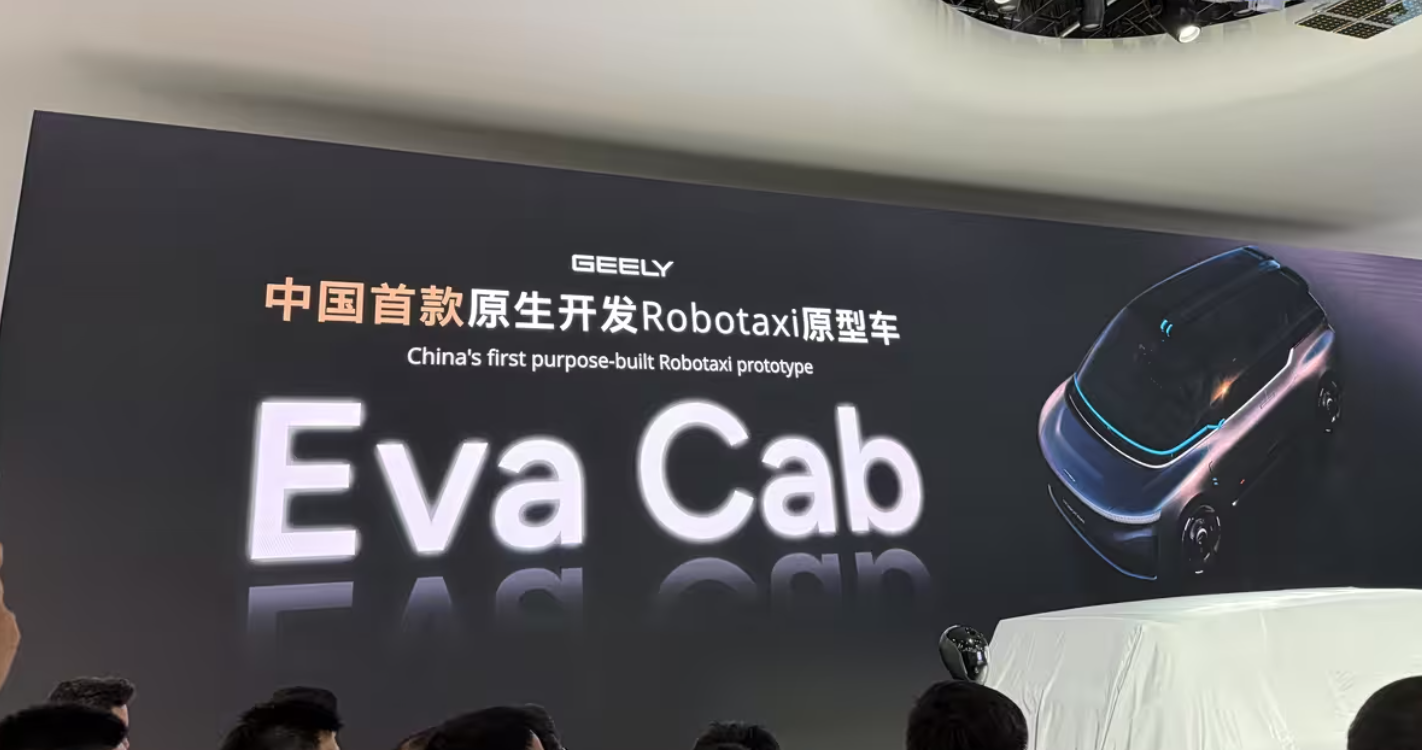
Caocao Chuxing demonstrates with the Eva Cab just how tightly this integration can be achieved. It explains why a ride-hailing platform would invest so heavily in defining a vehicle—only through this can services be standardized and scaled globally to any city.
Caocao Chuxing plans to deploy 100,000 fully customized Robotaxis by 2030, while exploring operations in Hong Kong and signing an overseas cooperation memorandum with the Abu Dhabi Investment Office. Its domestic operational foundation across 195 cities, service data from hundreds of millions of users, and full-lifecycle asset management system provide reference points for this model's transferability.
The endgame doesn't signify the end of technological competition—it merely confirms the rules of the game.
When a Robotaxi can automatically exit a Mobility Hub at midnight, complete full-day operations, clean and recharge itself, then quietly return to its berth, what's running behind this scene isn't just a vehicle but an entire unmanned operational system. The first to fully implement this system will likely define the shape of the Robotaxi era.
*All images in this article are sourced from the internet
-
![]()
Is Zhipu's Trillion-Yuan Market Cap, Despite No Profit, Truly 'Outrageous'?
-
![]()
XiaoPai Unveils Home AI Brain, Paving the Way for Smart Homes to First Grasp 'Home Understanding'
-
![]()
Is the Future of Extended-Range EVs Pure Electric or Li Auto’s 5C Extended-Range? A Li Auto Executive Shares Insights
-
Ant Group’s New Board of Directors: Signaling a New Era?
-
![]()
Google Initiates TPU Sales, as Industry Leaders Eye AI Chips for 'Cost-Effective Tokens'
-
![]()
Input Methods: The Rising Star in AI! WeChat, Doubao, and Qianwen Lead the Charge into the Voice Input Era
-
![]()
Struggling to Sell? Cut It Out! Toyota, Volkswagen, and Changan Lead the Charge in Streamlining, Eliminating Non-Core Products in the Blockbuster Model Era
-
![]()
Arm China and Volcano Engine Join Forces to Expedite Cloud Computing and AI Infrastructure Rollout