AI-Generated Fruit Videos Go Viral: The End of the 'Li Ziqi' Era in Short Videos?
 05/07 2026
 502
502

Reflecting on the Chinese internet landscape in recent years, every time we think content quality has reached its nadir, reality proves there's always room to sink even lower.
In 2016, information feeds overtook traditional news and information dissemination, ushering in the era of content fragmentation. Concerns arose about whether high-quality, in-depth content would be marginalized by these feeds, leading to a vulgarization of online discourse. Little did we know, we were about to enter the age of short videos.
By 2018, Kuaishou had experienced explosive growth, and Douyin successfully broke through into the mainstream, with short videos permeating every corner of urban and rural China. Everyone was glued to their phones, endlessly scrolling, while various sensational, melodramatic, and intellectually vacuous contents emerged to capture attention and drive traffic. When outsiders questioned whether these sensory-stimulating short videos would lead to an unprecedented decline in content quality, the trend of live-stream commerce arrived on the scene.
Live-stream commerce was chaotic, with celebrities and influencers alike jumping on the bandwagon, using various gimmicks to 'trick' viewers into opening their wallets.
From information feeds to short videos to live-stream commerce, we can clearly perceive a degradation in content quality and a shift towards a more entertaining yet intellectually impoverished mental state. However, the advent of AI has exacerbated this situation.
My Short Videos Have Been 'Polluted'
Pregnancy, infidelity, confrontations between mistresses and original partners, best friends turning into enemies... Would you watch these melodramatic yet addictive plots if they featured a cast of 'fruit characters'?
Many people find them irresistible. Zhou Yun, an avid short video enthusiast, recently stumbled upon an AI-generated video. It depicted a gold-digging mango sister and a naive mango brother in a relationship, only for her to set her sights on his wealthy grandfather, Old Banana. The adulterous couple hooked up and even had a baby banana, leaving both the mango brother and banana grandmother bewildered. Despite the粗糙 (rough) visuals and unappealing protagonists, the eerie yet novel feeling kept Zhou Yun glued to the screen until the end.
These fruit AI videos originated from the AI short drama 'Fruit Love Island,' which went viral on TikTok in March this year. An account named 'Ai Cinema' released 22 episodes, amassing over 3.3 million followers in just ten days, with total views exceeding 200 million. Later, 'Fruit Love Island' was taken down, but this type of AI video, which anthropomorphizes various fruits to enact plots of infidelity, family abandonment, and revenge, quietly swept across the global internet.
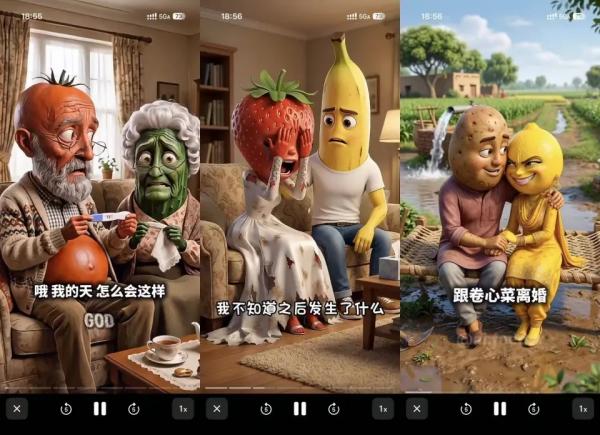
Moreover, the content became increasingly absurd. For instance, a banana and an orange have a strawberry baby. The orange brother feels cheated, yelling and screaming every day, accusing the banana mother, and threatening the banana grandmother and grandfather to transfer their house and factory to his name as compensation. However, the banana family is unaware that the orange brother is actually a strawberry disguised in an orange peel.
Another example is the fruit version of 'Temptation of Go Home.' Miss Banana peels off her own skin to fund her boyfriend, who becomes successful and marries Miss Cherry. With the help of her best friend, Miss Banana transforms into a golden 'Niu Hulu' banana and successfully exacts revenge.
Zhou Yun binge-watched several such videos and even encountered plots where an iPhone sister and a Samsung brother 'cheated.' Afterward, Douyin often recommended similar AI videos to her. 'It made me feel physically uncomfortable, and what's even more frustrating is that the content is becoming increasingly vulgar,' she lamented.
In these AI videos, various fruits star in chaotic plots. Viewers don't identify with 'human' roles, and creators seem to have no lower limits, with 'excrement, farts, and urine' taking turns on stage, and plot settings becoming increasingly dramatic and sensational. Especially when it comes to having babies, whether it's a 90-year-old Banana Grandmother or a 90-year-old Tomato Grandfather, they can all 'bear pearls in their old age,' and some even give birth to 999 at once. All the human fertility KPIs have been excessively completed by these fruits.

We feel repulsed by the 'pomegranate spirit' protagonist who gives birth to 999 children in 8 hours, yet we watch without any burden when a peach 'gives birth' to 999 watermelons.
From eye-catching to increasingly outrageous, the global popularity of AI cat videos last year followed a similar trajectory. Initially, these AI cat videos condensed the most common and melodramatic TV drama tropes from human society into a few dozen seconds, with cats as the protagonists. Later, many AI cat videos took on an indescribably eerie tone, with plots that were absurd beyond belief.
'Actually, I can watch these AI cat videos and AI fruits for the novelty, but what I find most unacceptable are those creepy videos where humans suddenly mutate and grow abnormal limbs to become monsters,' a netizen commented. He expressed that such videos caused him significant mental pollution, making him very averse to AI-generated videos for a long time.
Terrifying, sensational, mindless, stimulating... As AI continuously lowers the barrier to content production, the first to explode are precisely these low-level, meaningless, and even somewhat negative demands.
Will the Future of Short Videos Be Dominated by AI Slop?
Slop, selected as the 2025 Word of the Year by Merriam-Webster, traditionally means 'a product of limited value' or 'kitchen waste fed to animals.' In the 2025 context, it refers to 'AI-generated, soulless low-quality content produced in bulk.'
In the past two years, with the capability upgrades of video generation tools from Sora to Seedance 2.0, we seem to be inching closer to an era where everyone can be a director. While everyone is eager to try their hand at it, the reality is that instead of AI masterpieces, we are inundated with AI Slop.
Last year, video editing company Kapwing conducted research on 15,000 popular YouTube channels worldwide (covering the top 100 channels in each country). The results showed that 278 of these channels only published AI-generated low-quality content. Researchers also registered a brand-new YouTube account and found that among the first 500 videos recommended on its homepage, 104 were AI-generated low-quality content, and one-third of these 500 videos could be classified as 'brainrot.'
The overload of AI Slop is the result of the lure of 'efficient, mass-producible profits.' Previously, creators invested time, effort, and money to produce a single video. Now, with the advent of AI tools, videos can be generated in bulk in a short time, continuously testing traffic mechanisms, thus having a greater chance of gaining traffic and revenue.
Importantly, AI also maximizes the exploitation of algorithmic 'loopholes.' The more controversial, questionable, or even scolding-inducing content tends to receive higher attention and more traffic, making algorithms more likely to recommend it. AI-generated videos can break free from the constraints of the physical world, turning our mental imaginations into visual content. Naturally, these imaginations also include some of the most primitive, human-nature-aligned desires.
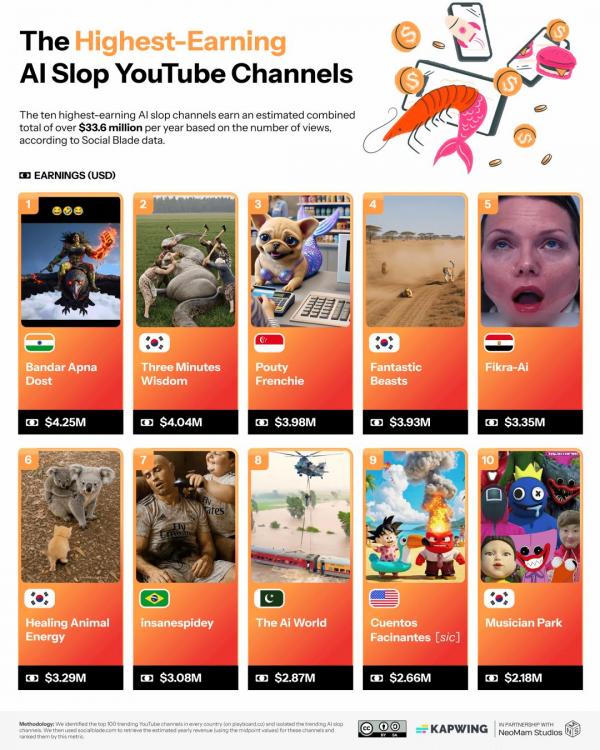
The Indian YouTube short video channel Bandar Apna Dost features only an AI-generated monkey repeatedly performing similar actions, accumulating over 2 billion views and an estimated annual advertising revenue of about $4.25 million. The most-watched AI channel in the United States is the Spanish-language channel Cuentos Facientes, with 1.28 billion views and an estimated creator income of about $2.66 million.
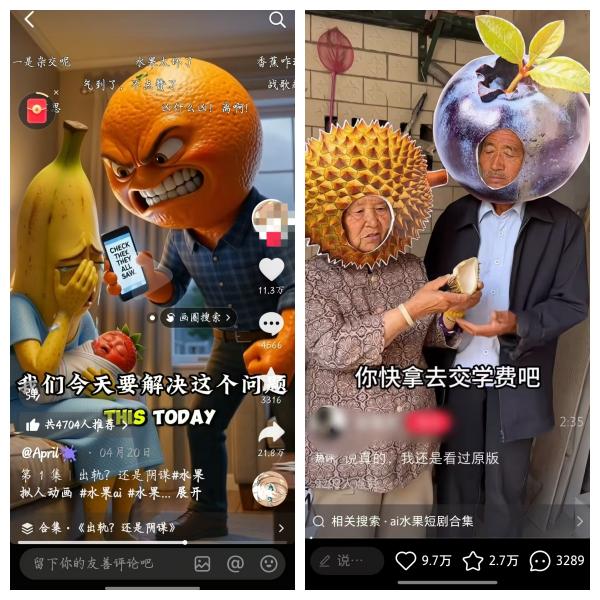
On social and content platforms familiar to us, data such as likes and views for AI videos are also outstanding. For example, a fruit AI short drama lasting just over a minute received over 110,000 likes, while another video mimicking such AI fruit short dramas with real people received nearly 100,000 likes.
In the content industry, the transition from wild growth to orderly development is a common and inevitable process. However, in the AI era, the biggest challenge in governing AI content is that AI produces content too quickly, outpacing platform algorithm adjustments and various mandatory intervention measures, making the proliferation of AI Slop impossible to curb. Just like fruit AI videos, after 'Fruit Love Island' was taken down, short dramas featuring fruits as protagonists in love-hate stories still became popular.
The consequences of this phenomenon are not just that high-quality content is easily drowned out by low-quality content. A greater concern is that AI Slop may risk becoming the mainstream of content. Since platforms have always encouraged and favored creators who can produce stable and large amounts of content, and the core advantage of AI generation is 'efficiency' and 'high yield,' this naturally caters to platform demands, providing the best soil for AI Slop to grow wildly.
Moreover, when authentic, high-quality content cannot receive better recommendations, yet AI-generated low-quality content can reap traffic and revenue, many creators may naturally flow into the AI creation camp. This could be a massive disruption to the content ecosystem.
The 'War' Between AI and Anti-AI
In late January this year, the YouTube platform launched a cleanup operation targeting low-quality AI-generated content. Since November last year, the platform has shut down or cleaned up dozens of channels actively publishing 'AI garbage' content, with cumulative views exceeding 4.7 billion. This includes one of YouTube's most popular AI content channels, 'CuentosFacianantes,' which had about 5.95 million subscribers.
Similarly, Douyin has also taken action against AI videos. According to its disclosure, it has taken down over 538,000 AI infringement videos and penalized over 4,000 violating accounts. Just the inappropriate content of 'AI domineering CEO' inducing middle-aged and elderly people to interact has been cleaned up over 30,000 times.
Whether for protecting rights or maintaining user experience, platform governance of AI content cannot be ignored. However, relying solely on platforms to block the proliferation of AI Slop is unrealistic. Because while AI content brings troubles to platforms, it also brings irresistible financial temptation.
According to Meta's data, in 2024, after a large influx of AI content onto the platform, user retention time increased by 8% on Facebook and 6% on Instagram. Against the backdrop of global internet platforms largely trapped in growth dilemmas, this data is precious. Therefore, Meta even increased the proportion of AI content in user feeds while selling AI production tools to advertisers.
If we zoom out from short videos to the entire content industry, including long videos, we can see that almost all internet platforms are eager to experiment with AI's transformation in the content industry. This shows that despite generative AI potentially leading to a new round of content degradation, it cannot prevent AI content from sweeping and 'occupying' platforms in the future.
Some time ago, iQiyi took the lead in establishing an AI artist library, which confirmed this point. However, this controversy also made platforms see strong anti-AI sentiment among the public. Regarding AI artists, we are not simply 'anti-technology' but are defending against both job security and emotional attachment. Similarly, for AI-generated images, text, and videos, many users' aversion comes from protecting content produced by real people.
A netizen said, 'I dislike AI videos because many seem like products created without any thought. If they proliferate, we won't see real talents showcasing their skills in the future.'
Compared to platforms' half-hearted 'rectifications,' anti-AI sentiment may be the last line of defense against the excessive production and invasion of AI content into the original content ecosystem.
In the era of short videos, vulgar and crude content once reaped massive traffic dividends. However, leading creators like Li Ziqi still stood out relying on high-quality content. But in an era dominated by AI-generated content, where human creation is marginalized, we dare not imagine what human creation would rely on to defeat AI generation.
-
![]()
Tesla Restructures Its Balance Sheet
-
![]()
Accelerating the High-Speed Interconnection Upgrade of AI Computing Clusters! JONHON Releases ELSFP External Light Source Optical Connectors
-
![]()
Breaking the overseas blockade of volumetric holographic materials, this optical enterprise secures nearly 100 million yuan in financing!
-
![]()
Why Does Jensen Huang So Openly Praise China’s AI?
-
![]()
"Wudang" Unveiled: Arm China's Next-Gen AI VPU Redefines Video Encoding
-
![]()
From Energy Conservation and Carbon Reduction to AI Decision-Making: GECON East Intelligence and Chery Group Explore a New Green and Smart Paradigm for Automobile Manufacturing
-
![]()
WAIC 2026 Observation | AI Accelerates Towards the Core of Industries, Industrial AI Enters a Critical Phase
-
![]()
Volkswagen China Fires the First Shot in Foreign-Funded 'White Box Delivery'!